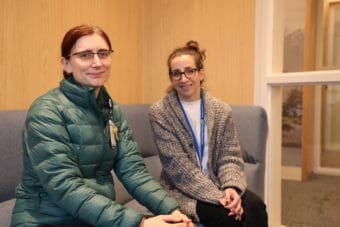
Dr. Marie Roy Babbitt, a child and adolescent psychiatrist, and Sarah Zaglifa, Bartlett’s clinical director of behavioral health services, sit in one of the meeting rooms at Aurora Behavioral Health Center’s crisis care unit on Dec. 20, 2023. (Katie Anastas/KTOO)
Bartlett Regional Hospital has started offering crisis care to adolescents.
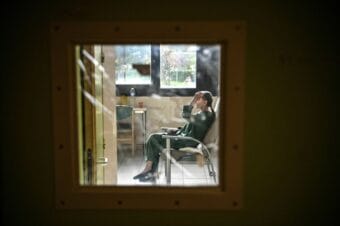
The unit is on the center’s top floor. There are common areas with board games and puzzles, yellow bean bag chairs and warm lighting. Wallpaper in the hallways depicts mountains, trees and water.
“I think the space and how it’s designed presents the care with such dignity,” said Sarah Zaglifa, Bartlett’s clinical director of behavioral health services.
Common areas in the unit have board games, yellow bean bag chairs and warm lighting. (Katie Anastas/KTOO)
Patients’ rooms have built-in nightstands and desks, and the windows overlook the Gastineau Channel. There are rooms with couches and armchairs where staff can talk to whole families or take parents aside.
In 2020, suicide was the leading cause of death for Alaska Native youth aged 10 to 19 and all youth aged 10 to 14, according to the state. It was the second leading cause of death that year for Alaskans aged 15 to 34.
Bartlett’s unit serves youth aged 12 to 17. It follows a Crisis Now model, which aims to reduce reliance on law enforcement and emergency rooms when people are in crisis.
Teens and their parents won’t have to call ahead before going to Aurora. They won’t need a referral from the Juneau Police Department or the Office of Children’s Services to get treatment. It’s meant to be as accessible as an emergency room.
Patient rooms at the Aurora Behavioral Health Center’s crisis care unit overlook the Gastineau Channel. (Katie Anastas/KTOO)
Dr. Marie Roy Babbitt, a child and adolescent psychiatrist leading the new crisis services, said the goal is to provide well-rounded services all in one place.
“We can offer medications, we can offer a medical check-up, but we also have one-on-one counseling, family counseling and that link to services outside of the crisis unit,” she said. “It’s all on the same floor within the same space, so somebody isn’t getting shuffled from all over the building.”
Small atriums at the Aurora Behavioral Health Center give patients, families and staff a chance to feel like they’re outside without leaving the unit. (Katie Anastas/KTOO)
Most teens will be there for less than a week. Before they leave, staff will work with families to explain the treatment plan, which may involve medication or working with the teen’s school on an Individualized Educational Plan. The unit’s navigators will keep working with teens and their families to make sure they’re getting the outpatient services they need.
Zaglifa said teens had to go to the emergency room for crisis care before the new unit opened.
“This gives us an alternative that’s more developmentally appropriate for adolescents, is warmer, more inviting, less clinical or sterile and adult-focused, like an emergency room can sometimes feel to an adolescent,” she said.
Teens can still go to the emergency room if they feel like that’s the right first stop. Jennifer Carson, Bartlett’s executive director of behavioral health services, said there’s no wrong door into Bartlett’s crisis services.
“Even if they’re not appropriate for admission, our goal is to help get them to the right location,” she said.
If you or a loved one are experiencing thoughts of suicide, you can call or text 988. You can also call the Careline at 877-266-HELP for grief support or if you just need someone to talk to.
Americans with mental health conditions often can’t get treatment, a new report finds. (SDI Productions/Getty Images)
Roughly two-thirds of Americans with a diagnosed mental health condition were unable to access treatment in 2021, though they had health insurance. And only a third of insured people who visited an emergency department or hospital during a mental health crisis, received follow-up care within a month of being discharged.
These are among the findings of a new report by the actuary firm Milliman, released Wednesday. The mental health advocacy group, Inseparable, commissioned the report and also released an accompanying brief offering policy solutions to address the gaps in mental health care.
“We kept hearing nightmare stories about Americans not getting the treatment that they needed because insurance companies were denying them care,” says Bill Smith, founder of Inseparable. “But we didn’t have enough data to show just how extensive and deep the problem was.”
The report is “illuminating” and timely, says Meiram Bendat, a psychotherapist and an attorney, who wasn’t involved in writing it. “We’re dealing with an issue that [is] on top of mind for nine out of ten people.”
While the overall findings aren’t surprising, “it is striking that the access impediments remain what they are,” adds Bendat who founded PsychAppeal, a law firm focused on mental health insurance advocacy. Those barriers include a workforce shortage, poor reimbursement rates for providers, and “substandard enforcement” of consumer protections and laws requiring that insurance companies cover mental health conditions.
“The data confirm what so many families and our friends know, which is that mental health access is a problem,” says psychologist Benjamin Miller, one of the authors of the accompanying policy solutions brief. “It’s very clear that there are people who have identifiable conditions, who are not able to find providers to help them.”
The Milliman report, which used a range of publicly available surveys as well as proprietary health insurance claims data, found that nearly a quarter of people with insurance – Medicaid, commercial insurance and Medicare – had at least one mental health diagnosis in 2021.
Many of those people don’t get treatment. Among the roughly half of Americans who are covered with commercial insurance, only about 30% of those with a mental health or addiction diagnosis got connected to a behavioral health specialist.
People on Medicaid with such diagnoses were the most likely to see a mental health care provider, with about 44% getting care. Only about 15% of those on Medicare got care for their diagnoses.
That’s an “astonishing gap” in mental health coverage, says Smith. “Across the board, the numbers aren’t great.”
The gap in mental health treatment, “won’t close unless private insurance companies” take steps to increase access to mental health care, he says. “We have a long way to go.”
The report also finds that over half of the U.S. population lives in areas designated as Mental Health Professional Shortage Areas, and that the country has less than a third of the psychiatrists needed to meet those provider shortages.
“We have not moved the needle on increasing availability of our workforce,” says Miller. “I’ve been using the same data point for about ten years that half the country lives in a mental health provider shortage area. And it hasn’t changed.”
In their report, Miller and his colleagues offer concrete policy solutions to address the workforce shortage and coverage gaps in insurance plans, including expanding the use of telehealth and use of peer support specialists.
The authors also suggests providing “competitive reimbursement rates” for mental health care professionals
Another report by Milliman published in 2019 had found that mental health care providers are reimbursed at lower rates than physical health providers. “We’ve known for a long time that there is under-reimbursement of care,” says Bendat.
Addressing that disparity in payment would help prevent health care worker burnout and ensure more mental health providers are in-network to care for the growing number of people in need.
The Inseparable solutions report also recommends that insurance companies be mandated to provide up-to-date accurate directories for in-network providers.
“The problem with these in-network directories is that when you begin to call around and you begin to ask people, ‘Can you see me? Are you accepting new patients?’ The answer to a lot of them is no, they’re not accepting new patients,” says Miller. “Some provider directories are old enough that you might even have people on there that are not practicing anymore.”
But requiring health plans to cover out-of-network care is also crucial, say Miller and his colleagues.
“The insurance company should pay that cost to cover your care regardless of whether or not it’s in their network or not,” says Smith. “It’s a huge problem when you have people that are making decisions about their health and the safety of their families and doing that from a place of scarcity.”
As the Milliman report finds, the average out-of-pocket cost for an hour-long psychotherapy session in 2021 was $174, which is a huge barrier to access.
Copyright 2023 NPR. To see more, visit https://www.npr.org.
Search and rescue teams are hoping to find two missing Haines residents on Sunday, Dec. 6, 2020, after a 600-foot landslide in Haines, Alaska. State geologists say the slide is still unstable, so teams haven’t been able to push far into the debris. (Photo by Rashah McChesney/KTOO)
All residents were affected in one way or another. The recent deadly landslide in Wrangell can trigger that past trauma. KHNS spoke with the mental health professionals who were in Haines during the crisis to care for the community from the first moments.
In early December of 2020, a storm dropped over a foot of rain on Haines. Some parts of town flooded. Landslides destroyed homes. Two well-loved residents died. There was much physical damage, and also much psychological distress.
“I was home when the slide went, and my house faces it, so I did see it,” said Cesre McQuaid.
McQuaid is a therapist in Haines. She was on call, working for the local clinic at the time. She has trained for crisis response, and she says that training kicked in.
“So I kind of knew there were things that needed to be done,” she said. “I knew quickly that we needed to make sure we got in touch with Bartlett (Regional Hospital) to figure out a way to make sure that if we had a psychiatric emergency, how were we going to get someone over to Bartlett if that’s what we needed to do. Some of those early kinds of things helped. Having a job to do. Having a first responder role helped me.”
Twenty-five miles up the valley, Riley Hall, a counselor also on the clinic’s staff, knew his services would be needed.
“We were responding, and we were also impacted at the same time,” Hall said. “I was up the highway, so on that first day it was hard to respond, because there were landslides blocking access to town, and it didn’t feel super safe yet to be on the corridor. But once we were able to, I responded a little bit up the highway, in effect putting an outpost for people to talk if they needed to.”
Hall said he eventually loaded his truck with shovels and a chainsaw, and managed to make it to town. Once there, he joined a team of mental health care professionals who rotated between the legion hall, the public safety building and other places where people gathered. They provided what McQuaid describes as psychological first aid.
“In practice it would be just a lot of psycho education, a lot of normalizing the responses that people are having. Making sure that people are being connected to the resources that they need,” McQuaid said. “It’s pretty important in the very beginning after a disaster, to really help people understand that what they are having, oftentimes they are having new emotions and new reactions, and so to help them understand that these strong responses are normal.”
John Hischer is a therapist in Skagway. He also has helped patients affected by the event. He says during these kinds of emergencies, people go through a series of stages.
“The first phase people are kind of in shock,” he said. “But they also see a lot of altruism in their community, so there are a lot of emotional highs that can happen too.”
McQuaid concurs.
“I still tear up when I think of the volunteers that showed up, the folks that sat in the firehall, the people that were feeding one another, the people that were checking in on one another, the people that wanted to make sure that folks had the information as quickly as possible,” she said.
But Hischer says this phase does not last forever.
“It’s the next phase when people start leaving or public officials stop talking about it, that a lot of that depression and anger can start coming up,” Hischer said. “It wasn’t immediately after it, but months after the slide happened, I saw a lot of folks feeling abandoned or forgotten.”
McQuaid says during a traumatic emergency, it is important that people understand how their mind is reacting.
“Our brain is designed for survival, it’s not designed for happiness, so our brain is designed to help us psychologically digest in a way that we can manage,” McQuaid said. “You might have a harder time remembering things, or concentrating, but that’s your brain doing just what it’s supposed to be doing right now, which is kind of taking things in in bite-sized chunks just so that you can be able to process what is going on.”
Hall also stresses the importance of patience and connection. He says kids were affected by the deaths, which also happened in the recent tragedy in Wrangell. Jenae Larson, who died in the Haines landslide, was a kindergarten teacher.
“With Wrangell and in Haines, Jenae was so integrated into the school, and the Heller family there in Wrangell had kids in just about every age group,” he said. “It’s really important to give kids some space and some places where they can talk about the loss of their friends or the loss of their teacher. Just allowing kids some channels where they can sort through complicated and hard feelings about what is going on.”
McQuaid says sleep is very important to help process what is going on.
“When you go to sleep at night, your brain is going through the natural process of taking your memory networks and processing those into adaptive resources for us,” she said. “ So it’s like this idea of when you fall asleep, you have a problem that’s going on and then you say, ‘Well I need to sleep on this’, and you sleep on it and you actually do wake up in the morning feeling better, coming up with a couple other ideas on how to handle something.”
Hischer says the slide in Wrangell has no doubt revived some painful feelings for Haines residents.

“I was just thinking about Haines when I saw what happened in Wrangell,” Hischer said. “That can be one of those triggering events that can bring up a lot of distress in folks. Reliving some of that sadness and fear when something like that happens in a neighboring community.”
McQuaid says anyone who feels moved to help or reach out should not hold back.
“I think people shouldn’t be afraid to put themselves out there. You have something to offer,” she said. “Each person has something to offer. You don’t have to wait to be asked. If there is something that you feel personally moved to do, a gesture of support is never worthless.”
Hischer wants communities to prepare for the long-term effects of catastrophes.
“Hopefully, the communities in Southeast Alaska are really thinking about that, not just short term mental health services, but really helping provide long term mental health services after a disaster,” Hischer said. “Because disasters don’t just happen and conclude, they have really long range impact on people’s lives.”
Hall agrees.
“Grief is funny that way. Grief kind of comes to us episodically, we go through periods when we might not think about it as much and then at other times, something will bring it up really acutely,” he said. “I’ve certainly heard from many people that the landslide scarp is still kind of a pretty shocking trigger to witness.”
McQuaid says she is impressed and proud of how the community of Haines came together during the tragedy.
“It’s ok to not be ok. It’s ok to be scared,” McQuaid said. “Collectively, we are going to figure this out. There is a collective impact on us all. Knowing that others care, knowing that people want to show up. Knowing that they are not alone. That makes all the difference in the world. Even if we are all freaking out together. It doesn’t have to look great, that’s the best way to describe it. You know people are getting upset, we are still in it together.”
She says anyone experiencing distress should not hesitate to reach out to friends, family, or a professional.
Phase two of Juneau’s Housing First project in Lemon Creek doubled the size of the existing Forget-Me-Not Manor. (Photo by Adelyn Baxter/KTOO)
The Alaska Mental Health Trust has awarded Bartlett Regional Hospital and the Juneau Housing First Collaborative more than $850,000 in grant funding.
The hospital’s funding will go toward staffing, training and infrastructure for behavioral health crisis services at the new Aurora Behavioral Health Center.
Jenn Carson, Bartlett’s executive director of behavioral health, said they hope to start serving youth aged 12 to 17 experiencing mental health emergencies by the end of the year. Staff will help them get through mental health crises. They’ll also offer short residential stays if needed.
“We do have a significant number of adolescents that come through our emergency department, and unfortunately right now, if they need to be admitted, they’re put on our medical-surgical floor with minimal intervention,” she said. “That’s not an overly therapeutic environment for an adolescent.”
She said the new space offers a warmer, more calming atmosphere overlooking Gastineau Channel.
“This would be a place to come to decompress,” she said. “It doesn’t feel as sterile as a regular hospital room.”
The $476,200 in grant funding will help Bartlett hire staff and pay for equipment as construction on the building continues. In the meantime, staff are working with a Crisis Now consultant to develop policies and procedures for the new services.
Housing First’s $375,000 grant will help pay for construction of 28 new units at Forget-Me-Not Manor, bringing the total number of units to 92. The facility in Lemon Creek is operated by the Glory Hall and provides permanent supportive housing for people who’ve been homeless for a year or more and have a disability or chronic health condition. Physical, behavioral and addiction treatment services are available on site.
Mariya Lovishchuk, executive director of the Glory Hall, said they hope to start construction on the new units in spring. She said providing low-barrier housing along with medical services is key to addressing the root causes of homelessness.
“These people are not just nameless, homeless individuals,” she said. “They’re all people, and they all have families, and they have a tremendous amount of trauma. The way to even begin to heal that trauma is not to stick them in an emergency shelter – it’s to create dignified, safe spaces, and that is permanent supportive housing. And it really works.”
Researchers from the University of Alaska Anchorage School of Social Work found that people who moved into Forget-Me-Not Manor had fewer emergency room visits and police encounters. They also reported better physical and mental health.
“These are all things that aren’t only good for the individual, but they’re good for the community as a whole,” said Alaska Mental Health Trust CEO Steve Williams. “We were happy to see this program expand a third time.”
The third recipient of the trust’s recent grants is Volunteers of America, Alaska in Anchorage. They’ll use that funding to help youth experiencing mental illness and substance use disorders find jobs.
A house and condo buildings in the 4400 block of Riverside Drive hang precariously over the Mendenhall River on August 6, 2023. Molly Barnes and Kris Dorsey lived in units on the building’s left side. Though the riverbank has been partially restored since the flood, their building is still condemned (Mikko Wilson / KTOO)
One of the worst days of Molly Barnes’ life went viral.
As the Mendenhall River carved the land out from under her condo building during August’s glacial outburst flood, videos of the destruction flooded the internet.
“I haven’t even been able to watch. I’ve tried twice, but it makes me physically sick,” Barnes said. “I’m definitely still affected by it.”
A month later, the loss is still surreal, and heartbreaking.
Margaret Wellberg, a Red Cross therapist who has taken on clients affected by the Juneau flood, said many people who experience a disaster feel a grief that lasts for weeks, months and even years.
“We’re hearing the guilt, the anger over the damage and loss,” Wellberg said. “And then, there’s sometimes a real hopelessness that can be overwhelming.”
As a volunteer counselor for the Red Cross’s mental health disaster response team, Wellberg has provided free therapy after hurricanes in Florida and Puerto Rico, Typhoon Merbok in western Alaska and the 2018 Anchorage earthquake.
She said that often, navigating heavy emotions is a neglected part of disaster recovery.
“There’s so much of an immediate need for physical response,” Wellberg said. “And it’s hard to take care of yourself.”
Barnes and many of her neighbors cannot return home. Their condo building was condemned. As those displaced families navigate the challenges of financing repairs and finding new places to live, they’re also still dealing with fear, shock and grief after losing their homes.
The Red Cross offers free counseling services in the first few weeks after a disaster. Wellberg said she believes that care helps people prepare for long-term recovery.
“There’s really a need to have a safe place to cry, and to be upset and to really feel that loss,” Wellberg said. “Doing some of that immediate steam-release helps them to see a direction forward.”
Kris Dorsey, Barnes’ downstairs neighbor, sought out mental health care soon after the flood. Dorsey said she found it hard to function.
“This mental health side of it is more severe than I think people are aware of,” she said. “I’m having nightmares. I have this startle response to things.”
She said her home is unrecognizable. The yard where her family used to play with their dog, the cottonwood trees on the riverbank that Dorsey used to paint — they’re both gone now.
“It’s just disorienting to be in this place where you don’t recognize it anymore,” she said.
Dorsey said her grief has come in waves. She’s been able to regroup while staying with her mother in town, but there have been many sleepless nights over the last month.
“Our homes are our safety and our comfort,” Dorsey said. “When you’re processing something that’s so traumatic — you can have family members help and you can have friends help, but it’s not the same as going to your own bed at night.”
One of the most surprising responses, she said, is a new tendency to catastrophize. While driving around Juneau, Dorsey has found herself making note of potential hazards — homes at the bottom of the mountains that might be vulnerable to landslides or mudslides, or homes near the water that could be taken out by the next flood.
Dorsey said she was able to process some of that fear with a Red Cross therapist. She said swimming and talking with friends and her neighbors has helped, too. Still, it’s hard to cope with the loss of her home.
But additional therapy through the Red Cross won’t be an option. The organization wrapped up its disaster response in Juneau just over a week ago, and Dorsey said paying for sessions at a private practice is too expensive.
And finding private mental health care in Juneau can be time-consuming too. The demand for therapists is high, and the number of providers is limited. New patients often face long wait times for an appointment.
Barnes, Dorsey’s neighbor, said she found it difficult to prioritize her mental health even before the flood. The emotional vulnerability brought on by losing her home has been an adjustment.
“Twenty-eight days later. I think this is the first day I haven’t cried,” Barnes said. “I’ve always been so resilient. But right now, this is hard.”
Still, she thinks it will be too hard to find the time for more therapy. Both she and her husband work full-time as teachers. The school year started just days after the flood.
Michelle Overstreet is the director of MyHouse, the organization sponsoring the Carson-Cottle Center. (Facebook Live screenshot)
A new facility providing shelter and job training opportunities broke ground Friday in Wasilla.
Michelle Overstreet is the founder and executive director of MyHouse, the organization sponsoring the $23 million project. She says it will serve people aged 14 to 25 and is modeled after an award-winning apartment building on Skid Row in Los Angeles.
“What makes that building unique is that it has retail shops on the main floor and then wraparound services and housing on the upper floor,” she said. “So that when you move somebody in who is houseless, they have the opportunity for job training in the businesses on the main floor.”
The Wasilla project, called the Carson-Cottle Center, will include treatment programs for substance abuse and sex trafficking, a recovery high school and permanent supportive housing. On the main floor, Overstreet said, tenants will include a restaurant and a clothing store. The project came about, she said, because Sen. Lisa Murkowski knew she kept a photo of the Los Angeles apartment building on her office wall. Then one day, Overstreet said, Murkowski called.
“And she said, ‘Michelle, we’ve got an appropriation opportunity coming up. And I really would like you to apply,’” Overstreet recalled. “And I said really? And she said ‘Yes, I want you to dream big and send me something awesome.’”
Murkowski included the project on her list of earmark requests for a federal spending bill last year.
The center is slated to open in September 2025.
Close
Update notification options
Subscribe to notifications
Subscribe
Get notifications about news related to the topics you care about. You can unsubscribe anytime.