
Mental Health

An Army division in Alaska is combating high suicide rates with mandatory wellness counseling

Monique Andrews, a licensed professional counselor, sits in her office on June 5. Andrews is a private practice therapist and is in the Alaska Army National Guard. She sees many active duty military service members and said they face unique struggles with mental health. (Matt Faubion/Alaska Public Media)

Infantryman Robert Waddle’s mental health was declining early this year while he was stationed in Fairbanks.

“The situations I had been encountering inside of my unit had greatly impacted my mental health,” said Waddle. “I would definitely say I was in a crisis state.”

Waddle was not the only service member struggling. People serving in the military here face all the typical stressors of Alaska life – like short winter days and geographic isolation. And they often don’t have a strong support system nearby because they’ve been stationed here from elsewhere in the United States.

The rate of suicide in the military in the state peaked in 2021; that year 17 Army soldiers took their own lives. It was a wake-up call. And the Army’s 11th Airborne Division at Fort Wainwright decided to create a program called “Mission 100” in response.

“We realized that connectedness is critical to the health and well being of our soldiers,” said Col. Masaki Nakazono, the command chaplain for the division.

It’s now a year and a half into the Mission 100 program. And Nakazono and others say it seems to be paying off – although there’s still work to be done.
Nakazono said all soldiers must now see a professional for a wellness visit once in their first six months and then once a year after that. And team leaders also call a soldier’s family members to introduce themselves.

“A lot of times it is a family member who understands when their soldier is in trouble and is struggling,” said Nakazono, “and they really don’t understand the military system or even how to contact a unit or a leader.”

The program has brought more chaplains and counselors to Alaska. Nakazono said this has led to shorter wait times for counseling, and a 95% reduction in soldiers experiencing an immediate crisis. Suicide rates are also down – but the numbers are so small it’s hard to draw conclusions just yet. Halfway through the year, there has been one suspected suicide. The total was six last year, down from the high of 17, yet similar to years before the spike.

Nakazono said that one key piece is that chaplains are available after hours and on the weekend around army barracks – when talks won’t interfere with work. He thinks these casual conversations help catch problems earlier.

“I believe that these meaningful conversations really allow soldiers to process through issues before they kind of bubble up and get to a point where they’re there alone, disconnected and have no one to really talk to,” said Nakazono.

Nakazono said the division is also working on other mental wellness efforts like helping soldiers buy plane tickets to visit family and providing blackout curtains to promote better sleep quality.

Monique Andrews is a therapist in Anchorage and she’s in the Alaska Army National Guard.

She sees many soldiers in her practice but she’s not associated with Mission 100. She described the program as a brilliant approach to reduce the stigma sometimes tied to seeking mental health care.

“If every single person has to connect and talk, then there isn’t this us versus them,” said Andrews. “You know, a general is going to talk to a mental health provider. A private is going to talk to a mental health provider.”

Andrews is not speaking as a representative of the military – which she said is wrestling with its long history of stigmatizing mental health care.

“Back in the day, if you went to mental health, your career was over,” said Andrews. “That’s no longer the case. But there is some truth and validity with every stigma.”

Andrews said military culture leans on several positive roles like “heroism, being a provider, being strong, never quitting, taking care of the family, good relationships.”

Those roles can be positive, but if a soldier struggles to meet those expectations for any reason, it can cause shame and guilt.

Andrews said she also sees a lot of patients in the military struggling with isolation and loneliness. Last month the surgeon general labeled loneliness in America an epidemic. Its toll on health and mental health is twice as harmful as obesity.

Waddle, the infantryman stationed in Fairbanks, said he struggled with feeling alone. He saw Chaplain Drew Paul who came up to the division as a part of “Mission 100.” And he said their discussions helped him learn to reframe his relationships.

“I had constantly been feeling really ostracized or alone,” said Waddle. “And after having someone that I could connect with. It’s hard to describe. It had been nice to feel connection with a person for the first time in a long time.”

He began seeing the chaplain regularly, sometimes as often as once a day. He said it was easier to open up because the chaplain is also in the military and has been deployed. And this June, Chaplain Paul was the officiant in Waddle’s wedding.

Chaplain Drew Paul officiated the wedding of Emily Rose Waddle and Robert Waddle. Robert Waddle sought out mental health care from the chaplain during a crisis and has since found more stability. (Photo courtesy of Robert Waddle)

But Waddle said getting help wasn’t perfectly smooth. He got pushback from peers and was reprimanded by a supervisor for being late when a session ran over – even though he had a written excuse.

“When that happened, it honestly made it really hard for me to want to continue going because I felt like I was going to get reprimanded or in trouble for trying to seek help,” said Waddle.

But he did continue to see the chaplain. And it continued to help. He considers his mental health a work in progress, but no longer a crisis.

And now he tells his peers about the value of his visits with the chaplain. He thinks that’s helping nudge military culture around mental health in the right direction.

With broadband set to expand across Alaska, Sullivan calls for regulation of social media, ‘big tech’

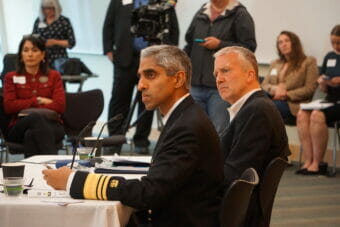
Murthy and Sullivan listen to a speaker at the June 26, 2023, mental health roundtable held at the University of Alaska Anchorage. (Photo by Yereth Rosen/Alaska Beacon)

Alaska will receive $1 billion in federal funding for affordable, high-speed Internet service, the U.S. Department of Commerce announced Monday. Nearly 90,000 homes and small businesses in the state lack access to a high-speed connection, according to the National Telecommunications and Information Administration.

Sen. Dan Sullivan highlighted the announcement at a press conference with U.S. Surgeon General Dr. Vivek Murthy, where they urged action and awareness about the nation’s youth mental health crisis. Sullivan said that as Internet access expands, there is a need for policies to protect Alaska youth from adverse mental effects from social media.

“How that’s done, and the safeguards we need to put on social media, it needs to happen. It needs to happen on the national level. There’s a growing bipartisan consensus for the need to do that,” he said.

The money is part of the Biden-Harris administration’s “Internet for All” initiative, which makes $42 billion available nationwide through a broadband equity program.

Sen. Sullivan said the surgeon general’s recent report on the connection between social media and adverse mental health outcomes shows that social media and “big tech” need to be regulated more strictly at the national level.

“They’re not being transparent with their data,” he said. “Can you imagine any other company in America saying, ‘Sorry, we have data that may or may not show that what we’re doing is harming kids, but we’re not going to give it to you.’”

He hinted at future policy changes to address that: “Well, I think you’re going to see some laws here soon saying, ‘No, damn it, you are going to give it to us,’” he said.

Sullivan suggested there may be a bill or bills that would limit social media to users aged 16 and older, which social media companies would be called on to enforce. Currently, the Children’s Online Privacy Protection Rule stipulates that social media users should be 13 years old, and Sullivan said that isn’t well enforced.

He said Alaskans can’t be sure that social media is safe for their kids and suggested he’d rather go too far with regulations than not far enough: “If we overshoot, well, we’re overshooting with regards to protecting our youth,” he said.

Dr. Murthy called youth mental health the defining mental health issue of our time.

“For many of our kids, social media has not been a positive influence in their life,” he said. “When kids are spending three hours or more on social media, they face double the risk of experiencing depression and anxiety symptoms.”

He said his main concern was exposure to harmful content and the impact of constant online comparisons on self esteem.

This story originally appeared in the Alaska Beacon and is republished here with permission.

Juneau’s hospital showcases new center for people experiencing mental health crises

Bartlett Regional Hospital Board President Kenny Solomon-Gross cuts the ribbon at the open house of the Aurora Behavioral Health Center. June 16, 2023. (Photo by Yvonne Krumrey/KTOO)

Bartlett Regional Hospital is opening a new center for people experiencing mental health crises in the coming months.

The center, which is on the Bartlett campus, means that patients who urgently need care won’t have to leave Juneau to get it.

The Aurora Behavioral Health Center comes amid a growing mental health crisis in Juneau, including wait lists for services for young people. 

Jennifer Carson, Bartlett’s interim executive director of behavioral health, said a recent Department of Justice review of youth mental health care in Alaska shows a large gap, with many young people having to leave their communities or even the state for treatment. 

“We know that kids are in crisis. And so we’re hoping to be able to fill that. We know that there’s nothing else like this in the state right now,” she said.

Starting this fall, the center will follow a model called Crisis Now for addressing acute mental and behavioral health needs. Carson said the model is designed to improve on problems that are too common with other approaches — like patients waiting for months on wait lists, getting sent far from home, or ending up in prison. 

“The plan is that law enforcement can do a nice soft handoff to our team, to help the individual come in and then get the therapeutic services that they need,” Carson said on Juneau Afternoon this week.

Aaron Surma, with the National Alliance on Mental Illness in Juneau, said the center will better serve people who urgently need help.

“You see five feet in front of your face, right? You’re not thinking long term. And so I think a service that matches the mindset just makes sense,” he said. “Long term service doesn’t match the way you are when you’re in crisis.”

The center’s crisis stabilization center will be open around the clock and staffed with nurses, clinicians and social workers. It will offer emergency stabilization services for adolescents and adults in emergency mental health situations, according to the website. Those stays average around 18 hours.

The center will also offer short residential stays for people who need more care. The residential center will have seven beds that overlook Gastineau Channel. 

Carson said the stabilization center and residential program will open first in early fall for youth aged 12 to 17.  She hopes the services will be open to adults in late fall. 

According to the Alaska Department of Behavioral Health, Aurora Behavioral Health Center’s services fall under Medicaid coverage, and private insurance coverage is case-by-case. 

Alaska Senate passes bill allowing involuntary psychiatric commitments of up to 2 years

Alaska Psychiatric Institute in 2022. (Matt Faubion/Alaska Public Media)

A bill that would allow the state to keep people in psychiatric facilities against their will for up to two years passed the Senate on Monday.

The bill gives prosecutors the ability to request a two-year commitment to keep the public safe if the defendant has a history of violence and is a danger to themselves or others.

It also requires the state law department to ask for an involuntary commitment if someone has criminal charges dismissed against them because of incompetency.

Sponsor Sen. Matt Claman, D-Anchorage, said the bill is necessary to protect the public. He pointed to an incident last year at the Anchorage library where a woman was stabbed by someone recently found incompetent to stand trial. After charges were dismissed against him, he was released back to the community.

“Two months earlier he had attacked two other women and then was released into the community after they dismissed his case because he was not competent to stand trial,” said Claman on the Senate floor. “The man who stabbed Angela should not have been released when they dismissed his criminal case.”

Claman said his bill would prevent a similar situation by requiring the Department of Law to seek a civil commitment for someone after criminal charges are dropped.

Currently, prosecutors can ask juries to hold people who are found unfit for trial because of mental incompetencies for up to 30 days. That commitment can be renewed up to six times for up to 180 days total. During that time the person is supposed to be treated at a psychiatric facility.

Some civil rights groups, including the ACLU of Alaska, the Citizens Commission on Human Rights and the Disability Law Center of Alaska, opposed the bill even after the maximum length of involuntary commitment was dropped from five years to two.

ACLU advocacy director Michael Garvey said it’s unclear whether the bill would have prevented last year’s library stabbing, and it’s unnecessary infringement on civil liberties.

“The bill is thinking about it in this way of ‘how long do we need to keep someone off the streets’ but our constitution mandates that we need to think of it as what’s the minimum amount we need to keep a person,” said Garvey.

The bill allows people who are involuntarily committed for two years to petition for early release if they can give “clear and convincing” evidence to a judge that they no longer risk  harming themselves or others.

Garvey also pointed to the state’s overburdened psychiatric care system, the state ombudsman investigated for improper patient care and hostile workplace in 2019 and again in 2022. In a 2019 settlement, the state was also found to be housing people in jails and hospitals while they awaited evaluations at the Alaska Psychiatric Institute. Garvey said even if people are able to get evaluated within 10 days as required by the bill, there could be unintended consequences for other people needing psychiatric help.

“That will push people outside API who could be using that space for restoration for a brief hold. And where are they going to go instead? They’ll be sent to a jail, in a hospital, or released out into the community where they won’t be able to get any treatment,” he said.

The bill passed the Senate 14-6 with three Democrats and three Republicans voting against it.  The House is considering a similar bill. If it passes, the two will likely be reconciled in a conference committee.

The truth about teens, social media and the mental health crisis

For years, the research picture on how social media affects teen mental health has been murky. That is changing as scientists find new tools to answer the question. (Olivier Douliery /AFP via Getty Images)

Back in 2017, psychologist Jean Twenge set off a firestorm in the field of psychology.

Twenge studies generational trends at San Diego State University. When she looked at mental health metrics for teenagers around 2012, what she saw shocked her. “In all my analyses of generational data — some reaching back to the 1930s — I had never seen anything like it,” Twenge wrote in the Atlantic in 2017.

Twenge warned of a mental health crisis on the horizon. Rates of depression, anxiety and loneliness were rising. And she had a hypothesis for the cause: smartphones and all the social media that comes along with them. “Smartphones were used by the majority of Americans around 2012, and that’s the same time loneliness increases. That’s very suspicious,” Twenge told NPR in 2017.

But many of her colleagues were skeptical. Some even accused her of inciting a panic with too little — and too weak — data to back her claims.

Now, six years later, Twenge is back. She has a new book out this week, called Generations, with much more data backing her hypothesis. At the same time, several high-quality studies have begun to answer critical questions, such as does social media cause teens to become depressed and is it a key contributor to a rise in depression?

In particular, studies from three different types of experiments, altogether, point in the same direction. “Indeed, I think the picture is getting more and more consistent,” says economist Alexey Makarin, at the Massachusetts Institute of Technology.

A seismic change in how teens spend their time

In Generations, Twenge analyzes mental health trends for five age groups, from the Silent Generation, who were born between 1925 and 1945, to Gen Z, who were born between 1995 and 2012. She shows definitively that “the way teens spend their time outside of school fundamentally changed in 2012,” as Twenge writes in the book.

Take for instance, hanging out with friends, in person. Since 1976, the number of times per week teens go out with friends — and without their parents — held basically steady for nearly 30 years. In 2004, it slid a bit. Then in 2010, it nosedived.

“It was just like a Black Diamond ski slope straight down,” Twenge tells NPR. “So these really big changes occur.”

At the same time, around 2012, time on social media began to soar. In 2009, only about half of teens used social media every day, Twenge reports. In 2017, 85% used it daily. By 2022, 95% of teens said they use some social media, and about a third say they use it constantly, a poll from Pew Research Center found.

“Now, in the most recent data, 22% of 10th grade girls spend seven or more hours a day on social media,” Twenge says, which means many teenage girls are doing little else than sleeping, going to school and engaging with social media.

Not surprisingly, all this screen time has cut into many kids’ sleep time. Between 2010 and 2021, the percentage of 10th and 12th graders who slept seven or fewer hours each night rose from a third to nearly one-half. “That’s a big jump,” Twenge says. “Kids in that age group are supposed to sleep nine hours a night. So less than seven hours is a really serious problem.”

On its own, sleep deprivation can cause mental health issues. “Sleep is absolutely crucial for physical health and for mental health. Not getting enough sleep is a major risk factor for anxiety and depression and self-harm,” she explains. Unfortunately, all of those mental health problems have continued to rise since Twenge first sounded the alarm six years ago.

“Nuclear bomb” on teen social life

“Every indicator of mental health and psychological well-being has become more negative among teens and young adults since 2012,” Twenge writes in Generations. “The trends are stunning in their consistency, breadth and size.”

Across the board, since 2010, anxiety, depression and loneliness have all increased. “And it’s not just symptoms that rose, but also behaviors,” she says, “including emergency room visits for self-harm, for suicide attempts and completed suicides.” The data goes up through 2019, so it doesn’t include changes due to COVID-19.

All these rapid changes coincide with what, Twenge says, may be the most rapid uptake in a new technology in human history: the incorporation of smartphones into our lives, which has allowed nearly nonstop engagement with social media apps. Apple introduced the first iPhones in 2007, and by 2012, about 50% of American adults owned a smartphone, the Pew Research Center found.

The timing is hard to ignore, says data scientist Chris Said, who has a Ph.D. in psychology from Princeton University and has worked at Facebook and Twitter. “Social media was like a nuclear bomb on teen social life,” he says. “I don’t think there’s anything in recent memory, or even distant history, that has changed the way teens socialize as much as social media.”

Murky picture becomes clearer on causes of teen depression

But the timing doesn’t tell you whether social media actually causes depression in teens.

In the past decade, scientists have published a whole slew of studies trying to answer this question, and those studies sparked intense debate among scientists and in the media. But, Said says, what many people don’t realize is scientists weren’t using — or didn’t even have — the proper tools to answer the question. “This is a very hard problem to study,” he says. “The data they were analyzing couldn’t really solve the problem.”

So the findings have been all over the place. They’ve been murky, noisy, inconclusive and confusing. “When you use tools that can’t fully answer the question, you’re going to get weak answers,” he says. “So I think that’s one reason why really strong evidence didn’t show up in the data, at least early on.”

On top of it, psychology has a bad track record in this field, Said points out. For nearly a century, psychologists have repeatedly blamed new technologies for mental and physical health problems of children, even when they’ve had little — or shady — data to back up their claims.

For example, in the 1940s, psychologists worried that children were becoming addicted to radio crime dramas, psychologist Amy Orben at the University of Cambridge explains in her doctoral thesis. After that, they raised concerns about comic books, television and — eventually — video games. Thus, many researchers worried that social media may simply be the newest scapegoat for children’s mental health issues.

A handful of scientists, including MIT’s Alexey Makarin, noticed this problem with the data, the tools and the field’s past failures, and so they took the matter into their own hands. They went out and found better tools.

Hundreds of thousands of more college students depressed

Over the past few years, several high-quality studies have come that can directly test whether social media causes depression. Instead of being murky and mixed, they support each other and show clear effects of social media. “The body of literature seems to suggest that indeed, social media has negative effects on mental health, especially on young adults’ mental health,” says Makarin, who led what many scientists say is the best study on the topic to date.

In that study, Makarin and his team took advantage of a once-in-a-lifetime opportunity: the staggered introduction of Facebook across U.S. colleges from 2004 to 2006. Facebook rolled out into society first on college campuses, but not all campuses introduced Facebook at the same time.

For Makarin and his colleagues, this staggered rollout is experimental gold.

“It allowed us to compare students’ mental health between colleges where Facebook just arrived to colleges where Facebook had not yet arrived,” he says. They could also measure how students’ mental health shifted on a particular campus when people started to spend a bunch of their time on social media.

Luckily, his team could track mental health at the time because college administrators were also conducting a national survey that asked students an array of questions about their mental health, including diagnoses, therapies and medications for depression, anxiety and eating disorders. “These are not just people’s feelings,” Makarin says. “These are actual conditions that people have to report.”

They had data on a large number of students. “The data comes from more than 350,000 student responses across more than 300 colleges,” Makarin says.

This type of study is called a quasi-experiment, and it allows scientists to estimate how much social media actually changes teens’ mental health, or as Makarin says, “We can get causal estimates of the impact of Facebook on mental health.”

So what happened? “Almost immediately after Facebook arrives on campus, we see an uptick in mental health issues that students report,” Makarin says. “We especially find an impact on depression rates, anxiety disorders and other questions associated with depression in general.”

And the effect isn’t small, he says. Across the population, the rollout of Facebook caused about 2% of college students to become clinically depressed. That may sound modest, but with more than 17 million college students in the U.S. at the time, that means Facebook caused more than 300,000 young adults to suffer from depression.

For an individual, on average, engaging with Facebook decreases their mental health by roughly 22% of the effect of losing one’s job, as reported by a previous meta-analysis, Makarin and his team found.

Facebook’s rollout had a larger effect on women’s mental health than on men’s mental health, the study showed. But the difference was small, Makarin says.

He and his colleagues published their findings last November in the American Economic Review. “I love that paper,” says economist Matthew Gentzkow at Stanford University, who was not involved in the research. “It’s probably the most convincing study I’ve seen. I think it shows a clear effect, and it’s really credible. They did a good job of isolating the effect of Facebook, which isn’t easy.”

Of course, the study has limitations, Gentzkow says. First off, it’s Facebook, which teens are using less and less. And the version of Facebook is barebones. In 2006, the platform didn’t have a “like” button” or a “newsfeed.” This older version probably wasn’t as “potent” as social media now, says data scientist Chris Said. Furthermore, students used the platform only on a computer because smartphones weren’t available yet. And the study only examined mental health impacts over a six-month period.

Nevertheless, the findings in this study bolster other recent studies, including one that Gentzkow led.

Social media is “like the ocean” for kids

Back in 2018, Gentzkow and his team recruited about 2,700 Facebook users ages 18 or over. They paid about half of them to deactivate their Facebook accounts for four weeks. Then Gentzkow and his team looked to see how a Facebook break shifted their mental health. They reported their findings in March 2020 in the American Economic Review.

This type of study is called a randomized experiment, and it’s thought of as the best way to estimate whether a variable in life causes a particular problem. But with social media, these randomized experiments have big limitations. For one, the experiments are short-term — here only four weeks. Also, people use social media in clusters, not as individuals. So having individuals quit Facebook won’t capture the effect of having an entire social group quit together. Both of these limitations could underestimate the impact of social media on an individual and community.

Nevertheless, Gentzkow could see how deactivating Facebook made people, on average, feel better. “Being off Facebook was positive across well-being outcomes,” he says. “You see higher happiness, life satisfaction, and also lower depression, lower anxiety, and maybe a little bit lower loneliness.”

Gentzkow and his team measured participants’ well-being by giving them a survey at the end of the experiment but also asking questions, via text message, through the experiment. “For example, we sent people text messages that say, ‘Right now, would you say you’re feeling happy or not happy,'” he explains.

Again, as with Makarin’s experiment, the effect was moderate. Gentzkow and his colleagues estimate that temporarily quitting Facebook improves a person’s mental health by about 30% of the positive effect seen by going to therapy. “You could view that meaning these effects are pretty big,” he explains, “or you could also see that as meaning that the effects of therapy are somewhat small. And I think both of those things are true to an extent.”

Scientists still don’t know to what extent social media is behind the rising mental health issues among teenagers and whether it is the primary cause. “It seems to be the case — like it’s a big factor,” says MIT’s Alexey Makarin, “but that’s still up for debate.”

Still, though, other specifics are beginning to crystallize. Scientists are narrowing in on what aspects of social media are most problematic. And they can see that social media won’t hurt every teen — or hurt them by the same amount. The data suggests that the more hours a child devotes to social media, the higher their risk for mental health problems.

Finally, some adolescents are likely more vulnerable to social media, and children may be more vulnerable at particular ages. A study published in February 2022 looked to see how time spent on social media varies with life satisfaction during different times in a child’s life (see the graphic).

The researchers also looked to see if a child’s present use of social media predicted a decrease of life satisfaction one year later. That data suggests two windows of time when children are most sensitive to detrimental effects of social media, especially heavy use of it. For girls, one window occurs at ages 11 through 13. And for boys, one window occurs at ages 14 and 15. For both genders, there’s a window of sensitivity around age 19 — or near the time teenagers enter college. Amy Orben and her team at the University of Cambridge reported the findings in Nature Communications.

This type of evidence is known as a correlative. “It’s hard to draw conclusions from these studies,” Gentzkow says, because many factors contribute to life satisfaction, such as environmental factors and family backgrounds. Plus, people may use social media because they’re depressed (and so depression could be the cause, not the outcome of social media use).

“Nevertheless, these correlative studies, together with the evidence from the causal experiments, paint a picture that suggests we should take social media seriously and be concerned,” Gentzkow adds.

Psychologist Orben once heard a metaphor that may help parents understand how to approach this new technology. Social media for children is a bit like the ocean, she says, noting that it can be an extremely dangerous place for children. Before parents let children swim in any open water, they make sure the child is well-prepared and equipped to handle problems that arise. They provide safety vests, swimming lessons, often in less dangerous waters, and even then parents provide a huge amount of supervision.

Copyright 2023 NPR. To see more, visit https://www.npr.org.

Juneau youth say needing parental permission would limit access to LGBTQ+ spaces

Juneau drag queen Gigi Monroe performs at the youth Pride party on June 20, 2019. (Photo by Zoe Grueskin/KTOO)

Earlier this month, Gov. Mike Dunleavy introduced legislation that would require parental permission for Alaska students to participate in school clubs related to gender and sexuality.

In Juneau, two such clubs are open to middle schoolers. They’re both called the Alliance, like other Gender and Sexuality Alliance clubs across the country. At one meeting last week, students told KTOO what the group means to them.

“[It’s] a place where you can be yourself,” said one student, who asked not to be identified in this story. KTOO agreed to not use club members’ names in order to protect their privacy.

“My mom is against LGBTQ,” the student said. “So I can’t really be myself around her because she doesn’t like that stuff. I’ve been coming here for around four months. And I think I really like this place.”

Oliver Sheufelt, an adult facilitator with the Alliance, says clubs like the Alliance are necessary because kids may not have other LGBTQ+ family members or support. 

“That sort of community isn’t really baked in for these kids. We really have to intentionally create that,” they said. “And these kids often have to seek it out. But these are really life-altering, life-saving spaces.”

When they say life-saving, it’s not an exaggeration. The Trevor Project reported last year that 45% of LGBTQ youth in Alaska seriously considered suicide in the past year, and 64% of LGBTQ youth in Alaska lacked access mental health care they wanted. One of the top reasons was that they didn’t want to ask their parents for permission.

Another student in the Alliance said they are out to their mom but not their dad, and if they had to get permission from him, they may not be able to come anymore. 

“My mom, it wouldn’t be a problem. She knows about me being transgender, but my father doesn’t. And that would cause problems,” they said.

For now, they tell their dad that they go to a homework club after school. 

Some of the youth said their parents were supportive of their identities and know they go to the Alliance group. But the group is still special because they can be around other youth who share their identities.

For others, the group offers support while they think about how to talk to their families about who they are.

“I kind of want to tell them that I’m bisexual,” said one student. “It’s kind of hard to tell them, though. Itʼs scary.”

The Alliance meets weekly at Floyd Dryden and Dzantik’i Heeni middle schools. The Zach Gordon Youth Center has a weekly group for LGBTQ+ teens each Thursday. The groups are open to any student on a drop-in basis. 

Site notifications
Update notification options
Subscribe to notifications