Katie Anastas

Local News Reporter, KTOO

Why is gas cheaper in Auke Bay? And why is it cheaper to fly to Seattle than Ketchikan?

The De Hart’s gas station in Auke Bay charged $3.49 per gallon on Feb. 15, 2024. (Katie Anastas/KTOO)

On a sunny Saturday at the Fisherman’s Bend gas station back in February, Juneau resident Joyce Sepel was filling up her tank. She said the Auke Bay gas station is her favorite.

“I’ve been going to Fred Meyer because it was cheaper,” she said. “But now I’ll just watch. I like coming here. It’s convenient, and I love watching the water here while I do it. But they’ve been the most competitive during the winter.”

Do you have a Curious Juneau question? Submit it at the bottom of the page.

On Valentine’s Day, prices at Auke Bay stations were cheaper than elsewhere in Juneau — as much as 40 cents cheaper. De Hart’s charged $3.50 per gallon, and the Fisherman’s Bend station charged $3.51. 

Meanwhile, Mike’s Airport Express was charging $3.70 per gallon. Petro One was charging $3.58 at its Lemon Creek station. Downtown, the Delta Western station was charging $3.90.

Some listeners have asked us why gas tends to be cheaper in Auke Bay. For her last Curious Juneau, erstwhile KTOO reporter Katie Anastas decided to find out. And as a bonus, she took on another reader question: Why does it cost more to fly to Ketchikan than to fly all the way to Seattle?

Catching drivers before they head south

Matthew Lewis is an economics professor at Clemson University. He studies how gas stations compete with each other, and how consumers respond to that competition.

“If consumers are driving or commuting a fair distance, they’re probably passing more gas station options along the way,” he said. “So that gives much more flexibility in where consumers might purchase.”

If someone lives in Auke Bay and drives to Lemon Creek or downtown for work every day, that driver passes by a lot of gas stations. Lewis said the Auke Bay stations need to keep prices low to try to catch those drivers before they go south.

“It is on the outskirts of where people are,” he said. “It’s not a convenient location for a lot of people, and so they need to have a relatively low price to stay competitive. Stations on a prominent, convenient part of a heavily traveled road or downtown can charge a high price and many consumers will still go.”

But gas stations do compete within neighborhoods

More broadly, four things affect the cost of gas, according to the U.S. Energy Information Administration. The biggest is the cost of crude oil, which makes up more than half of the retail price of gasoline. Lower oil production drives up crude oil’s cost per barrel. 

Taxes and the costs of refining and distribution make up the rest.

As those costs change, so do the prices at the pump. But ultimately, Lewis said, stations decide how much they think they can charge.

The Fisherman’s Bend gas station charged $3.50 per gallon of unleaded gas on Feb. 15, 2024. (Katie Anastas/KTOO)

When the crude oil and refined gasoline prices go up, the stations have to raise their prices and they do so fairly rapidly,” he said. “But when oil and wholesale costs go down, the stations tend to be a little bit slower to lower their price.”

Lewis said competition drives stations’ prices, even within the same neighborhood. Back in October, the Juneau Empire reported an 80-cent per gallon difference between the two Auke Bay stations.

“Prices do change regularly, so consumers really often aren’t all that well informed about what different stations are charging at different points in time,” Lewis said.

So next time you need to fill up, call around to a few stations. The lowest price could be closer than you think.

Along those same lines…

An Alaska Airlines flight comes in for a landing at the Juneau International Airport.
An Alaska Airlines flight comes in for a landing at the Juneau International Airport. (Heather Bryant/KTOO)

Have you ever wondered why it’s sometimes cheaper to fly from Juneau to Seattle than to Ketchikan? Some of our listeners have.

Alaska Travelgram writer Scott McMurren answered us with a question: “How many airlines fly between Juneau and Seattle?”

There are two.

“So Alaska and Delta compete on that route, particularly in the summer,” McMurren said. “The next question is, how many airlines offer jet service between Juneau and Ketchikan?”

For jet service, there’s just one.

Like gas prices, it comes down to competition. Multiple airlines will compete for customers. But if one airline has a monopoly on a route, like Alaska Airlines does from Juneau to Ketchikan, it’s up to them to set the price. 


Curious Juneau

Are you curious about Juneau, its history, places and people? Or if you just like to ask questions, then ask away!

Alaska Women’s Cancer Care expands service to Juneau

Nurse practitioner Sarah Lucas, gynecological oncologist Dr. Melissa Hardesty and registered nurse Marlowe Dunker stand in the lobby of Bartlett Regional Hospital’s oncology center. (Katie Anastas/KTOO)

When Suzanne Luken learned she had cancer, it came as a surprise.

“There was no pain. There was nothing at all — no indication,” she said. “I was tired, but I’m 77.”

Then, after other symptoms appeared, she went to the doctor.

“I thought I had a kidney infection because I started to pass blood,” she said. “So I went to the SEARHC walk-in over in Vintage Park, and they said, ‘No, that’s not what you think.'”

Instead, Luken was diagnosed with uterine cancer. Luken immediately thought of people she knew who’d had devastating experiences with cancer. And similar thoughts came up when she learned she would need to have a hysterectomy, a surgery to remove the uterus. She thought of family members who’d gone through the same procedure.

“I feel very fortunate that the terror I had seen with them did not overcome me,” she said.

Back then, hysterectomies required a large incision in the abdomen and several weeks of recovery. Today, they can usually be done with minimally invasive techniques, if a hospital has the right equipment and the right doctors. And now, Juneau’s Bartlett Regional Hospital does.

Doctors from Alaska Women’s Cancer Care are now flying down from Anchorage twice a month to meet with and operate on gynecologic cancer patients. Last month, Luken became their first surgery patient in Juneau.

Dr. Melissa Hardesty, a gynecological oncologist and one of the co-owners of Alaska Women’s Cancer Care, said Bartlett’s acquisition of the da Vinci Xi Surgical System made it possible.

“That was when we were in a position to really bring the same level of care here to town that we were providing in Anchorage,” she said.

Hardesty also operates on non-cancer patients whose surgeries might be more complicated than those typically done by an OB-GYN. She said the da Vinci Xi system allows for more precise movement for surgeons.

“The instrument has a wrist, and that allows us to do much more complicated motion,” she said. “Imagine the things you can do in life if you had wrist splints on both of your wrists or not.”

The Da Vinci Xi Robotic Surgery System unwraps a Starburst at Bartlett Regional Hospital in May 2023. (Clarise Larson for the Juneau Empire)

It also means smaller incisions — and an easier recovery — for many patients. That was the case for Luken.

“There’s four teensy-tinesy scars, that’s all,” Luken said. “It’s amazing. It truly is amazing.”

Hardesty and Dr. Joanie Hope usually travel to Juneau on Wednesday nights, see patients on Thursday and do surgeries on Friday. Hardesty said their consistent schedule means Juneau-based patients have more time to sit with the surgery recommendation and think about their options.

“In the Anchorage model, we really tried to have it be a turnaround. I’m going to see you, I’m going to operate on you the next day. That’s a lot for people,” Hardesty said. “If we’re here and it needs to be less hurried, it can be.”

Luken said, if she’d had to go to Anchorage, she might have put the surgery off.

“I think I would have been a lot more upset had I had to go to Anchorage, get a hotel, get a car, get somebody to stay with me, and then you’re there for a week,” she said. “How many people can afford to take a vacation, so to speak, with hotels and plane fare and everything else, to go for health reasons?”

Instead, after surgery, Luken got to go home and fall asleep in her own bed. She hopes other women will see how important — and now, how accessible — this kind of treatment can be.

“We now can go through a surgery that we need with no problems, and we can do it right here in our own home — well, hometown, I should say — and feel comfortable about it,” Luken said. “It’s not the big scary thing that it used to be.”

Education commissioner disputes feds’ claim that Alaska didn’t fund schools equitably during the pandemic

A group of first grade students play on the playground at Sayéik Gastineau Community School on Thursday, Jan. 14, 2021, in Juneau, Alaska. The school resumed in-person classes after spending months doing remote learning because of the COVID-19 pandemic. (Photo by Rashah McChesney/KTOO)
A group of first grade students play on the playground at Sayéik Gastineau Community School on Jan. 14, 2021, in Juneau, Alaska. (Rashah McChesney/KTOO)

State education officials continue to dispute the federal government’s claim that Alaska didn’t fund schools equitably during the pandemic.

In December, federal education officials said Alaska failed to meet conditions attached to COVID relief funding for schools. The rule, called “maintenance of equity,” said states couldn’t disproportionately reduce state funding to its highest need districts when it gave out pandemic relief.

The U.S. Department of Education says Alaska did that in four school districts: the Juneau School District, Anchorage School District, Fairbanks North Star Borough School District and Kenai Peninsula Borough School District.

But during a press call on Friday, Alaska Department of Education and Early Development Commissioner Deena Bishop said Alaska followed its funding formula as usual during the pandemic.

“This equalized funding approach did not change during the COVID-19 pandemic,” Bishop said. “Alaska did not reduce per-pupil spending on education in any of our school districts in order to take advantage of federal funds.”

Bishop said districts lost students during those years. Since state funding is based on enrollment in a district, a drop in enrollment means a drop in state funding.

“This is not a reduction or cut, it’s simply how the state formula works,” Bishop said.

Alaska’s school funding formula starts with a base amount per student — called the base student allocation — and then makes adjustments for things like school size, the number of students with intensive special needs and other factors specific to each district. The goal is to recognize the wide range of students’ needs across the state and provide the funding to meet them.

The state also has a provision called “hold harmless,” which helps districts who’ve lost students by gradually reducing the amount of state funding they receive over the course of three years instead of immediately.

All those factors mean state funding varies from year to year. During the pandemic, as some students dropped out of brick and mortar schools and enrolled in homeschool programs, the amount of funding they generated for districts changed.

Bishop stressed that the maintenance of equity requirement was the first of its kind.

“For states with an equalized per-pupil funding formula like ours, there was no way to know how to comply, if simply maintaining your funding and distribution in the same historical manner was insufficient,” she said.

And she said the state’s passage of the disparity test — a separate federal rule that allows the state to count some federal aid as state education funding — shows that the state fairly funds all districts.

Last week, federal policy advisor Austin Reid told the Alaska Senate Education Committee that more than 40 states were initially deemed out of compliance with the maintenance of equity requirements. 

“To date, I’m aware of at least seven states that have made supplemental appropriations to demonstrate compliance for fiscal year 2022, with payments ranging from several hundred thousands of dollars, up to nearly $100 million,” he said.

Last month, the Department of Education said Alaska could resolve its non-compliance by sending nearly $30 million to the four school districts. The department did not respond to a request for comment on Bishop’s claim that Alaska did fund schools equitably by following the formula.

Bishop said it’s too early to say whether supplemental payments are the only solution. She said she hoped to meet with federal education officials sometime this week.

Juneau School District announces principals and assistant principals for next year

Thunder Mountain High School principal Shawn Arnold, now principal of Thunder Mountain Middle School, smiles during a graduation ceremony in May 2023. (Clarise Larson / for the Juneau Empire)

The Juneau School District has named principals and assistant principals for its reorganized schools next year. The announcement comes after the school board reaffirmed its plan to close three buildings and combine the district’s two high schools.

Next year, sixth graders will stay at elementary schools, seventh and eighth graders will be at Thunder Mountain Middle School and ninth through 12th graders will be at Juneau-Douglas High School: Yadaa.at Kalé. 

School closures mean fewer principal and assistant principal positions across the district, but Superintendent Frank Hauser said they didn’t have to lay anyone off.

“We’ve got a great group of administrators that are going to continue to do great things in the Juneau School District, for the community, and I’m excited about the placements,” he said.

The new Thunder Mountain Middle School will be led by principal Shawn Arnold and assistant principal Laura Scholes. Arnold is the current principal at Thunder Mountain High School and Scholes is the assistant principal at Dzantik’i Heeni Middle School.

At Juneau-Douglas High School: Yadaa.at Kalé, Principal Paula Casperson will keep her role. She’ll be joined by assistant principals Kelly Stewart, from Thunder Mountain, and Luke Gunkel, currently the district’s activities and Community Schools coordinator.

Floyd Dryden Middle School Principal Kristy Germain has been named the district’s Director of Operations starting next year. She’ll oversee district maintenance, information technology, Community Schools and RALLY, the district’s child care program.

“We’re just really excited to have Principal Germain be part of the cabinet for next school year,” Hauser said. “Her leadership skills, organizational skills, the experience that she brings with her – she’s going to be a great asset.”

Current JDHS assistant principal Nate Creel will become principal of Kax̱dig̱oowu Héen Elementary, replacing Elizabeth Pisel-Davis, who’s retiring. And Dzantik’i Heeni Middle School Principal Molly Yerkes will become principal of the Tlingit Culture Language and Literacy program. Yerkes replaces Eldri Westmoreland, who is going on a leave of absence while she pursues a doctorate degree in Indigenous studies with a focus on education.

Some Juneau city staff will move to Alaska Permanent Fund building

Juneau city leaders say construction at the Municipal Way building has been disruptive for employees. (Clarise Larson/KTOO)

Some City and Borough of Juneau staff will soon move to the Michael J. Burns Building, which houses the Alaska Permanent Fund Corporation.

Staff from multiple city departments now work in a building on Municipal Way owned by Sealaska Heritage Institute. The city is leasing office space there until June, but city leaders say construction there has been disruptive to employees.

Deputy City Manager Robert Barr told the Juneau Assembly on Monday that the Burns building will be a better fit.

“This is really a short-term solution to a short-term problem, and getting our staff in a good space that they can work productively and collaborate in,” he said.

The city hopes to start its lease at the Burns Building on May 1. That means the city would pay rent at both buildings for two months.

City leaders are still working on a long-term office plan for staff. Options include putting some in the Burns Building and the rest in the Juneau School District office, or moving into one of the school buildings set to close next year.

“This effort is not our broader city hall effort,” Barr told the Assembly. “That is a separate conversation that you’re having separately.”

Barr said the Assembly will resume discussions about city hall at its next Committee of the Whole meeting on April 15.

Juneau School Board decides to keep previously approved school closure plan

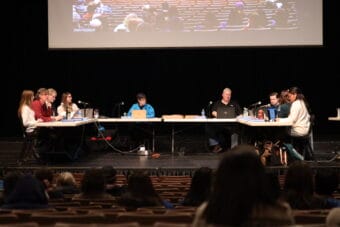
The Juneau School Board meets in the auditorium of Juneau-Douglas High School: Yadaa.at Kalé on Tuesday, March 12, 2024. (Clarise Larson/KTOO)

The Juneau School Board voted Tuesday night to stick with its previously adopted school closure plan. It puts seventh and eighth grades at Thunder Mountain High School’s campus and ninth through 12th grades at Juneau-Douglas High School: Yadaa.at Kalé. 

Last week, board member Amber Frommherz proposed that the board revisit that plan and look more deeply into a model that would keep two high schools open. She proposed putting eighth through 12th graders at the two high school campuses and closing the Marie Drake building and either Kax̱dig̱oowu Héen Elementary or Mendenhall River Community School.

On Tuesday night, Frommherz said her model would bring the district more state funding because the state’s funding formula gives more money to smaller schools. 

“There’s a configuration model out there that could bring in more revenue, that would save state funding,” she told the board. “That was my concern.”

Frommherz’s presentation focused on preserving state funding, not on cutting expenses. Board member Emil Mackey said it was important to consider the long-term savings that come with the approved model.

“Bringing more revenue isn’t the same as saving enough money, because shutting down the buildings saves us in maintenance, repair and utilities,” he said. “There’s a difference between chasing money from the state and balancing the budget on expenditures and revenue.”

High school principals outlined several scheduling challenges that would come with Frommherz’s model, including staggering lunchtimes for older and younger students and sharing amenities like gyms after school.

“The physical plan of JDHS is not really structured in a way to isolate based on the hallway configurations,” said Juneau-Douglas High School: Yadaa.at Kalé principal Paula Casperson.

Dozens of people spoke during the public comment period. Juneau Education Association President Chris Heidemann said revisiting the closure plan was creating even more uncertainty for teachers.

“In the last week, I’ve received several notices of resignation,” he said. “My members are starting to decide to leave on their own because of the continued uncertainty in this district around the budget.”

Floyd Dryden Middle School seventh grader Maisey Mar said she was looking forward to going to middle school with students from both Floyd Dryden and Dzantik’i Heeni Middle Schools next year.

“When I heard about the plan to combine the middle school at TM, I was excited about being able to go to school with my friends from both Floyd and DH, including my best friend since kindergarten who currently attends DH,” Mar said.

Others spoke in favor of Frommherz’s model and thanked her for looking into an option they say should have received more consideration from the beginning. Parent Margaret Katzeek said students can get more attention at smaller schools.

“I think about all of our youth who will fall through the cracks, educationally, physically, mentally,” she said.

But several teachers, like Juneau-Douglas High School: Yadaa.at Kalé math teacher Alexandra Razor, said the board should listen to principals about what it would mean for staff layoffs and course offerings.

“As a teacher of 24 years, I am frustrated right now,” she said. “I’m frustrated that people are questioning teachers and admin on our ability to work together, our ability to welcome students, our ability to create an equitable learning environment, and the idea that we’re going to start allowing students to fail and not graduate.”

After midnight, the board voted 5-2 to indefinitely postpone voting on the amendment, meaning the original closure plan still stands. Members Frommherz and Britteny Cioni-Haywood voted no. 

The board is set to approve next year’s budget at 5:30 p.m. Thursday at the Juneau-Douglas High School: Yadaa.at Kalé library.

Site notifications
Update notification options
Subscribe to notifications