Curious Juneau

What happened to the ‘awooga’ button at the Gold Creek Power Plant?

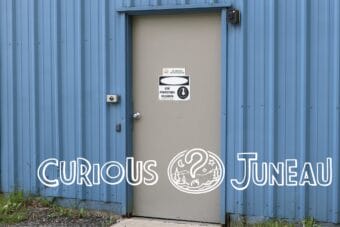
A gray door against a blue metal building with the sign "Ear Protection Required."
The door and disconnected doorbell to the Gold Creek Power Plant in Juneau on July 7, 2025 (Photo by Jamie Diep/KTOO)

Listen here:

Nestled in the Flats neighborhood near Juneau’s federal building is the city’s oldest and longest running hydropower plant.

For many, the large blue building is just a noisy part of the neighborhood. But for lifelong Juneau residents like Kevin Gullufsen, the building has a fun little Easter egg.

“When I pressed this years ago, and this was about 10 years ago, it would make this really satisfying, like, ‘awooga’, sound, you know, like a Tex Avery cartoon,” he said.

Gullufsen is talking about a small, black button next to the power plant’s door on Capitol Avenue. A sign on the door states that hearing protection is required inside, and there’s a hum of machinery in the air. Gullufsen was one of many people that pressed the button as they walked by, especially in his twenties.

“I lived on the corner over here, coming out of college, and it was like our favorite thing to do coming to and from the bars with my three roommates, was to press this button right here,” he said. “And then sometimes we’d run, like we, you know, we’re little kids playing a prank or something like that.”

But the button’s silent now.

Do you have a Curious Juneau question? Submit it at the bottom of the page.

For Curious Juneau, Gullufsen wanted to know what the button is for — and what happened to it.

The answer to what this so-called “awooga button” is, is a simple one.

“A favorite of the Juneau public to push on the way by. I remember it went out from when I was a kid as well,” said Bryan Farrell, the chief power generation operator for AEL&P. “But yeah, it’s a doorbell. It is just a loud industrial doorbell.”

AEL&P owns and operates the power plant. Its office in Lemon Creek is relatively quiet, but over at the power plant, things get loud. Really loud.

“These are just the hydro units running,” Farrell said over the sound of roaring generators. “These are the diesels over here. If these were running, it’d be considerably louder.”

Back in the quieter office, he said that loud noise required a really loud doorbell.

“It used to be that there was someone within that building actually operating those units, and within that building there’s another control room,” he said. “So they’d be inside that control and that had to be loud enough to alert them in that control room.”

But Farrell said they disconnected the doorbell about five years ago, partly because of the noise.

“People do like to push that on the way by, and it is a loud sound. So if you’re in there working on something, and someone pushes that doorbell on their way by, it can be a little bit jarring,” Farrell said. “And then also, we just disconnected it because we don’t want people to be distracted when they’re in there working by them, by those loud noises.”

He says there’s also no need for a doorbell anymore either because of cell phones.

“You would just call someone knowing that there’s an operator in there to get their attention or or we would call our main operations center, and they could radio into that building,” he said.

The building’s small black doorbell is still there now, but it’s just effectively a button.

So what did it sound like? Gullufsen gave his best impression.

“It was like a mix between, like a Tex Avery thing like Wile E. Coyote going, ‘awooga,’” he said. “And then a, like a tsunami siren, because if you would hold this down, it would keep going.”

Farrell declined to give his impression. Instead, he reconnected the doorbell one more time for KTOO to capture the sound that delighted and annoyed Juneau residents for years.

Click here to hear the awooga sound!

But for now, that small, black doorbell will go back to being a defunct relic of the past.


Curious Juneau

Are you curious about Juneau, its history, places and people? Or if you just like to ask questions, then ask away!

Why is the state capital Juneau and not Anchorage?

The Alaska State Capitol on Friday, June 13, 2025. (Photo by Clarise Larson/KTOO)

Listen to this story:

It’s a question that’s swirled around town for decades, often with some heated debate: Why is the state capital Juneau and not Anchorage? 

Kirk Smith is a volunteer with the Juneau-Douglas City Museum, which works together with the Capitol Building to provide tours during the summer tourism season. He says he often finds himself having to answer the question. 

Do you have a Curious Juneau question? Submit it at the bottom of the page.

“The question does come up quite frequently, ‘Why is a city that’s inaccessible by road or rail, why is it the capital?’’ he said.

For this Curious Juneau, a listener asked KTOO to take a look at where the question — and the debate — stand. 
Smith has been giving tours of the Alaska State Capitol since 2018, so he knows the building, its history and its artwork like the back of his hand. He starts each tour in the Senate Finance Committee hearing room, where a painting of Sitka hangs on a wall. 

“Major issues that affect Alaskans are decided in this room,” he said.

He explained that the painting is there because Juneau wasn’t actually the first capital of Alaska — Sitka was. But that changed in 1906.

“Juneau was the largest and wealthiest and most successful city in the territory in 1900 when the Congress actually mandated moving the capital to Juneau,” he said. “Anchorage existed in that time, in a sense, it was a small community.”

A sign at site of future Capitol in this photo taken between 1913 and 1939. (Alaska State Library Historical Collections)

But Juneau wasn’t the state capital yet because Alaska wasn’t a state yet; it was a territory.  The Capitol building was built in 1929 and opened in 1931 as a federal building and territorial building.

“I like to refer to the architectural style as ‘early 20th-century American post office,’” Smith said. 

The federal government then gifted the building to the state when Alaska became the 49th state of the Union in 1959. 

An American Flag is draped from the Alaska State Capitol in this picture taken on July 4, 1959. (Alaska State Library Historical Collections)

In the decades since then, there have been multiple attempts to move the capital to a more populated area. Some of them almost succeeded. In 1974, Alaska voters passed an initiative to move the capital to the road system. But a measure to fund the move failed, as did four other capital move votes in 1960, 1962, 1994 and 2002.

Juneau Democratic Sen. Jesse Kiehl said that, despite the many failed attempts, there’s always going to be a new effort to move the capital onto the road system.

“It’s a little bit like a zombie movie. It’s never all the way dead,” he said. “You can count on it to come back smelly and shambling and still a problem that has to be dealt with.”

Sen. Jesse Kiehl, D-Juneau, speaks during a joint session of the Alaska Legislature on Feb. 26, 2024. (Clarise Larson/KTOO)

When Juneau became the territorial capital in 1906, Anchorage wasn’t the hub that it is today. But now, Anchorage’s population is roughly nine times the size of Juneau’s population.

Over the years, a lot of state jobs have migrated there. So much so that the movement coined the name Capital Creep — the slow trickle of state jobs moving away from Juneau to Anchorage. 

Kiehl said he’s obviously biased because he lives here, but argues there are numerous reasons why Juneau should remain the capital despite the movement away.

“Oh, good Lord in heaven, the price tag,” he said. “I have no idea what that price tag would be  — hundreds and hundreds of millions of dollars at least. And that’s probably a low-ball estimate.”

He said that Juneau’s identity as a town is intertwined with being the capital of the state. Other states like California, New York, Texas and Montana all have their capitals in locations that aren’t the most populated areas of their respective states. 

But House Rep. George Rauscher, R-Sutton, said holding the Alaska Legislature at the Alaska State Capitol in Juneau is a disservice to Alaskans because it’s hard to get to Legislators. 

Rep. George Rauscher, R-Sutton, speaks during a session of the Alaska House of Representatives on Sunday, May 12, 2024. (Photo by James Brooks/Alaska Beacon)

“It costs so very much money for our legislative constituents to come down and see us,” he said. 

Since 2017, Rauscher has introduced a bill each session in the Alaska Legislature seeking to have lawmakers convene in Anchorage instead of Juneau. He argued that Juneau is inconvenient and expensive for everyone who is not local and too far from the state’s big population centers.

“This is the only state on the planet where people have to take a boat or an airplane to go to do the work of the people,” he said. 

His bill didn’t go anywhere last session —  nor has it ever in previous years — but there’s always the chance it could get picked up next session in January. 

But every time the issue springs up, so does the opposition. 

“As long as we remain dedicated and vigilant, I think we can continue to hold this off and keep this smelly old zombie that tries to shamble out of the crypt periodically from threatening the town,” Kiehl said. “But you’ll never stop it from getting reanimated by somebody somewhere.”


Curious Juneau

Are you curious about Juneau, its history, places and people? Or if you just like to ask questions, then ask away!

Where do Juneau’s bald eagles go in the winter?

Bald eagles perch in trees beside the Lemon Creek Landfill. (Photo by Alix Soliman/KTOO)

Listen to this story:

On a sunny morning at the Lemon Creek Landfill, Steve Lewis, a wildlife biologist with the U.S. Fish & Wildlife Service, walks through the wetland toward the line of trees surrounding the dump. Bald eagles are squabbling over a big, salmon-colored plastic bag. 

They congregate here to eat. He counts more than 20 eagles swooping around the trash piles.

“It’s just unfortunate, because it’s basically like an unnatural occurrence that mimics natural occurrence,” Lewis said. “This is pretty similar to what you might see at the Chilkat.” 

Do you have a Curious Juneau question? Submit it at the bottom of the page.

He’s talking about the Chilkat Bald Eagle Preserve in Haines, where thousands of bald eagles from all over Southeast go in the winter to feast on a late fall run of chum salmon. 

But that’s not where they all go.

For Curious Juneau, KTOO listener Mark Branson asked where Juneau’s bald eagles go in the winter, and what they eat.

“Eagles eat a lot of fish and they eat a lot of waterfowl those are probably the two big things,” Lewis said. “But, you know, they’ll eat things at the dump here.”

Lewis outfits the birds with little GPS backpacks to track their movements. He said bald eagles go where the food is, including hooligan and salmon runs, areas where waterfowl hang out, places they can scavenge dead animals and yes landfills. 

How far they travel for a meal depends on whether they’re going to have eaglets. Those who will be parents don’t go far. 

“We have birds that stay here all year,” he said. “There’s territorial birds that have nests.” 

Hundreds of bald eagles stick around Juneau through the winter, Lewis estimates. They feed on what they can find nearby so they can defend their territory from potential thieves and retain their nest to have eaglets in the spring. 

But Lewis said that not all eagles are interested in breeding. Those birds travel to Haines and even farther.

“There’s adults that are not territorial,” he said. “We call them floaters. They have a little bit less affinity to necessarily staying in one place.”

Since bald eagles can live around 30 years, he reckons the floaters probably don’t feel a sense of urgency about reproducing. Instead, they can wait until the conditions feel right and roam along the coast and up rivers in the meantime. 

Lewis estimates that 30% to 40% of adult bald eagles in Southeast are ‘floating’ in a given year. That’s not including juvenile eagles, which ‘float’ as well while they learn about their environment. 

The young birds can be identified by their splotchy brown feathers. They develop the characteristic white head and tail plumage at around four years old.

Many floaters visit the Chilkat Valley near Haines, where an odd upwelling of warm water at the confluence of the Chilkat and Tsirku Rivers prevents the water from freezing and allows a late fall run of chum salmon to spawn. The salmon provide a feast for thousands of bald eagles starting in November. 

Reba Hylton, the tourism director for Haines, said locals call it the “council grounds” since there are so many white heads poking through the trees like wigged legislators of old. She said the eagles are most active in the morning. 

“They’re still lazy,” she said. “I mean, there’s plenty of food to go around, but they’ll still try and come in and take each other’s food. So you get a lot of squawking that happens.”

But Southeast’s floaters don’t just fly to Haines. Some bald eagles that Lewis tagged in Juneau, Sitka and the Chilkat Valley have traveled as far north as the Peel River in Yukon Territory and as far south as Vancouver Island, British Columbia.

He said their movement patterns look as if he put GPS tags on his friends.

“The church would be important for some, and the bar is important for some and the library is important for some,” Lewis said. “Eagles are kind of that way, I guess.”

For some bald eagles, the dump is important. In Juneau, it’s common to hear people refer to the national bird a trash bird or a “dump buzzard,” Lewis said. But he still finds them impressive, no matter where they like to hang out. 


Curious Juneau

Are you curious about Juneau, its history, places and people? Or if you just like to ask questions, then ask away!

What’s the story behind the Fiddlehead Cookbook’s North Douglas chocolate cake?

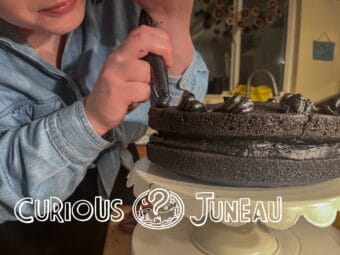
Abigail Sweetman frosts a North Douglas chocolate cake. (Photo by Yvonne Krumrey/KTOO)

If you ask longtime Juneau residents what cake they want on their birthday or for special occasions, one answer comes up a lot — North Douglas chocolate cake. 

“People love this cake,” said Abigail Sweetman, a Juneau resident originally from Ketchikan. She spends nearly all of her free time coming up with new recipes in her Starr Hill apartment.

Do you have a Curious Juneau question? Submit it at the bottom of the page.

“I am a huge sugar person, and I grew up making a lot of desserts because it was something I like, something I couldn’t get much of in Ketchikan,” she said. “Most of my love of food came from baking at a young age.” 

For Curious Juneau, Sweetman asked KTOO about the cake’s origin.

While I started looking around for the people who named it, Sweetman gathered ingredients to make it at home.

“It has butter and oil, which is pretty decadent,” Sweetman said, reading aloud from the recipe. “She says to combine, basically like, most of the wet ingredients in the cocoa and bring it to a boil.” 

The recipe lives in the Fiddlehead Cookbook. The cookbook, which is older than Sweetman, is based on a restaurant that operated in Juneau for nearly 30 years. The Fiddlehead Restaurant closed two decades ago, but the cookbook — and North Douglas chocolate cake — has taken on its own life.

“It was a cake that I had in childhood,” she said. “and I’m like ‘I didn’t realize that they named a cake after North Douglas’ and I was like ‘There’s gotta be a story there.’”

The story is rather simple actually, according to Linda Zagar. She’s the baker the cookbook credits with bringing it to the restaurant. 

Linda Zagar at the Fiddlehead Restaurant sometime in the 1970s. (Courtesy of Deborah Marshall)

“My best friend’s mom made this cake, and it was called choco bake,” she said. “It has a real name. It’s a real recipe. I did not create the recipe. That’s what I always tell people. I just brought it.” 

Zagar moved to Alaska with that same best friend in the 1970s, and followed her now husband to Juneau. They’ve lived in North Douglas for decades.

She worked at the Fiddlehead Restaurant for several years, and worked in just about every role there — waiting tables, washing dishes, prep cooking — before she became the morning baker. Zagar said a lot of staff would bring in favorite recipes they had accumulated over the years. 

“For some reason, this one stuck,” she said.

Zagar added a couple of twists: she made it a layer cake, with more frosting, and added walnuts around the edge — though the nuts didn’t make it into the cookbook version. And, Zagar said, she loves chocolate, so instead of plain cocoa powder, she used dark. 

The name, however, was a savvy act of branding. 

“My boss at the time said, ‘Well, what’s the name?’ And I said, ‘choco bake’. And he goes, ‘Hmm, no.’ He goes, ‘You’re the North Douglas Baker. Let’s call it the North Douglas chocolate cake.’ And I think that’s half of it,” she said. “It has a cool name, yeah? But then it just became a thing.”

Nancy DeCherney was part of the Fiddlehead Restaurant too, as a cook and manager. 

North Douglas chocolate cake. (Courtesy of Deborah Marshall)

“All of us were getting out of college, and there was money up here, and so we had the blessing of having a staff that was highly educated and full of — you know — it was the 70s,” she said. “Everybody was full of exciting ideas.”

DeCherney remembers what it was like to walk into the Fiddlehead. She described dark wood furniture and ferns, a smoking and non-smoking section.

She wrote the Fiddlehead Cookbook in the 90s and she said she loves hearing people talk about their favorite recipes from the cookbook. She’s glad it’s lived on. 

Abigail Sweetman displays a freshly baked North Douglas chocolate cake. (Photo by Yvonne Krumrey/KTOO)

“I think partly, it’s not real difficult food,” she said. “It’s accessible. Some of it is a little unusual, but I think the average bear can cook it, and it’ll turn out okay.”

Back in her apartment, Sweetman pulled the cake out of the oven and started to assemble it. 

“I always want layer cakes to turn out a little better than they do, and then I usually get to the end of it and I’m like, it’s more important to me that this tastes good,” she said as she started frosting. 

For the record, it also looked good, with some extra decoration that wasn’t in the cookbook – edible eyeballs. 

The cake is rich and moist. You’ll probably want a glass of milk nearby. And Zagar says, it’s always better on the second day. 


Curious Juneau

Are you curious about Juneau, its history, places and people? Or if you just like to ask questions, then ask away!

Curious Juneau takes over Juneau Afternoon to look back and preview what’s ahead

Joe Gorilla, a one-time candidate for Juneau mayor, makes a surprise appearance Friday, Feb. 3, 2017, for Erin Heist of Juneau, who asked Curious Juneau if the rumors of a simian mayoral candidate were true. Joe Gorilla is the sometimes-identity of KTOO funnyman Jeff Brown. (Photo by Tripp J Crouse/KTOO)
Joe Gorilla, a one-time candidate for Juneau mayor, makes a surprise appearance Friday, Feb. 3, 2017, for Erin Heist of Juneau, who asked Curious Juneau if the rumors of a simian mayoral candidate were true. Joe Gorilla was the sometimes-identity of former KTOO funnyman Jeff Brown. (Photo by Tripp J Crouse/KTOO)

KTOO’s Digital Content Director Adelyn Baxter joins Juneau Afternoon Host Bostin Christopher for a look back at the creation of Curious Juneau ahead of its new 2025 season premiering on Friday, May 16. From the very first episode to listener favorites, it’s a deep dive into what makes Curious Juneau one of the most popular features as it answers burning questions, wonderings, and myths from viewer-submitted queries.
Episodes of Curious Juneau featured:

For more Curious Juneau, visit Curious Juneau – KTOO https://ktoo.sandbox.5mts.com/curiousjuneau/

Join KTOO for the kick-off of the new season of Curious Juneau on Friday, May 16, at 8:00 a.m. in the downstairs studio.

Bostin Christopher hosts the conversation. Juneau Afternoon airs at 3:00 p.m. on KTOO and KAUK with a rebroadcast at 7:00 p.m. Listen online or subscribe to the podcast at ktoo.org/juneauafternoon.

Subscribe to the podcast:

Juneau Afternoon is a production of the KTOO Arts and Culture Team.
Bostin Christopher produced today’s show with help from Adelyn Baxter.

Did people really used to race down Gold Creek on the Fourth of July?

A paper boat made by KTOO staff braves Gold Creek. July 11, 2024. (Photo by Clarise Larson/KTOO)

Alaskans celebrate the Fourth of July in a myriad of ways, whether it’s log-rolling competitions, launching cars off of cliffs, or jumping high in the air in the blanket toss.

Do you have a Curious Juneau question? Submit it at the bottom of the page.

In Juneau, we have our fireworks on the third, an old tradition that let miners sleep off their hangovers. But KTOO listener Mary McEwen wrote in to ask about a different July 4 tradition — one her father told stories about.

“It’s kind of been a piece of family lore that, you know, ‘Oh you know I once won a race down Gold Creek on a piece of Styrofoam,’” she said. 

It’s true. Some brave Juneauites used to celebrate Independence Day by racing down Gold Creek on improvised rafts — something akin to the Red Green Regatta, on speed. 

For this Curious Juneau, we talked to some of the people who did it — like Jim Williams.

“There were probably 15 or 20 idiots that attempted it,” he said.

Williams said that when he did the race in the 1960s, dozens of people came to watch the racers from the banks of the creek in downtown Juneau. 

Gold Creek runs in a paved channel, and the water flows fast over the concrete. The race started in Cope Park and wound through downtown, so the racers sped past the Federal Building and Foodland before getting dumped into Gastineau Channel.

The Gold Creek sluice. Going over this sluice was the starting point for the race. July 11, 2024. (Photo by Clarise Larson/KTOO)

People went down the creek one at a time, riding everything from proper inflatable rafts to wooden doors. Williams rode an air mattress.

It didn’t go well.

“I just remember going over something and immediately popped my raft, so I was dead last in the race,” he said. “I had to walk all the way down Gold Creek because the only way to get out of there was to get down by Foodland.”   

Williams competed with his friend Gary Rosenberger, a high school sophomore at the time. Rosenberger said he laid on his air mattress like a surfboard and paddled with his arms. 

“I had to hold on to it going over the falls, and then it was smooth sailing from then,” he said.

Old newspaper stories said the fastest time in 1967 was nearly two-and-a-half minutes. The next year, the currents must have been stronger — the winner came in at a minute and a half.

Gary Rosenberger said he may have won the race once if he hadn’t gotten out of the water too soon.

“But I didn’t know there was an end — where the end was,” he said. “So everybody was yelling at me, but I didn’t know what they were yelling because it had to be six or seven people all yelling the same thing.” 

Gary Rosenberger at Gold Creek, where he competed in a race almost 60 years ago. July 10, 2024. (Photo by Yvonne Krumrey/KTOO)

And Mary McEwen’s dad? Duane McEwen said he won the race on a raft built from Styrofoam with a wooden frame. 

“I think I made a paddle out of a broom handle and a piece of wood — it was strictly homemade,” he said. 

But then he left his raft outside all year, and the foam was heavy and waterlogged by the next July.

“The second year I came in last place,” McEwen said. “I dragged bottom all the way down there.” 

It’s not clear just how enduring this tradition was — the race did not get a lot of news coverage. Williams said it seems like it only happened once or twice more.

“I think they decided there was some liability there. Which, I don’t know why they would have ever thought that,” he said. 

But another listener wrote to say he remembered the race continuing well into the 1980s. And a 1967 story in the Alaska Daily Empire calls that year’s running the “75th annual sluice race down Gold Creek” — though Curious Juneau could not find anything to back that up.

Rosenberger said it would be more dangerous now. Since the 1960s, some large rocks have been placed at the end of the creek.

“You wouldn’t — I don’t think — drown or anything,” he said. “But you’d probably be embarrassed if everybody was watching you.”

Correction: This story has been edited to include new information about what years the race took place.


Curious Juneau

Are you curious about Juneau, its history, places and people? Or if you just like to ask questions, then ask away!

Site notifications
Update notification options
Subscribe to notifications