Curious Juneau

How has the consolidation of Juneau and Douglas affected the two communities?

The Douglas Fourth of July parade. (Photo by Elizabeth Jenkins/KTOO)
The Douglas Fourth of July parade in 2015. Douglas still holds separate Independence Day festivities from Juneau; residents have a lot of pride in their identity, but that all came into question during a 1970 controversial vote, in which Juneau voted to consolidate its smaller neighbor. (Photo by Elizabeth Jenkins/KTOO)

For 70 years, Juneau and Douglas were separate cities.

That came to end in 1970 following a controversial vote in which Juneau overwhelmingly voted to consolidate with its smaller neighbor.

Curious Juneau recently received a note from Miles Brookes. He’s lived in Alaska for 10 years and Juneau for four and works as a research analyst for the Alaska Department of Transportation.


Welcome to Curious Juneau, starring you and your questions. Every episode we’ll help you find an answer to your question. This episode we look into the consolidation vote affecting Juneau and Douglas. You can listen to the full podcast here:

He writes: “How has borough consolidation vote of 1969 shaped our current community? Would people that voted for it then vote differently now?”

For some insight we put the question to Rich Poor, 71.

Poor was born in Juneau’s hospital and raised in the city of Douglas. He served on the Juneau Assembly from 1981 to 1988.

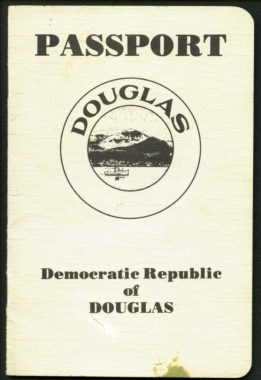
“I know you don’t need a passport to go over the Douglas Bridge, now, so that’s a step in the right direction,” Poor replied in reference to a notorious 1981 prank by the Douglas Lions Club that stopped travelers on the bridge and sold Democratic Republic of Douglas passports to raise money.

In 1981, the Douglas Lions Club created these gag passports for the Democratic Republic of Douglas to give away as gifts during a fundraiser.
In 1981, the Douglas Lions Club created these gag passports for the Democratic Republic of Douglas to give as gifts during a fundraiser. (Courtesy Juneau-Douglas City Museum)

“It definitely stepped on some fingers and hands and whatever. You’re losing your community identity when you’re talking about merging two very competitive towns. But just looking at the overall picture it was probably the best thing for Juneau at the time, and Douglas, because it combined a lot of the forces like, the, you didn’t have two mayors to deal with, you didn’t have two city councils to deal with.

asked how it all come about in the late 1960s. How did one city effectively swallow up another whole?

“Basically you had a vote, and what they did at the time is they combined Juneau and Douglas as one vote instead of allowing Douglas to decide on its own whether it wanted to be part of the one local government,” Poor explained. “They voted it down 4 to 1. We were overwhelmed, so to speak, in Douglas.”

That’s some democracy. 

“So more of an annexation than anything else? Or hostile takeover?”  Brookes asked. “You’d mentioned we don’t need a passport to cross the bridge anymore, to go to the pub or to go to the ice arena to play hockey. Were there armed vigilantes that put a toll up across the bridge after the vote or before the vote?”

“No, I believe it did go to a legal question of whether they could legally do it,” Poor recalled, “but then the courts fell down on the side of unification.

KTOO reporter Jacob Resneck, left, talks with Miles Brookes and Rich Poor on Friday, Feb. 17, 2017, about the Juneau-Douglas consolidation vote for Curious Juneau. (Photo by Tripp J Crouse/KTOO)

Did this help answer this Curious Juneau question?

Brookes said it did.

“I have a better understanding of how Douglas came to be, how Juneau has come to be and I look forward to both communities growing together in my future here in Juneau,” Brookes said. “Hopefully, it’s long and prosperous. Thank you guys for the opportunity.”

And what does Rich Poor think of all this?

“I’m glad you’re doing what you’re doing, because a lot of this stuff gets lost,” he said, “and you tend to lose these local people that lived through it.

Where does a gorilla run for mayor? Juneau, of course.

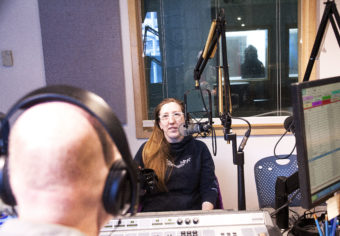
Erin Heist of Juneau talks with KTOO's Matt Miller on Friday, Feb. 3, 2017, about an old rumor that she'd heard of a gorilla running for mayor. (Photo by Tripp J Crouse/KTOO)
Erin Heist of Juneau talks with KTOO’s Matt Miller on Friday, Feb. 3, 2017, about an old rumor that she’d heard of a gorilla running for mayor. (Photo by Tripp J Crouse/KTOO)

Southeast Alaska’s rainforest is home to several species of flora and fauna. It wouldn’t be much of a surprise if some mysterious creature was hiding up in the mountains, rarely making its appearance known.

And just maybe that creature had a political platform to run for the municipality’s top office.

Erin Heist, who works as a state admin officer, wasn’t sure where she heard the rumor, but it ate at her constantly.

Heist moved to Juneau with her family when she was 9. Sometime during high school, she says the rumor struck: A gorilla had ran for mayor in Juneau’s storied past.


Welcome to Curious Juneau, starring you and your questions. Every episode we’ll help you find an answer to your question. This episode we look into the rumors about a Juneau mayoral candidate whose political platform went — bananas. You can listen to the full podcast here:

Heist reached out to Curious Juneau in the hopes of finding an answer. KTOO’s Matt Miller sat down with her in the studio to help her get to the bottom of her mystery monkey mayor candidate.

“I vaguely remember at some point hearing that a gorilla ran for mayor in Juneau, and promised everyone bananas. That was his big campaign promise,” Heist said. “I just want to know if that happened.”

Heist never saw the gorilla, she said. She also wasn’t sure where she heard the rumor. Only when: about 1999 or 2000, she said.

“(My husband) has this saying that I have a degree from MSU, which is making stuff up,” Heist said. “So he’s pretty sure that I made this up, and I feel like 85 percent sure that I didn’t.”

Heist said she thought the gorilla’s political platform was bananas.

“Bananas for everyone,” she said. “Who doesn’t like bananas?”

“I feel like this political year a gorilla running for mayor, promising everyone bananas — that would be the best.”

KTOO's Matt Miller talks to Erin Heist of Juneau on Friday, Feb. 3, 2017, about an old rumor that she'd heard of a gorilla running for mayor. She didn't know it at the time, but the rumors were true. Or mostly true. (Photo by Tripp J Crouse/KTOO)
KTOO’s Matt Miller talks to Erin Heist of Juneau on Friday, Feb. 3, 2017, about an old rumor that she’d heard of a gorilla running for mayor. She didn’t know it at the time, but the rumors were true. Or mostly true. (Photo by Tripp J Crouse/KTOO)

“What would you say if the gorilla was still around?” Miller asked her.

“You mean like happily retired here in Juneau!?” she said.

The studio door shuts. Heist turns to her right.

And screams.

Joe Gorilla, a one-time candidate for Juneau mayor, makes a surprise appearance Friday, Feb. 3, 2017, for Erin Heist of Juneau, who asked Curious Juneau if the rumors of a simian mayoral candidate were true. Joe Gorilla is the sometimes-identity of KTOO funnyman Jeff Brown. (Photo by Tripp J Crouse/KTOO)

Confronted with a 5-foot-plus tall gorilla with black fur, she shouts “Nooooo!!” when a familiar voice speaks to her.

“Hi, How’s it going, Erin?”

It’s KTOO’s programming director Jeff Brown, a master of monkeyshines.

You see, Heist first met Brown in 2000, when she started volunteering for KTOO during her senior year of high school. More recently, the two have frequently worked together for the Alaska Folk Festival.

But she had no idea he was the gorilla.

Brown, a long time Alaskan, has won numerous awards for his humor and entertainment, including a lifetime achievement award from the Governor’s Awards for the Arts.

In 1985, Brown ran an unsuccessful write-in campaign for Juneau mayor. He donned the monkey suit, created the moniker Joe Gorilla. According to an Associated Press story published in the Daily Sitka Sentinel that year, Brown lost to Ernie Polly.

“Is that the actual gorilla outfit!?” Heist asks Brown, looking over the mothballed costume.

It is. But it wasn’t just bananas the one-time mayoral candidate promised everyone, it was banana daiquiris.

“I’d been doing singing telegrams for a number of months, and when the election came around, I just knew I had to run,” Brown said.

And how did he come up with the platform?

“It just came naturally to me,” he said. “It’s a jungle out there!”

The best political platform of the bunch.

Brown says Joe Gorilla still gets write-in votes from time to time.

Election results for Joe Gorilla weren’t immediately available from the municipal clerk’s office for 1985 or succeeding elections.

Municipal Clerk Laurie Sica said in an email that Juneau adopted a policy in 2006 to provide a generic number of votes cast for write-in candidates in the results. To be specifically listed in the results, a person needs to file as a write-in candidate a minimum of five days before the election.

“I can’t wait to tell my husband,” Heist said. “It’s all real. I didn’t make it up.”

Site notifications
Update notification options
Subscribe to notifications