Curious Juneau

Why’d they put the whale way over there?

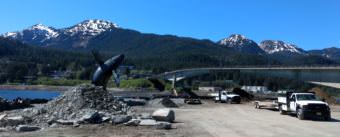
Work continues on the Juneau's Whale Park on May 16, 2017. (Photo by Jacob Resneck/KTOO)
Work continues on the Juneau’s bridge park on May 16, 2017. (Photo by Jacob Resneck/KTOO)

Aaron Woodrow is a commercial fisherman in Juneau. Often he can be found selling fresh seafood off the side of his 38-foot boat in Harris Harbor.

“I drive up and down the channel a lot fishing and so I see the whale as I go by and when I’m coming in, you can’t really see it with the naked eye until you’re just about to it,” Woodrow said.

Which led the mariner to wonder why the city chose to put the new bronze whale sculpture in a location that only seems visible from the Douglas Bridge or the Breeze Inn parking lot in West Juneau.

“I think most people seem to think it was going to go up on the island that was being constructed where it would’ve been visible from the highway. Unless you have binoculars coming up the channel, you wouldn’t even know it was there.”


Curious Juneau stars you and your questions. Every episode we help you find an answer. Catch up on past episodes, or ask your own question on the Curious Juneau page.

Listen to the podcast version here:

To try and answer Mr. Woodrow’s question I paid a visit to the city’s engineering department.

“Well, there’s always a lot of questions and obviously how it ended up there was a long process,” said Skye Stekoll, a city engineer.

The original whale committee had proposed the sculpture to be downtown in Marine Park. But the whale park isn’t just a 6-ton piece of bronze that towers 25 feet skyward. There will also be a pool of water around it.

So engineers pushed back.

“One of the problems we came to when we tried to look at the downtown area like Marine Park is you know, the size of the whale – sure if it was just the whale by itself it could fit in – but with the pool infrastructure it became large enough that essentially it’d be the entire Marine Park and it wouldn’t have a lot of usable space,” Stekoll said.

So how about down near where the cruise ships dock?

“Those areas are already dominated by seasonal tourism and that would not be good location for Juneau citizens,” said City Manager Rorie Watt, who headed the engineering department back then.

A whale park could get cluttered amid T-shirt shops. The whale committee looked further north.

“The other areas on the waterfront are controlled by the Mental Health Trust, so we didn’t control the land, or they are city tidelands that are not filled and would take a long time to develop,” Watt said. “The bridge park really was the best location.”

And the artificial island? There are no utilities out there. Running power and water out there would get expensive. Not to mention it would need more permits from the U.S. Army Corps of Engineers.

It turns out there isn’t as much free space on Juneau’s waterfront as one might imagine.

Artist R.T. “Skip” Wallen is the guy who sculpted the whale.

“I think it’s a good site. … This sculpture requires some room. Because it’s so tall,” Wallen said, speaking from his studio in Florida. “It requires space enough around it so that people can get back a bit from it. So it can’t really be shoehorned into a small space.”

Then there’s another consideration: lighting.

“Because the sun arcs over Douglas Island, items on the waterfront tend to be backlighted,” Wallen said. “In its current site in the early morning and again in the late afternoon, the whale gets some light on its front face – the side that most people will be viewing.”

The city is being sued by the cruise ship industry over its use of marine passenger fees for the seawalk and whale park. That’s still playing out in federal court.

The whale park site is still mostly a muddy building site. Work is progressing slowly around the solitary humpback whale sculpture.

Portions of the seawalk should be opening in coming weeks, though the whole park with its elaborate water features won’t be ready until next spring.

No public funds went into the whale sculpture – it was paid for through donations.

There is sales tax and marine passenger fee money going into the infrastructure around it, so Juneau taxpayers and cruise ship passengers are paying for much of the project.

I press Aaron Woodrow a bit to see if he’s just a whale hater.

“But you do like the sculpture itself, though?” I asked.

“I think the whale sculpture is awesome,” Woodrow said. “I don’t think anyone would deny that it’s a pretty amazing piece of art. But I think they could’ve chosen a better location for it.”

The city’s staff is appealing for patience for when it’s finally done.

“I think when we’re finished, people are really going to enjoy it and they’ll forget there ever was a controversy,” Watt said.

Optimistic talk from a city manager. We’ll check back in a year’s time.

100 years after China Joe’s death, Juneau historian remembers immigrant pioneers protected

Mark Whitman talks about the life of China Joe, a Chinese immigrant who settled in Juneau and was the only Chinese person in the city after a mob ran all the others out of town.
Mark Whitman tells Kathy Buell about the life of China Joe, a Chinese immigrant who settled in Juneau and was the only Chinese person in the city after a mob ran all the others out of town. (Photo by Tripp J Crouse/KTOO)

Mark Whitman has an annual tradition on May 18, the day a prominent Juneau man died. He goes down to Evergreen Cemetery, finds a specific grave marker, and smokes a cigar. He’ s remembering how the generosity of a person known as China Joe had such a huge impact over our early city.

Curious Juneau stars you and your questions. Every episode we help you find an answer. Catch up on past episodes, or ask your own question on the Curious Juneau page.

Listen to the podcast version here:

Whitman has lived in Juneau for much of the last 37 years. He’s researched China Joe for about 20 years, and is largely responsible for the State Library, Archives and Museum’s small collection on him.

His interest began in the former Biliken Bar on Douglas when he found a photo of a Chinese man smiling. Fair warning: Whitman uses term considered offensive when he recalls Joe’s life.

“I probably had one drink too many and I looked over and I saw that photo of and felt like there was a Chinaman smiling at me,” Whitman said.

China Joe lived a life of generosity during his time in America. That generosity endeared him in the hearts of Juneau’s early pioneers enough to save him from a rabid, anti-Chinese mob.

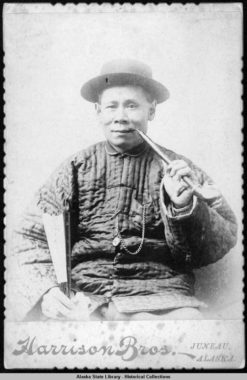
China Joe smokes a pipe and holds a fan in this gold rush era studio portrait.
China Joe smokes a pipe and holds a fan in this gold rush era studio portrait. (Photo courtesy
Alaska State Library, Early Prints of Alaska Photo Collection, ASL-P297-118)

Whitman’s take on Joe is based off of old newspaper clippings and legal documents. He said Joe was part of a larger immigration wave of Chinese workers that came to America in the 1800s. Many were fleeing turmoil and rebellion in their home lands, and came to America to make a better life with the hopes of returning one day or sending money back to their families.

Whitman said the American West was expanding. Railroads needed labor to expand, and an influx of Chinese provided plenty of it.

“There weren’t a lot of people who were willing to climb into a straw basket and be hung over a cliff of black granite with dynamite to blow the passage for the railroad to get through,” he said. “The Chinese did that and did the work that no other person would do.”

Whitman said China Joe came to North America in 1864, arriving in Victoria, British Columbia. Joe later moved to Boise, Idaho, where he learned Western cooking and baking.

In 1874, Whitman said, China Joe was working in a mining camp at Dease Lake during the Cassiar gold rush, when tragedy struck. The river froze and no steamboats were unable to deliver supplies.

“A horrible winter hit, … 60 below zero, no food is going to make it up there. The men knew they were probably going to starve.”

Whitman said China Joe called a meeting in the camp.

“He told every man, ‘You can have flour, all you need till spring. I’m not marking the price up, when you get the money in the spring you can pay me back then.’ Everyone was all the same to him, he basically made sure that they made it through that winter.”

Whitman said in 1878, he moved to Wrangell. He had a riverboat named Hope on which he built a boarding house. He later moved to Sitka and ran a bakery.

“That’s the same pattern he followed when he got here,” Whitman said.

In 1881, Joe moved to Juneau, where he opened the city’s first bakery on the corner of 3rd and Main streets.

“He knew Western cooking,” Whitman said. “He’d fit right in with artisan baking today. He had a brick oven built, he was baking sourdough bread on a three-day cycle in that oven which was connected to his log cabin there.”

And the tales of Joe’s generosity grew.

“I think what’s important to see is that China Joe associated himself with the first circle of Juneau. … Every Chinese New Year, China Joe would open up his log cabin for three days. He would have food laid out in a buffet, everything from roast beef to chicken to special candied ginger from China. He’d also lay out Cuban cigars, and it didn’t matter if you were man or woman, you could come in.”

Whitman said Joe loved to give the schoolchildren cookies.

“In a way over the years, China Joe truly has belonged to us. I’m not saying as a possession, but the generosity,” Whitman said. “It’s the idea that when you have something and people are suffering, you share with them. He learned that from China forward.”

Joe’s generosity and adherence to the Golden Rule very well could have saved his life. During the expansion in the American West, the sentiment toward Chinese immigration soured.

“After the railroads were built we went into an economic panic or depression. An easy scapegoat was to say it was the Chinese. So they passed the Exclusion Act of 1882 and they started to cut their pigtails off and shoot them and do all kinds of horrible things after they had built the railroads for us.”

The Chinese Exclusion Act was the culmination of the anti-Chinese attitude that swept through the Lower 48 and into Alaska. The act prevented Chinese from immigrating to the U.S. Riots such as one in Rocksprings, Wyoming, turned violent.

Mark Whitman shows Kathy Buell a collection of images documenting the life of Chew Chung Thui, more commonly known as China Joe. Joe was a Chinese immigrant who settled in Juneau and owned a bakery. In 1882, Congress passed the Chinese Exlusion Act, suspending Chinese immigrants for 10 years, and an anti-Chinese sentiment ran all but Joe out of town. (Photo by Tripp J Crouse/KTOO)
Mark Whitman shows Kathy Buell a collection of images documenting the life of Chew Chung Thui, more commonly known as China Joe. Joe was a Chinese immigrant who settled in Juneau and owned a bakery. In 1882, Congress passed the Chinese Exclusion Act, suspending Chinese immigration for 10 years, and an anti-Chinese sentiment ran all but Joe out of town. (Photo by Tripp J Crouse/KTOO)

“Lots of Chinese were killed,” Whitman said. “A lot of conflict between the Irish railroad workers and the Chinese, and that spilled over with the miners here. Every Chinaman who was in Juneau in 1886 was shoehorned on to two schooners at gunpoint, and told to leave or be killed,” he said. “But there was one Chinaman, China Joe, who members of the community said, ‘You leave Joe alone, he belongs to us.'”

And so friends and family stood up for Joe, who became the only Chinese person in Juneau.

China Joe went on to live in Juneau until his death May 18, 1917. Whitman says police officers found him lying in bed on a blanket with his arms folded over his chest. He died of heart failure.

“In a land of treasure seekers, China Joe’s life remained a compass of true fortune, a generous heart that outweighs a mountain of gold,” Whitman said.

Whitman and local author Brett Dillingham had kept China Joe’s story alive in the past, performing a play about him they’d written. That play’s come and gone, but Whitman said now, Dillingham is working on a book about China Joe.

The grave marker for China Joe is located in the pioneer section of Evergreen Cemetery in Juneau. (Photo by Tripp J Crouse/KTOO)

Whitman says China Joe had several different names during his lifetime. The one on the bronze grave marker where Whitman will be smoking his cigar is Hi Chung. It’s in the pioneer section of the cemetery.

Franklin Street named after early prospector who later settled in Interior

Franklin Street is one of the oldest streets in Juneau, but how it got its name is a mystery to many. (Photo by Tripp J Crouse/KTOO)

A street in Juneau is a popular locale for residents and tourists alike. South Franklin Street particularly is home to several bars, shops and a rich history.

For many, Franklin is iconic. But where the street gets its name is a bit of a mystery that one resident asked us to look into.

“I walk up and down it every day,” said Allison Eddins, who moved to Juneau 2½ years ago and works as a city planner. “It’s the heart of the historic district.” 

“I feel like I know a fair amount about Juneau’s history,” Eddins said, “but where some of these streets got their names has always been a little bit of a mystery to me. So, I decided it would be a good question to pose to you guys, specifically about Franklin Street,” she said.

We asked Jody DeBruyne, curator of collections and exhibits for the Juneau-Douglas City Museum.

Jodi DeBruyne, curator of collections and exhibits for Juneau-Douglas City Museum, pulls items from the museums collections on April 14, 2017. (Photo by Tripp J Crouse/KTOO)
Jodi DeBruyne, curator of collections and exhibits for Juneau-Douglas City Museum, pulls items from the museum’s collections on April 14, 2017. (Photo by Tripp J Crouse/KTOO)

“Franklin Street was named after Howard Franklin,” DeBruyne said, consulting The Centennial Gazetteer’s “A Guide to Juneau Alaska Place Names.” “He was a chairman of a committee appointed at the miners meeting on March 21, 1881, to lay out the city’s streets and lots.”


Curious Juneau stars you and your questions. Every episode we help you find an answer. Catch up on past episodes, or ask your own question on the Curious Juneau page.

Listen to the podcast version here:

Franklin first appears in Juneau records on Feb. 24, 1881, when he and five other men staked a group of placer claims on Specimen Gulch in the Gold Creek Valley.

Franklin the man came to Juneau from British Columbia, and engaged in mining in the Silverbow Basin for several years.

According to Robert DeArmond’s book “The Founding of Juneau,” J.M. Cooper and Frank McMahon also were named to the committee. That committee laid out Main, Seward and Franklin streets, the cross streets and established the blocks at 200 square feet.

The Franklin Street name first appeared in local records on April 4, 1881.

“He later went to the Interior and he was reported to have been the first man to discover gold in the Fortymile country, where the Franklin Gulch is also named after him.”

It’s a mystery why Franklin’s name was chosen for one of the streets, and not one of the other men.

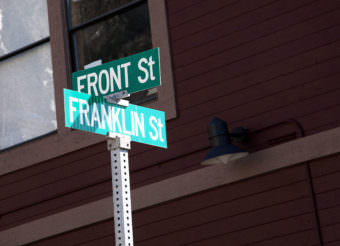
DeBruyne says the downtown Juneau then would have looked vastly different from today: Front and Franklin streets bordered the waterfront. Today that area has been filled in and built upon.

But in 1881, one property owner almost derailed the committee’s plan for plotting out downtown Juneau.

“When they were looking at lots and things, a man named N.A. Fuller’s lot was squarely what was to become Franklin Street at its present intersection with Front Street and refused to vacate,” DeBruyne read from DeArmond’s book. “As a result that portion of Franklin was not cut through to the waterfront until the mid-1890s, the last five lots were along what is now South Franklin.”

In its early days, Franklin Street almost ended at Front Street because one person refused to give up a lot, so the thoroughfare could be extended to the waterfront. (Photo by Tripp J Crouse/KTOO)
In its early days, Franklin Street almost ended at Front Street because one person refused to give up a plot of land, so that the thoroughfare could be extended to the waterfront. (Photo by Tripp J Crouse/KTOO)

Franklin almost ended at Front Street. Because of one guy.

“So it wasn’t until a few years after Franklin Street got named that it actually reached all the way down to the waterfront, because somebody refused to give up his spot,” DeBruyne said.

According to The State of Alaska Guide, Fuller was from Sitka, and in spring 1880, he urged Joe Juneau and Richard Harris to investigate a prospect around what’s now known as Gold Creek.

Those miners, of course, went on to found Harrisburg, which was later renamed Juneau.

Franklin Street’s past is just as storied.

“It was the prostitution district. I think probably most people know that but it’s one of those kind of fun facts,” DeBruyne said. “Right there where the cruise ships dock and we greet people with jewelry stories today was a different kind of greeting back in the day.”

According to the Dawson Daily News, Franklin died of heart failure in 1904. He was 65. Franklin was buried in Dawson, Yukon.

Two buildings along South Franklin Street are on the National Register of Historic Places: the Alaskan Hotel and the Alaska Steam Laundry building.

Who was Calhoun Avenue named for?

Our next question takes us about a half-mile northwest, up the hill. Another question-asker pondered the origins of another somewhat famous street: Calhoun Avenue.

He wanted to know if the street was named after John C. Calhoun, the statesman and political theorist in the early 1800s.

Juneau’s Calhoun Avenue is named after a different Calhoun altogether.

Jody DeBruyne is the curator of collections and exhibits for the Juneau-Douglas City Museum. (Photo by Tripp J Crouse/KTOO)

DeBruyne helped me dig into that street’s history.

The road was a narrow cart track carved out of the steep western slope of Bonanza Ridge, according to a 1988 article by Robert DeArmond on Juneau Public Libraries website. It gave early residents easy access to the Evergreen Cemetery.

“It was renamed for Mary V. Calhoun, an early resident of the area,” she said. “Her and her husband, John, arrived in Juneau from Wisconsin in 1888, and they established a dairy that was on Calhoun Avenue, right around where the governor’s mansion is.”

Their cows grazed along Gold Creek, the south bank of which was sometimes-called Calhoun Flats.

“They were there until they moved south in 1902 and sold their dairy,” she said. “There’s not much that I could find on either Mary or John, but one of the references that I found said that she was so well liked that they renamed the street for her.”

John died in Seattle in 1906. Mary died in Nanaimo, British Columbia, in 1912.

Why aren’t there strip clubs in Juneau?

One Juneau visitor's Super Bowl tradition prompted him to wonder why Juneau doesn't have any strip clubs? Photo of eXXXotica Miami 2010 on May 15, at the Miami Beach Convention Center. (Creative Commons photo by brh_Images)
One Juneau visitor’s Super Bowl tradition prompted him to wonder why Juneau doesn’t have any strip clubs? Photo of eXXXotica Miami 2010 on May 15, at the Miami Beach Convention Center. (Creative Commons photo by brh_Images/Flickr)

Ashwin Kiran was visiting Juneau in February when he noticed something was missing from the local entertainment scene.

A few weeks later, we brought him into the studio to chat.

“Why are there no strip clubs in Juneau?” he wondered aloud. 

Curious Juneau stars you and your questions. Every episode we help you find an answer. Catch up on past episodes, or ask your own question on the Curious Juneau page.

You can listen to the full podcast here:

His question came to him on the eve of Super Bowl Sunday.

“One of my traditions was my buddies and I, at least in Indianapolis, went and watched the Super Bowl at strip clubs,” he explained. “Only because it was the only place we could actually sit down and focus on the game where there wouldn’t be any other people.”

“Were the strippers stripping while the game was going on?” I asked. I couldn’t resist.

“Most of the time they came over and watched with us because we were the only ones there,” he said. “It wasn’t like we were paying for dances and watching the Super Bowl at the same time.”

Full disclosure: Ashwin and I know each other.

We’ve actually been dating for two years, and I played a supporting role in his Curious Juneau question. Back in February, when we were figuring out where to watch the Super Bowl in Juneau, and I joked that we could watch it in a strip club as an “homage” to Ashwin’s days as a single man.

But, we couldn’t find a strip club!

We took some time to speculate, drum up leads, and, of course, do a Google search.

Nothing. At least, nothing that would give us a straight answer. So, we started with a theory of mine.

“I think there could be something in statute that prohibits strip clubs,” I said. 

I called the state Department of Labor and asked them to explain any and all regulations around strip clubs in Alaska.

Turns out, there aren’t any. They said it’s a local issue.

So I marched over to city hall to get the real story. They sent me to the clerk’s office, which sent me to the permitting office.

That’s where I met Allison Eddins, who works at the Juneau Planning Department. She didn’t have an immediate answer but said she would get back to me.

A few days later, she left me a voicemail.

“Legally the city is not allowed to restrict strip clubs. We can dictate where they go, but the city can’t say no adult entertainment,” she explained. “Um, and it turns out that Juneau does have a sometimes-strip club, which is at The Viking bar downtown.”

A sometimes-strip club? I had to investigate.

I went to The Viking on a Saturday about 11:30 at night. The place hadn’t transformed into a full-blown strip club, but rather a club with some strippers.

One of those strippers was Rachael Byrd, who goes by “Lucy” when she’s on stage. She runs a company that brings strip shows to The Viking and a few other bars in town.

Rachael Byrd runs Byrdcage Promotions, a company that brings strip shows to bars in Juneau. She’s also a dancer herself. (Photo by Tripp J Crouse/KTOO)

I asked her how often she does this.

“You know I think it’s roughly once every few months or so,” she said. “A few times they’ve come down from Anchorage and other places they’ve come from is Texas, and California, Colorado, and also Florida.”

Rachael is quite a history buff. In fact, her interest in adult entertainment stems in part from reading about the history of sex work in Alaska — everything from burlesque to prostitution.

“I spent like the last day and a half doing archival searches on interesting historical factors that probably gave Juneau its leaning,” she told me as we sat down for an interview. 

Rachael Byrd says a negative reception to stripping and strip clubs likely shaped Juneau’s attitudes toward that form of entertainment. (Photo by Tripp J Crouse/KTOO)

She unzipped her bag and pulled out a piece of paper that had been scribbled on. It was a list of historical events she wanted to discuss. We got right to it.

“There’s temperance, of course,” she said. 

Temperance and the criminalization of prostitution were part of the early progressive movement, a widespread effort to reform society that lasted from the 1890s to the 1920s in most parts of the country. But prostitution didn’t go down without a fight in Juneau.

“There’s that red-light district in the 1955-1956 era where something happened in downtown Juneau where that was closed off.”

While other states outlawed prostitution in the early 1900s, it remained legal in Alaska until the mid-’50s. The U.S. government ordered it to stop in 1954.

The string of brothels on South Franklin Street, known as “The Line,” closed down. But the industry continued for two years until a scandal erupted.

Public officials had been quietly condoning the industry due to the immense political power of saloon and brothel owners.

Now, neither Rachael nor I am a historian, and stripping is not the same as prostitution, but we agreed that this not-so-distant history has probably shaped Juneau’s attitudes toward strip clubs to some degree.

“It’s possible that they slowed the growth of it … is what I would say best fits,” she said.

I asked her, “If you had to give an explanation, would you have one for why you think there aren’t any strip clubs right now in Juneau?”

“I think it’s a possibility that business owners are scared to have that association because it seems like there’s some possibility they could have negative reception,” she said. 

This was something I heard from others as well.

I spoke with the owner of the Viking, as well as a few other bar owners downtown.

None wanted to go on the record, but they all alluded to the same thing: they thought that doing it out in the open would draw criticism and possibly damage their reputations.

They also said the social backlash could result in regulations. The industry enjoys some of the most lenient rules in the country.

But, it wasn’t just them. Almost every person I spoke with for this story hinted at the social consequences in one way or another.

So it’s possible that the brand of progressivism that led to Juneau’s reform is still alive and well today. But, apparently, so is the spirit of Juneau’s red light district.

DOT artillery defends Thane Road from avalanche threats

Melissa Griffiths of Douglas walks her dog, Beau, on Sandy Beach, where she has a great view of the Thane avalanche chute across Gastineau Channel.

“I know that the state blasts a howitzer, and I was wondering, who does that and are there specialized skills that you need?” Griffiths asked.

Curious Juneau stars you and your questions. Every episode we help you find an answer. Catch up on past episodes, or ask your own question on the Curious Juneau page.

Alaska’s Department of Transportation operates the howitzer to protect Thane, a community of about 60 houses 5 miles south of downtown Juneau.
“The only way to Thane is on Thane Road and we have to drive through some avalanche chutes to get here — and so that’s just a given,” said Larri Irene Spengler, who is active on the board of the Thane Neighborhood Association.

That’s right: one way in and if an avalanche strikes, no way out.

Her husband, Steve Behnke, recalled a February 2009 avalanche that left him stranded in Juneau while his family was home in Thane.

“It makes you real aware of that mountain, ya’ know?” Behnke said. “It just makes it real because so much of the time we just drive back and forth and don’t pay full attention.”

DOT’s solution is gunning down the avalanches before they build up large enough to threaten the road.

On a recent afternoon, a crew is waiting for Juneau’s air traffic control tower to clear the airspace

“Are we gonna shoot?”

“They’re clearing the air … so I guess they’re gonna start now.”

“The last time we got one on our first shot and everyone got all excited and it brought a lot of snow down — after that nothing happened,” said Scott Gray, DOT’s operations superintendent for the Southeast District.

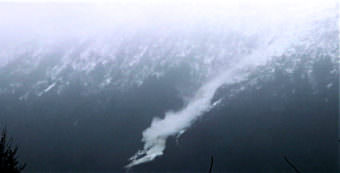
They fire the first shots. Within minutes, the snowpack begins to give way.

“There’s a nice little dump of snow there,” Gray said. “That was a nice one.”

More shots are fired.

Every two minutes the howitzer roars as an artillery shell is lobbed 3 miles across Gastineau Channel.

More snow cascades down. It’s effect is mesmerizing — almost hypnotic.

“It’s kind of interesting to watch,” Gray said. “The powder leaves the air — it’s like a waterfall just coming down — it’s pretty.”

The howitzer has triggered a slide to prevent a a larger, uncontrolled avalanche that could swallow up Thane Road.

A few days later DOT offers a closer look at the howitzer.

Casey Walker is DOT’s maintenance foreman in Juneau. He explains that the howitzer belongs to the U.S. Department of Defense.

“It’s pretty much like a big rifle,” he said. “This is your breach block. The bullet goes in and you close the breach behind it and then your triggering mechanism is just your typical rope pull.”

Military regulations only allow a handful of authorized people near the gun when it’s assembled and loaded.

“It’s a military weapon and we use it for avalanche mitigation strictly, and so they want to make sure that it doesn’t fall into the wrong hands, number one,” Walker said. “And number two, it is operated and maintained the way that the military expects it to be.”

A master gunner is always part of the DOT firing crew. It takes 10 years to reach that certification.

The rest of the crew are checking each other’s work to make sure the howitzer is sighted accurately to one of 24 pre-selected target points.

“We have a guy on each side of the gun. We plug in the coordinates. We have a guy that loads, he loads the gun and then he double checks everything,” Walker said. “And then the guy on the left-side of the gun triple checks everything and then we do our all-clear and make sure everything’s good to go and fire a round.”

JACC sports new paint thanks to Anchorage graffiti artist

A woman enters the Juneau Arts & Culture Center on Wednesday, February 15, 2017. Will Kozloff's unfinished mural can be seen on the outside the JACC's exterior. The Anchorage artist was invited to Juneau to work on set pieces for the Goveror's Awards for the Arts in January. (Photo by Tripp J Crouse)
A woman enters the Juneau Arts & Culture Center in February. Will Kozloff’s unfinished mural can be seen on the outside the JACC’s exterior. The Anchorage artist was invited to Juneau to work on set pieces for the Governor’s Awards for the Arts in January. (Photo by Tripp J Crouse/KTOO)

Welcome to Curious Juneau, starring you and your questions. Every episode we’ll help you find an answer to your question. This episode we look into the street art mural on the JACC. You can listen to the full podcast here:

I see her sometimes in the morning while I’m walking to work. My commute-by-foot brings me down the steps along Fireweed Place, past Bullwinkle’s Pizza, and by Centennial Hall. And, then, I see her.

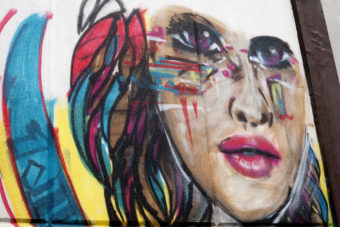
We lock eyes for a moment. She’s a 16-foot-tall mural next to the JACC’s entrance.

“Our Lady of Perpetual Evolution.”

In her current state, the mural is a portrait of a young woman wearing a black top. She has multi-color hair, and a detailed neckline that features triangles and small red circles. The words “Our Lady of Perpetual Evolution” are scrawled in a turquoise street tag across her right shoulder, with the word “perpetual” spilling over her flesh-toned chest. Most striking are the streaks of primary colors under her eyes, and her full red lips.

It caught Megan Ahleman’s eye, too. She was leaving Centennial Hall after an event when she saw it. (Megan Ahleman is married to a 360 North employee and occasionally works for us on television productions.)

“It looked like it was in the early phases, but it looked like there was a face coming to fruition,” she told Curious Juneau.

Anchorage artist Will Kozloff was chosen by the Alaska State Council of the Arts and the Alaska Humanities Forum to do the set pieces for the Governor’s Awards for the Arts in January.

Kozloff said the wall was the product of having idle time.

“I’m looking at my schedule and I found one weird, spare day in my schedule for the time I was in Juneau,” Kozloff said. “I was asking around for a wall to paint. … Nancy from the JACC, said, ‘We have a wall!'”

Will Kozloff pauses during a workshop with the Juneau Arts and Humanities Council. (Photo by Annie Bartholomew/KTOO)
Will Kozloff, 31, of Anchorage, pauses during a workshop with the Juneau Arts and Humanities Council. (Photo by Annie Bartholomew/KTOO)

So the 31-year-old began work on the mural that caught Ahleman’s eye.

Kozloff doesn’t usually sketch his work out before hand. Sometimes, like in this case, he uses pictures of friends as a creative jumping off point.

“For this one though, I drew up a general idea of what I was going to be doing, and then just kind of like diverted a little bit from there, but still kind of stuck with where I was going.

Kozloff wasn’t prepared for the elements when he began painting in Juneau, he said.

“This is my first time actually being in Juneau before, so I enjoy you guys’ warm weather but I was not prepared for the dampness that is just everything. … So I was like ‘OK this might take longer than just one day.'”

Kozloff is able to travel with his spray paint caps, but he isn’t able to fly with aerosol cans. He has to buy his paint locally.

“The paints – there’s a difference between paint in Juneau, and paint in Anchorage, and paint in the Lower 48,” he said. “Lower 48, it’s all fancy, laser beam paint, you know, that … it handles, like, the pigments even out by themselves. In Anchorage we have decent paint, not perfect.”

“Going to Juneau, it was just me hitting up Fred Meyer and just scooping up a bunch of $3 and $4 cans and going out and doing two or three layers to get the color and opacity that I was aiming for.”

A woman enters the Juneau Arts & Culture Center on Wednesday, February 15, 2017. Will Kozloff's unfinished mural can be seen on the outside the JACC's exterior. The Anchorage artist was invited to Juneau to work on set pieces for the Goveror's Awards for the Arts in January. (Photo by Tripp J Crouse/KTOO)
Detail of Will Kozloff’s unfinished mural on the JACC’s exterior. (Photo by Tripp J Crouse/KTOO)

He has spent eight years working on his art.

Kozloff has made his living off his painting for the last eight months. Graffiti is his primary medium.

“It’s the only one I know: I can’t draw, I can’t paint,” he said. “It’s partially ’cause I have some red-green color blind issues so a lot of the things like mixing colors just doesn’t work out for me.” 

“Mostly with spray paint it’s all single color, so you’re working with a limited palette and the name of the color is usually on it,” Kozloff said. “There’s a couple of blacks that look blue to me, or whatever. So, I’m just trusting the can.”

But sometimes, particularly when he’s closer to home, Kozloff has some help.

“My 3-year-old, he’s not color blind so I’d have him, and he rolls with me for almost all my gigs, except for the Juneau one: He’s my color guy,” Kozloff said. “I’m like, ‘Is this yellow or is this brown?’ So I let him take care of all the color differentiation.”

Kozloff says he plans to spend about a week in Juneau sometime after April to finish the JACC piece, and possibly work on some other walls as well.

“I actually have to go back and finish it up and maybe expand a bit, because for some reason I thought I could get a 16-foot painting done in one day,” he said

See photos from the Kozloff’s workshop:

Site notifications
Update notification options
Subscribe to notifications