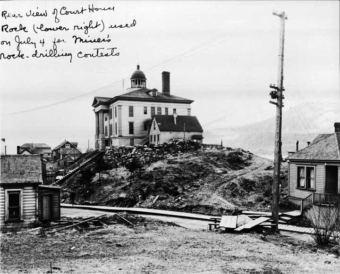
The Juneau Courthouse on April 29, 1922. In Alaska’s territorial days, Juneau was the site of three legal executions. Seven years after the last man was hung, the territory banned capital punishment. (Photo used with permission from Alaska State Library Photo Collection, P01-1073)
A man accused of murdering his wife aboard a cruise ship in Southeast Alaska waters could face the death penalty. But it’s a long process and it may be unlikely to end in the defendant’s death.
In July, Kristy Manzanares was found dead in the couple’s cabin aboard the Emerald Princess. They were on an Alaska cruise celebrating their wedding anniversary.
According to court records, her blood was everywhere, including on her husband. The cruise ship diverted to Juneau, docked, and federal authorities investigated the scene and interviewed more than 100 witness.
Curious Juneau stars you and your questions. Every episode we help you find an answer. Catch up on past episodes, or ask your own question on the Curious Juneau page.
Federal Public Defender Rich Curtner has been with the District of Alaska office since 1992.
“Somebody can be charged with murder in the first degree, but before the government could seek a death penalty at sentencing, they’d have to go through this process where the Department of Justice would have to authorize it,” he said.
Curtner, who is also the board president of Alaskans Against the Death Penalty, said that process can take two to three months. The U.S. Attorney’s office investigates and makes the final decision.
Curtner’s office is representing Manzanares, so he couldn’t speak about that case specifically, but he said the death penalty has been authorized in just a few Alaska cases since he became a federal public defender here. But they were all resolved without the death penalty.
As a state, Alaska has never had capital punishment available at criminal sentencing. You have to go back to the end of the territorial days under federal jurisdiction to find the last person executed.
In the early 1990s, some lawmakers tried unsuccessfully to establish a state death penalty. Averil Lerman, then a civil attorney, was inspired to research the history of executions in the territory. An interest in the case of the last man put to death in territorial Alaska prompted her to find out more.
She later became a criminal defense attorney and specialized in examining convictions and writing appeals.
“I learned many things that helped inform my feeling about what had happened to the last man. I did an oral history of the death penalty in Juneau,” she said. “There were three executions in Juneau in 1939, 1948 and 1950.”
When Lerman retired after practicing law in Alaska for more than 30 years, she devoted more time to researching. The racial demographics of those executed troubled her.
“The fact is that after 1902, all of the people who were executed in Alaska were either racial minorities or ethnic minorities.”
Lerman said prejudice and poor legal training on the part of the defense lawyers were mostly to blame. She said the lawyers just weren’t very good at writing appeals.
Three men were hung in Fairbanks in the 1920s. But after that, the 4th Judicial District didn’t put anyone else to death. The last man executed in the territory was in Juneau in 1950
Seven years later, the territorial Legislature banned capital punishment.
“I think that one of the things that suggests is that in small communities there’s a learning curve about the death penalty and what it feels like to have it, and implement it and to have it live in your town,” Lerman said.
The Emerald Princess is moored Wednesday, July 27, 2017, at the S. Franklin Street Dock in Juneau. (Photo by Tripp J Crouse/KTOO)
Fast forward to today, and the death penalty is again being considered for a case in Alaska.
It would be good to note that Alaska does not have a death penalty.
But if Alaska doesn’t have the penalty, how can the Manzanares case be eligible?
The alleged murder happened in territorial waters, so it’s under federal jurisdiction. And while Alaska doesn’t have the death penalty, federal capital punishment is legal.
If the alleged crime had happened while the ship was docked, the death penalty wouldn’t be an issue, because the state would have jurisdiction.
Since 1963, only three men have been executed under federal jurisdiction in the entire country. Timothy McVeigh, for example, was one of them. He was convicted and sentenced for the 1995 Oklahoma City bombing.
As of January 2017, there were 63 inmates on federal death row. They include convicted Charleston church shooter and white supremacist Dylann Roof and convicted Boston Marathon bomber Dzhokhar Tsarnaev.
Kenneth Manzanares is being held at Lemon Creek Correctional Center in Juneau. His next hearing is scheduled for Nov. 29.
Headline and excerpt of Jan. 23, 1909, article in Alaska Weekly Transcript.
Many people are familiar with the story of Robert Stroud, one of the country’s most famous inmates of the last century, and how he spent over half his life in solitary confinement and gained fame for his careful study of birds and bird diseases.
But many people probably don’t know that Stroud was initially sent to prison for a murder he committed just a few short blocks away from the present-day Alaska State Capitol in downtown Juneau.
Author Thomas Gaddis wrote about Stroud in the 1955 book “Birdman of Alcatraz,” which was adapted into the 1962 movie of the same name starring Burt Lancaster.
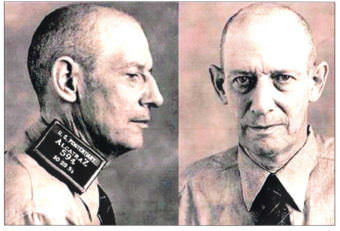
Mugshot of Robert Stroud at Leavenworth circa 1912 (Kansascity.com via Juneau-Douglas City Museum)
Originally incarcerated at McNeil Island in Washington in 1909 for the first of two murders, Stroud spent his adult life in the federal prison system, including well over four decades in solitary confinement.
While incarcerated at Leavenworth prison in Kansas, Stroud took in a few birds and nursed them back to health. That led to a small cottage industry of bird care remedies, and one of the first and most widely regarded books on bird diseases and bird care.
Stroud was forced to end his study of birds when he was transferred to Alcatraz in San Francisco. But that didn’t deter Gaddis from using it as a cool title for his book.
Mugshot of Robert Stroud at Alcatraz (Alcatraz via Juneau-Douglas City Museum)
The movie takes a few liberties with some facts and glosses over some of Stroud’s character flaws.
In this edition of Curious Juneau, an anonymous listener writes “I want to know the address where the Birdman of Alcatraz, Robert Stroud, committed the murder that got him sent to Leavenworth.”
Well, I think I know.
Curious Juneau stars you and your questions. Every episode we help you find an answer. Catch up on past episodes, or ask your own question on the Curious Juneau page.
Robert Stroud met his girlfriend Kate Dulaney in Cordova in 1908. Dulaney, also known as Kitty O’Brien, was a dance hall girl among her occupations.
A few sensational accounts paint Stroud as Dulaney’s pimp. But Stroud was only 18 years old and, according to Gaddis, completely inexperienced with women until he met Dulaney. She was twice his age and probably bonded with Stroud when she nursed him back to health after a bout of pneumonia.
Stroud and Dulaney left Cordova and followed one of Dulaney’s acquaintances to Juneau. Charles Damer had become a bartender at the Montana Saloon.
He would also become Stroud’s first victim.
Stroud eventually pleaded guilty to the crime. Since Stroud never stood trial, there was never a trial record.
So, I needed to come up with other ways to pinpoint the scene of the crime.
Over the course of two months, I carefully examined boxes of 109-year-old court records, old newspaper microfilm reels, and city and state archives.
Where did the murder happen in Juneau?
Excerpt of Juneau Townsite Historic Building Survey produced in 1988 lists the Dickinson House at Fourth and Gold streets. William Dickinson lived in a house adjacent to a house occupied by murder victim Charles Damer.
1910 Census appears to shows William Dickinson and his wife Clara living near the corner of Fourth and Gold.
Excerpt of Jan. 23, 1909 article in Alaska Weekly Transcript.
Excerpt of Jan. 19, 1909 article in Daily Alaska Dispatch.
Excerpt of March 14, 1995 article by Robert DeArmond.
Excerpt of June 9, 1978 article by Robert DeArmond.
Several important items turned up.
Two different sets of newspaper articles were published by the Daily Alaska Dispatch and Alaska Weekly Transcript days after the murder in late January 1909. There also were 1904 and 1914 fire maps of the downtown area, a 1910 census record, and a 1988 Juneau Townsite Historic Building Survey. Digital Bob, the online archives of historian and writer Robert DeArmond, also had important clues.
I asked Leo Helmar to serve as another set of eyes, look over my research, and help me walk through the story. Helmar is a paralegal at the City and Borough of Juneau’s Department of Law. He also just started a podcast called “Murder Alaska.”
“A lot of the things about Robert Stroud have sort of passed into the realm of myth,” Helmar said. “Like the fact that he’s called the Birdman of Alcatraz is not accurate at all, for example. He didn’t have birds at Alcatraz.”
During our walk through downtown Juneau, Leo and I compared old photographs of Front Street (click on the locations in the map below) and determined the Montana Saloon, where Damer worked, may have been located between the Percy Building and First National Bank Building.
“Six windows across the top. Six windows across the bottom,” I said as I compared the front of the bank with the photographs. “So, that would place the Montana Saloon right here where the Gross 20th Century Theater is.”
“Yeah, and of course, the theater has been here for a long time, too,” Helmar confirmed.
Montana Saloon, Kate Dulaney’s crib, and Charles Damer’s cottage in Juneau
Leo and I then walked down Franklin Street into the old red light district.
Dulaney was working in a cabaret while the unemployed Stroud stayed with her in her room in the Clark Building. A 1987 column by DeArmond suggests the Clark Building was one of the women’s boarding houses on the water side of Franklin, also called Lower Front.
“Apparently, there’s some previous relationship there between Dulaney and Damer,” Helmar said. “Obviously, that was a flashpoint with Stroud, for whatever reason.”
Sanborn fire map of 1914 shows female boarding houses on water side of Lower Front Street (what is now South Franklin). Kate Dulaney and Robert Stroud stayed in Room 12 of the Clark Building which is believed to have been located in that area. (Courtesy of City and Borough of Juneau)
Some accounts say Damer stiffed Dulaney on money he owed her. But according to Gaddis’ account, Damer wanted Dulaney to stay with him. He assaulted her, gave her black eyes and took a gold locket with her daughter’s picture after ripping it from around her neck.
Stroud came back to her room, became enraged, and took Dulaney’s revolver when she passed out drunk. Stroud bought some ammunition and headed to Damer’s cottage. Newspaper articles place that on Fourth Street between Franklin and Gold.
“I grew up right down at the top of Gold Street,” Helmar said. “My parent’s house has been there since the same time period. One thing that you come to find out living in a really old house is that they get changed quite a bit. My parent’s house started out as a simple mining shack, basically. Over the years, they added on a second floor and another wing. A lot of these houses have been through an incredible amount of changes over the years.”
Scene of the crime?
Possible scene of Charles Damer’s murder at 325 Fourth Street (Photo by Matt Miller/KTOO)
View from underneath the facade of Mendenhall Tower Apartments of the possible scene of Charles Damer’s murder at the white house at 325 Fourth Street or the adjacent vacant lot at 319 Fourth Street. The blue house at the corner of Fourth and Gold was the probable residence of witness William Dickinson. Holy Trinity Episcopal Church is in the background.
(Photo by Matt Miller/KTOO)
1914 Sanborn fire map shows houses on Fourth Street between Franklin and Gold.
Stroud and Damer fought at Damer’s cottage.
Stroud fired a shot and missed. He fired again into Damer’s temple and down into his pelvis.
According to newspaper accounts, William Dickinson, who likely lived in the adjoining house at the western, downhill corner of Fourth and Gold, said he heard two shots. Dickinson watched Stroud leave Damer’s house and walk down Franklin. Stroud returned the locket and gun to Dulaney’s room, and then turned himself into the local marshal.
“This makes sense to me in terms of the architecture of it,” Helmar said.
I asked Leo to poke holes in my research or come up with alternative locations.
“This would be the best bet by far unless I’m missing something, of course,” Helmar said. “It’s so interesting to try to do historical reconstruction because a lot of the time you don’t have all the info you’d like to do, you don’t have all the photos and stuff like that.”
Portion of a panoramic photo taken by Winter & Pond in 1916 at the corner of Third and Harris streets shows the old Church of the Holy Trinity in the foreground. The church’s cross gable roof partially obscures the possible residences of Charles Damer and William Dickinson on Fourth Street. The highlighted structure may be the cottage where Charles Damer was murdered. Although the hip roof is identical to the roof of the existing structure at 325 Fourth Street, the ridge line runs in a different direction. (ASL-P87-1-002)
Based on old newspaper articles and census data, I believe Damer was possibly killed at what is now 325 Fourth Street or at the adjacent parking lot at 319 Fourth Street.
“I suppose it’s possible it could’ve been a structure on this lot or the neighboring lot on the corner,” said Eric Jorgenson, one of the attorneys who works inside the home at 325 Fourth Street that has been converted into an office. His firm EarthJustice bought the hip-roofed house with the small eyebrow dormer back in the late 1980s.
He had heard the murder was committed somewhere on the block.
Jorgensen also recalled early tourist walking tours stopping in the adjacent lot. He wasn’t entirely sure, but he presumed it was about the murder and Birdman of Alcatraz.
“Well, it’s a little oddity about living and working here, I guess,” Jorgenson said. “We’ve all seen the ‘Birdman of Alcatraz’ movie or many of us have, and know something about it. I did before coming here. And, so, it was unusual. An interesting thing to find out that the place that I’m working is near where something like this happened. Not a particularly positive thing to have this place be associated with, but an interesting little nugget of history for this little place.”
Jorgensen said their house was probably constructed after the 1920s and likely not the first on the lot.
Well, I think I came pretty close to the scene of the crime. I’m probably within a few lots, anyway. If anyone has any additional information about the case, please let me know.
Acknowledgments:
First, this story would not have been possible without the enthusiastic help of the staff at the Father Andrew P. Kashevaroff State Library, Archives and Museum. Chris Hieb went into the vault to retrieve several boxes containing 109-year-old federal court documents about Robert Stroud and Kate Dulaney’s cases following the murder. Hieb even went the extra mile to spend his own time searching for an elusive document that was part of the case. Sara Bornstein, Connie Hamann and Zach Jones made copies of digital records and showed me how to navigate their digital archives. Anastasia Tarmann and Jim Simard retrieved old photographs of downtown Juneau, dug up a 1914 fire map of Fourth Street, and found one of the first newspaper accounts of the murder. They also provided advice on research presentation.
Staff at Fr. Andrew P. Kashevaroff State Library, Archives and Museum retrieved from their vault several boxes of old documents from U.S. District Court in Juneau in 1909. Since Robert Stroud never stood trial for the murder of Charles Damer, most of the available court records were daily notations written by the in-court clerk that focused on Stroud’s several pre-judgment appearances in court. (Photo by Matt Miller/KTOO)
In this example of the many court documents found in the state’s archives, Robert Stroud’s defense attorney and the prosecutor appear in U.S. District Court on Feb. 23, 1909. They argue over changing the trial location to Skagway on June 7, 1909. At the bottom of the page, ‘Kitty Dulaney’, who was initially charged as an accessory to the murder, has her own case continued to the following Monday.
Also providing valuable help was Jodi DuBruyne of the Juneau-Douglas City Museum, who handled my research requests about the structures on Fourth Street and the Robert Stroud story.
Eric Jorgensen, Barbara Frank and Tom Waldo of EarthJustice told me as much as they could about the house at 325 Fourth Street and copied some old documents for me that were believed related to the structure.
Nathaniel Dye and Bruce Denton of the Senate Building told me a short history of early Lower Front/Franklin Street construction and provided a key clue about the location of the Montana Saloon.
City and Borough of Juneau cartographer Quinn Tracy tracked down 1904 and 1914 fire maps that showed the location of women’s boarding houses in Juneau’s red light district and possible location of the Montana Saloon. He also provided an updated version of the Juneau Townsite Historic Building Survey which appeared to confirm the location of the William Dickinson house.
Tony Sholty with the law firm Faulkner Banfield dug up some archived materials, including what appeared to be a transcribed oral history account from Herbert Faulkner, a U.S. Marshal who responded to the murder scene and helped investigate the case.
Marjorie Hamburger of CBJ’s Community Development Department tried to fill my repeated and sometime ambiguous public records requests for plat maps, as-built surveys, and ownership listings of structures in the downtown Juneau area circa 1909.
Other key sources:
Birdman of Alcatraz by Thomas Gaddis and published by Signet Books
Good Time Girls of the Alaska-Yukon Gold Rush by Lael Morgan and published by Epicenter Press
On a clear, sunny day, a boat makes down the Gastineau Channel way on Wednesday, Oct. 12, 2016, in Juneau, Alaska. (Photo by Rashah McChesney/Alaska’s Energy Desk)
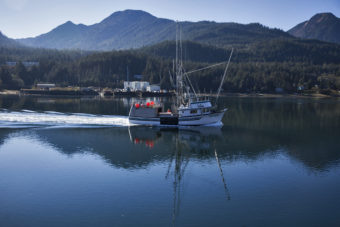
For most mariners Gastineau Channel is a cul-de-sac. Vessels coming into Juneau almost always have to exit the way they came in. The Douglas Bridge isn’t the issue – it’s just too shallow for most boats except small craft running at high tide.
A pair of listeners recently wrote to Curious Juneau asking why Gastineau Channel is a dead-end for shipping.
“We’ve got a canal or a channel and it goes up toward other communities but people who use that can’t go through it,” Joann Flora, a resident of the Mendenhall Valley said. “They come into Gastineau Channel and they have to turn around and go back and come around Douglas Island and it just seems to me like a tremendous waste of time and fuel if there was a way to get there – directly.”
Curious Juneau stars you and your questions. Every episode we help you find an answer. Catch up on past episodes, or ask your own question on the Curious Juneau page.
Sharon Van Valin, a resident of Douglas for about three years, also wrote in: “I’m curious about the Gastineau Channel. I know when I first came to Alaska in 1964 it seemed like it was a little bit deeper with more going on.”
It probably was deeper back then since it had been recently dredged.
“It was dredged initially in 1959 and ’60, but by 1962 there was already enough shoaling issued to limit the ability of vessels to use the channel,” explained Julie Anderson, chief of operations for the U.S. Army Corps of Engineers in Alaska.
Shoaling is the natural process of sediment filling in a channel over time.
“The shoaling appears to be coming from the side slopes, they’re very unstable, so the material is slumping in and filling it back in,” Anderson said.
A process called isostatic rebound, caused by the retreating glaciers, is also causing the land to rise.
But Anderson said it’s the instability of the side slopes that’s the issue.
In 2000, the corps looked at it again. Cost estimates ran at about $16 million to build the dike and around $2 million a year for maintenance and dredging.
“It’s not cost-effective. It just, it fills in faster than we can clean it out,” Anderson said.
But dredging Gastineau Channel still had one true believer: Gov. Frank Murkowski. In 2006, he secured several million dollars from the legislature to try and resume dredging.
“There’s an open question on whether it was a serious a proposal or whether Gov. Murkowski had an epiphany that we should open up channels when he was sitting on his boat,” said Juneau attorney Joe Geldhof. He was involved because he’s a past president of a citizens group that advises Fish and Game on the Mendenhall Wetlands State Game Refuge.
Any dredging project would run straight through this protected area.
“The trouble is when you’re the governor, some people pay attention to notions and whims and I think that’s what really happened,” Geldhof said. “Some of the staff in the governor’s office overreacted to what was really a goofball idea.”
Jim Clark was Gov. Murkowski’s chief of staff. He said the governor supported dredging but the large expense and lack of support from the Army Corps of Engineers made attracting federal dollars difficult. So it never went anywhere.
“It cratered,” Geldhof recalled. “Like a lot of peculiar ideas that float around the political sphere, it just died a quiet death.”
These facts in hand, I circle back to our Curious Juneau question askers.
“Well, I’m not surprised,” Flora said. “It makes sense to me but I was just curious if anybody had taken a serious look at it.”
Van Valin was also pleased for the information: “I didn’t have an opinion on whether there should be dredging or not,” she said. “I was just curious and I really appreciate you looking into it and giving all this information about it.”
Here’s an historical footnote: about $3 million of the unspent dredging money secured by Gov. Murkowski was never returned to state coffers.
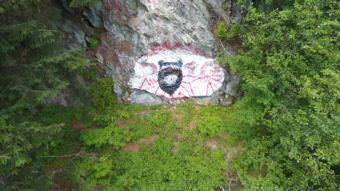
The eye painted on Mount Juneau as it appeared in 2016. (Photo courtesy Mikko Wilson)
In this Curious Juneau, we look into the origins of the eye glaring over downtown.
“When I first moved here in 1974, as a kid in the playground at Harborview we’d look up and all the kids would always wonder what that eye was,” local Paul Prussing said.
Prussing was one of many people that asked Curious Juneau what the story is behind the bloodshot eye painted on the side of Mount Juneau.
“Was it something scary looking down on us? Was it the mountain looking down?” Prussing said. ”Of course it always ended up being something scary and suspicious.”
Is the eye a high school prank? Part of an underground rock climbing club’s initiation? A Masonic conspiracy?
Curious Juneau stars you and your questions. Every episode we help you find an answer. Subscribe to our podcast, catch up on past episodes, ask your own question on the Curious Juneau page.
Listen to the Curious Juneau segment about the Mount Juneau eye:
The eye is an age-old symbol of the divine and all-knowing. In parts of Europe and the Middle East, the evil eye is an emblem of misfortune. In George Orwell’s “1984” it symbolizes government surveillance and omnipotence. The Eye of Providence on the dollar bill is a source of conspiracy theories and “National Treasure” films.
Here in the capital city, it seems like everyone has a theory about the Mount Juneau eye.
“I was always thought it was a group of seniors a couple years ago just went up there and painted it,” Amber Rounds-McPherson said.
Fred Triem thinks an avalanche caused it.
We picked up the story with the Juneau-Douglas High School class of 1970.
“All I know about that spot is that it’s been kind of a spot for mountain graffiti for many years,” Skip Gray, a longtime Juneau resident who sometimes work for us in television production. “Dating back to when I was a senior in high school. Somebody in my class wrote a big ‘70 up there for the graduating date of our class. ”
Before it was an eye, it was a huge, fluorescent ‘70. Gray cautiously put me in touch with a classmate who claims he originally painted the rock face.
In the spring of 1970 my best friend and I, Joe Smith, took a day off from school and a case of fluorescent orange spray paint and hung off the rock on the side of the mountain and painted a big 70,” said John MacKinnon.
He was skipping school, but MacKinnon said it wasn’t exactly vandalism. He claims they had permission.
“We researched that and discovered that was a claim,” MacKinnon said. “We went to AJ Mines and talked to a very nice old gentleman … and he typed up a permission to paint Class of ’70 on the rock up there. … Class of ’70 had a tremendous amount of class spirit and there were spirit competitions in high school and that particular class won it every year from freshman to seniors. And this was just another show of our class spirit.”
Today, an eye’s been painted over that same rock face. Up close, it looks pretty rough. It’s barely recognizable as an eye.
The pupil looks like it might be the face of a black bear, and its gaping maw could be the zero in a faded “2010.”
We couldn’t confirm MacKinnon was the first to paint the rock. And a lot of longtime Juneau residents with fuzzy memories had conflicting accounts of when it became an eye.
Paul Prussing likes to think it’s always been there.
“Well, I’d like to always think it was like the ever watchful eye of hope on Juneau,” he said. “One of my friends, I remember, in grade school said his dad said it was when the federal building was built it was the eye to watch the feds.”
Whatever it means or wherever it came from, it’s probably not as exciting as the stories dreamed up here at ground level.
“It’s probably high school kids and a case of beer,” Prussing said.
Can you help us nail down the eye’s origin? Email us at curious@ktoo.org.
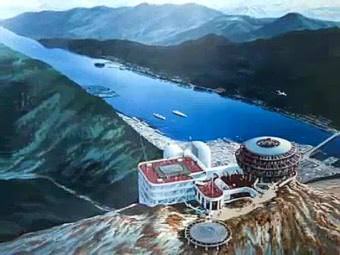
In this concept art, a helicopter prepares to land at a proposed Mount Juneau tramway complex where Chuck Keen envisioned a hotel, restaurant and performance stage. His widow, Karen Keen, says she has the concept art hanging on her wall. (Image courtesy Karen Keen)
In this edition of Curious Juneau, we answer another question about Mount Juneau.
Listener Joann Flora writes about “that piece of hardware atop Mount Juneau, how did it get there and what is its purpose?”
Curious Juneau stars you and your questions. Every episode we help you find an answer. Catch up on past episodes, or ask your own question on the Curious Juneau page.
Listen to the Curious Juneau segment about the Mount Juneau tramway project:
When we got in touch with her, Flora said she was asking about the big microwave reflector on the side of the mountain which we found out on a previous edition of Curious Juneau.
But that got us thinking about the other stuff, including the unfinished building that was left at the summit you can’t see from downtown Juneau.
We’ve got an answer for that, too.
Many longtime Juneau residents may remember before the Goldbelt Mount Roberts Tramway, there were plans to build the Mount Juneau tramway.
Chuck Keen had the idea for the project. The local character was a U.S. Marine, hard rock miner and timber faller before becoming a freelance cinematographer working for such clients as Disney. He also spent time in Vietnam capturing footage of the war.
“Chuck Keen’s experiences traveling the world led him to a vision of Juneau’s future as a tourist destination,” said a narrator in a short documentary produced by Pat Race in 2006.
“Keen had purchased property on the top of Mount Juneau in 1970 and dreamed of a tram leading to a beautiful alpine setting which would host a hotel, a two-story revolving restaurant, a museum, and a stage for performances, as well as access to the mountain trails and the icefield,” the narrator explained.
The original plan called for a lower tramway station on South Franklin Street, with a mid-point tower on Gastineau Ridge. The upper tramway station with the hotel and restaurant would be at the summit of Mount Juneau.
The project began to stall in the mid-1980’s after one of Keen’s companies filed for bankruptcy protection.
Keen and the City and Borough of Juneau also became embroiled in a big dispute over mining claims and property he had purchased for the project.
Keen claimed the city was trespassing because they were using an old AJ Mine tunnel under his mining claims as a water reservoir. The dispute dragged on and eventually ended up before the Alaska Supreme Court.
Keen also missed the project’s permitting deadlines and conditions. The tram project was eventually canceled in 1991.
The Mount Roberts tram opened six years later.
“I think he always felt that if he could build his tram, the other tram would just dry up and blow away,” said Chuck Keen’s son Mike in the documentary video.
At the very top of Mount Juneau, Keen had a heavy-lift helicopter haul up a backhoe, some shipping containers, and other equipment for the project. He also started construction on a bunkhouse for workers. That was all left on the mountain when the project fell apart.
Then, Keen died in 2003.
A backhoe awaits dismantling at the summit of Mount Juneau in 2009. (Photo courtesy Trail Mix)
Pieces of the backhoe are lifted by helicopter from the summit of Mount Juneau in 2009. (Photo courtesy Trail Mix)
An abandoned backhoe is cut into pieces at the summit of Mount Juneau in 2009. (Photo courtesy Trail Mix)
View of the summit of Mount Juneau in 2009 with the shipping containers, unfinished bunkhouse and abandoned backhoe. (Photo courtesy Trail Mix)
George Schaaf remembers that Karen Keen, widow of Chuck Keen, contacted him in 2009 for help in cleaning up her property at the summit.
“She had a desire to get all of that off of the mountain and try to return it back to its natural state as best as we could,” Schaaf said. “We told her that we would help her out with that.”
Back then, Schaaf was head of Trail Mix, the local trail rehabilitation group.
“We were grateful for her permission to get access up on the mountain to get it taken care of,” Schaaf said.
Schaaf remembers they got help from Temsco, AEL&P and Skookum Sales and Recycling. He and three other Trail Mix volunteers and staff members spent a few days up on the summit.
They used an oxyacetylene torch to cut the containers and back hoe into pieces.
“We had to cut it into about three pieces — the boom, the bucket and the frame — to fly it off. Just because of the weight,” Schaaf said. “The helicopters that we have here in Juneau these days are limited in how much they can lift. So, we had to cut the pieces down to a size that the helicopter can actually fly it off the mountain.”
Schaaf recalls that some cable rigging, logs and the unfinished bunkhouse still remain up there. They planned on burning the bunkhouse, but they didn’t have a burn permit. And they figured an unpublicized fire on the summit might alarm Juneau residents.
The remains of the unfinished bunkhouse at the summit of Mount Juneau. (Photo courtesy Juneau’s Hidden History/Alaskanweed Photography)
The Alaska Division of Libraries, Archives and Museums has posted YouTube video collections of outtakes and stock footage taken by Chuck Keen, volume 1 and volume 2.
George Schaaf serves on the KTOO Board of Directors.
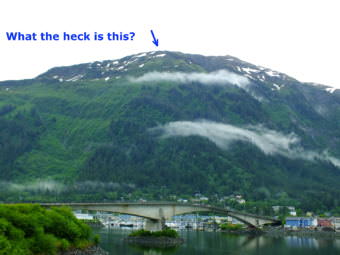
The AT&T Alascom microwave reflector is located at an elevation of 3,012 feet on Mount Juneau. (Photo illustration by Matt Miller/KTOO)
In this edition of Curious Juneau, we answer a question about one of the Capital City’s most imposing landmarks: Mount Juneau.
Listener Chris Murray writes, “What in the world is that billboard looking structure on top of Mt. Juneau that can be seen from all over downtown and Douglas?”
A telephoto view of the AT&T Alascom microwave reflector on Mount Juneau as seen from North Douglas. (Photo by Matt Miller/KTOO)
If you look through binoculars, you can see what appears to be a large metal frame subdivided into four smaller panels and angled slightly downward.
Curious Juneau stars you and your questions. Every episode we help you find an answer. Catch up on past episodes, or ask your own question on the Curious Juneau page.
Listen to the Curious Juneau segment about the microwave reflector:
It certainly looks like a billboard or perhaps a drive-in movie theater screen. The assembly is held up by what appears to be a metal support framework.
We checked with the City and Borough of Juneau, and their cartographer Quinn Tracy said the structure is probably 25 feet wide by 16 feet high, based on a light detection and ranging, or LIDAR, survey done in 2013.
After checking property maps, we discover that the panel sits on an L-shaped parcel at an elevation of 3,012 feet. The owner is listed as AT&T in New Jersey.
We tracked down somebody with AT&T Alascom who told us it was used as a passive repeater for microwave communication signals.
Alascom used to beam telephone and video signals from their downtown office about 1.4 miles up to the panel. The signals were reflected nearly 14 miles to a satellite uplink station at Lena Point.
Our source at AT&T Alascom did not want to be identified or quoted because he didn’t have permission to speak for the company. And, no one at their Anchorage offices got back to us.
So, we turned to Gray Haertig, an electrical engineering consultant based out of Portland, Oregon, who also worked on the White Alice communications system in Hoonah during the Cold War.
(Gray Haertig works as a consultant for several public radio stations in Alaska, including KTOO.)
He explained that telephone lines were impractical over long distances with no roads.
High frequency radio had limited capacity and only one call could be made at a time.
“In the mid- to late-50s, AT&T developed microwave systems, which operated at a much higher frequency,” said Haertig, who works as a consultant for several public radio stations in Alaska, including KTOO. “That system probably operated in the 2 gigahertz region.”
Microwaves could carry multiple telephone channels at once. But there was one big drawback.
“At 2 gigahertz, radio waves don’t go around corners very well. If you run into dirt, they stop,” Haertig said. “They had to figure out a way to get a signal from one place to another place when there was no way to see them, see one end to the other.”
Haertig wasn’t sure when the reflector was installed on Mount Juneau, but this is how it worked.
“If you imagined that the reflector was a mirror – nice and shiny and optically wonderful – if you stood at one end of the microwave path and somebody else stood at the other end of the microwave path and you got out your binoculars, you should be able to see each other. That’s how these things worked. (They) worked effectively optically even though it was microwave frequencies.”
The microwave signal from downtown Juneau would be sent up and bent down to the receiver at Lena Point.
Haertig said microwave communications later gave way to satellites in the 1970s and then fiber optic cable. The reflector was probably last used in the 1990s, even though AT&T Alascom still holds a license for it.
Coincidentally, the old AT&T Alascom public telegraph office in downtown Juneau is now the KTOO building.
Close
Update notification options
Subscribe to notifications
Subscribe
Get notifications about news related to the topics you care about. You can unsubscribe anytime.