Carter Barrett

With cut after cut, state food safety inspections stretch years apart

The Timberline Bar and Grill's food safety permit hangs on the wall on July 29, 2017. (Photo by Jeremy Hsieh/KTOO)
The food safety permit for the Timberline Bar and Grill in Juneau hangs on its wall on Saturday. With fewer inspectors conducting fewer inspections, some restaurants go years between inspections. (Photo by Jeremy Hsieh/KTOO)

Salmon patties sizzle on a grill at The Salmon Spot, a new addition to Juneau’s many downtown seasonal food stands. Its license hangs just above a box of plastic gloves.

With food inspectors available in town, navigating the permits and getting open for business was a lot of work – but not impossible. The seasonal stands in Juneau are inspected regularly.

Food Safety and Sanitation license hangs on the wall inside Forno Rosso, a mobile food stand in Juneau. The stand features a full-size custom pizza. They were inspected twice in 2016, both with zero violations.

In the western Aleutian island of Adak, there are only two full-service restaurants. The federal government considers restaurants high-risk and recommends food safety regulators inspect them four times a year.

But none of the restaurants in Adak have been inspected in over four years.

In 2013, the Aleutian Sports Bar and Grill was cited for rodent droppings and storing food in the kitchen restroom, among other violations. It’s since closed its kitchen.

In Alaska, inspections are creeping further apart. High-risk facilities are inspected on average once every 18 to 24 months. In rural areas, it can be even longer.

Outside of Anchorage, the state’s Food Safety and Sanitation Program is responsible for inspecting restaurants pools, spas, tattoo parlors, food processors and other facilities. The check-ins are intended to protect public health. But after several years of state budget cuts, fewer inspectors are paying fewer visits.

“I would say the number of inspections staff at this point would need to triple or maybe even quadruple for us to be able to get out with any degree of adequacy,” said Kimberly Stryker. She manages the state’s Food Safety and Sanitation Program.

Her inspectors have to triage.

In 2016, 50 percent of high-risk retail food establishments were inspected – up a few points from two years before. Less than one in five low-risk facilities – like coffee shops, bars, grocery stores – were inspected.

Low-risk facilities are only inspected if there are complaints or if inspectors have time.

How frequently Food Safety and Sanitation inspects a facility is based on an assessment that factors in proximity to their offices, the concentration of high-risk facilities, if it is a hub community with access to smaller villages, among other criteria.

“Once you go outside those larger communities, you’re really talking about much more expensive travel, much more difficult travel,” Stryker said.

A round trip Anchorage-to-Adak plane ticket is $1,200, and there’s only one flight a week.

Over the last three years, lawmakers cut over a million dollars from Food Safety and Sanitation’s budget. Two offices closed and a fifth of the staff was cut. And expensive plane tickets to a town with just a handful of restaurants are harder to justify.

“I would say overall it’s resulted in a reduction in our capacity to be able to prevent and respond to illness outbreaks, reports of illness, or reports of lack of sanitation,” Stryker said.

The Federal Food and Drug Administration contracts to inspect facilities that sell food across state lines – usually large processing plants. The state uses these trips to inspect other nearby facilities as well. The state also raised the fees facilities must pay, to make up for lost funds.

“We’re like a puppy dog chasing our tail, that’s just what we do, we’re never caught up,” said Jason Wiard, an environmental health officer based in Juneau. “It gets a little stressful, it gets a little tough.”

Part of the job is being gone for a week or more on trips.

“You might be sleeping in places that would surprise you,” Wiard said. “You could be sleeping on a gym floor, in a clinic cause there’s no lodging, or you might have someone say, ‘You can sleep on my couch.'”

Staff turnover is common in Food Safety and Sanitation because of tough working conditions and budget layoffs. Keeping staff well trained, and investing money in training is a challenge.

In recent weeks two fully-trained inspectors quit. Stryker remembers an employee counting 16 positions that have turned over since November 2014.

Are there consequences?

The Centers for Disease Control estimates 1 in 6 Americans gets sick from a foodborne illness a year.

According to the most recent CDC data, 2015 was Alaska’s worst year for foodborne illnesses and hospitalizations since its tracking began in 1998. There were 234 reported illnesses and 31 hospitalizations where the location of preparation was confirmed as restaurants.

A graph based on CDC data shows cases of foodborne illnesses from outbreaks traced to restaurant-prepared food.
Data from the Centers for Disease Control. No cases were reported in 2007, 2009 and 2011. Only cases that are part of an outbreak under the CDC’s definition are counted. (Graph by Carter Barrett/KTOO)

“I can certainly speak as an Alaskan first, and as a public servant second, I’m concerned about Alaskans becoming sick with foodborne illness,” Stryker said. “It’s completely preventable and it can absolutely change a person’s life.”

The city manager in Adak said the small town rumor mill keeps restaurants and cooks in-check, but Adak is scheduled to be inspected this fall.

“I’ve been out to rural communities where I’ve been just scared. Like, I know it’s been so long since we’d been out here. You show up and they’re dialed in perfectly,” Wiard said. “I think everybody understands the importance of food safety. Then again, I’ve been to places where you walk in and it’s a disaster.”

There used to be a McDonald’s, a movie theater and a swimming pool in Adak. They’re gone now, just the skeletal, weathered structures are left. A zombie movie was nearly filmed on the island – the perfect apocalyptic-esque set.

“When they don’t see us for a lot of years it’s hard to go in there and say, ‘You’re doing all this stuff wrong.’ And they’re like, ‘Great, where were you for the last 10 years? We’d love to hear this more often, so we’re not out of compliance,'” Wiard said.

In Juneau, sometimes it takes a visit to reassure food safety. In 2011, Wiard shut down Juneau’s downtown soup kitchen, The Glory Hole.

“It was awful, it was egregious, it was the worst thing possible that I could have done,” Wiard said. “They had lots of rodents, and cockroaches and ickies.”

After an overnight cleaning binge, Wiard returned early the next morning to see if the kitchen could reopen for breakfast.

“Just the impact of being able to do that, so folks down at The Glory Hole could have a breakfast that morning, you know, that was some of the sacrifices that I look at – yeah, that was a good thing,” Wiard said.

In rural communities, that level of follow up and education isn’t always possible.

As for the Food Safety and Sanitation Program’s budget for this year, it didn’t lose any more funding.

Changing climate pushes polar bears toward more dangerous interactions with humans

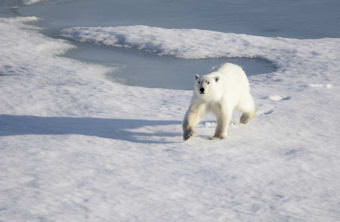
Faster-moving sea ice brought on my rapid global warming is added to the physiological stress of Alaska's polar bears, a new study says. Creative Commons photo by
As melting sea ice forces polar bears onto dry land, interactions with humans are becoming more common and potentially more dangerous. (Creative Commons photo by Christopher Michel/Flickr)

For Halloween in 2014, the kids in the village of Arviat in the Canadian Arctic had to trick-or-treat indoors. In the community center, they had a warm place to show off their costumes, but more importantly, they were safe from three polar bears outside.

That night a polar bear and her two yearlings spent three hours on the outskirts of town trying to find a way in.

The polar bear patrol used four wheelers and bright lights to try to keep the bears from getting too close to town.

Elisabeth Kruger with the World Wildlife Fund was there that night.

“The bears would go a bit on the ice and they would just wait for the four wheelers to go away and then they’d come back on shore and try to cause trouble,” Kruger said.

Jim Wilder, the polar bear project leader for the U.S. Fish and Wildlife Service in Anchorage, recently published a paper on how climate change is impacting polar bear behavior.

“When they have less opportunity to hunt, obviously that has impacts to their body condition – so the bears become thinner, skinnier,” he said. “What our study has shown actually is that when polar bears become thinner and skinnier they become a little more aggressive in their pursuit of feeding opportunities.”

The study is the first of its kind, combining research from the United States, Norway, Canada, Greenland and Russia to look at what motivates polar bears to attack humans.

Polar bears usually hunt on the sea ice, stalking unsuspecting seals. But when there’s open water where there used to be ice, the bears are forced onto land. Wilder’s study found when bears are thinner and desperate, they also become more aggressive hunters.

For evidence of this, the paper points to the worst years on record for polar bear attacks: 2010 – 2014, a period of historically low summer sea ice.

“Bears in general, particularly polar bears, make their living by investigating anomalies on the landscape. Something that might indicate there’s something there to eat,” Wilder said.

That used to mean places in the ice that indicated there were seals, but now small coastal communities on the flat tundra landscape can also look attractive to the bears.

Wilder says not to panic — there have only been six recorded polar bear attacks in the last 145 years in Alaska. But, there’s still cause for concern.

“If I lived in a coastal community,” he said. “I would be concerned about the loss of sea ice and the impact of that to polar bears.”

A majority of bears that attacked people were malnourished.

Part of Elisabeth Kruger’s job is advising small communities on the best way to keep polar bears out of town.

“One thing I hear really often in the villages is people saying ‘we’ve been here for a millennia and we’re a pretty resilient people and we’ll get through this’,” she said. “I’ve seen how people live and I don’t doubt that they will get through it. That said, this is something we haven’t seen before and it is going to cause drastic changes no matter what we do.”

In order to prepare for increased interactions between polar bears and humans, Wilder’s study mentions Arctic residents should learn to recognize malnourished bears, manage their trash properly and – if it comes down to it – know how to use a firearm.

Newscast – Thursday, July 20, 2017

In this newscast:

  • Bogoslof volcano was a haven for endangered animals, but scientists did not know if animals would return to the eastern Aleutian Island. Biologists are now starting to answer that question.
  • Former NBA player Carlos Boozer is returning to Juneau to host his Carlos Boozer Basketball Camp.
  • An Alaskan radio station is facing tens of thousands of dollars in fines for a list of FCC violations.

Alaska-Texas penpals reunite 27 years later in Juneau

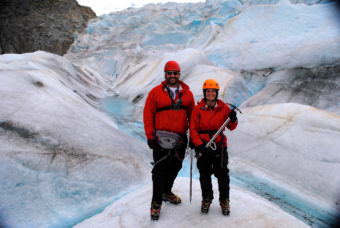
Shawn Hipsh and Darla Orbistondo standing on the glacier during Hipsh’s trip to Juneau this month.

In October 1990, Shawn Hipsh, a fifth-grade kid from Lewisville, Texas, bought a classified ad in the Juneau Empire asking for someone to send him info about Alaska for a class project.

Darla Orbistondo responded to the ad, sparking a 27-year friendship.

Shawn Hipsh and Darla Orbistondo the first time they met in Tulsa, Oklahoma. Orbistondo said Hipsh’s height surprised her.

The penpals reunited this month in Juneau and reminisced.

Darla’s first letter to Shawn began like this:

“Shawn, saw your letter in our paper and thought since I was home being a housewife and mother I would answer your request. I hope these things are some help. Thought you would enjoy seeing our local paper, maybe you can compare things in Juneau to Lewisville.”

“I just started gathering all this stuff from Juneau,” Darla said. “I mailed it off to him and of course I had my address in the letter if he wanted to respond back. He was only in fifth grade so that’s how it all started … Eighth grade, and prom, and graduation. … Pretty much seen his whole life for almost 27 years.”

Shawn lives in Memphis, Tennessee, now.

“We used snail mail for the first number of years and switched over to email and Facebook,” Shawn said.

They met up years later in Tulsa when Darla was passing through.

“Been trying to get up to Alaska the entire time, and finally was able to make it happen 27 years later,” Shawn said.

Snail mail, Shawn said, is “the original form of social networking.”

“With text and stuff you lose a lot of the emotion and the thought. When you’re writing a letter you’re sitting there and you put your thoughts on paper and actually have time to think about it. … But having someone out there, that cares about you, that doesn’t really know you is kind of cool.”

Darla still gets choked up remembering some of the old correspondence.

“I think the hardest thing for me was when he went off to Kuwait, and seeing him over there with his uniform on and the guns,” she said. “He turned into my own boy, so that was the hard part.”

Before Shawn made the trip up, Darla did send another snail mail letter.

“I just had to do this, wow 27 years ago this happened, a friendship. What an amazing journey we have been on. I can’t wait to see you guys in Alaska. I get goosebumps just thinking about it.

“P.S. – this is how it all started, a boy’s fifth-grade school project.”
Darla said the friendship is priceless. For his visit, she’s been playing tour guide for Shawn around the region.

Thanks to Marian Call for the use of an instrumental version of “Highway Five” in the radio version of this story.

‘Nones’ in Juneau changing religious landscape

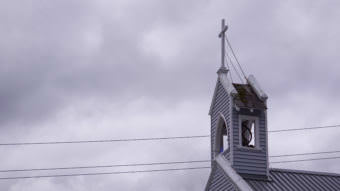
Grass grows in a planter off a window of St. Nicholas Russian Orthodox Church in downtown Juneau on July 15, 2017. The Catholic Cathedral of the Nativity of the Blessed Virgin Mary is in the background. (Photo by Jeremy Hsieh/KTOO)

Today, Alaskans are on average less religious than the rest of the country, and a subset who don’t identify with any particular religion is growing, according to data from the Pew Research Center.

“I grew up fairly religious, went to organized church, and then kept that going probably through the first year of college, and kind of lessened that. Now I don’t practice anything specific,” Chelsea Maller, a Juneau local, said.

Despite this, Maller says she still prays.

“I would say that’s the most consistent thing I keep up with if anything,” Maller said. “Just giving myself a peace even if I don’t necessarily feel like if I need to go worship in a church or anything like that.”

Maller falls into a growing group of the religiously unaffiliated, which can include anyone from atheists to the “spiritual but not religious” types.

The Pew Research Center refers to this group collectively as “nones,” which originates from the “none of the above” option on a religion survey.

In Alaska, about 3 out of 10 people are nones. Nationwide, it’s 2 out of 10. Both have grown since 2007.

A common misconception about nones is they don’t have any beliefs — but like Maller many of them fall into a spiritual gray area.

Elizabeth Drescher, the author of the book, “Choosing our Religion: the Spiritual Lives of America’s Nones” conducted her own research on the subject.

“It turns out that about 70 percent of the religiously unaffiliated, or nones, believe in God or a life force or some kind of higher power,” Drescher said. “They don’t identify with a particular religious tradition, even though they might participate in things that are kind of obviously religious to most of us.”

It’s not uncommon for nones to pray, attend religious services or consider religion important in their lives.

“That package that’s called religion, some of it works for me, but mostly not so much all the time,” Drescher said, voicing  what many nones feel. “I’m happy to take some of those resources, but I don’t belong to that.”

Drescher hasn’t studied nones in Alaska specifically, but she guessed a seasonal workforce and fewer connections within the community could contribute to more nones.

Across the country, religious unaffiliation has increased and in every race, age, gender, education and socioeconomic background.

This concerns some religious leaders, and there are theories why people are leaving traditional religion, such as a more scientific world views, seeking out a more individualized religion and LGBTQ and women’s rights.

Juneau local Rachel Smith grew up Mormon but doesn’t align with that anymore.

“Mormonism is so – it’s very black and white. I just never felt that way, it’s a little, depending on who teaches it, it’s a little bit demeaning towards women,” Smith said.

Pat Casey, a pastor for the Catholic Church here in Juneau, says there are a lot of nones in town, but he also sees a lot of people who mix religious traditions.

“People tell me you know I’m a Christian, I believe in God but I like to do it in my own way,” Casey said. “You know, the yoga movement and other types of meditation.”

He says to say the Catholic Church is shrinking is a misconception. Nationally, immigrants are a major source of growth in the Catholic Church. Catholicism is still really popular in Latin America and the Philippines. But what draws people to Catholicism now?

“I’ve had a number of people come to me who want to talk about the Catholic Church where it is now, versus where it was when they left,” Casey said. “Many of them find that challenging and welcoming.”

In 1966, Time magazine published one of their most iconic covers ever. In bold red against a black background, a single three-word question sparked outrage and backlash.

“Is God Dead?”

Half a century later, the issues the magazine explored may sound familiar: Explaining the divine in an increasingly secular world, how theologians responded, and the move toward individualized religion.

Site notifications
Update notification options
Subscribe to notifications