Carter Barrett

Juneau makes collection of property mapping data easier to access online

It’s been about a year since the City & Borough of Juneau made reams of land, property and mapping data readily available to the public through a web-based application.

Conservationists, landscape architects and second-grade teachers are using the city’s Parcel Viewer system.

Each second-grade student painted their own section of the map. The project was to help them learn about mapping, Tlingit history and patterning. (Photo courtesy City & Borough of Juneau)

At the bottom of stairwell at Juneau City Hall, a group of second-graders are looking at a tall patchwork of paper grids posted to a wall.

Each kid worked on a grid, coloring in blue for water and green for land, and they patterned in symbols for traditional Tlingit uses of the land – hunting, berry picking, fishing. 

With geographic information systems technology, or GIS, the city’s cartographer, Quinn Tracy, produced the map grids that made the second-grade class project possible.

Nancy Lehnhart with the school district created the lesson for all of Juneau’s second-grade classes.  

“We created a map together and he could very easily, when I said, I’d like to see some creeks and rivers but not all of them,’ he could kind of back off, you know, it so easy with the GIS program he uses and his skills to make quick changes and get me right what I needed,” Lehnhart said.  

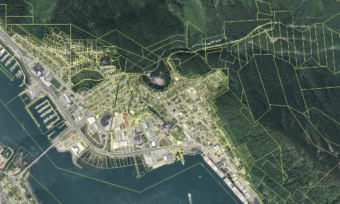
Parcel Viewer is a free online application that shows an aerial view of Juneau with each piece of property — the parcels — outlined in yellow.  These boxes are interactive, show property lines, the landowner, zoning, assessed value, topography and more.

“For the average Juneauite a question the lands and resources division often gets asked is, who owns this property? Who manages this property?” Juneau lands specialist Rachel Friedlander said.  

Before Parcel Viewer, getting this information was arduous and time consuming.

Juneau land information has become very accessible since the city took the system public a year ago.

“GIS and remote sensing in general would make Ponce de Leon or any 15th, 16th century, 17th century explorer super jealous, because basically it’s a whole another way of understanding the landscape,” Friedlander said. 

Running Parcel Viewer costs the city $9,800 annually, regardless of it being a public or private program.

Parcel Viewer has been a time-saver for Allison Gillum, the executive director of the Southeast Alaska Land Trust.

“To look at different parcels and just as basic as locating them, finding out where they are and seeing the surrounding areas,” Gillum said. “Is it surrounded by wetlands? Is in next to the refuge? It helps visualize where things are, and gets us started when we’re looking and evaluating properties for protection.” 

Parcel Viewer has been useful for Chris Mertl, both as a landscape architect and as the chair of the city’s Parks and Recreation Advisory Committee.  

“Previously, I remember working with the GIS department, and you had to work with them bringing all these layers together,” Mertl said. “Now that it is a public domain, or within the public domain, and you have access and can control the layers, I find that it’s a great tool. For us, we use it all the time for our master planning, and I think it’s a great resource.”

As the technology advances, it’s almost possible to update maps in real time. Drones may be used in the future to take aerial photos of rapidly changing landscapes.

“That will be more nimble, more efficient, less expensive and more available,” said Greg Chaney, CBJ Lands and Resources manager. “That’s where I see us coming on and that’s not going to be that far in the future, maybe even five years.”

Everything from the assessed value of a house, the owner of a property and the year a building was constructed are online.  

The information is available to the public  by going online epv.juneau.org

360 North documentary “Inside Out: Leaving Prison Behind” premieres Friday

“Inside Out: Leaving Prison Behind,” 360 North’s new documentary, premieres 8 p.m. Friday, June 23, on 360 North. (Still courtesy 360 North)
The documentary “Inside Out: Leaving Prison Behind” premieres 8 p.m. Friday, June 23, on 360 North. (Still courtesy 360 North)

“Inside Out: Leaving Prison Behind,” a nearly 30-minute documentary, follows three Lemon Creek Correctional Center inmates re-entering society.

The film premieres 8 p.m. Friday, June 23, on 360 North.


“In and out, in and out, in and out, feel like what’s the point of getting out, getting a job, coming back and burning another bridge, and getting a place to live and losing your clothes and your shoes and all this stuff again,” one of the documentary subjects, Stephan Haseltine, said in the film.

But the story started with another project published last year called “The Flying University” about a literature and philosophy class in the prison.

“We got such great footage that day in the prison, that that blossomed into a short documentary,” said KTOO’s Scott Burton, a producer on the documentary. “It sort of opened the door to Lemon Creek a little bit, for us. We wondered if we could get the opportunity to film someone from the moment they got out of prison.”

The documentary was funded by Alaska Mental Health Trust Authority, a state organization that uses its resources to support an integrated mental health system.

The documentary also will be available on 360north.org.

Editor’s note: KTOO’s building sits on land leased from the Alaska Mental Health Trust Authority. KTOO has also applied for and received occasional grants for special reporting projects from the authority.

Newscast – Thursday, June 22, 2017

In this newscast:

  • Hilcorp snapped up more than 100,000 acres in Cook Inlet for additional oil and gas development at federal and state lease sales held yesterday.
  • Alaska U.S Sen. Lisa Murkowski says she needs time to review a health care bill drafted by fellow Republicans to understand its effects.
  • A black bear believed to have mauled a 16-year-old to death over the weekend has been shot and killed.

New state ombudsman to start this week

Kate Burkhart is starting as the state’s new ombudsman this week, replacing Linda Lord-Jenkins who held the position longer than any other investigator since the agency started in 1975.

The ombudsman is a non-partisan position that investigates complaints of state agencies and will often make recommendations to agencies or the state legislature on how to fix problems.

Lord-Jenkins retired this week.

“The incoming ombudsman is a very capable, and talented and resourceful woman, and she has a real good track record,” Lord-Jenkins said. “I think the office will continue on and I hope people continue to use it as an option in dealing with state government.”

Burkhart started working for Alaska Legal Services as a public interest lawyer, she was an assistant ombudsman for a year under Lord-Jenkins, and then became the executive director for the Alaska Mental Health Board.

Burkhart sometimes volunteers with KRNN.

“I have a background in working with Alaskans from all over the state, and helping them resolve all kinds of problems,” Burkhart said. “I’m familiar with the work of the ombudsman and how important it is to ensuring government is responsive to the needs of its citizens.”

The ombudsman serves five year terms. Burkhart said it’s not a well-known office.

“I get asked the question very often, ‘Great you’re the ombudsman, what do you do?’” Burkhart said. “So I’m thinking that will be part of our outreach helping people understand what this office does. Really becoming a resource for more Alaskans.”

Lord-Jenkins said one of the office’s successes was its 2012 investigation into the Office of Children’s Services and its poorly designed system to receive and track complaints.

After the investigation she recommended adopting an agency-wide computer tracking system for grievances, as well as training for employees.

According to the most recent annual report released by the office, complaints sent to the ombudsman’s office against the Children’s Services increased by 59 percent in 2015. That year the ombudsman opened 250 new citizen complaints against the office.

Why Juneau’s garbage bears and parking scofflaws may catch a break

Community service officers are a subset of Juneau police. They don’t carry guns or make arrests. But they do enforce laws — like parking and garbage — and help with community outreach.

And sometimes that means they have to deal with trash-rummaging bears.

A black bears claws its way into a non-bear resistant trash can, Tuesday June 12th. (Photo by Carter Barrett/KTOO)
A black bears claws its way into a trash can in the Mendenhall Valley on June 12. (Photo by Carter Barrett/KTOO)

A black bear claws its way into a non-bear resistant trash can. Debris litters the ground to a backdrop of thick evergreens.

It is one of community service officer supervisor Bob Dilley’s first stops of the day.

With the bear 40 feet away, Dilley honks and revs his engine, he drives his SUV onto the gravel driveway.

The bear retreats a few feet, but returns to dig through a cascade of plastic — milk jug, mayonnaise container, a Gatorade bottle. The bear stands up, peering at the man trying to come between it and the trash.

Dilley nearly bumps the bear with his car, and only after a few minutes does the bear sulk back into the thick woods at the base of Thunder Mountain.

It was the second trashcan rummaged on the street.

“Usually they run off a little quicker than this,” Dilley said. “That’s the problem you get with these habituated bears that become accustomed to eating garbage.”

On this particular morning, Dilley encountered bears and ravens in trashcans, abandoned cars and one particularly petty complaint about a neighbor marking a parking spot with traffic cones.

For a long time, Juneau’s had five community service officers, but one retired this spring and city officials cut the vacant position from the budget.

The Alaska Department of Fish and Game works closely with CSOs to determine hot spots for bear activity, and educate the community about proper waste management. Fish and Game biologist Stephanie Sell said the cut will be felt.  

They’re going to be overworked,” Sell said. “They can’t keep doing all the things they’re currently providing for the community, and one of those is the bear nuisance attractants laws.”

The tension between bears and people is especially high in low-income areas that don’t have garages or sheds to store trash, Sell said.

“Are people going, you know, just leave their trash out knowing they’re not going to get a ticket or fine?” Sell said. “Whether they do it knowingly or they do it because they’re not sure what’s the right thing to do.”

Juneau Assembly member Jesse Kiehl was one of the no votes on the cut.

He said the CSO positions are not the place to save money, and is concerned the consequences could stretch beyond enforcement and public safety outreach.

“I think it means less of that work and/or moving some of our police officers, our full-scale cops over to that kind of work,” Kiehl said. “They need to focus on building those relationships and investigating crimes and preventing crimes. They do a great job with that, I don’t want to see them diverted.” 

Deputy City Manager Mila Cosgrove said the work will be divided among the remaining four officers, though the fifth position could come back.   

“There’s room to reconsider during the fiscal year provided we can find funding for it,” Cosgrove said. “In order to reconsider though I would want to see that the data there to support that.”

After leaving a ticket Dilley, cruises farther down the street.

“Some of the proactive stuff like we’re doing today where it’s not their garbage day, we go out drive through the neighborhood just because we know it’s a hot spot for bear activity, that type of proactive enforcement will probably go down some and we’ll be dealing with more complaint driven stuff,” Dilley said. “If nobody complained about that bear getting into the garbage that I just wrote the ticket for, we probably would not have been out here.”

On the right, a colorful playground sits empty in the drizzling mist.

“Really, he’s only 100 yards from the playground up here,” Dilley said. “Not good when you get kids and bears interacting.”

Site notifications
Update notification options
Subscribe to notifications