Curious Juneau

What happened to the downtown bells?

Curious Juneau

Have your own Curious Juneau question? Submit it, subscribe to Curious Juneau podcast and catch up on past curiosities on the Curious Juneau page.

As recently as 2009, clock bells marked a specific location in Juneau. That year, former KTOO reporter Casey Kelly began a story like this:

“As the clock chimes 12 o’clock, Mike Anderson works a ratchet jack at the end of an old pier at NOAA’s downtown port facility…”

Hourly clock chimes. In downtown Juneau.

Jeste Burton posts for a photo in her shop, Pie in the Sky, in downtown Juneau on Oct. 11, 2018.
Jeste Burton posts for a photo in her shop, Pie in the Sky, in downtown Juneau on Oct. 11, 2018. (Photo by Jeremy Hsieh/KTOO)

In this Curious Juneau, local businesswoman Jeste Burton asks, “Where did the sound of the lovely chimes and bells go? When I first moved here there used to be these gorgeous bells that would ring all the time. They started at I believe at eight o’clock in the morning, finished at nine or 10 o’clock at night. During the holidays, at like, 4:30 in the afternoon, they would play like a whole big, lovely series of, like, sounds and musics and everything like that. … Will you pretty please turn them back on? I mean, I feel like it was one of the most endearing qualities about living in Juneau. It was like, my hands-down favorite thing.”

The chimes or bells were actually from a carillon. That’s an instrument with a whole bunch of tuned bells. Keys are laid out like on a piano, but they’re connected to hammers that strike bells instead of strings.

J. Allan MacKinnon is pretty sure he’s the only person around who’s played the carillon that rang across downtown Juneau for decades. He’s also known for playing the Friday Kimball organ concerts in the atrium of the State Office Building, which is where I met with him.

MacKinnon was in town when the carillon was installed in the bank at the corner of Second and Seward streets. It was the National Bank of Alaska at the time, but now it’s a Wells Fargo (which bought out Bank of Alaska in 2000). He remembers the bank installing it in 1962, the year he graduated from high school. Verdin, the parent company of Schulmerich Carillons, has a record of a sale to the Juneau branch of the bank in 1967.

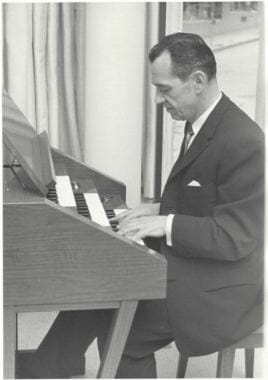
MacKinnon kept a file of information on the carillon over the years, including a photo he snapped from the 1960s of a man in a suit at the keyboard. It looks like a piano but with three rows of keys. MacKinnon said he’s got a filing cabinet full of historical stuff.

J. Allan MacKinnon snapped this photo in the 1960s of an unidentified man who played the Schulmerich Americana carillon at the National Bank of Alaska in downtown Juneau, which later became a Wells Fargo. MacKinnon remembers the bank installing the carillon system in 1962, though the carillon company has records of a sale to the Juneau bank branch in 1967.
J. Allan MacKinnon snapped this photo in the 1960s of an unidentified man who played the Schulmerich Americana carillon at the National Bank of Alaska in downtown Juneau, which later became a Wells Fargo. MacKinnon remembers the bank installing the carillon system in 1962, though the carillon company has records of a sale to the Juneau bank branch in 1967. (Photo courtesy J. Allan MacKinnon)

MacKinnon’s carillon file has old correspondence with the Juneau Assembly, Schulmerich Carillons (the company that manufactured Juneau’s carillon), and the Juneau Downtown Merchants Association, a predecessor of the Downtown Business Association. This model is a Schulmerich Americana.

This carillon didn’t have any actual bells. It was electronic and designed to sound three kinds of bells: Flemish, harp and celesta. It was programmed to play the timekeeping chimes and a few songs for special occasions.

MacKinnon studied music at the Westminster Choir College in New Jersey, with a focus on the organ. His studies were interrupted by several years in the Air Force during the Vietnam era. When he got back to the campus in the 1970s, he started dabbling with the carillon on campus.

MacKinnon can’t remember when, but at some point after finishing college in 1975 and moving back to Juneau, he started playing the downtown carillon live for holidays and special occasions.

It went on hiatus after the Christmas season of 1982. Its last concert might have sounded something like this:

The carillon had fallen into disrepair and was largely obsolete. The bank donated it to the Downtown Business Association.

In 1985, businesses, the Juneau Assembly and private donors pooled together $28,000 to restore it. Sealaska headquarters became its new home and MacKinnon programmed the restored unit.

So back to Jeste Burton’s question: Why’d it stop? The 8 a.m. chime used to be her drop-dead cue to get to work.

“So you didn’t have to look at your phone all the time, and you could be like, ‘I have to hustle my bustle,'” she said. “Because, on the half hour, it was, like, a single chime. And then on the hour, it would play a specific chime and then count out the hours like a grandfather clock would and it was – I loved it.”

After the 1985 restoration, records and memories get fuzzy. The city clerk and I searched the next 33 years of Juneau Assembly minutes and meeting documents for the word “carillon.” There was one hit. It was in a 2014 memo noting it had been removed from the Sealaska building.

Longtime city officials can’t remember why it was removed, or what actually happened to the parts. There wasn’t any fanfare around its decommissioning.

Juneau Parks and Recreation Director Brent Fischer, who’s retiring after 25 years with the city, said his best guess is that the carillon was surplussed or trashed.

MacKinnon doesn’t remember any problems with the carillon’s condition. When I met with him, he didn’t know it was gone.

“But I’m interested in finding out, because something like that could get damaged or, you know, ignored,” he said.

Three different Sealaska building managers, past and present, weren’t certain why it was removed, either. They each had conflicting memories and guesses.

Regardless, Jeste Burton thinks the bells should come back.

“Well, I feel like if we’re willing to put a ton of money into the whale — and I am in no way disparaging the whale — I think we as a collective community would derive equal value out of the beautiful lyricism of the bells,” she said. “And I would personally, with my very meager resources, be happy to kick in to that and I suspect there’s any number of other people who would.”

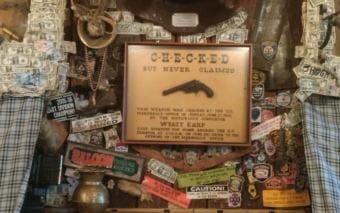
Did Wyatt Earp really leave his gun in Juneau?

The famous gun as seen on Aug. 13, 2018 — more than a century after famous gunslinger Wyatt Earp is reputed to have left it behind on his way to Nome. (Photo by Jacob Resneck/CoastAlaska)

Juneau’s Red Dog Saloon claims it has a pistol that belonged to one of history’s most notorious gunslingers. But does the bar’s story check out?

Wyatt Earp was among the most famous frontier lawmen. In 1881, he and his brother fought alongside Doc Holliday in a deadly confrontation with outlaws at the Shootout at the O.K. Coral in Tombstone, Arizona which has been dramatized countless times for film and television.


Curious Juneau stars you and your questions. Every episode we help you find an answer. Catch up on past episodes, or ask your own question on the Curious Juneau page.

Subscribe to the podcast:
[podcast-subscribe podcast=”curious”]

A decade after his death, the 1939 film Frontier Marshal was one of the earliest in a long line of films about his brutish style of justice.

By the turn of the century, he was already a celebrity of sorts. That about when Wyatt Earp and his wife Josephine traveled to Nome at the height of the gold rush to start a saloon.

Legend has it he briefly passed through the gold mining town of Juneau. And left something valuable behind: a Smith & Wesson No. 3 revolver that to this day is a kitschy tourist attraction in a downtown bar.

According to the legend, the revolver was confiscated by U.S. Marshals when Wyatt Earp was changing steamships in Juneau.

Given the man’s fearsome reputation as a gunfighter, federal marshals demanded, or so the story goes, that Wyatt Earp surrender his weapon while in town. His boat to Nome in the morning left earlier than the federal offices reopened. The gun went unclaimed in federal custody.

You can take the story at face value. But I got to talking with Juneau newspaperman James Brooks.

“How did Wyatt Earp’s gun come to be on the wall of the Red Dog Saloon?” Brooks asked me on a recent afternoon.

We agreed there’s got to be more to the story.

“So the story that I got… back in the early 1900s, early teens or ’20s. The gun was part of what was then this Territorial Museum,” explained saloon owner Eric Forst.

The pistol’s been a fixture behind the bar for decades, he said.

The story is that a museum employee – or at least someone with access to its treasures – had a bit of a drinking habit, Forst said.

“And he would periodically pay off his bar tabs with stuff out of the Territorial Museum,” he continued, “and at one point he had a significant bar tab at the Red Dog Saloon and he paid that with that gun.”

At least that’s what Forst was told when he bought the bar a decade ago.

The Territorial Museum would later become the Alaska State Museum so that’s where I headed next.

“I can’t rule anything out but I have been through the records pretty thoroughly over the last 30 years,” said Steve Henrikson, curator of collections. “I’ve never seen it listed either as something that belonged to the museum or as a loan.”

There’s something else that doesn’t add up.

“I don’t believe that Wyatt and Josephine were in Juneau in June of 1900,” said New York-based author Ann Kirschner who’s written about Wyatt and Josephine Earp’s time in Alaska and published the 2013 book Lady at the OK Corral. “I believe they sailed from Seattle and stopped in Unalaska and then continued on to Nome, that was the western water route and I don’t believe that they would have necessarily stopped in Juneau.”

I enlisted the help of Zachary Jones at the Alaska State Archives for help to confirm that.

“We have records that document him in Nome,” Jones said. “But documenting a shot stop on his way to Nome is a little more difficult.”

The only written account of Wyatt Earp’s time in Juneau comes second-hand. It’s contained in the official history of the first 50 years of the Alaska State Troopers and references federal records discovered in the 1960s.

“Those letters purportedly say that U.S. Marshals had a … firm discussion with Wyatt Earp when he arrived in town,” the archivist told me. “If that’s true, it’s really interesting. I still don’t understand why a U.S. Marshal would want to accost and sort of run off a retired law officer.” He’s since written the national archives to see what might be on hand in Washington.

In the meantime, not only is it questionable the pistol belonged to Wyatt Earp. There’s doubt he was even ever in Juneau.

It felt like a dead end, but journalist colleague James Brooks suggested I dig deeper in the state archives.

There’s a trove of old newspapers on microfilm in the archives. I thumbed through Juneau’s Daily Alaska Dispatch. I had a date and the name of the steamship: the sign on the wall said he’d been disarmed on June 27, 1900. He supposedly sailed two days later on the S.S. Senator.

Juneau’s newspapers around that time are full of news about miners heading to Nome. (And ads for Rainier beer).

But there’s nothing about Wyatt Earp or that ship.

That’s because I was looking in the wrong place.

Acting on Kirschner’s tip, I located an item in the Nome Daily News reporting on Wyatt Earp’s arrest in a drunken brawl. It’s dated June 29, 1900 – the same day he supposedly left his gun in Juneau.

So there’s a hole in the bar legend right there.

But just because the dates are wrong doesn’t mean the whole story’s bunk, though it probably is. From the start, bar owner Eric Forst told me he bought the saloon but not necessarily the legend around Wyatt Earp’s pistol.

“The reality as of how it got to the Red Dog Saloon may be lost to history,” he said. “The story as I’ve been told, is what I told you, but I’ve never seen any documentation of how it ended up from one place to the other.”

I was hoping for a firmer resolution. But James Brooks takes the long view.

“Maybe that’s for the best, I mean this is someone whose life is shrouded in legend,” Brooks suggested. “There’s almost as many tall tales as there are facts. So maybe it’s kind of appropriate that it’s that way.”

Either way, it’s a good story. And it brings tourists from all over the world who stop in at the Red Dog Saloon for a glimpse of the famous revolver.

What’s the deal with Juneau’s barefoot guy?

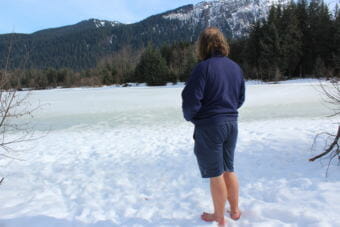
"Barefoot Guy" Ezra Strong looks out on Dredge Lake during a hike. (Photo by Adelyn Baxter/KTOO)
“Barefoot Guy” Ezra Strong looks out on Dredge Lake during a hike. (Photo by Adelyn Baxter/KTOO)

Xtratufs, Bogs, Muck Boots — comfortable, waterproof footwear is pretty much a necessity here in Juneau. But not for the local some know as “the barefoot guy.”

Curious Juneau stars you and your questions. Every episode we help you find an answer. Catch up on past episodes, or ask your own question on the Curious Juneau page.

“Oh yeah, barefoot guy! What’s the story?” said Juneau resident Michael Boyer. “Is he a hobbit? Is he into New Age spiritual stuff? Don’t his feet get cold?”

Boyer lives in the neighborhood above Juneau-Douglas High School.

As he’s out walking his dog or with his kids day to day, he’s noticed a certain walker who also frequents the area.

“Rain, shine, 10 degrees, 70 degrees, uh, never any shoes,” Boyer said after submitting his question to Curious Juneau. He wanted to know more about the mysterious man whose bare footprints crisscross the neighborhood.

One 30-degree day, I had my own sighting downtown near the State Office Building. The ground was slick with ice, and across the street, a bearded man in cargo shorts was walking — without shoes.

I introduced myself and he laughed in a “not again” kind of way.

I met Ezra Strong on a sunny day in late March for a hike along Dredge Lake Trail. Several inches of snow were on the ground. He wore shorts, a light pullover and, of course, no shoes.

Strong grew up in Tenakee Springs, the youngest of six kids. He’s 29 and works in IT for the Juneau School District, where he has to wear sandals.

He’s brought a book with him for the hike, just something he pulled off the shelf at home. He often reads while he walks.

As we set off, I noticed pretty quickly that Strong seemed to fare better than me in a lot of the slushy spots.

“Stuff like this, I’m probably better off than most people in shoes,” he said. “Actual real ice? Not so much.”

He said he would love it if they made micro spikes for bare feet, but he makes do.

Gravel sticking to his feet is probably the most annoying thing he deals with.

Ezra Strong poses after a hike on Dredge Lake Trail. (Photo by Adelyn Baxter/KTOO)

Of course, the main question is why go barefoot at all?

“My right foot is defective. I was born with a birth defect, apparently,” he said. “I think it has something to do with the shape of the arch.”

One of his older brothers had the same issue.

Doctors told their parents the solution was to break the foot and reset it.

Doctors did that for the brother, but by the time Strong came along, his mom hesitated.

“I guess she didn’t want to have to put another kid through having his foot broken, so they just never did it to me,” he said. “So, getting stuff that fit me was a pain.”

Strong’s right foot is abnormally wide. And people with weirdly shaped feet just don’t have a lot of options.

As a kid growing up in a rural community, running around without shoes was no big deal.

He moved to Fairbanks for college. Winters were colder and he didn’t have a car.

For the first time, his feet started drawing attention.

A reporter for the student newspaper at the University of Alaska Fairbanks did a story on him.

Then the questions really started up.

“Facebook and that sort of thing were just becoming a thing,” he said. “I started getting these weird emails from people on the East Coast who had read this.”

He doesn’t understand the fascination with his feet.

For him, it’s always been about comfort.

He experimented with different sizes, styles and brands, but nothing works. He owns a pair of 15-year-old running shoes — They’re about two sizes too big, and the sides are almost worn away.

“The shoes hurt pretty bad too, but it’s better to have the shoe pain for 15 minutes to go jogging than it is to deal with having a shattered callus for the next three days,” Strong said.

He’s experienced mild frostbite, cuts, infections and cracked heels.

Ezra Strong hikes barefoot along the Dredge Lake Trail in Juneau. (Photo by Adelyn Baxter/KTOO)

He uses over-the-counter products like Flexitol, a cream with shea butter and aloe, to help heal.

But it’s not as easy as it used to be.

“As I get older, my theory, again, is my body takes a little longer to recover and to repair,” Strong said. “It’s been getting worse.”

Not long ago, he reached out to a California startup company that 3-D prints shoes.

Their custom-sizing model seemed promising. But they told him they’re in the middle of a transition period and not accepting orders.

Strong said he’s hopeful technology will eventually catch up to his feet.

In the meantime, it’s not all bad.

“I have to say, I love being a bad influence for children,” he said, laughing. “The idea to these children that you don’t have to wear shoes for your entire life seems to startle them and I have seen more than one child, when they see me pass, sit down on the sidewalk or the beach and start trying to pull off their own shoes.”

Juneau’s recorded wind speed blows away Coast Guard retiree

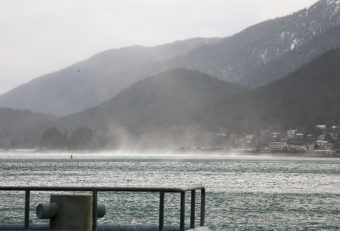
A cold weather phenomenon known as the Taku winds causes white caps and water to mist into the air on Friday, January 6, 2017, on the Gastineau Channel as seen from the U.S. Coast Guard Juneau station. National Weather Service issued a high wind warning for Juneau and Southeast Alaska that will last until Sunday afternoon, January 8, 2017. The warning was for hazardous high winds of about 60 to 80 mph. (Photo by Tripp J Crouse/KTOO)
A cold weather phenomenon known as the Taku winds causes white caps and water to mist into the air Friday, Jan. 6, 2017, on the Gastineau Channel as seen from U.S. Coast Guard Station Juneau. (Photo by Tripp J Crouse/KTOO)

John Hollis began serving in the Coast Guard in 1974. He transferred to Juneau three years later for a 13-month stint in public affairs.

“I liked it up there. My main job was to answer press queries,” Hollis said. “The biggest thing while I was there was the oil came down to Valdez, and worked that extensively.”

Hollis asks: What’s the highest wind speed recorded in Juneau? The answer will blow away this Coast Guard retiree.
Curious Juneau stars you and your questions. Every episode we help you find an answer. Catch up on past episodes, or ask your own question on the Curious Juneau page.

Hollis, 70, grew up in Southern California, but he said the weather he remembers in Juneau was somewhat comparable. Except it gets a little windier here.

“There’s an area south and just inland from Juneau where the wind just tunnels through there, just outrageous amounts of wind. I just don’t remember getting that kind of wind the one winter I was there in Juneau – not outrageous amounts of wind.”

So I called Sharon Sullivan, who’s a meteorologist intern at the National Weather Service.

She said records downtown are a little inconsistent because sensors are placed in different areas. And historically, there were just poor records.

“We did find at least the Federal Building had 78 mph wind gust Jan. 7, 2017, and some of the other ones was listing 57, 60 mph,” she said. “The airport we had — the highest recorded there was 92 mph at the airport on Nov. 1, 1969.”

She said in March this year, gusts of about 72 mph were recorded at the Juneau docks. Some Taku wind gusts in 2011 and 2015 reached as high as 85 mph.

“I think the one in 2015, a 15,000-pound gangway in the Douglas Boat Harbor was actually moved as a result of these higher wind speeds,” Sullivan said. “It takes a lot of force to move that.”

John Hollis retired from the Coast Guard in 1995, and later worked in publishing in Southern California. He and his wife now live in North Carolina to be closer to their grandchildren.

His memory of the winds as he experienced was fuzzy. He guessed they topped out around 20 or 30 mph, “Enough to certainly catch your attention.”

When I tell him they topped 90 mph at the airport, this was his reaction.

Hollis came back to Juneau about eight or nine years ago on a cruise ship. But he still remembers his commute from Douglas to the Coast Guard office in the Federal Building, all those years ago.

“The worst thing when I would walk to work in the winter, crossing the bridge, I would get all the snow going right in my ear.  That wasn’t very fun.

That doesn’t sound fun at all.

Yes, there really is a doll museum in Juneau and it’s filled with little treasures

A doll display at Aunt Claudia's Dolls museum in downtown Juneau. (Photo by Tripp J Crouse/KTOO)
A doll display at Aunt Claudia’s Dolls museum in downtown Juneau. (Photo by Tripp J Crouse/KTOO)

Kerri Tanner has lived in Juneau for six years — but there’s one place she’s never been, and she has lots of questions:


Curious Juneau stars you and your questions. Every episode we help you find an answer. Catch up on past episodes, or ask your own question on the Curious Juneau page.

“What is the doll museum? How did it come to pass? How do you get in it? How does someone collect enough dolls to put in a museum? Are they old worn teddy bears? Are they antique dolls?”

Tucked away on the second floor of the Triangle Building, there’s a museum filled with snapshots of history – but in this museum, they’re made out of wood, cloth and plastic.
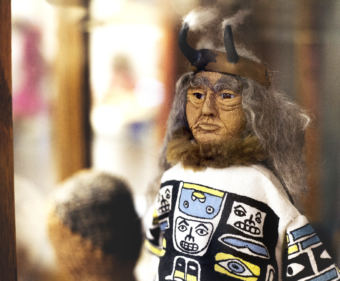
Aunt Claudia’s Dolls, a Museum, displays a collection of handmade Alaska Native and antique dolls.

The nonprofit museum’s curator is a dollmaker herself.

Mary Ellen Frank is the director and curator of Aunt Claudia's Dolls museum at 114 South Franklin, on the second floor of the Triangle Building. (Photo by Tripp J Crouse/KTOO)
Mary Ellen Frank is the director and curator of Aunt Claudia’s Dolls museum at 114 South Franklin, on the second floor of the Triangle Building. (Photo by Tripp J Crouse/KTOO)

Plastic, wood and tools clatter around as Mary Ellen Frank searches some boxes.

“I’ve sort of cleaned up now, because I’ve been … working on the museum more,” she says. “But this is a doll I’ve been working on.”

She picks up the torso and a head with long dark hair. She test fits the pieces together, along with a pelvis, and the doll begins to take shape.

“I’m interested in trying to do a fully articulating wooden body so there’ll be springs,” she says. “So she’ll be fully posable and movable. I’ve got her legs all ready to go. Here’s some of her springs.”

Born in 1952, Frank’s fascination with dolls began early. Some of the dolls that she had in her crib and as a young girl are nestled with care in a green shoe organizer hanging on her studio wall. There’s giraffes, knitted dolls and even a pink bunny.

Mary Ellen Frank shows off her studio and work space at Aunt Claudia's Dolls museum in downtown Juneau. Frank creates custom dolls and owns an extensive collection of Alaskan Native doll art. (Photo by Tripp J Crouse/KTOO)
Mary Ellen Frank shows off her studio and workspace at Aunt Claudia’s Dolls museum in downtown Juneau. Frank creates custom dolls and owns an extensive collection of Alaskan Native doll art. (Photo by Tripp J Crouse/KTOO)

Now she’s the director and curator of Aunt Claudia’s Dolls. Pictures of the museum’s namesake, Claudia Kelsey, are featured throughout museum.

A former state economist, Frank took a doll-making workshop in 1988, where she met Claudia.

“At that time, some little old lady with a doll collection. I sort of trivialized it,” Frank said. “But then I saw at Christmastime at times the state museum would put on shows of her dolls and they were so fascinating.”

Frank began visiting Claudia’s house weekly.

“She was mainly interested in antique dolls and dolls from around the world,” she said. “She had probably 800 dolls. Her thing, she was so proud that she had never purchased a doll personally. They’d all been given to her by family to start with and then people that knew that she loved dolls started giving her dolls.”

Claudia died about 10 years ago, leaving her collection of dolls with a friend, who in turn asked Frank what to do with them.

“I had a studio in this building so I said, ‘Until we find another place for them, we can move them into an adjacent room to my studio and I’ll store them there until we find another place.’”

They moved Claudia’s collection from the house to the studio, cabinet by cabinet and doll by doll.

The two women first opened the studio for its first First Friday in 2008. Then they decided the downtown location was the perfect place for the collection.

Claudia’s antique and cultural dolls are just one part of the museum. The other is Frank’s collection of Native American and Alaska Native dolls she’s collected — and some she’s made herself.

A doll in the likeness of Tlingit elder Walter Soboleff is on display at Aunt Claudia's Dolls museum in downtown Juneau. (Photo by Tripp J Crouse/KTOO)
A doll in the likeness of Tlingit elder Walter Soboleff is on display at Aunt Claudia’s Dolls museum in downtown Juneau. (Photo by Tripp J Crouse/KTOO)

She creates likenesses of Alaska Native leaders and elders, and favors Northwest Coast art and dolls. Frank took Northwest Coast carving classes and uses several of the tools in making her dolls. She even uses Alaska yellow cedar.

“Dolls are so culturally interesting and you can see so much about a culture from looking at these dolls,” Frank said. “And you kind of learn stuff by looking at the clothing that dolls provide. People don’t wear a lot of this clothing anymore but you get a picture of where it came from.”

Aunt Claudia’s Dolls is located at 114 S. Franklin St., Suite 105, with street access across from the Rockwell. Normally, it’s only open during tourist season, but the rest of the year the museum opens for First Fridays and Saturdays. This weekend, it’s open from 4 to 7 p.m. Friday and noon to 5 p.m. Saturday. Admission is free.

Our question asker Kerri Tanner plans to finally make it to the museum.

“When I think of doll museum, I don’t think of the Native dolls. I think of the typical baby doll or teddy bear,” Tanner said. “So it’s neat that she’s got all of it.”

David Purdy contributed to this report.

https://www.facebook.com/ktoopublicmedia/videos/1537051569727510/


Does Juneau really have a Florida federal building’s pelicans?

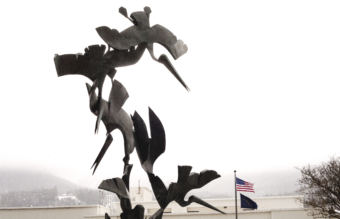
Bronze pelicans dive bomb the concrete behind a bus stop shelter near the Federal Building in Juneau on Thursday, Feb. 22, 2018. (Photo by Tripp J Crouse/KTOO)
Bronze pelicans dive bomb the concrete behind a bus stop near the Federal Building in Juneau on Thursday. (Photo by Tripp J Crouse/KTOO)

At the corner of Ninth Street and Glacier Avenue in downtown Juneau, there’s a 16-foot column of bronze.

Closer up, you can see the bronze was sculpted into nine individual pelicans, oriented so they appear to be diving — into pavement.


Curious Juneau stars you and your questions. Every episode we help you find an answer. Catch up on past episodes, or ask your own question on the Curious Juneau page.

In a handwritten comment on an official, federal General Services Administration condition checklist, one snarky inspector described it best: “The pelicans have yet to collide with the ground.”

But the closest place you’d find a live pelican is maybe near Vancouver, and that’s only in the summer, according to the Cornell Lab of Ornithology.

So what’s the deal with this statue? In this Curious Juneau, we try to find out why these temperate and tropical birds are in front of one of the capital city’s biggest buildings.

Tour guides share one pervasive local legend. Local Ken Kearny has heard it, too.

“Supposedly, the person that got the contract for that looked on the map and saw Pelican, Alaska, and made pelicans, although there aren’t any pelicans in Alaska.”

Another story is that there was a shipping mix up; somewhere in Florida, there’s a federal building with our eagle statue, and we got their pelicans.

An exhaustive search of an art database for Florida federal buildings did turn up some eagle artwork, but nothing old enough to match up with the pelicans sculpted in 1966.

A spokesperson with the General Services Administration said the mix-up story is just an urban legend, and the statue was no mistake.

But I’d gotten a tip that somewhere in the federal building’s bare-walled maze of a basement, there’s a painting of the pelican statue with valuable information on the back.

I wrangled a federal building employee for my pelican painting chase. We couldn’t find it under the dim, fluorescent lights.

We did find old architectural plans for the building. In some, it looks like the statue was supposed to be surrounded by a pool of water, which would explain why the birds are diving.

Part of a technical drawing of Juneau's Federal Building shows a sculpture at the corner of Ninth Street and Willoughby Avenue surrounded by a water feature. The drawing was in the basement of the federal building in 2017. The pool doesn't exist, but the sculpture of diving pelicans does, and they appear to be diving into pavement.
Part of a technical drawing of Juneau’s Federal Building shows a sculpture at the corner of Ninth Street and Willoughby Avenue surrounded by a water feature. The drawing was in the basement of the federal building in 2017. The pool doesn’t exist, but the sculpture of diving pelicans does. (Photo by Carter Barrett/KTOO)

Another local tale is that the artist didn’t know how to sculpt eagles. This is also false.

The artist, Thomas Hardy, passed away in 2016. But he sculpted the eagle on a presidential seal at a memorial in Washington D.C. for Franklin D. Roosevelt.

The eagle is perched on a “1933” with its wings outstretched.

An eagle sculpture is part of the Franklin D. Roosevelt Memorial in Washington D.C. as pictured here in January 2018. The artist, Thomas Hardy, also made the Diving Pelicans sculpture outside Juneau's Federal Building.
An eagle sculpture is part of the Franklin D. Roosevelt Memorial in Washington, D.C., as pictured here in January 2018. Artist Thomas Hardy also made the diving pelicans sculpture outside Juneau’s Federal Building. (Creative Commons photo by Plum Pine)

Hardy also made the University of California Berkeley campus’s golden bear statue. So that’s two iconic Alaska animals that were passed over.

After exhausting local leads, I filed a records request with the General Services Administration in D.C.

About a month later, a 90-page document arrived. It was mostly unexciting emails and maintenance forms about the statue.

But this local legend is something the government employees have tried to work out for themselves. In GSA emails, one employee contacted Hardy in 2011 and confirmed this story.

And it’s not nearly as exciting as local legend describes.

Architect Linn Forrest was working on Juneau’s federal building in the ‘60s when he visited Hardy’s studio in Oregon.

He saw Hardy working on the pelican statue and selected it.

That’s it. It’s anticlimactic. But maybe it’s not such a bad thing.

“It’s unique, it’s different. But we like it,” said Juneau resident Daneille Lepoidevin. “I’ve been here since 2000, and it’s always been part of Juneau.”

Bronze pelicans dive bomb the concrete behind a bus stop shelter near the Federal Building in Juneau on Thursday, Feb. 22, 2018. (Photo by Tripp J Crouse/KTOO)
Bronze pelicans dive bomb the concrete behind a bus stop shelter near the Federal Building in Juneau on Thursday. (Photo by Tripp J Crouse/KTOO)
Site notifications
Update notification options
Subscribe to notifications