Curious Juneau

Was there really a gun range in the basement of Harborview Elementary School?

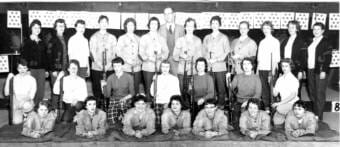
The 1958-'59 high school rifle club poses for a yearbook photo.
The 1958-1959 girls’ high school rifle club poses for a yearbook photo in the basement of Harborview. (Courtesy of Karleen Grummett)

As part of KTOO’s Curious Juneau project, a listener asked: “Was there really a gun range in the basement of Harborview Elementary School?”

The short answer is yes. It was there for decades, and there are plenty of people still around in Juneau who remember it.

Flipping through decades of Juneau’s high school yearbooks, you’ll find some dated extracurriculars, like candy stripers and the Future Homemakers of America.

You’ll also find the rifle club, which was founded in 1934. Karleen Grummett is a former member. 

“Rifle club was one of the more common groups to join in high school, and it sounded like fun to me,” she said. “They had both boys’ and girls’ rifle clubs, and they were both very well attended.”

Grummett participated in the club from 1958 until 1960, when she graduated from what was then Juneau High School (not yet Juneau-Douglas High School).

“It was just assumed that that’s where you went to learn how to shoot a rifle,” she said. “It was in the basement of the Harborview school.”

She joined the group hoping that if she could properly handle a gun, her father would take her hunting. 

The 1974-'75 high school rifle club as pictured in the yearbook.
The 1974-1975 high school rifle club as pictured in the yearbook. (Bridget Dowd/ KTOO)

“That didn’t happen, but we still had a lot of fun,” Grummett said. “It was really noisy down there in that basement, with all the guns going off. I have nothing but fond memories of it.”

The girls would start in the prone position and work up to sitting, kneeling and standing.

“There were certain goals for each of those positions,” she said. “At the end of the year, you were awarded some brass bars that you put on a pin on your high school sweater.”

Club members could work their way up to “expert” or “distinguished” levels, and Grummett was proud to achieve the expert title.

Karleen Grummett (then Karleen Alstead) saved this certificate from her time in the Juneau High School rifle club in the late 1950s.
Karleen Grummett (then Karleen Alstead) saved this certificate from her time in the Juneau High School rifle club in the late 1950s. (Courtesy of Karleen Grummett)

“But I was a little disappointed when I found out later that the way to get your ‘distinguished’ was to get special time at the gun range, and that wasn’t readily available to women at that time,” she said.

But the high school rifle club wasn’t the only organization to use the Harborview gun range. James Cartmill wasn’t yet 10 years old when he started taking gun safety classes through Territorial Sportsmen in the early 1970s.

“There was an open area down there [in the Harborview basement] right next to the rifle range that we would go in and play around until our names were called,” he said.

Courses were held for several weeks each year, and Cartmill’s family was heavily involved. 

“My mom would be the one that would take down the names at the front door,” he said. “You would check in with her, and then they would have movies on shooting safety and hunting. My dad would run the movie projectors in the library area.”

At one point, Cartmill remembers there being about 50 kids involved in the program.

“There was, I believe, five different stations, and each one of the stations had a coach or an adult there to tell you how to use the gun, your breathing, your sight alignment, your trigger squeeze,” he said.

At the end of each day, the kids took their targets home to show off and later received certificates of completion. A few years later, in 1986, Ryan Scott took a hunter education class in the Harborview basement. Now he teaches the course through Alaska’s Department of Fish & Game, but a lot has changed since he first learned to shoot.

“Many of us, when we were older, especially in high school when we were able to drive, would hunt in the mornings before school started or in the afternoons as soon as it got done,” Scott said. “Certainly, I had shotguns in my vehicle because that’s what I was doing after school.”

The 1946-'47 high school rifle club as pictured in the yearbook.
The 1946-’47 high school rifle club as pictured in the yearbook. (Photo by Bridget Dowd/ KTOO)

Nowadays, taking a gun to school would land you in a lot of trouble. Debates over American gun laws heated up over the years as mass shootings became more frequent. 

Scott said his courses aren’t just for hunters, and being familiar with a gun could help dispel some of the fear people associate with them.

“That does give an individual more comfort, just understanding what the firearm really is and what it will do,” Scott said. “And then also knowing, well, this is the type of ammunition. You know, it’s not a shotgun shell, it’s a cartridge, and this is a revolver, this is a semi-automatic pistol, things like that.”

Scott said that education could come in handy even if you don’t have a gun in your home because it’s not uncommon to come across one in someone else’s, especially in Alaska. 

Continuing through those high school yearbooks, the number of rifle club members gets much smaller in the late ’70s, then the club disappears completely.

The 1976-'77 high school rifle club as pictured in the yearbook.
The 1976-1977 high school rifle club as pictured in the yearbook. The club practiced in the basement of Harborview. (Photo by Bridget Dowd/ KTOO)

As for the rifle range at Harborview, it’s long gone. The school was renovated in the early 2000s and didn’t include a range. Around that time, a new gun range was built in Montana Creek.

But for James Cartmill, when it comes to gun safety, some things haven’t changed. He and his two grown children still go hunting, employing the lessons he learned in Harborview’s basement more than 40 years ago.

“You know, it’s not a toy, it’s a weapon,” he said. “That’s something that I’ve instilled in my kids.”


Are you curious about Juneau, its history, places and people? Or if you just like to ask questions, then ask away!

Is there gold in them thar beaches?

Curious Juneau

It’s after work, and the summer sun and the tide are out at John Wright’s go-to fishing spot in Juneau: the wide, sandy beach where Sheep Creek meets Gastineau Channel.

“I’ve been fly fishing in Alaska — Juneau specifically — for seven years. I’ve been fly fishing for 20 years. I’m 32, so that’s a good chunk of my life. … This is probably one of the first places I fished when I moved here, and the first place I broke a rod, here as well.”

He caught something too big.

“Yeah, the chum salmon. FEROCIOUS.

A few years back, he says he started noticing someone showing up on the beach with a different hobby.

“If I recall correctly, my first years here, there were no dredgers here. And then one day, there was maybe one? And it just seems like, within a couple years there were many. And you know, I’ve just always been curious.”

They’re dredging — for gold.

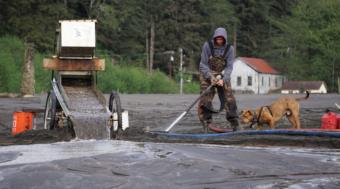
On this day, we count seven different rafts on the beach with motors, pumps, hoses, ropes, wheeled sluice boxes and plastic tubs. It’s weekend warriors’ gear for recreational gold dredging.

Nathan Brooks tidies up his raft at the beach near Sheep Creek in Juneau on May 15, 2019. He and other recreational gold dredgers leave their gear out there.
Nathan Brooks tidies up his raft at the beach near Sheep Creek in Juneau on May 15, 2019. He and other recreational gold dredgers leave their gear out there. (Photo by Jeremy Hsieh/KTOO)

The rafts themselves are made of pallets, wood and big foam blocks lashed together, about the size of a big mattress. The combination of improvised, DIY stuff and special gold-sifting gear probably ordered off the internet looks real janky, like something out of “Mad Max” or “Waterworld.”

The beach itself is pockmarked with unnatural pits about as deep as a bathtub.

“They’ve been pretty busy,” Wright says.

The rafts are tied up to old pilings and big rocks that’ll be underwater when the tide comes in. They’re unattended, except for one. We head over so Wright can ask one of these DIY dredgers about what they’re doing.

“What if they don’t want to share their secrets?” Wright wonders aloud.

A pitbull named King is keeping watch around a fresh pit in the sand. His owner is in hip waders, spraying seawater from a hose into the pit. His name is Nathan Brooks, and he’s game to answer Wright’s questions over King’s protest.

Nathan Brooks sprays seawater into the sand at the beach near Sheep Creek in Juneau on May 15, 2019, while his pitbull King watches. The slurry gets pumped to the top of his sluice box.
Nathan Brooks sprays seawater into the sand at the beach near Sheep Creek in Juneau on May 15, 2019, while his pitbull King watches. The slurry gets pumped to the top of his sluice box. (Photo by Jeremy Hsieh/KTOO)

“How much time do you think you spend out here, and is there a season?” Wright asks.

“Depends on the tides, really,” Brooks says. “The season is more when it’s warm, not so much the frozen ground. Other than that, it’s when the tides let us. You know, the best times is when the tide’s going out.”

Brooks’ raft is about 50 feet away in the water. One hose is running seawater up the beach to the pit. Another hose in the pit is sucking the slurry out and up to the top of his sluice box. He’s got it propped up on a float and some buckets.

We can’t see through the slurry, but the bottom of the box is lined with special mats with a bunch of little ridges. They’re supposed to trap tiny bits of gold and let the less-dense sand and pebbles run off.

Brooks has been out here all afternoon. He won’t know if he’s had a good day until the end.

Nathan Brooks sprays seawater into sand on the beach near Sheep Creek in Juneau on May 15, 2019. It's part of his recreational gold dredging operation.
Nathan Brooks sprays seawater into sand on the beach near Sheep Creek in Juneau on May 15, 2019. It’s part of his recreational gold dredging operation. (Photo by Jeremy Hsieh/KTOO)

“On a good shift, we can run an ounce a day, you know, if we catch both tides. We can pull an ounce out of the ground,” Brooks says. “I’ve pulled over 40 ounces out of here.”

Spot gold prices have spiked above $1,300 an ounce a few times this year. When the math catches up with our brains, all that comes out of our mouths is “Whoa!” and “Wow!” and some goofy chuckles.

“When I see this, I just see this big, kind fan of sand,” Wright says, looking across the beach. “What do you see when you look at this landscape?”

Nathan Brooks tidies up his gold dredging gear at the beach near Sheep Creek on May 15, 2019. He and other recreational gold dredgers leave their gear out there on makeshift rafts.
Nathan Brooks tidies up his gold-dredging gear at the beach near Sheep Creek on May 15, 2019. He and other recreational gold dredgers leave their gear out there on makeshift rafts. (Photo by Jeremy Hsieh/KTOO)

“I see money! That’s what I see when I look around,” Brooks says. “There is a payout, but it’s nice just being able to let my dog run out on the beach, and hang out here and just kind of do my own thing.”

He got into this hobby with his dad three or four years ago. King helps out too, pulling gear up the beach.

“He really does, actually. I hook him up to the end of it, he helps me pull the heavy thing back up, in and out.”

There are a lot of different rules around recreational mining. Some kinds require state permits, some don’t. Brooks says this spot is special, because if you follow the rules, you don’t need a permit, and unlike other spots, you’re not jumping on anyone else’s claim. The sand is special, too: It’s the pulverized tailings of a nearby mine that closed long ago, so there’s leftover gold.

Nathan Brooks checks his sluice box after shutting down his gold dredging operation for the day on the beach near Sheep Creek in Juneau on May 15, 2019. He spent all afternoon out there.
Nathan Brooks checks his sluice box after shutting down his gold-dredging operation for the day on the beach near Sheep Creek in Juneau on May 15, 2019. He spent all afternoon out there. (Photo by Jeremy Hsieh/KTOO)

Eventually, Brooks shuts off his pumps and wraps up for the day.

He points out some sand spotted with yellow flecks in his mats.

“Not too bad,” he says. “There’s some of it. It’s in that real fine area, you can see it up in that corner.”

Recreational gold dredger Nathan Brooks says there's gold and pyrite in his sluice box on May 15, 2019, at the beach near Sheep Creek in Juneau. The ridges in these mats are designed to trap gold.
Recreational gold dredger Nathan Brooks says there’s gold and pyrite in his sluice box at the end of his day on May 15, 2019, at the beach near Sheep Creek in Juneau. The ridges in these mats are designed to trap gold. (Photo by Jeremy Hsieh/KTOO)

It isn’t very shiny.

“Nope, that’s a mistake,” Brooks says. “People always think it’s real shiny, and that’s that pyrite. Which, there is pyrite in there, also.”

John Wright had a good day, too. He caught two Dolly Varden trout. But he doesn’t think he’ll be switching hobbies.

“No,” Wright says. “I think I’ll just stick with mine. Mine’s much more peaceful.”

For a profile of an especially colorful gold dredger, check out filmmaker Beau Sylte’s short film about Ray Rusaw from a few years ago.

Curious JuneauHave your own Curious Juneau question? Submit it here. You can also subscribe to the Curious Juneau podcast and catch up on past curiosities at ktoo.org/curious.

Does Juneau really have the smallest Costco in the world?

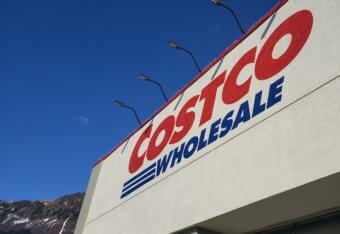
Even in the middle of the workday Tuesday, March 26, 2019, there's steady traffic at Costco in Juneau.
Even in the middle of the workday on Tuesday, there’s steady traffic at Costco in Juneau. The city assessor’s records put its total square footage at 76,696. (Photo by Jeremy Hsieh/KTOO)

The other day, Phil Fleming was loading up a car in the parking lot of the Costco in Juneau. He said a salty version of something you may have heard before.

“Just now on the phone, actually, a woman was saying, ‘Yeah, that’s the smallest damn Costco I’ve ever seen,’” he said. “She’s comparing it to the Seattle and Anchorage ones. … It’s one of the smallest, from what I’ve heard.”

But is it the smallest Costco in the world?

“As far as I can tell, that is true, yes,” said Costco Wholesale Assistant Vice President Kevin Green.

He oversees the warehouse club chain’s northwest regional operations. He said that’s out of 770 Costco locations on four continents.

There was some wiggle room in his initial answer, so I pressed him.

“Are there other ones that are close that leave you some doubt?” I asked.

“No. Absolutely not,” Green said.

Green said the Juneau Costco, built in 1993, was a prototype, one of only a few that small. There was also one in Sequim, Washington. A full-sized Costco eventually replaced that one.

“And yeah, at the time, it was a test to see if that kind of smaller-market format would work. We’ve since decided that it probably doesn’t,” Green said. “But it does work in Juneau.”

Juneau’s Costco is about half the size of a typical store, which is around 160,000 square feet. Like the one that opened in Fairbanks in November.

And it’s only a third the size of the world’s biggest in Salt Lake City, Utah, which was also a test build, Green said. It opened in 2015.

Size comparison by area of the largest and smallest Costco stores in Salt Lake City and Juneau. (Graphic by David Purdy/KTOO)

In Juneau, Green said the geography limits growth and makes shipping challenging. But it is a profitable store, with 2-to-3 percent growth per year and 100-plus employees.

Back in the parking lot, customer Steve Houlihan ventured a guess about why Juneau’s store can cut it.

“I think, ’cause of the villages and all the stuff that comes remotely here, this seems like this gets a lot of use,” Houlihan said. “But it doesn’t seem like the parking lots are as full as down south. You can’t get in and out of them down south.”

ToshCo is a hardware and grocery store in Gustavus, pictured here on June 2, 2018. Many of its products come directly from Costco in Juneau. (Photo by David Purdy/KTOO)

There is one patron, about 70 miles away by boat, who’s about as transparent as can be about his dependence on Costco: Toshua Parker, founder of ToshCo.

He said the hardware and grocery store in Gustavus is about eight years old now. When he started it, it was named Icy Strait Wholesale. But the community promptly rebranded it.

“Everyone calls it ToshCo,” Parker said. “Before the doors opened, people started calling it that because my name’s Tosh and most of the products in the beginning all came from Costco in Juneau.”

Parker said Costco’s store-brand products are pretty ubiquitous in Gustavus, which has a year-round population of about 450.

But Caroline Malseed in Juneau thinks she’s missing out.

“We would like it to be bigger,” she said. “More stuff.”

Juneau’s not actually missing out on that much. Green said there are about 3,200 products in Juneau’s warehouse. A typical Costco warehouse has about 3,800 products at a time. That’s a small fraction of the selection at a typical big-box everything store — and part of Costco’s strategy for controlling costs.

The company did explore a 12,000-square-foot expansion in 2006, though it never happened. Green said it’s still a possibility, but there are no current plans.

Fleming is OK with that.

“I can’t say — maybe if I saw a bigger one, then I’d be, ‘Oh yeah! We gotta have a bigger one!’ Right now I’m pretty, pretty gruntled with it,” Fleming said.

I asked Green to weigh in on one more Costco controversy: Within the store, do you shop clockwise, or counterclockwise?

“Um, I always go counterclockwise, yeah,” Green said. “Although, there’s some — like where we work in Issaquah, if you go into that building, you do go clockwise, because that’s the way it’s laid out. So there are some. Yeah.”

Curious JuneauHave your own Curious Juneau question? Submit it, subscribe to the Curious Juneau podcast, and catch up on past curiosities at ktoo.org/curious.

Volunteers get thumbs up on spruced-up peace sign redesign

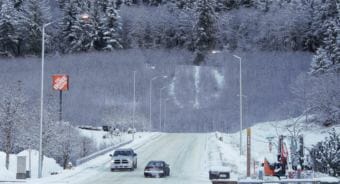
The alder trees -- and the peace sign among them -- at the end of Commercial Boulevard in Juneau are about 10 years old, pictured here on Jan. 8, 2019. The slope was cut and stabilized as part of the construction of the Home Depot.
The alder trees — and the peace sign among them — at the end of Commercial Boulevard in Juneau are about 10 years old, pictured here on Jan. 8, 2019. The Juneau Urban Forestry Partnership and local chapter of Veterans for Peace got an OK from a Juneau Assembly committee on Monday to prune the overgrowth and plant spruce seedlings in the peace sign’s footprint. (Photo by Jeremy Hsieh/KTOO)

On Monday, a Juneau Assembly committee authorized the local chapter of Veterans for Peace and the Juneau Urban Forestry Partnership to do some new landscape work on the peace sign at the end of Commercial Boulevard.

In January, KTOO told you the story behind the huge peace sign carved out of the foliage on the hill. That was the story with surveyor and guerrilla artist Garrith McLean explaining how he laid out the symbol back in 2008.

“It wasn’t anything political,” McLean had said. “Art for art’s sake, you could say.”

The new work will be on the up-and-up. The groups plan to enlist volunteers to prune some of encroaching vegetation, and to plant spruce seedlings in the footprint of the peace sign. Eventually, they expect the spruce will outgrow and contrast with the existing alders on the hillside.

Gene Miller is a retired forester and member of both groups.

Gene Miller, left, and Craig Wilson pose for a photo in downtown Juneau on March 21, 2019. Miller is a retired forester and member of Juneau Veterans for Peace and Juneau Urban Forestry Partnership. Wilson is president of Juneau Veterans for Peace. The groups recently got an OK from a Juneau Assembly committee to landscape the peace sign at the end of Commercial Boulevard. Miller is holding a photo of the peace sign lit by people with headlamps and flashlights taken on Martin Luther King Jr. Day in 2014.
Gene Miller, left, and Craig Wilson pose for a photo in downtown Juneau on Thursday. Miller is a retired forester and member of Juneau Veterans for Peace and the Juneau Urban Forestry Partnership. Wilson is president of Juneau Veterans for Peace. Miller is holding a photo of the peace sign lit by people with headlamps and flashlights taken on Martin Luther King Jr. Day in 2014. (Photo by Jeremy Hsieh/KTOO)

“People will begin to notice, we think, greening up of the spruce trees in about 5 years, because spruce that are well cared for will grow about 18 inches a year,” Miller said. “Most of us won’t be around long enough to see the full outcome.”

He said spruce trees can live as long as 800 years.

The timeline for the work isn’t set, but they’re aiming for this summer.

“Our vision is that the peace sign will persist, and particularly the children in the community today that hear about it as adults maybe 50 years from now, some of them will be coming back to Juneau and say, ‘Oh, I remember when —’ that type of thing,” Miller said.

Have your own Curious Juneau question? Submit it, subscribe to the Curious Juneau podcast, and catch up on past curiosities at ktoo.org/curious.

Curious Juneau

Curious Juneau: Why do Norah Jones tickets cost over $500?

Norah Jones performs on tour in 2010 promoting her album "The Fall."
Norah Jones performs on tour in 2010 promoting her album “The Fall.” (Creative Commons photo cropped from original by youngrobv)

Juneau mom Mara Jennings said she was over the moon when she found out Norah Jones was playing a concert in Juneau. Over the years, she’s sung the nine-time Grammy Award winner’s songs like lullabies to her kids at night.

“Yeah, moms get emotional about the songs they sing to their babies growing up. … I absolutely love her. I actually cried a bunch on Friday.”

That was Feb. 1, when the tickets went for sale online through Ticketfly. Jennings had an account ready and an alarm set to buy tickets. But they immediately appeared sold out.

Face value tickets started at about $60. She found tickets on other websites — of ticket resellers, also commonly known as “scalpers” — with huge markups she can’t afford. Up to $585 each.

So why did the prices get so high?

Curious Juneau

Have your own Curious Juneau question? Submit it, subscribe to the Curious Juneau podcast and catch up on past curiosities on the Curious Juneau page.

First off, Norah Jones’ team, the concert promoter and the ticket vendor all declined or didn’t respond to requests for comment.

But I did find someone with years and years of experience with events and ticketing in Juneau: Nancy DeCherney, executive director of the Juneau Arts and Humanities Council. She also oversees Centennial Hall, which Norah Jones booked for her upcoming concert in July.

She can’t think of another act that’s come to Juneau that’s topped the fervor around Norah Jones.

“Well, people seem pretty upset that they didn’t get tickets. Yeah, it’s caused quite a stir,” DeCherney said. “You know, it’s a small venue for heaven’s sakes.”

To be clear, the arts council wasn’t responsible for the Norah Jones ticket sales, but as the manager of the concert venue, it was given access to an early, limited sale for its members. Similarly — full disclosure — Jones’ team gave KTOO members access to the same early sale after buying promotional underwriting.

DeCherney said professional ticket reselling is rare in Juneau. She can remember one notable case during one of her first years involved with Wearable Art.

“A young man came in and bought more Wearable Art tickets than necessary and sold them on eBay,” she said.

She didn’t know if it worked out for him.

“I mean, it’s a small town, and so we all knew who it was. You know what I mean?” she said, laughing.

At its core, the high prices are an indication of a supply-and-demand imbalance. Too many buyers for too few tickets. Mara Jennings suspects pros may have inflated demand for Norah Jones’ concert.

“Well, my message to Ticketfly,” Jennings said, “would be that I think it would be a step of good faith for them to research the ticket sales for this event and to see if someone has purchased an unusually large number of tickets.”

DeCherney said event organizers and ticket vendors like Vendini, which her organization uses, have a bunch of common ways to combat third-party sellers:

  • Cap how many tickets each buyer can get.
  • Make the tickets non-transferable.
  • Reserve some tickets to sell at the door.

Grumpy consumers probably don’t have a legal recourse. A state Department of Law spokesperson said there’s nothing on the books about reselling tickets.

But many states have tried to legislate remedies. New York, for example, outlaws software-assisted mass buys and requires ticket resellers get licensed and bonded.

Which is secondary market stuff. Before tickets get there, performers do have a supply-side lever of their own. Just this week, Norah Jones announced she was adding a third show in Anchorage due to demand as part of her tour.

And (hint hint, nudge nudge) Norah Jones’ tour schedule has a few buffer days on either side of her show in Juneau.

“I will be hopeful that I will be able to find a way to go enjoy her music live,” Jennings said.

How a mischievous Home Depot surveyor turned this hill into guerrilla art

The alder trees -- and the peace sign among them -- at the end of Commercial Boulevard in Juneau are about 10 years old, pictured here on Jan. 8, 2019. The slope was cut and stabilized as part of the construction of the Home Depot.
The alder trees — and the peace sign among them — at the end of Commercial Boulevard in Juneau are about 10 years old, pictured here on Jan. 8, 2019. The slope was cut and stabilized as part of the construction of the Home Depot. (Photo by Jeremy Hsieh/KTOO)

Curious Juneau

Have your own Curious Juneau question? Submit it, subscribe to the Curious Juneau podcast and catch up on past curiosities on the Curious Juneau page.

In Juneau, a lot of people like Wes Adkins have wondered aloud about this:

“Ever since I moved to Juneau in 2012, I’ve been passing by this gigantic peace sign carved into the vegetation above Home Depot and Costco up in Lemon Creek,” he said. “I’m sure aliens didn’t do this. … Who do I need to thank for this creative work of art for our city?”

He’s got surveyor Garrith McLean to thank. We met up the other day at the end of Commercial Boulevard, next to his handiwork.

“Well, you know, my son and I worked on the Home Depot project, building this. And when we were done, we had this bare hill here, and it just seemed like it would be fun to have some artwork on it,” McLean said.

In 2008, he was working for the construction company that built the Home Depot. Now 63 years old, he’s got long hair and a long beard that sits on his overcoat. It’s mostly gray with ginger roots — think ZZ Top, but with a vibe more like The Dude from “The Big Lebowski.”

Garritt McLean catches his breath along the Lemon Creek Trail in Juneau on Jan. 8, 2019.
Garrith McLean catches his breath along the Lemon Creek Trail in Juneau on Jan. 8, 2019. (Photo by Jeremy Hsieh/KTOO)

“Sure! I mean, I’m a giant fan, but I have not been to any of the fan clubs or the drinkathons,” he said. (For the record, his look predates the 1998 Coen brothers movie.)

We hiked up a switchback to the top of the peace sign. The slope was steep below us. It’s getting overgrown with alders, but the vertical part of the peace sign is so precisely aligned with Commercial Boulevard that, visually, it still pops.

McLean pointed to a spot a half-mile away where he surveyed the hillside that would be his canvas.

Garritt McLean explains how he applied his expertise as a surveyor to lay out a peace sign on the hill at the end of Commercial Boulevard in Juneau on Jan. 8, 2019. McLean made the guerilla art in 2008 after working on the construction of Home Depot.
Garrith McLean explains how he applied his expertise as a surveyor to lay out a peace sign on the hill at the end of Commercial Boulevard in Juneau on Jan. 8, 2019. The gap in the alders is the vertical part of the peace sign. (Photo by Jeremy Hsieh/KTOO)

“I stood at the instrument, way down at the end of the road there —”

“The instrument” is the thing on a heavy tripod that construction crews use that looks like a telescope or chunky camera.

“Yeah, the theodolite. … So what I did was I just calculated the angle, the vertical and horizontal angle for each of the 36 points, at 10 degrees around the circle,” he said.

So the circle is really a 36-sided polygon.

Garrith McClean took these surveyor's notes in 2008 to help lay out the peace sign at the end of Commercial Boulevard in Juneau in 2008.
Garrith McClean took these surveyor’s notes in 2008 to help lay out the peace sign at the end of Commercial Boulevard in Juneau in 2008. (Photo courtesy Garrith McLean)

“And so that was pretty easy. Just sine and cosine. … Straight trig. ”

Hear that, high schoolers? Guerrilla art: a practical application for trigonometry.

“The guys ran around on the hill, and they stuck the survey points in the ground all around the circle,” McLean said.

It’s “guerrilla” art because the city owns the land. They didn’t ask permission.

“Well, you know, that was maybe an issue,” McLean said with a guffaw. “So, maybe we should have gotten permission. We didn’t really think or even consider the possibility of it being depicted as graffiti. But it may have been so, in fact.”

Initially, they marked the peace sign with dark topsoil. The hillside was basically bare then, with only a light-colored jute meshing on it for stabilization. He showed me a photo — it’s like someone took a giant Sharpie to the hillside.

The slope at the end of Commercial Boulevard in Juneau cut and stabilized with jute meshing as part of the construction of the Home Depot in 2008. Surveyor Garrith McLean said that made for a good canvas -- hey laid out this peace sign with topsoil.
The slope at the end of Commercial Boulevard in Juneau was cut, then stabilized with jute meshing, as part of the construction of the Home Depot in 2008. Surveyor Garrith McLean said the slope made for a good canvas; he laid out this peace sign with topsoil. (Photo courtesy Garrith McLean)

He’s not sure, but he thinks city workers used leaf blowers to clear away the topsoil after a few days. McLean didn’t really maintain it after that. He thinks other volunteers over the years have used the markers still in the ground to clear the brush.

The peace symbol itself was popularized during the Cold War. It’s a representation of the letters “n” and “d” for “nuclear disarmament” in a visual code called semaphore.

That really wasn’t on McLean’s mind.

“It wasn’t necessarily a patriotic or political statement of any kind. It was merely a continuation of my life as I lead it,” he said. “My Volkswagen bus has peace symbols all over it, and it was just part of my heritage, I guess you could say. So it wasn’t anything political.”

Or, as Jeff Bridges as The Dude might have said…

https://youtu.be/mdcJrFMGoAI

McLean said it was art for art’s sake.

Cue Bob Dylan’s “The Man in Me.”

Site notifications
Update notification options
Subscribe to notifications