Makenzie O’Halloran makes a sandwich at Subway in the Mendenhall Valley on Tuesday, March 12, 2024. (Clarise Larson/KTOO)
Fast-food restaurants have come and gone from Juneau for decades — but very few stick around for long.
Beyond Subway, McDonald’s, Domino’s, Papa John’s and Papa Murphy’s, you won’t find any other national chains in the capital city. Sure, there are restaurants like Pel’meni’s or Crepe Escape downtown where you can get food fast, but that’s not what we’re talking about.
Do you have a Curious Juneau question? Submit it at the bottom of the page.
Some residents, like Ken Judson, who was grabbing a Subway sandwich during a recent lunch hour, wish they had more choices.
“Oh you know, Taco Bell or Burger King. Arby’s,” he said. “We see the commercials, but we’re always stuck with the one McDonalds, and there used to be other stuff. I think there’s still room for more.”
He’s right — partly. Juneau once had popular chains like Taco Bell, Burger King and Wendy’s. Some even had multiple locations. But they came and went. Several Curious Juneau listeners asked KTOO why that is.
Any day of the week you can pull up to McDonald’s in Juneau and grab a Big Mac and fries. It’s right by the McNugget intersection. When it opened in 1982, corporate officials said it sold more hamburgers and fries in its first week than any other store in the company’s history.
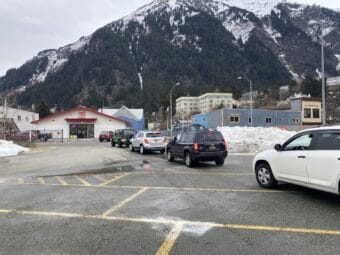
And at one point there were two McDonald’s in Juneau. A second one opened downtown, four years after the first one, where Heritage Coffee is now. That one closed in 2010.
The former downtown McDonald’s location in Juneau. (Photo courtesy of City and Borough of Juneau)
There’s no Taco Bell in Juneau today, but once there were two of those, too. Wendy’s, Kentucky Fried Chicken, Taco Time, Burger King and Baskin Robbins — they all came and went by the mid-90s. Burger King even had a food truck, but that shut down, too.
Bruce Denton opened the Senate Building on South Franklin Street downtown in 1982 and still owns it today. Wendy’s and Burger King had locations there in the 80s.
“It’s interesting when you look historically at Juneau,” he said. “I mean, we had a Kentucky Fried Chicken for years that isn’t here anymore. We had Taco Time and a Taco Bell. McDonald’s is kind of the sole success story.”
Denton said the downtown area is tough for restaurants in general — but especially fast food — because you can’t put in a drive-thru, and there’s not enough foot traffic.
“They clearly weren’t getting enough traffic,” he said. “Particularly in the winter. And you think about the cruise ship passengers, one thing about the cruise is that they’re royally fed. So there’s not a lot of tourists that are scrambling in to eat.”
One of the few fast-food restaurants in Juneau that has passed the test of time is Subway. Its owner is Assembly member Wade Bryson.
A photo of the old Wendy’s restaurant in the Senate Building downtown where the Bear’s Lair and Juneau Artist’s Gallery now reside. (Photo courtesy of Senate Mall)
He said owning any business in Juneau is tough, but trying to make money in fast food here is like walking a razor-thin wire.
“What do you call a business without profit? You call it closed,” he said. “So, once a business doesn’t cross a profit threshold, it can’t continue to operate. It is hands-down one of the most challenging locations in the United States to operate a business.”
Bryson took over the two existing Subway restaurants in Juneau in 2004, one in the valley and one downtown. The downtown location burned down less than a year later. He opened another one in Lemon Creek in 2010, but that closed in 2015. Then he opened yet another one downtown, but closed it in 2020.
Like many businesses in Juneau, he said that fast-food restaurants deal with three big issues: inflated prices, lack of housing and a struggle to find workers. To make a profit, he said he typically needs to charge about 30% more than what a Subway sandwich would cost in the Lower 48.
“The cost of food is just escalating literally on a daily basis,” he said. “And in Alaska, the housing crisis, which led to the employment crisis, which led to the wage crisis, which has now compounded the housing crisis — I mean, it’s all just circling together.”
None of this is new. Even back in 1995, former McDonald’s owner and operator Mike White told the Juneau Empire that finding employees in Juneau was tough. Dale Martens, the former vice president of the Anchorage Taco Bell of Alaska was quoted in the story saying that staffing in Juneau “has always been a challenge.”
Bryson said the demand for fast food in Juneau hasn’t gone away, but running a restaurant in Juneau often just doesn’t pencil out.
“I wish I had a dollar for every time someone asked me to open a Taco Bell here in town — I would have had enough money to do it,” he said.
Curious Juneau
Are you curious about Juneau, its history, places and people? Or if you just like to ask questions, then ask away!
The Salvation Army Family Store on a busy Saturday donation day in February 2024 (Photo by Anna Canny/KTOO)
Dick Wood wrestled white garbage bags and cardboard boxes from the backseat of his beat up red car.
There were children’s books, toys and clothes that once belonged to Wood’s son, who is 35 now with a brand new baby.
“We were saving it for his kid, and they don’t want it,” Wood said. “His generation, they don’t want clutter.”
Wood pulled out a yellow, plastic hobby horse mounted on a rusted blue frame, then a crib with a sun-faded orange cover.
Do you have a Curious Juneau question? Submit it at the bottom of the page.
“Vintage,” Wood said. “Vintage is hot!”
When Juneau residents want to get rid of their vintage wares — or their junk — they can line up for Saturday donation days at the Salvation Army Family Store. Behind Wood, there are dozens of cars waiting. They spill over into the parking lot across the road.
Everything that’s dropped off gets packed into a shipping container in the store’s back parking lot. Once that fills up, anyone left waiting in line is turned away. Sometimes, the store gets so full that they have to stop taking donations altogether.
That’s left people like KTOO listener Mary McEwen with would-be donations piling up in their attic or the trunk of their car.
“I mean, a lot of us have a bag somewhere that’s like, ‘Oh man, next time I have time on a Saturday morning for that one window where you can drop things off at Salvation Army,” McEwen said.
For this installment of Curious Juneau, McEwen asked KTOO to find out why it’s so hard to get rid of things in town — and what alternatives are there when the thrift stores fill up.
Volunteer Jamie Raymond packs donations into a shipping container is the back lot of the Salvation Army Family Store downtown (Photo by Anna Canny/KTOO)
Everything — including the kitchen sink
On a sunny Saturday in February, Salvation Army store manager Christina Austin was all bundled up. But the weather hinted of spring. That usually leads to a spike in donations.
Juneau’s many seasonal residents also contribute to the ebb and flow. Austin said there’s more people trying to get rid of things at the ends of the legislative session and the tourist season.
“They just get stuff, just for the season, and then they fill their apartment or their studio just temporarily,” Austin said. “People always say that they’re just borrowing it, and it’s coming back to the store.”
The store’s capacity to accept those donations is mostly limited by staffing, Austin said. She’s one of two full-time employees, but all of the sorting and pricing is done by volunteers.
Those volunteers ebb and flow with the seasons too. Folks drop off during the holidays or over the summer. Also, a lot of volunteer groups disbanded during the pandemic. It’s taken a while to rebuild them.
Mary Ellen Frank stands next to the sorting table at the Salvation Army Family Store. All the donated household items – including two kitchen sinks – are examined and priced here by volunteers (Anna Canny/KTOO)
Mary Ellen Frank stuck around. She spends every third Saturday in the store’s back room, stationed in front of a giant sorting table, which has everything — a box of dented water bottles, a teasing comb in its original packaging from the 1960s, a vintage dissection kit in an alligator leather carrying case. And not one, but two kitchen sinks.
“I don’t know why the kitchen sink has to be there. I don’t even think I could pick that up,” Frank said. “That’s unusual. There’s always something new.”
Frank’s job is to decide what’s sellable. She’s an avid second-hand shopper herself — it’s how she sources materials as the curator of Juneau’s doll museum — so she approaches the table with an open mind.
Other options for recycling old clothes: Clothing swaps — host one with friends or participate in a public one such as the swap at the Mendenhall Valley Public Library on Saturday 3/23 at 12 p.m.
“We’ve got a good balance of people that are kind of like, ‘Ehhh, get rid of it,’ Frank said. “And me like, ‘Ahhh, that has so much potential!’”
Still, Frank estimates they throw out about 20% of what gets dropped off. So far, she’s discarded some cloth face masks, a tote bag with torn handles and a scorched, stained potholder.
It’s not unheard of for people to donate straight up trash. Austin worries that could become more common because of rate hikes at the landfill.
Junk items can clog up operations at the St. Vincent De Paul thrift in the Mendenhall Valley, too, according to store manager Sharon Mallet. And at both stores, things that don’t sell within a few weeks have to be cleared to make more space on the store floor — which means some things might head to the landfill later.
Mallet said she does her best to prevent that, because she learned to make the most of secondhand materials while growing up in the Caribbean.
“I grew up on an island, so this to me — I think I just fit right in,” Mallet said. “I remember as a kid, you made everything last or you reused it a different way.”
Items that are beat-up but usable go to the Dan Austin Center Free Store. Shrunken wool sweaters get put aside for a local artist who makes mittens for people experiencing homelessness. And ripped cotton t-shirts become rags, which the store sells to boat owners or contractors.
Though the garbage collectors come once a week, Mallet said she can’t remember the last time the store’s dumpster was full.
Still, Juneau’s thrift stores say they can barely keep up, even for perfectly sellable items. Unlike the Salvation Army store, the St. Vincent De Paul store is open four days a week instead of just one. And they have more full-time staff.
Store manager Sharon Mallett stands in the storage room of the St. Vincent De Paul thrift store. The store received more than 400 donations in the first three weeks of February 2024 (Anna Canny/KTOO)
Even so, Mallet says they have to put a cap on how much stuff they can take.
“Because once we take it we also have to sort it, price it, hang it,” she said. “There’s a lot involved with it after we get it.”
In February alone they took more than 500 donations. By March, St. Vincent De Paul’s had posted a sign that said “No More Clothes” in the window by their donation drop-off.
“Clothing we have an abundance of,” Mallet said. “We never lack for clothing cause we get so many donated.”
Both stores say they receive an abundance of women’s clothes, especially shoes and accessories.
Some community organizers have started to hold occasional clothing swaps, to provide an alternative to thrift stores. Community Clothing Swap Juneau and the Southeast Alaska Gay Lesbian Alliance each hold one quarterly.
An old-timey solution
After local artist Mary McEwen submitted her Curious Juneau question, she found herself dreaming up her own ways to reuse old clothing that she and her friends had piling up.
“I was thinking about it in the context of Juneau, where like, if you can’t donate clothes, what do you do with them?” McEwen said. “And so that got me thinking about reuse. And that got me thinking about weaving.”
Artist Mary McEwen weaves scraps of a pink cotton sweatshirt into her current project (Anna Canny/KTOO)
Though she had never woven before, McEwen bought a vintage loom on Craigslist. Now, three years later, her downtown weaving studio houses three wooden looms and a huge variety of used textiles. There’s a bag of worn-out pajama pants in one corner, a stack of misprinted t-shirts on the floor, and a big garbage bag full of socks.
There are a half-dozen multi-colored rugs around, and on every loom there’s a work-in-progress. One small rug incorporates strips of plastic bags. Another has alternating stripes of old jeans and a pink cotton sweatshirt.
McEwen uses the local thrift stores herself.
“I mean, everything I’m wearing, except for my socks and underwear, was thrifted,” McEwen said. “At this point in my life, I don’t buy any clothing firsthand.”
But she found herself frustrated when they couldn’t take donations. More than that, she found herself wondering what to do about clothes that don’t last long enough to make it to the second hand market.
“We have more like, fast fashion throwaway kind of stuff that doesn’t survive long enough, without falling apart to become something in a thrift store,” McEwen. “So I was thinking, you know, what if what if we use this kind of old-timey solution to this current problem?”
Artist Mary McEwen shows off what remains of a pair of jeans, which she cut up to to weave into rag rugs (Anna Canny/KTOO)
Rag rugs, which people have woven from scrap fabric for hundreds of years, became her answer. McEwen has been able to source most of her materials from friends and family — stuff they had a hard time donating but couldn’t bring themselves to throw out.
Though she advocates for reducing clothing purchases and mending or repairing garments when possible, McEwen said that using rugs to keep stuff out of the landfill has been a great challenge for her as an artist.
“I think, what color combinations am I going to use, and what other ways can I think of to elevate the aesthetics of it?” McEwen said. “Even though it is garbage, and even though we are going to step on it on the floor.”
Curious Juneau
Are you curious about Juneau, its history, places and people? Or if you just like to ask questions, then ask away!
Snow dusts trees on a mountain in Juneau on Nov. 30, 2023. (Katie Anastas/KTOO)
Anywhere you go in Juneau, there are mountains shooting up all around. Mt. Juneau and Mt. Roberts loom over downtown. Across the channel, Mt. Bradley – better known as Mt. Jumbo – notoriously blocks South Douglas from getting much sun. And in the valley, there’s Thunder Mountain — supposedly named for avalanches rumbling down its slopes.
A listener asked KTOO what the local mountains’ original Lingít names are. For this installment of Curious Juneau, Yvonne Krumrey spoke with Lingít educators to find out.
Do you have a Curious Juneau question? Submit it at the bottom of the story.
Like most of Juneau, Kristen Rankin likes to hike. On some of those hikes, she started wondering what some of her favorite peaks were called, before they were named after settlers.
“I love to be up on all of the mountains around us,” she said. “And I think it’s really important to know those names, and I want to. I want to feel connected with the land and the history.”
When she was thinking about that history, she couldn’t help but see how names like Mt. Juneau have only been around for a short time.
“We have these names that have been in existence for places for what — 150 years tops,” Rankin said. “And then there are the names for places, that these names have been around for thousands of years.” University of Alaska Southeast Lingít Language Professor X̱’unei Lance Twitchell says, from a Lingít perspective, the newer names don’t make much sense.
“Imagine if your grandmother was 98 years old, and her name was Nora, and I met her and I started calling her Sally. And then you say, ‘Hey, my grandma’s name is actually Nora.’ And if my response is, ‘I’ve been calling her Sally for like a week now.’ And if that’s my response, to just keep calling her by a different name, then it sounds kind of silly,” Twitchell said. “But from a colonial perspective, people say ‘It’s been called that for, like 100 years.’ And so 100 years compared to 18,000 is not a very significant amount of time.”
And the staying power of these men’s names isn’t just a coincidence, he said.
“What you have behind that is erasure of Indigenous peoples,” Twitchell said.
A Lingít tour of Juneauʼs peaks
(Click on words in gray boxes to hear their pronunciation)
Twitchell said there are much older names for these mountains. Let’s take a tour, starting with the one the tram goes up. That one has mostly been called Mt. Roberts over the last century or so.
“Starting a little towards Thane there’s a place called Wooshkeenax̱ Deiyí,” he said. “And Wooshkeenax̱ Deiyí is ‘trails going up together.’”
And the one that now shares Juneau’s name?
“Coming over this way, Yadaa.at Kalé,” Twitchell said. “If you’re standing kind of right outside these studios and looking up towards the mountains that are kind of to the left of downtown, that’s Yadaa.at Kalé.”
You might recognize Yadaa.at Kalé as the name of the high school, which makes sense, since it faces the school. That name means “beautifully adorned face.” But that’s just the name of the face of Mt. Juneau — the top has a different name.
“Then if you look up from the high school, there is a mountain with a bit of a rounded top,” Twitchell said. “And that is Shaa Tlaax̱, and Shaa Tlaax̱ is a moldy head.”
And in the Mendenhall Valley, there’s the one that most of us call Thunder Mountain.
“Tleix̱satanjín is the one in between Costco, and the Valley over there,” he said. “And so Tleix̱satanjín is ‘hands at rest.’”
Then on South Douglas, there’s Mt. Bradley – though it’s mostly known as Mt. Jumbo.
“If you were standing here, downtown you look across, then there’s a mountain on the other side, on the big island over there,” Twitchell said. “It’s called Sayéik.”
Sayéik means “spirit helper,” and it’s also part of the name for the elementary school in Douglas. Twitchell said he knows the language is a learning curve.
“As we sort of use these names more, we shouldn’t be afraid of making mistakes,” he said. “And so some people are gonna say Sah-YEEK, as opposed to Sayéik. And that’s not a big deal.”
He said with gentle corrections, the right pronunciations will come with time.
‘You should always be working to learn to be an Indigenous person of the world.’
If you want to learn, there are classes you can take. Neelaatugha Anna Clock is a local Lingít language teacher. She’s Koyukon Athabascan and Eyak, so she learned the language as a visitor on Lingít land.
“Indigenous place names often describe the landscape or how to survive on it, how it can be useful to you, what to watch out for there — whereas colonial place names are often named after a person of power or wealth in a faraway land, because settlers wanted to honor that person if they funded their trip or whatever,” she said.
Clock said the Lingít language community is full of resources that can help people who live in Juneau to learn more about the land through language. She said she sees it as a vital part of getting to know this place.
“Having traditional stories, to read and listen to, and then having the language community was a big part for me of understanding and feeling like I belong there — even though I’m not of Lingit heritage, but I belonged there as a student,” she said.
One of Clock’s mentors, Marie Olson, an Áak’w Ḵwáan elder, gave Clock some advice that informed how she thinks of her language journey and her role in the world around her.
“One of the things she told me was, ‘You should always be working to learn to be an Indigenous person of the world,’” Clock said.
‘Now it’s time to do this with the land itself.’
Twitchell said that for most of these place names, it’s not a matter of changing a name to a Lingít one, but changing it back to what it was called before settlers came.
“When we look at place name restoration, we’re not looking at changing things so much as saying it never should have changed in the first place,” he said. “We were here, we belong. The land belongs to us, we belong to the land. And this relationship is not something that anyone had a right to remove.”
Language learners are scrambling to record as many place names as possible, he said. It’s a race against time because the number of elders who hold that knowledge dwindle each year. There are just seven master speakers now.
But, he said, there’s room for new place names too.
“It’s a living language,” Twitchell said. “And we could make new names as new things emerge, or as we find places where we couldn’t document those names in time. But we can make some names based on the knowledge that we have of this area.”
And, Twitchell said, mountains and valleys are a great place to start.
“We’ve done this with some schools, and that’s been effective. Now it’s time to do this with the land itself,” he said.
He said he believes in a future where everyone living here won’t think twice about saying they’re going for a hike up Wooshkeenax̱ Deiyí, or that their kid goes to school at Kax̱dig̱oowu Héen.
Curious Juneau
Are you curious about Juneau, its history, places and people? Or if you just like to ask questions, then ask away!
Alaska’s Capitol has a ground floor and a first floor. It’s relatively uncommon in American buildings. (Katie Anastas/KTOO)
When Americans walk into a multi-story building, they’d usually say they’re on the first floor. Not in the lobby of Alaska’s Capitol building.
“It has a very European feel to it,” tour guide Kirk Smith said on a recent morning tour. “Right now, you are not on the first floor, you are on the ground floor. And the reason for that is that, as a multi-agency federal building, it was required to have a post office in it.”
Kirk Smith leads a tour of Alaska’s Capitol building. (Katie Anastas/KTOO)
Smith said visitors often wonder why that is. KTOO listener Sylvan Robb asked us to find out for this installment of Curious Juneau.
The Capitol was built in 1931. That was before statehood, so it was built to serve as a federal and territorial building. The post office was on the second of six stories, but Juneau’s steep streets still made it possible to put entrances and loading docks on that floor — on the uphill side, on 5th and Seward Streets. So the architects called that the first floor and called the one below it the ground floor.
“In order to meet the post office’s requirements of having a first floor street entrance, they had to call this the ground floor,” Smith said in the lobby.
The doorway to Seward Street is still there, though the post office is long gone. When Alaska became a state in 1959, the building became the state Capitol. In the years that followed, the post office and other federal offices moved to the newly constructed Juneau Federal Building.
“There’s nothing of it left,” Smith said. “It would be nice if there was an antique post office box or a teller window or something, but there’s really nothing there. It just looks like a hallway. It’s too bad.”
This used to be the employee entrance to the post office. Now, it’s just another hallway in the Capitol. (Katie Anastas/KTOO)
One lingering sign of the building’s history, though, is its art deco style.
“I like to refer to the architectural style that’s in use here as ‘early 20th century American post office,’” Smith said.
Like many other federal buildings and post offices built during that time, the Capitol was designed by the Treasury Department’s Office of the Supervising Architect.
That office’s designs have come in handy for local architect Wayne Jensen. He’s been involved in many projects at the Capitol over the years, including renovations of the House and Senate chambers and remodels of committee rooms. Most recently, he oversaw seismic upgrades throughout the building, which took years of work between legislative sessions.
That’s when Jensen saw one remnant of the old post office.
“When we did the demolition, we found a door that was kind of closed into one of the walls,” he said. “I don’t remember if it said ‘post office’ on it, but that was the one thing we did find.”
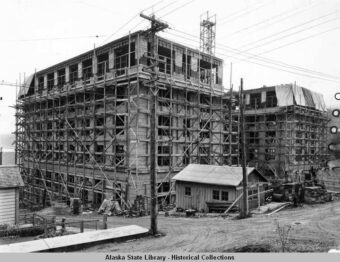
This 1930 photo shows a rear view of the Capitol under construction. (M272-2 Alaska State Library Manuscript Collection)
Jensen has studied the original architects’ ink-on-linen drawings. He said putting the post office on the first floor makes sense – that floor is bigger than the ground floor, and it has better street access.
“The ground floor isn’t as large as the other floors,” Jensen said. “It goes back into the mountain, back into the hill, so it’s truncated a little bit. Plus it has the boiler rooms and all those things that are not really occupiable spaces. But the first floor has access on the back side of the building and on Seward Street.”
According to the building’s original floor plans, the door to Seward Street was an employee entrance and the one to 5th Street was the public entrance. The post office lobby and work room took up the entire east wing of the first floor. Postal workers would sort the incoming mail in the workroom and feed it into post office boxes.
“I know stories from people who lived here in the ‘50s, ‘60s – they would go there every day to get their mail and it became a social area,” Jensen said.
This door, which goes out to Seward Street, was once the employee entrance to the post office. The steep street allows for a street entrance into the second story of the building. (Katie Anastas/KTOO)
Jensen said the history of the Capitol building is worth remembering. Before construction started, Congress only allocated enough money to pay for half of the block where the building stands today. Juneau residents raised the rest of the money and then gave the property to the federal government.
“The community got together and said, ‘Well, if the feds can’t do it, we can do it ourselves,’” Jensen said. “It’s very Juneauite. Over the years, we’ve done a lot to keep the Capitol here and support the Capitol, and that was one of the first efforts to do that.”
The post office may be a nearly-forgotten piece of the building’s history. But it’s why today’s visitors need to pay extra attention to what floor they’re on inside the Capitol.
Curious Juneau
Are you curious about Juneau, its history, places and people? Or if you just like to ask questions, then ask away!
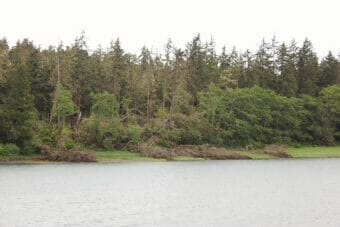
A jumble of fallen trees at Auke Nu Cove caught the attention of a Curious Juneau listener (Photo by Anna Canny/KTOO)
If you look across Auke Nu Cove from the parking lot at the Juneau ferry terminal, there’s a strange patch of fallen trees — about a dozen — that are splayed out in all directions.
Jesse Escamilla drives by on his evening commute every day. He’s used to seeing the occasional downed tree around his Lena Point home, but the fallen trees at Auke Nu Cove seemed mysterious and distinct.
“It looked odd, like it was isolated,” he said. “I remember it almost looking like someone with a bulldozer went and purposefully flattened that whole area.”
Escamilla grew up in Texas, and the pattern reminded him of the mark tornados leave. That became one of his two working theories.
“Option one would be Godzilla, and option two would be a tornado,” he said. “Both of those are viable, in my opinion.”
National Weather Service Meteorologist Rick Fritsch says the fan of fallen trees could be evidence of one of Juneau’s weirdest wind phenomena.
“To me, that sounds a whole lot like a microburst,” Fristch said.
The Southeast Alaska Land Trust manages the wetlands by the trees. Their conservation staff said the trees came down during a major wind storm that happened in October 2021.
That storm blew down dozens of trees across town. They hit houses and crushed cars, and in some neighborhoods they caused days-long power outages. It took days to clean up the mess of scattered trunks and branches.
The strong winds spread across all of Juneau. But in the small area around Auke Nu Cove, the wind may have generated a microburst, which can cause distinctive damage.
Fritsch says a microburst starts with a really strong gust of wind that blows straight down from the sky.
“And it comes down on the ground and it hits and goes out in every direction,” Fristch said.
As the winds gush outwards, they can exceed 100 mph — typically causing a lot of damage in a very small area. Just like what Escamilla noticed at Auke Nu Cove.
Elsewhere, microbursts are often associated with thunderstorms. When a thunderstorm forms, a swell of warm air rises to create clouds, which get heavy as they fill with rain or hail. If they get too heavy, they can release a strong gust of air that speeds toward the ground. That’s a microburst.
But thunderstorms are rare in Juneau, and that’s not what happened in the October storm. The alternative is even more interesting. It has to do with how wind interacts with Juneau’s coastal mountains.
“We in the business talk about straight-line winds, microburst winds and cyclonic winds, which are more associated with tornadoes. Basically circular,” Fritsch said.
Wind has basic, somewhat predictable directions, too. During a high pressure system — the kind that’s associated with clear skies — winds spiral clockwise and outwards to form gentle breezes. When a stormy, low-pressure system forms, winds spiral counterclockwise and inwards, building speed as they turn.
Those are the basics, but they’re not enough to predict exactly how the wind will behave.
“How do you get these winds flowing the way they do?” Fritsch said. “The topography on the inside is everything.”
Wind — like all weather in Southeast Alaska — is heavily influenced by topography.
Take straight-line winds. They’re strong storm winds that blow in just one direction. In stormy weather, they race down Gastineau Channel.
“So there’s sea level there. And then we got 3,000 feet on this side and 2,500 feet on this side,” Fristch said, pointing to downtown Juneau and Douglas on a map. “And that just acts like a natural funnel.”
That funnel directs strong gusts across Mendenhall Peninsula and up the runway at Juneau International Airport — in the case of that October storm, for nearly 24 hours. It kept planes on the ground, and it pushed many of the trees at the end of the runway to their breaking point.
Straight-line winds caused most of the tree falls during the storm, but the mystery treefall at Auke Nue Cove can probably be linked to what’s called the mountain wave phenomenon.
When wind hits a mountain, it’s forced upward. Then it hits a mass of stable air high in the sky, which pushes it back down. Those opposing forces make the wind move in an up-and-down wave motion.
When there are really strong winds and a stable air mass around Gastineau Channel, that wave action creates the famed Taku Winds in downtown Juneau.
But mountain waves can also cause microbursts. In some cases, clouds form under the mountain waves. When the windy waves pass over the top of a cloud, the friction can cause the cloud to start turning.
“You can’t necessarily see it spinning, like a sideways tornado,” Fritsch said. “But it is rotating. That’s the rotor cloud.”
On the side of the rotor cloud by the mountain, there are strong updrafts; on the far side, strong downdrafts. As gusts come over the mountains, they can get caught in those rotor clouds, spiraling and speeding up into the downdraft side of the cloud. And that downdraft can break away and come down as a microburst.
When that happens, it has the potential to cause Godzilla-sized damage. Fritsch isn’t sure that’s what took down the trees at Auke Nu Cove, but he says it’s the natural explanation.
“It may have been that you had this air that hit the Mendenhall Peninsula, and it rose, and it got trapped in a rotor,” Fritsch said. “And on the far side of the rotor, it went straight down.”
Fritsch said the wind is leaving its mark on Alaska’s landscape every day.
“Somewhere, there will be some kind of wind anomaly in the great, huge, awesome state of Alaska that will probably go unnoticed,” he said. “Because there’s nobody there to see it.”
Curious Juneau
Are you curious about Juneau, its history, places and people? Or if you just like to ask questions, then ask away!
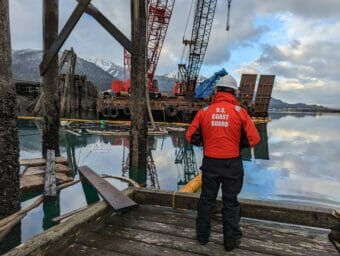
A Coast Guardsmen working on the recovery of the 81-year-old tugboat Tagish, which sank just south of Juneau’s cruise ship docks in December, 2022. (Courtesy of Coast Guard Sector Juneau)
At a Coast Guard change-of-command ceremony on Thursday, about 30 active-duty Coast Guardsmen gathered with some retirees, friends, and family under a tent at the Juneau docks. Young service members, wearing light blue uniforms and white caps, stood at attention while officers sent one officer off and welcomed another to town.
Senior Chief Boatswain’s Mate Sean Crocker, the officer in charge for Station Juneau, said he didn’t want to come to Alaska when he was younger. But now he’s going to miss it.
“It’s a little more bitter than sweet. And it’s not because I’m going to miss all the amazing fishing, hunting, boating,” he said. “For me, it’s going to be the people.”
The ceremony marked a passing of the torch from Crocker to Chief Boatswain’s Mate Nicholas Sedberry, who will now direct the 25-person Station Juneau.
Capt. Darwin Jensen, commander of Sector Juneau, said that in Crocker’s two years of service, his unit conducted 90 search-and-rescue operations. Still, Crocker’s wife couldn’t make the ceremony. Their daughter graduated from kindergarten that morning.
“Even more important,” Jensen said.
Chief Boatswain’s Mate Nicholas Sedberry, Capt. Darwin Jensen and Senior Chief Boatswain’s Mate Sean Crocker at Coast Guard change-of-command ceremony on May 25, 2023 in Juneau. (Yvonne Krumrey/KTOO)
That’s how the Coast Guard is in Juneau – part of the community.
“You don’t see a huge Coast Guard base down here. There’s Coast Guard here, there’s Coast Guard there,” said former Coast Guard captain Ed Page, who founded the Marine Exchange after he retired. “We’re more integrated in the community.”
While the Coast Guard is not as visible a presence in Juneau as some other Alaska military communities, it is large. A Curious Juneau reader wanted to know just how large — and how much the Coast Guard contributes to Juneau’s economy.
‘A major footprint’
Coast Guard members in Juneau might serve in the local unit — Station Juneau — or they might be involved or in regional or statewide management. Sector Juneau manages activities in Southeast, and District 17 runs the Coast Guard for all of Alaska. Both have their administrative offices in Juneau’s federal building.
Lt. Catherine Cavender works in waterways management for Sector Juneau. She says there are about 150 Coast Guard members in Juneau altogether and 270 throughout Southeast.
Like Page, she points to the lack of a base in Juneau, Coast Guard members live in houses and apartments all over town — they get their cars fixed, hair cut, and buy groceries at the same places everyone else does.
The Coast Guard’s headquarters inside the federal building in Juneau. (Photo by Jacob Resneck/CoastAlaska)
And they face the same challenges finding housing as the rest of the community.
“I lived in a hotel for four months before I was able to move into my rental,” Cavender said.
Meilani Schijvens of the research firm Rain Coast Data says that as of 2019, Coast Guard members had more than 400 dependents living in Juneau, too.
“It’s a major footprint. And then we also have people who work for the Coast Guard who are not active duty,” she said. “It does end up being a significant economic driver in the community.”
The Storis years
Damon Stuebner works at the state library. He made a documentary about the Coast Guard cutter Storis, which was based in Juneau in the 1940s and 50s.
He says that in the past, the Coast Guard’s presence was a lot more visible.
“If the ship had to leave for an emergency situation, the first officer of the ship — the executive officer — would call around to the Imperial and the Red Dog and say ‘Is my crew there? Get them out,’” he said.
The Coast Guard Cutter Storis in Juneau in October 2006. (Creative Commons photo by Gillfoto)
Stuebner says the movie theater even used to have a red light that would start flashing to tell Coast Guardsmen to report for duty, right away.
The work was different then, too.
“When the Storis was based here in Juneau, she did a lot of the normal things as what you would expect from the Coast Guard to do,” Stuebner said. “But what they also did was what was known as the Bering Sea Patrol. This was a series of duties of transporting teachers to rural villages along the coast.”
Stuebner said the Coast Guard also delivered mail, groceries and supplies to coastal villages.
“When statehood came around, then those duties dramatically shifted, and a lot of that burden went to the state,” he said.
Stuebner says that the Storis – which was stationed in Juneau from 1948 to 1957 before moving to Kodiak — even had a pitbull mascot named Red Dog — rumored to have been “acquired by suspicious means from the Red Dog Saloon.”
Red Dog, mascot of the Cutter Storis. (U.S. Coast Guard photo)
A Swiss Army knife
What does the Coast Guard do now? A lot of things, says Page.
The Coast Guard served in certain combat situations like Vietnam and Bahrain, said Page, but typically, those serving don’t face violence of that sort.
“It’s a different type of service. It’s not just ‘Well, there’s a war, fight it.’ There’s a war all the time,” he said. “The war is in protecting the environment, the war is saving lives when the vessel sinks.”
Joe Geldhof, a maritime lawyer, said the Coast Guard rises to its many roles in Juneau.
U.S. Coast Guard and Hecla Greens Creek Mine crews deploy a boom April 3, 2019 to contain a fictitious heavy fuel oil spill at Hawk Inlet. (Photo courtesy of Coast Guard Sector Juneau)
“It’s kind of like a Swiss army knife — it’s got a lot of tools,” he said. “And they do extremely well.”
Sector Juneau has a huge area of responsibility — from Dixon Entrance to Icy Bay. Geldhof says that between the size and the amount of work, it’s a lot for one group to take on.
“I would say the Coast Guard is a reflection of all the disparate activities that they’re required by law to undertake,” he said. “Fisheries enforcement, drug interdiction at some point — you might conclude if you really study it, that they have too many tasks.”
They keep coming back
Cavender has served one year in town so far, with two more to go. One of her favorite parts of being stationed here? Fishing.
“I did catch a king salmon from the beach, which I’m very proud about,” she said.
It’s a new hobby that she started here. She says Juneau is a nice place to be stationed.
Coast Guard Station Juneau on Sept. 22, 2015. (Photo by Jeremy Hsieh/KTOO)
“People definitely come back here for their last tour, or come back here and know that they want to retire here,” she said. “It’s really rare to see people retour so heavily in one spot.”
She said the town can feel like home to a lot of servicemembers, who integrate more into the community than they would elsewhere.
Jensen, who commands Sector Juneau, says servicemembers look for opportunities to come back once they’ve been stationed here. He’s on his third tour in Juneau.
Curious Juneau
Are you curious about Juneau, its history, places and people? Or if you just like to ask questions, then ask away!
Close
Update notification options
Subscribe to notifications
Subscribe
Get notifications about news related to the topics you care about. You can unsubscribe anytime.