Curious Juneau

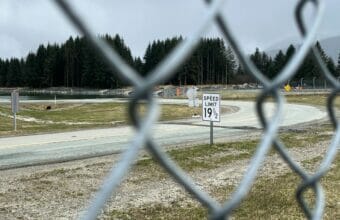
Curious Juneau: Why does that speed limit sign say 19 ½ mph?

A sign at the airport tells drivers to go no faster than 19 1/2 mph. (Katie Anastas/KTOO)

On a rainy afternoon at the Airport Dike Trail, Laura Minne is walking her dog, Bodhi. Over on the airport side of the fence, a speed limit sign tells drivers to go no faster than 19 ½ miles per hour.

When asked if she has a theory for why it’s such a specific number, Minne laughs.

“I can only imagine,” she says. “Whoever did it has to be pretty wonderful to have that humor.”

Airport Manager Patty Wahto says that person was a member of the airfield crew several years ago. The idea was to get the attention of the many workers who were driving faster than the actual speed limit of 20 mph.

“When the 20 mph signs were posted, you could ask people what the speed limit was,” Wahto wrote in an email. “They would either answer that they didn’t know, or that they didn’t think there was a speed limit posted.”

Studies show drivers remember fewer details about routes they’re more familiar with. Dwight Hennessy is a professor at Buffalo State University who studies traffic psychology. 

“The reality is, we can’t pay 100% perfect, focused attention on everything all the time,” Hennessy said. “If you have a monotonous environment, where everything is the same, breaking it up grabs our attention. We’re more likely to process things once we’ve paid attention to them.”

That’s why the 19 ½ sign works, he said. It stands out, which makes drivers think about the speed limit more.

The explanation gave Minne, the trail goer, an idea.

“So let’s just try that on Egan, right?” she said.

In fact, the Alaska Department of Transportation will try out a slower speed limit on Egan Drive this winter, though not quite as low as 19 ½ mph. From Nov. 1 to Jan. 31, the speed limit will be 45 mph from Mendenhall Loop Road to the Sunny Point interchange — a reduction of 10 mph. New radar speed signs will let drivers know how fast they’re going.

Nathan Purves, a traffic and safety engineer for the department, said the goal is to reduce winter crashes near Fred Meyer.

“That was where the majority of crashes were happening,” he said. “When it was icy out, people were trying to make that turn through traffic. The goal is by slowing people down, we’ll have bigger gaps in the traffic, and it’ll be easier to make the crossing.”

But a reduction much bigger than 10 mph could do more harm than good, he said. Drivers make assumptions about the correct speed limit based on the characteristics of a road, like its width and what kinds of buildings surround it. If DOT suddenly changed Egan’s speed limit to 25 mph, Purves said, most drivers would probably feel more comfortable driving faster.

“There would be the outliers that are like, ‘It says we’re supposed to go 25 on Egan, I’m going 24 because I’m not going to speed,’ and then here comes somebody going like, ‘Well I’m comfortable at 65,’” he said. “This person that’s following the law is being endangered.”

Like the airport, some cities are trying to make all of their speed limit signs more noticeable. In Seattle, transportation officials have added signs at more frequent intervals. They also lowered speed limits on arterial and residential streets by 5 miles per hour. The city reported a 22% decrease in crashes.

Time will tell whether the temporary speed limit and radar signs will reduce wintertime crashes on Egan. But, at the airport, the 19 ½ sign seems to be doing the trick.


Curious Juneau

Are you curious about Juneau, its history, places and people? Or if you just like to ask questions, then ask away!

Curious Juneau: Are those collapsing buildings along Glacier Highway the remnants of Juneau’s long gone dairy industry?

Elizabeth “Koggie” File stands in front of what was once her childhood home, then a dairy farm, on April 11, 2023.  (Photo by Yvonne Krumrey/KTOO)

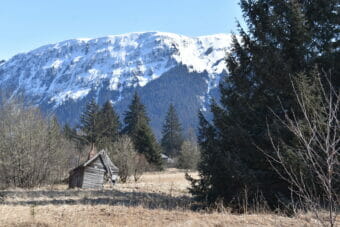
The ruins of two wooden houses stand about 30 feet off Glacier Highway, north of Kaxdigoowu Héen Dei, or Brotherhood Bridge Trail. One building has a rusted metal chimney on one side. The other, a diamond-shaped window overlooking the road. 

The houses are tucked in a grove of trees, with some small evergreens sprouting up inside them. Driving by, Tony Sholty always wondered what they were. He’s stopped to photograph them so he can remember them when they’re gone.

Sholty says he wondered if the buildings were from before statehood — perhaps even before Juneau’s dairy industry temporarily took over the area.

He was partly right. The buildings are from before statehood. But it turns out they’re actually what’s left of one of Juneau’s original dairy farms.

A Mendenhall Valley childhood

In 2020, someone posted a photo of the old buildings on Facebook along with the joke, “perfect air b&b, mostly air.” Elizabeth “Koggie” File replied that it was her childhood home. 

File was born in Juneau in 1935, and she’s lived in the Mendenhall Valley her entire life. In 1907, her Norwegian immigrant grandparents, the Pedersons, built a house in a big field and started a dairy farm. 

When File met KTOO at the farm, she brought photos her parents took of her as a child in the late 1930s.

“The first five years of my life I lived in that house,” she said. “And this now is me playing right out here, where we’re sitting.”

Elizabeth “Koggie” File on the porch of the home she grew up in. (Photo courtesy of Elizabeth File)

File says her dad would row across the river each day when he was a kid to get to school and back. And her grandmother, Jensine Pederson, helped make sure the school stayed open in its early days. When Jensine approached then-Gov. Alexander Parks with concerns that the school would close without enough students, he told her it would stay open as long as at least one child was there each day. 

Local legend also credits Jensine with the first bridge over the Mendenhall River. The story goes that she rescued an engineer who was sick with pneumonia. When he asked how he could repay her, she asked for the bridge. 

“He said once they put a bridge, no matter how small it is, that they will always replace the bridge if something happens,” File said. “And that is what happened.”

In 1956, Jensine was one of the first women to be accepted into the Sitka Pioneers Home, where she lived until her death three years later. 

Elizabeth “Koggie” File in an old photo of her family’s dairy farm. (Original photo courtesy of Elizabeth File, photo by Yvonne Krumrey/KTOO)

‘Not great dairy country’

Juneau historian Richard Carstensen has researched dairy farms like the one File’s grandparents ran. 

The industry began in earnest in the early 1900s, with most farms popping up along the wetlands in what’s now called the Mendenhall Valley and Lemon Creek areas. Many were started by homesteaders and then sold as businesses in the 1920s through the 40s. That’s what happened to the Pederson farm, which became the Sherwood Dairy. 

Carstensen says their heyday came not long after the Files sold it. 

The industry played an important role at a time when it was harder to get meat and dairy from Outside, Carstensen said. And the farm families pioneered the infrastructure in the area, like schools and bridges.

During World War II, the military took over some of the farmland. And in the postwar era, the airport began using more and more of that land as well. 

Juneau’s last dairy closed in 1965. While land encroachment contributed to the industry’s decline, Carstensen said the farms were bound to die out.

“I mean, this just is not great dairy country,” he said. 

Between the environment and the cost of supplies, dairies across the state have long struggled to stay open

One of the remains of Pederson’s dairy in the Mendenhall Valley still stands in view of Glacier Highway. (Photo by Yvonne Krumrey/KTOO)

Colonial history

Carstensen points out that these farms also played a part in the area’s colonial history. 

“Those early homestead claims, realizing that they just plop right down on the most important of the old village sites and fish camps, and everybody wants the same real estate,” Carstensen said. “So there was a lot of shoving aside of Lingít culture going on.”

He says this is something he’s becoming more aware of lately, and it shapes the ways he sees Juneau’s history. 

“We might look back on those families romantically,” Carstensen said. “And they were very much can-do people who provided for themselves, but they were part of a generation who just came in and shoved aside the original inhabitants.”

But Carstensen said he’s grateful for stories like File’s. 

“In spite of all my reservations about the dairy industry, I feel like it’s really worth understanding because there’s got to be some nuggets in there that are valuable to anyone trying to think about rational ways to live here and take care of ourselves and not exhaust the country,” he said.

File says most days, she drives past the slowly collapsing ruins of her childhood home.

“I’m surprised if it continues to stand,” she said. “I’m expecting someday when I go to church, on my way home, that that building is not going to be standing much longer.”


Curious Juneau

Are you curious about Juneau, its history, places and people? Or if you just like to ask questions, then ask away!

Curious Juneau: How far has the Mendenhall Glacier retreated in the last 12 months? 

The Mendenhall Glacier seen from the near the visitor’s center on Oct. 6, 2022. (Photo by Ian Dickson/KTOO)

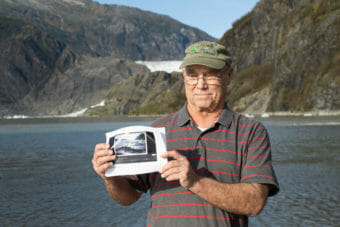
Longtime Juneau resident James Wycoff noticed on his regular walks to Nugget Falls that the face of the Mendenhall Glacier seemed to be retreating faster this year than any year he’s seen before. 

“I arrived in Juneau in 1974 as a young pharmacist from Kansas,” Wycoff said. “I had no idea that country as beautiful as that around Juneau even existed. I still haven’t got over it. Every morning I wake up, I feel like I’m in Disneyland.”

For Wycoff, the Mendenhall Glacier is “just such a good example of Juneau — it’s constantly changing.”

When he first saw the glacier in 1974, he remembered that Nugget Falls “poured into the top of the glacier and flowed out through a giant cave in the face of the glacier.” Today, visitors can barely see a corner of the glacier from the falls. 

Tourists catch a glimpse the now-distant Mendenhall Glacier from the beach at the end of the Nugget Falls Trail on Oct. 6, 2022. (Photo by Ian Dickson/KTOO)

Glaciologist, outdoor guide and Juneau resident Mike Hekkers also noticed that more rock was being exposed at the face of the glacier this year. 

“We’re losing that whole left side pretty dramatically in the past 12 months,” Hekkers said. 

 So how much has it really retreated?

Alaska Science Center geophysicist Christopher McNeil used publicly available satellite imagery to find an answer: between Aug. 30, 2021 and Aug. 18, 2022, the Mendenhall Glacier’s terminus retreated more than 800 feet. 

The big picture

For the last two decades, the glacier has “pretty consistently” seen over 160 feet of retreat per year, Hekkers said. From 1999 to 2022, the glacier’s terminus retreated a total of nearly 4,600 feet. 

“Nearly all of that retreat occurred along the western half of the terminus, where the west Mendenhall trail leads,” McNeil said. 

Hekkers speculated that the seemingly drastic loss of ice in the past twelve months is likely due to the water depth in that part of the lake.

“The ice is flowing downhill, and there’s shallower water on the far left where the remnant ice is stranded and not being re-fed anymore,” he said. 

In the next year or so, the glacier will likely retreat out of the lake, Hekkers said. At that point, it will likely slow down because its face won’t be regularly calving into the lake.

“We’ll probably still have small icebergs, but the really big icebergs are going to be a thing of the past within a year or two,” Hekkers said.  

Wycoff says seeing icebergs in Mendenhall Lake has always felt special to him. “That’s something you expect to see around Antarctica,” he said.

A seal slips between icebergs in Mendenhall Lake on Friday, July 6, 2012.
A seal slips between icebergs in Mendenhall Lake on Friday, July 6, 2012. (Photo by Heather Bryant/KTOO)

While the terminus retreating is the most obvious change, the glacier is also thinning, and the margins of the glacier are also retreating. Scientists like McNeil use three dimensional models of the glacier’s surface to measure thickening and thinning. A total of 85 feet of thinning was observed between 2000 and 2020. 

There is a seasonal and annual cycle to how a glacier changes,” McNeil said. “They advance forward in the winter because there’s no melt, but hotter, longer summers counteract that. Overall, melt is winning.”

Beyond what visitors see from the trail, McNeil said that the glacial retreat also directly affects the ecosystem as nutrient levels fluctuate and are delivered through freshwater and carried to the ocean. Ultimately, fish populations like salmon are impacted because of changes in water temperature and in the food chain, he said. 

What this means for Juneau

Hekkers’ team at University of Alaska Southeast was hired by the U.S. Forest Service to help redesign the Mendenhall Glacier Recreation Area. They determined that the glacier may not be visible from the visitor center in the next few decades and even considered having a “mobile modular visitor center” — taking visitors across the lake on electric boats to have a peek at the glacier.

The impacts of the glacier receding are “on a scale from local to global,” McNeil said. Global sea levels are on the rise, and here in Juneau, McNeil noted that glacial changes mean the ice caves are no longer accessible. 

“For a town like Juneau, those activities are keystone activities people like to do,” he said. 

Halfway up the Nugget Falls Trail, Wycoff talks about how things might have looked here, long ago. 

“This could be the face of the glacier here, standing 150 feet tall, and at one point dropping off all these boulders around here,” he said.

James Wycoff gestures toward the glacier while talking to KTOO reporter Chen Chen on Oct. 6, 2022. (Photo by Ian Dickson/KTOO)

He pointed to a boulder by the trail, which he identified as an ‘erratic’ — a boulder carried down by glacial ice. 

“That’s a high-riding boulder, and if it could talk, boy it would have a story to tell about what it was like coming down the valley on the glacier, getting ripped off the side of the mountain,” Wycoff said.

Wycoff says that in time, people in Juneau will have to reminisce about the Mendenhall Glacier.

“Bring out all the stories and say anything you want about the way it used to be,” Wycoff said. “Because the glacier is gone.” 


Curious Juneau

Are you curious about Juneau, its history, places and people? Or if you just like to ask questions, then ask away!

What happened to Juneau’s Taco Bell?

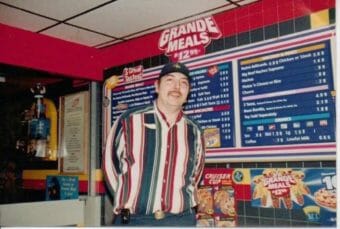
Charles McKenry poses in front of the menu at Juneau's downtown Taco Bell in 1999.
Charles McKenry poses in front of the menu at Juneau’s downtown Taco Bell in 1999. (Photo courtesy of Charles McKenry)

In the late ’90s, Juneau had two Taco Bells. But by the early 2000s, they were both gone. Juneau has a history of fast food franchises coming and going, but the disappearance of the Taco Bells left a lot of rumors in its wake, from “employees were selling drugs” to “wasn’t it hepatitis?”

“Every business is gonna have drama and rumors and this and that,” said Jennifer Solano, who used to work at the Taco Bell in Juneau’s Mendenhall Valley. “To be honest, Taco Bell was a good, wholesome place to work. They taught me enough that I’ve been able to raise a family, continuing my career managing fast food restaurants.”

Solano runs a Subway in Anchorage now, but she started working for Taco Bell in Juneau as a teenager. In the mid-nineties, it sat where the Asiana Garden restaurant is now, across from Super Bear. 

“We were having repeated problems with the [produce] shipments,” Solano said.  “We would have to throw away sour cream, cheeses, lettuce, tomatoes. They were coming in continuously frozen when they were only supposed to be refrigerated, and we were having to waste a lot of money.”

Solano eventually became an assistant manager. She said getting quality produce from the Lower 48 was just one of many problems.

“Everything in the building was just kind of crumbling and falling apart,” Solano said. “There were so many times that the grease trap had to be re-done because the pipes underneath all the flooring were so old and brittle that they were actually collapsing.”

A smaller, Taco Bell Express restaurant shared a space with Subway in downtown Juneau before closing in 1999.
A smaller, Taco Bell Express restaurant shared a space with Subway in downtown Juneau before closing in 1999. (Photo courtesy of Charles McKenry)

Plumbers were called in to try to fix the issue at night, which meant workers the next morning were walking on temporary floorboards.

“It’s not an overnight project,” she said. “So then we tried to keep staffing minimal so nobody was running into each other or getting hurt.”

The maintenance turned into a cycle. A pipe would be fixed, the flooring would be replaced, and another pipe would collapse somewhere else. 

The Valley Taco Bell also went through several different managers. Solano said she often picked up the slack when one of them was attending meetings in Anchorage. At one point, it became a combination Taco Bell and Baskin Robbins.

“They would expect somebody that’s making burritos to go over and make a frappuccino,” Solano said. “You know, you gotta make cakes out of ice cream and you have to be able to decorate them and trying to run a Taco Bell side and trying to make cakes was pretty rough for me.”

Repairs became so expensive that the owners started looking for a new building to move to.

“But there was no good place in Juneau 18-20 years ago to put a fast food restaurant with a drive-thru in it,” Solano said. “So they decided they were gonna cut their losses and just go ahead and close the doors.”

Some workers didn’t even have advance notice that the restaurant was closing. They showed up the next day to a note on the door and were told to pick up their compensation checks.

The Valley location was the last Taco Bell to exist in Juneau, but at one point, the city had two — there was a smaller Taco Bell Express downtown. It shared a space with a Subway in a building where Sealaska Heritage is now.

In 1997, Juneau's downtown Taco Bell won a Golden Bell award. It was named seventh in the nation for quality and service out of 1500 franchise stores.
In 1997, Juneau’s downtown Taco Bell won a Golden Bell award. It was named seventh in the nation for quality and service out of 1500 franchise stores. (Photo courtesy of Charles McKenry)

Charles McKenry started there in 1987 and worked his way up to general manager.

“Taco Bell was doing a competition called the Golden Bell,” McKenry said. “We managed to take that store to number seven in the nation for quality and service out of 1,500 franchise stores.”

But the downtown restaurant wasn’t very profitable. It closed in the summer of 1999 when the corporate office decided to focus its efforts on the Valley location. McKenry was transferred there as a shift manager to try to improve the service.

“The gentleman running the store insisted that no one listen to me because it was his store and he would teach them his way, not necessarily the Taco Bell way,” McKenry said. “He didn’t care about quality or service. It was all about his bottom line, even if it meant not being honest about some of the numbers.”

Eventually McKenry quit because of that manager, but his experience wasn’t all bad.

“We had great people,” McKenry said. “It was a fantastic product. I mean I thoroughly enjoyed working for Taco Bell itself, but you can only take so much.”

Now if you’re craving a Crunchwrap Supreme, the Lunch Crunch Wrap at the Lemon Creek Breeze In is pretty similar.


Curious Juneau

Are you curious about Juneau, its history, places and people? Or if you just like to ask questions, then ask away!

Why are some of Juneau’s street lights glowing purple?

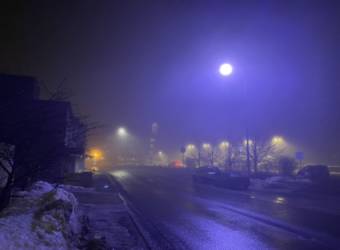
A street light near the Juneau Public Library glows purple on Sunday, Jan. 23, 2022.
A street light near the Juneau Public Library glows purple on Sunday, Jan. 23, 2022. (Photo by Bridget Dowd/KTOO)

On a foggy Sunday night in Juneau, the corner of Ferry Way and Marine Way is made eerie by a violet glow coming from a nearby street light. It’s just one of several lights around town that have changed colors.

A Curious Juneau listener saw these lights around the city and asked KTOO why the lights have a dark purple hue. As it turns out, the color is a mistake and the state is working to fix it. 

 Juneau resident Max Stanley said he and his girlfriend noticed the lights in October when they were driving toward Thane.

“At first we wondered if it’s something for Halloween,” Stanley said. “As we continued to drive, we realized it’s just — all the street lights have this hue.”

Stanley said over the next few weeks, they noticed the same purple hue coming from several other street lights all over town.

“It’s pretty noticeable sometimes when there’s one of the purple ones and then right after an older white one,” Stanley said. “So we just were wondering why there are these new purple-hued lights around town.”

The Alaska Department of Transportation and Public Facilities maintains a lot of Juneau’s street lights. Spokesperson Sam Dapcevich said the lights actually aren’t new at all and the purple hue isn’t intentional.

“The purple hue in the LED lights is caused by a computer chip issue, possibly a defect,” Dapcevich said.

The department is working with the manufacturer, American Electric Lighting, to get the lights fixed and Juneau isn’t the only place where the issue has been reported.

“It was occurring in quite a few places around the country,” Dapcevich said. “It appears that most of the LED street lights have three colors. They have yellow, red and blue and the yellow color is failing.”

Of course, when red and blue mix, the resulting color is purple. Dapcevich said most of the lights are less than 5 years old. They’re still under warranty, so the manufacturer should cover the cost of fixing them as well – though he didn’t have an answer as to when that would happen. 

Is there an Indigenous name for this cloud formation in Juneau?

A Maloja Snake or naagáas’ cloud formation over downtown Juneau at dawn on Aug. 26, 2021. (Image captured from SnowCloud Services webcam)

In the 2014 film “Clouds of Sils Maria,” the climax of the story features a scene in the Swiss Alps where the two lead actresses, Kristen Stewart and Juliette Binoche, hike up high in the mountains to witness an early-morning cloud formation called the Maloja Snake — a mist that flows like water along the valley floor.

A Curious Juneau listener wrote in saying they’d witnessed something similar along the Gastineau Channel, and they wondered if there are any Lingít stories or a Lingít name for this cloud feature.

Wes Adkins with the National Weather Service office in Juneau had never heard of the movie or the Maloja Snake, but once he saw clips from the film, he knew exactly what it was.

“I think there is not a meteorologist in town who doesn’t observe this with awe every time they go hiking, every time they commute down Egan Drive,” he said. “We see it all the time here.”

In Juneau you’ll see these clouds crawling down Perseverance Trail or along Treadwell Ditch on Douglas Island. They’re very snake-like and cling to the sides of the mountains, close to the ground. Sometimes a fat snake as wide as the channel rolls into town.

Adkins says that the changes in temperature, pressure and moisture that cause the snake to form are always there but not always visible. But sometimes, when conditions are right, you can actually see the boundary between cloud and no cloud.

“So what’s really cool is when you start to see … these Maloja Snakes when they start to do flips or cartwheels,” he said. “And people can witness this, you know, just above them in downtown just over Gastineau Channel.”

There’s not a lot of cloud watching in Juneau. We don’t get white puffy clouds that appear in the shapes of animals while we lie in a field on our backs. So these moving fog banks — these snakes — are some of the most dynamic clouds we have.

But we don’t have snakes in Alaska, so what should we call them?

X̱’unei Lance Twitchell is an Associate Professor of Alaska Native Languages at the University of Alaska Southeast.

“I started looking through some resources,” he said. “And I found this verb, which is naagáas’: ‘Clouds are moving along.'”

Naagáas’ is a Lingít word. It also means migration.

“‘Gáas’ is a house post,” he said. “So this is the verb. There’s a version of it to say, ‘aadé haa wligáas’:  ‘We migrated there.’ Which would be sort of like saying, ‘We picked up our house post, and we brought it over there.'”

So naagáas’ would be migrating clouds.

But X̱’unei found a metaphor where maybe there is just a cloud. For instance, Lingít has a whole bunch of readily available phrases to describe sunlight.

“Sometimes the Lingít language is just so matter of fact,” he said. “And I think what I’ve heard seems to be that way about clouds. Because we have clouds like 300 days a year, it figures you’d have this whole stack of metaphors for sunlight.”

X̱’unei says he doesn’t know if naagáas’ has been used to describe these clouds before. From multiple elders the consensus seemed to be that if there were another Lingít word for these cloud snakes, it might have been lost with the loss of language speakers.

“One of the great tragedies of colonialism — and there are many — is that nobody really took the time to figure out what the people knew about the land around them, the weather, the water,” he said.

You can see naagáas’ any time of year and any time of day in Juneau, but if you really want to be intentional about it, Wes Adkins at the National Weather Service says dawn or dusk are good bets, when the temperature is changing. Or just before or after a rainy spell.

The weather service doesn’t include these cloud snakes in their forecasts because they don’t really impact the weather. They don’t bring rain. They aren’t harbingers of storms. But Adkins says we should still be on the lookout for them.

“I’m originally from Alabama. We were really flat there, for the most part,” he said. “There’s nothing like this. So I think we can all relish this chance to see something special.”

And X̱’unei says the weather service and the rest of us should start practicing how to talk about it in Lingít.

Site notifications
Update notification options
Subscribe to notifications