Anna Canny

Local News Reporter

Flood-prone Juneau homeowners remain divided on city’s plan to address glacial outbursts

Alyson Cooper of Meander Way testified in favor of the flood barriers and local improvement district. (Photo by Anna Canny/KTOO)

The debate over the City and Borough of Juneau’s controversial plan to fight glacial outburst floods continued during Monday’s Assembly meeting. 

The proposal to install military-grade HESCO flood barriers along key sections of the Mendenhall River, at a cost of $7.83 million for the first phase, has received mixed reception from residents in the Mendenhall Valley’s flood-prone neighborhoods. 

More than 20 people testified on Monday. Some expressed frustration and anger with the city’s approach. Others, like Brandi Tolsma, championed it as the best way to safeguard homes before next summer’s flood season. Tolsma’s home on Sharon Street was among the nearly 300 properties damaged during this August’s record-breaking outburst.

“Over four and half months later, my family and I are still piecing our home back together, trying to rebuild what we lost,” she said. “This choice is clear. These barriers are not a permanent fix. They are a bridge to a more comprehensive solution.” 

Glacial outburst floods have become an annual summer occurrence in Juneau, though the 2023 and 2024 floods were uniquely catastrophic. The city has maintained that the flood barriers, which were recommended by the U.S. Army Corps of Engineers, are the only viable flood prevention that could be quickly installed by next spring or summer.

To cover the cost of installing the barriers and reinforcing the riverbank to support them, the city would provide some funding via Juneau taxpayer dollars, while the rest would be split among nearly 500 flood-prone homes through the creation of a local improvement district, or LID. 

But before the district is created, more than half of those affected homeowners must support the plan. If they approve, homeowners at the greatest risk of flooding would have to pay a share over the course of the next 10 years. But many, like Molly Zaleski of Meander Way, have already said they’ll object. 

 “I feel like we’re being forced into this position,” Zaleski testified on Monday. “I feel like if you guys want to push forward with these HESCO barriers, then the city should pay for it.” 

The cost has been a sticking point in the plan’s rollout. The Assembly attempted to address that concern on Monday. The original plan outlined a 50/50 split for the project budget between the city and homeowners like Zaleski, who would have to pay nearly $8,000 each. The Assembly amended the plan to a 60/40 split, which would bring the cost for homeowners down to just over $6,000.

Still, some said they’d vote against the project even if it came at no cost to them. Residents raised a variety of objections on the basis of liability if the barriers fail, sacrifice of personal property along the riverfront or concern that the installation of barriers might distract from a more long-term solution at the source of the flood, either by proactively draining Suicide Basin or building a levee, dam or dike at Mendenhall Lake.

While waiting for a long-term solution, riverfront homeowners like John Cooper of Meander Way would have to host the flood barriers on private property for up to 10 years. In his testimony, Cooper said he’s willing to do it. 

“I’m going to lose a significant portion of my backyard to do so,” Cooper said. “But I’m ready to do that for the good of other people that are inside this flood area.” 

City manager Katie Koester has said that the city is committed to more permanent flood fighting too. The Assembly has already set aside $3 million in funding to develop that plan, and this week, the U.S. Forest Service committed an additional $1 million. But any long-term fix won’t come quickly.

“I can’t tell you how long it will take to find a long-term solution. I can tell you that it will require persistence on all of our parts to keep our federal partners feeling the same sense of urgency that we do” Koester said Monday. “Large expensive projects take a long time to design, engineer and, most importantly, find funding for.” 

In previous meetings, Koester has indicated that a failure to install the barriers may jeopardize federal support for a long-term fix down the line. 

In testimony as a private citizen, recently retired Assembly member Michelle Hale implored the Assembly to support the city’s plan. Hale, who lives in the Mendenhall Valley outside of the proposed improvement district, previously called the flood an “existential threat” to Juneau. 

“The Army Corps of Engineers are the experts at flood control, and their recommendation right now is to install the HESCO barriers,” Hale said. “A dike is a great idea, but there is way too much at risk to try and push through and install a dike this year, before the 2025 jokulhaup.”

The time-sensitive nature of this flood, which could return with similar or larger magnitude next summer, has repeatedly been stressed as the reason for the barriers. If the local improvement district fails to pass, the city has stated in writing that they would not have time to pursue an alternative flood mitigation project. 

Sam Hatch, who lives on the riverfront on Meander Way, said that stance has contributed to anger and resistance across the Mendenhall Valley. Hatch said he is supportive of short-term flood fighting, but he’ll refuse to host the flood barriers on his property if the local improvement district is approved. He asked the city to consider alternatives

“If the LID fails, will the city and Assembly take no action — as these documents indicate — and abandon our neighborhoods to the flood waters,” Hatch said, referring to written statements in the Assembly meeting packet. 

Hatch, and the 465 other homeowners in the proposed improvement district, will receive a mailer this week with more information about the plan. The city will also host a neighborhood meeting in January to share more information.

Affected homeowners must object in writing or they will be considered in favor of the plan. They have until Feb. 3 to object. If more than 50% do, then the plan fails, though there’s a slim chance that the Assembly could override that decision at its Feb. 3 meeting. 

Mendenhall Valley residents divided on flood barriers before vote

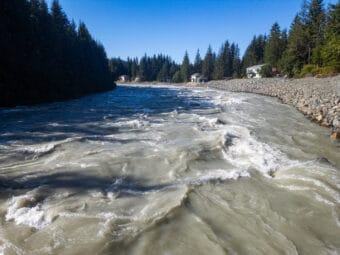
Water rushes past homes and reinforced riverbanks along the Mendenhall River during Juneau’s annual glacial outburst flood on Monday, August 5, 2024. (Photo by Eric Stone/Alaska Public Media)

Since the record-breaking glacial outburst flood damaged hundreds of homes in August, the City and Borough of Juneau has been focused on its short-term plan to install flood barriers along the Mendenhall River in hopes of holding back the next glacial outburst.

It’d be a temporary measure, but city leaders have maintained that it’s imperative. Some residents from flood-prone neighborhoods don’t see it that way. Starting next week, residents in Juneau’s Mendenhall Valley will be asked to weigh in on the proposal, and some, like Noah Teshner of Lakeview Court, said they’ll vote against it.

Teshner is part of a small group of well-organized homeowners that are calling themselves the Juneau Flood Solution Advocates. They’ve held community meetings attended by more than a hundred residents from flooded neighborhoods. Teshner said many would rather see a long-term solution to flooding, and they feel rushed by the city’s plan. 

“It doesn’t give people the opportunity to make an educated decision,” he said. “It’s like a drowning man. You’re going to reach out and cling to the first thing that you can that you think is going to save you.”

City Manager Katie Koester said she wants a more permenant flood prevention plan too, and earlier this month she visited Washington, D.C., along with other representatives from the city and from the Central Council of Tlingit and Haida Indian Tribes of Alaska to seek funding for it. But she said its success will depend on more immediate action, and the barriers are a critical way to buy time before next summer’s glacial outburst flood.

“We’re really concerned that if we don’t have a temporary, short-term solution, we won’t have much to protect,” she said.

The barrier installation would cost homeowners nearly $8,000 each over the next 10 years. A long-term solution would almost certainly be more–but homeowners might be less likely to have to foot the bill.

Juneau Flood Solution Advocates released a video earlier this month to draw attention the August flood and a Fairbanks project that they believe is a good example for Juneau. After a devastating city-wide flood in 1967, the U.S. Army Corps of Engineers took on the massive Chena River Lakes Flood Control Project. Teshner wants something like that to control the flow of water at Mendenhall Lake. 

And Koester said the Corps might be interested in pursuing that, but any long-term flood prevention project will require a lot of study, permitting and funding. For instance, it took six years for Chena River Lakes Flood Control Project to break ground and more than a decade to complete construction.

Koester says the Army Corps suggested the barrier plan as a first step. 

“We really need to follow their advice, because they are our partner in finding a long term solution to this problem,”

For Debbie Penrose Fisher, president of the Juneau Flood Solution Advocates, the city’s focus on the barrier plan has been scary. She worries that if she and her neighbors don’t go along with it, they won’t receive any help at all. And she said she’s willing to wait for a long-term solution, even if that means flooding again. 

“I choose not to be told scare tactics, and ‘It’s this or nothing,'” she said. “I think if I’ve seen from the community that we’re strong and we can come together and until they solve this in a long term way.”

She wants the city to develop a plan that makes the flood season easier on her and her neighbors–something with details for a better warning system, evacuation plan and sandbag deployment ahead of next year’s flood. 

Penrose Fischer and nearly 500 other homeowners will weigh in on the barrier proposal over the next few weeks. They’ll have the opportunity for public comment at the regular Assembly meeting on Monday, Dec. 16th.

Disaster aid wraps up after Juneau’s glacial outburst flood, but federal loans are available

Juneau’s Mendenhall Valley Library will serve as a disaster assistance center from Aug. 21 to 23. (Katie Anastas/KTOO)

Alaska’s state office of emergency management, and their federal counterparts at the Federal Emergency Management Agency, are almost finished doling out disaster aid grants for those affected by August’s record-breaking glacial outburst flood. 

So starting on Tuesday, Dec. 17, the Disaster Recovery Center that’s been operating in Juneau’s Mendenhall Valley Public Library since October will start to focus solely on the distribution of Small Business Administration Loans. They’re generally larger amounts of money and somewhat more flexible than FEMA grants. 

Claudia Anderson, a public information officer with the U.S. Small Business Administration, says flood victims should go to FEMA first, but there’s more federal money available for homeowners or businesses that still have repair work to do.

“While FEMA offers this great grant program, sometimes the rebuilding costs and repair costs exceed what they’re able to offer people,” Anderson said. “We offer a substantially larger amount of funding opportunities, but in the form of a low-interest loan.”

State or FEMA disaster grants don’t have to be paid back at all, but interest rates for small business administration loans are still considered very good. They can be as low as 2.813% over a 30-year term for homeowners. For businesses, they typically hover around 4% and for non-profits, around 3.25%. Interest won’t accrue until 12 months after the loan disbursement.

Homeowners who were affected by the flood are eligible for up to $500,000 to repair their property, and both property owners and renters could receive up to $100,000 to replace personal property, including cars that were destroyed by the flood. For businesses or non-profits, it’s up to $2 million. 

Another advantage of these loans is that they can be used to pay for measures to protect a home from future floods, like raising the house. Anderson said these loans are also flexible. When the Small Business Administration makes its offer, homeowners can take it or leave it for later on. 

“Sometimes the damage that occurs with flooding events doesn’t always appear right away, and if you miss the deadline of these programs, it’s very hard to backtrack and get into them,” Anderson said. “There’s no obligation to take the loan if it’s offered to you, but it does mean that you’re in the system, so that you have the ability to go back if you find out later down the road that the building or repair costs have exceeded what you had to anticipated, or if all of a sudden you have foundational damage that you weren’t aware of initially.”

Anderson says it’s still best to get applications in as soon as possible. The deadline is Monday, Dec., 16th, 2024, but if an application is incomplete or has problems, representatives from the U.S. small business administration will be posted at the library starting next Tuesday.

The center will operate Monday through Thursday from 10 a.m. to 6 p.m. and Fridays from 12 p.m. to 6 p.m.  through the first week of the New Year, with closures on Christmas Day and New Year’s Day. 

Caution advised as Juneau lakes freeze for the first time this winter

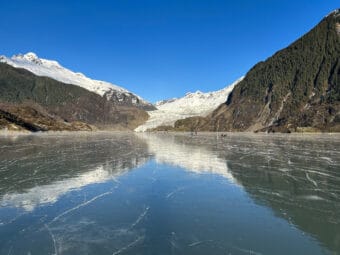
A fresh layer of ice on Mendenhall Lake on Sunday, Nov. 24, 2024 (Photo by Clarise Larson/KTOO)

Dozens of bikers, figure skaters and hockey players took to the ice at Juneau’s Mendenhall Lake this weekend. But venturing out onto a frozen lake can be extremely dangerous, and several reports of people falling through the ice circulated on social media. 
Cold temperatures allowed several inches of ice to form at the surface of Mendenhall Lake and Twin Lakes over the last week, but meteorologist Nicole Ferrin with the National Weather Service office in Juneau said lake ice that may appear solid is still prone to give way, especially near running water like streams or waterfalls and, in the case of Mendenhall Lake, near the face of the glacier. 

“Even if it looks like it’s frozen solid, there’s a lot of inflows and outflows of the lake where the ice thickness might not be as thick,” Ferrin said.

The National Weather Service office in Juneau does not monitor ice conditions, nor does the U.S. Forest Service, which manages Mendenhall Lake.

According to Capital City Fire Rescue, crews did not respond to any incidents at the lake over the weekend. One person reached via Facebook said they were present when a child’s leg broke through the ice on Sunday, but the child was able to pull himself out and crawl to safety. 

Ferrin said the crowds of people on the lake this weekend don’t necessarily prove that the ice is safe.

“Just because you see someone else out on the lake doesn’t mean that they are necessarily measured,” she said.

NOAA ice safety guidance. (Image courtesy of the National Weather Service Juneau)

Generally, 4 inches of ice can support ice fishing and walking, 5 inches can support small groups of skaters, and 6 inches can support snow machines, according to guidelines from the National Oceanic and Atmospheric Administration. The National Weather Service also advises that people keep a distance of at least 300 yards from the face of the glacier. 

Snowy weather expected across Southeast, but Juneau may be hit hardest

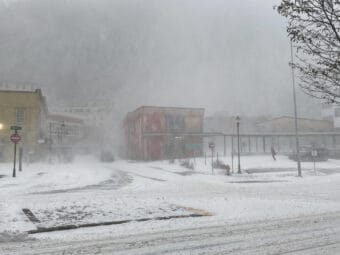
Strong winds kick up snow at the intersection for Main St. and Front St. in downtown Juneau on Nov. 20, 2023. (Anna Canny/KTOO)

Snowfall is expected across Southeast Alaska this week, starting tonight. But Juneau may be hit the hardest.

The National Weather Service has issued a winter weather advisory for the city from 6 p.m. Monday through 3 a.m. Wednesday, calling for 8 to 14 inches of snow.

Meteorologist Nicole Ferrin says snowfall is not expected to be especially wet or heavy, but it will be sustained over the next couple of days. Several bands of moisture are expected to stall over Juneau, and frigid air pouring in from Taku Inlet and Icy Strait will keep it cold enough for dry snow.

“It’s a 36-hour-long event so the totals are more reflective of how long we expect to see the snow accumulation,” Ferrin said.

The incoming snow is thanks to the collision of a low pressure system that’s gathering moisture over the northern Gulf of Alaska and a high pressure system over the Yukon, which has sustained dry conditions, clear skies and frigid temperatures across the panhandle over the last week.

Ferrin says the snowfall forecast could change as the storm hits. As snow begins this afternoon, forecasters expect more dry, fine crystals that won’t pile up much.

“But usually as the storm evolves the snowflake type will change and be able to accumulate a little bit better,” she said. ”

For now, the forecast calls for 3 to 5 inches overnight on Monday with an additional 3 to 5 inches throughout the day Tuesday.

Snowfall should be less severe outside of Juneau. Skagway, Haines, Sitka, Wrangell, Petersburg, Ketchikan and Prince of Wales Island may see more brief pockets of snow, with accumulations ranging from 1 to 4 inches over the next couple of days and the potential for freezing drizzle.

The storm already started to hit Yauktat as of this morning, but slightly warmer than expected temperatures there created a rain-snow mix.

Warmer temperatures expected mid-week may slow snow accumulations temporarily, but some less intense snowfall is still likely, and temperatures are expected to  Winter weather conditions might make travel hazardous.

Juneau’s flood fighting plan would cost Mendenhall Valley homeowners $8,000 each. Some of them don’t want it.

Assembly member Neil Steininger asks questions about HESCO flood-fighting barriers at a meeting on Monday, Nov. 18, 2024. (Clarise Larson/KTOO)

The City and Borough of Juneau’s controversial flood fighting plan could shield more than 450 Mendenhall Valley homes from annual glacial outburst floods. But there’s been a lot of pushback about who should pay for the project, which has an estimated budget of $7.83 million. 

At Monday’s meeting, the Juneau Assembly considered a plan that would split costs through the creation of a local improvement district, or LID, which would allow the city to collect a payment of $7,972 from every household in the flood zone.

Some homeowners who flooded this year, like Sandra Edwardson of Killewich Drive, said that cost will be a pain point for households that have already spent a lot of money on repairs. 

“I believe implementing the LID as suggested would unfairly penalize those who have already been affected by a natural disaster,” Edwardson said.

If the city’s plan fails to gain enough public support, it’s possible that nothing will be done to curb flooding before next summer’s glacial outburst. The floods have been an annual occurrence for more than a decade, after the rapid retreat of the Mendenhall Glacier due to human-caused climate change created a glacial lake known as Suicide Basin. Each year, it fills with rain and meltwater before bursting downstream into the Mendenhall Lake and River.

Until recently, most of that flooding was minor, but in 2023 flood waters surged to unprecedented levels and destroyed two homes. In 2024, flooding broke records again, damaging nearly 300 homes

Water fills the streets and floods houses in the Mendenhall Valley early the morning of Tuesday, August 6, 2024. (Photo courtesy of Rich Ross)

The city’s plan for next year’s flood, at the suggestion of the U.S. Army Corps of Engineers, is to construct a temporary levee made of military-grade HESCO flood barriers along key sections of the Mendenhall River. For phase one of the project, the levee would extend from Marion Drive to Killewich Drive and Meander Way. The Corps will distribute the barriers free of charge, but the installation and site preparation are costly. 

The city’s proposal would split costs 50/50, with $3,915,000 to be paid by Juneau taxpayers at large — the Assembly has already allocated $2 million of that funding — and $3,915,000 to be split among the households in the LID. 

Local improvement districts are typically formed to support construction projects that benefit a distinct neighborhood. If there’s a need to pave a new road, for instance, an LID might be created to split costs among homeowners who live along that road. 

In this instance, the proposed LID includes most of the households that are at risk of flooding during a 16-foot glacial outburst flood, though it does exclude a handful of homes that would not be protected by the levee, like the low-lying neighborhood along View Drive. 

That means 466 properties — six of which are owned by the city — would split the costs, with a nearly $8,000-per-household payment. A select few might have to pay even more — $50,000 — to armor their riverbank before barriers are installed. Many riverfront homeowners have already made major personal investments to armor the bank.

If the LID plan is approved, homeowners would have the option to make the payment in full, or pay it off in installments, with 4.87% interest, over the next decade — that’s the estimated lifespan of the levee.

But the project can’t move forward unless homeowners in the LID want to go along with it — if more than 51% of property owners in the district object in writing, then the plan fails. 

Technically, the Assembly could override that decision with eight affirmative votes, but member Alicia Hughes-Skandijs said she has no plans to go against the community’s will. She said she has received mixed feedback from constituents so far. 

“If you asked me what the pulse is — are you hearing mostly ‘we don’t want this’? Mostly ‘we do want this’? It is pretty hard to tell,” Hughes-Skandijs said. “But if people don’t want this, I don’t want you to have this. So I have no interest in forcing this on you.”

But Hughes-Skandijs and other Assembly members also expressed concern that failure of the current proposal could result in inaction ahead of next summer’s flood season. Member Maureen Hall said she hopes to move forward with the HESCO levee proposal and the LID.

“I so appreciate how harrowing this has been for all of our community members that have had to live through this trauma,” Hall said. “But I think, my gosh, if it does get voted down, that trauma could be repeated again and again.”

A house and condo buildings in the 4400 block of Riverside Drive hang precariously over the Mendenhall River after their foundations were eroded away during record high water from a glacial outburst flood on Saturday August 5th, 2023. (Mikko Wilson / KTOO)
A house and condo buildings in the 4400 block of Riverside Drive hang precariously over the Mendenhall River after their foundations were eroded away during record high water from a glacial outburst flood on Saturday, Aug. 5, 2023. (Mikko Wilson/KTOO)

The city has repeatedly emphasized this plan is meant to be a temporary solution — a way to buy time for more permanent flood prevention proposals like draining Suicide Basin or constructing a levee around Mendenhall Lake. Representatives from the Corps’ Alaska branch have said that those options would be impossible to pull off before next summer.  

And according to City Manager Katie Koester, abandoning the HESCO proposal could jeopardize more permanent solutions altogether. The city, she said, “spent a tremendous amount of political capital,” to secure the Corps’ support for the HESCO barriers. If the project fails to move forward, Koester said, the Corps’ may not support future flood prevention projects. 

Some residents who testified against the LID proposal asked about alternative ways to cover costs, like splitting the full cost across taxpayers, rather than just 50%. Koester said that option would require a longer public process, which would stretch well into next year. And it could complicate the city’s responsibility when it comes to other hazards, like the possibility of landslides downtown.

“Are we prepared, as taxpayers, to go in and help every single homeowner that suffers from a natural disaster? The answer is no,” Koester said. 

The other option might be to secure federal funding for the project. Though the city and the Central Council of the Tlingit and Haida Indian Tribes of Alaska are pursuing funding, most of those grants, if secured, would not be distributed in time for next year.

There’s a lengthy public process ahead before the LID could be finalized. The first official round of public comment on the proposal will happen at the Assembly meeting on Dec. 16. After that, everyone in the district will receive a mailer with more details, ahead of another round of public comment in February.

From February to March, property owners will have 30 days to submit their written objections. If there’s enough support, the ordinance to create the local improvement district would be effective in March.

Site notifications
Update notification options
Subscribe to notifications