Anna Canny

Local News Reporter

Juneau approves $2 million for flood barriers, despite opposition from some riverfront homeowners

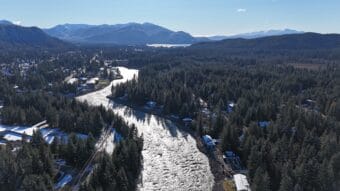
Water rushes in the Mendenhall River on Sunday, Oct. 20, 2024. (Clarise Larson/KTOO)

The Juneau Assembly has approved $2 million in funding to construct a semi-permanent levee along Mendenhall River in order to prepare for future glacial outburst floods.

But at a meeting Monday night, members of the Juneau Assembly and the public expressed hesitation about the city’s flood fighting plan. Phase one calls for the installation of flood barriers along about four miles of riverbank from Killewich Drive and Marion Drive to Meander Way.

That would require 79 homeowners to agree to have barriers installed on their properties. The city has been conducting preliminary outreach to those homeowners over the last couple of weeks. According to a memo from City Manager Katie Koester, “most homeowners were favorable to the concept of Hesco barrier installation to protect their and others’ property.” But a few who testified at the meeting, like Meander Way homeowner Sam Hatch, are not excited about the idea. 

“I, among others in the neighborhood, oppose the HESCO flood barrier proposal because of the risks that come with a fully constrained river, and the ambiguities in this project,” Hatch said. “Burdening the 70-plus waterfront homes with the cost of a temporary solution, while benefiting hundreds of Valley homes, is wrong.”

The flood barriers, made by a company called HESCO, are basically large reinforced sandbags that last up to five years. They were given to the city free of charge by the U.S. Army Corps of Engineers.

But the cost of planning, site preparation and installation of the barriers falls to the city. Koester said Monday that the total project budget will definitely balloon beyond this initial $2 million investment, which was pulled from the city’s restricted budget reserves. It could cost an estimated $5 to $10 million by the time the work is finished, and it’s not yet clear where that will come from.

One of the main topics of the night was figuring out how to pay for that. It could come down to splitting costs across all Juneau taxpayers, or it could involve making individual homeowners along the waterfront take on some share of the preparation work on their properties.

The Assembly also discussed the possibility of creating a local improvement district, or LID, in the Mendenhall Valley. That could establish a cost-sharing system for some or all homeowners in the flood-affected neighborhoods.

View Drive resident Elizabeth Figus testified against the LID plan, though she supports the barriers. She urged the city to focus on proposed long-term solutions like dredging new channels for the river or building a levee around Mendenhall Lake, expressing concern about the effectiveness of the HESCO levee. 

“This is a temporary, experimental installation. So as we’ve heard, this could actually damage properties, both where it’s installed or downstream,” Figus said.

By the end of a meeting, Assembly member Wade Bryson echoed that sentiment. 

“The more that I listen, the less that I like these HESCO barriers. It is a temporary solution that could empty our piggy bank and literally use up the funds that we will need to do a more permanent solution,” Bryson said. “It seems more reactionary.”

According to Koester, the long-term flood mitigation proposals require more careful planning and study, along with even more funding. She said the city is pursuing those long-term flood mitigation plans. But the HESCO barriers have been championed by city officials as a way to do flood fighting quickly, before another outburst happens again next summer.

New Assembly member Maureen Hall said she supports the barriers, but also said the Assembly has to reduce the financial burden that might fall on homeowners along the riverbank. 

“The HESCO barriers may not be a perfect solution, but we’re looking for something temporary, quick. We can’t stand by and not do anything this coming year,” Hall said. “We need kind of a combination of sharing of the costs between CBJ and trying to figure out an equitable way among the homeowners that are impacted.”

Despite the opposition, the city plans to keep working on project plans for the barrier installation, and will continue to discuss ways to cover the remainder of the project costs at future meetings.

Update: A previous version of this article stated that the U.S. Army Corps of Engineers was planning a public meeting for the week of October 28th. Now, those meetings are tentatively planned for sometime in mid-November, 2024. 

Correction: This article has been updated to reflect that while Elizabeth Figus opposed the LID plan, she was supportive of the HESCO barriers.

City will provide sandbags for those affected by Juneau’s glacial outburst flood

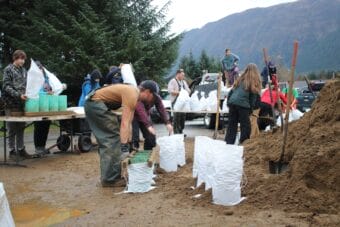
Members of the Juneau Douglas High School hockey team also filled sandbags, in an independent operation over the past two weekends (Photo by Anna Canny/KTOO)

The City and Borough of Juneau will offer sandbags this weekend  for residents affected by August’s record-breaking glacial outburst flood. Every household that flooded is eligible for up to 200 free sandbags provided by the U.S. Army Corps of Engineers. 

Bundles of empty bags will be available at the Mendenhall Valley Public Library starting Saturday through Tuesday from 9 a.m. to 4 p.m. People should be prepared to share their contact information and street address when picking them up. 
Sand to fill the bags will be provided at Dimond Park and Melvin Park. Emergency Programs Manager Tom Mattice said the city is not providing staff to help people fill and transport sandbags, but they’ve put out a call to several volunteer groups for help. 

“You know, 200 sandbags to load them by yourself is a lot of work, so we know everyone is going to need a hand,” he said. “We’re just asking if people have time, stop by, load a sand bag or two and help be a part of the solution.”

Suicide Basin could drain and trigger an outburst flood at any time. Right now, the basin is full enough to trigger a moderate flood, but floods have never happened in the winter months before.

Mattice said sandbagging is an imperfect solution, but placing sandbags in front of low-lying areas can be an effective way to divert some floodwater. 

“The idea with the sandbags is you can sandbag around your doors and your openings and your low spots so that it prevents water getting in early on and really helps,” Mattice said. “If there’s a small flood it will be instrumental, if it is a big flood it’s probably not going to do a lot but the more you can slow the water the better off you are.”

Guidance on how to use sandbags can be found on the City’s flood response webpage. 

Sandbags degrade over time with exposure to sunlight or moisture. So if you’re picking up sandbags this weekend, Mattice recommends you have a good place to store them until the next flood comes. 

This will likely be the only time the city offers sandbags this year, and it could be the last chance to get sand until next spring. Cold temperatures cause sand to freeze up, making it hard to work with. If temperatures drop this weekend, it’s possible that the city will pack up the sand early.

President Biden approves federal disaster declaration for August outburst flooding

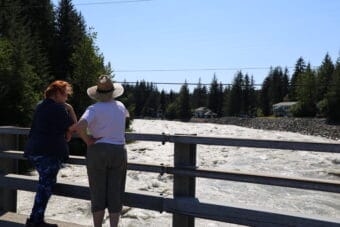
People watch as the water continues to rise along the Mendenhall River during Juneau’s annual glacial outburst flood on Monday, August 5, 2024. (Clarise Larson/KTOO)

U.S. President Joe Biden has approved a major disaster declaration for Juneau’s record-breaking glacial outburst flood, more than two months after it damaged nearly 300 homes in the Mendenhall Valley. 

The move frees up money from the Federal Emergency Management Agency for temporary housing, home repairs and low-cost loans to cover losses on uninsured property. Deputy City Manager Robert Barr said Wednesday evening’s declaration came as a surprise.

“I was certainly very happy and excited when I heard about it,” he said. “It’s never a guarantee.”

Last year’s catastrophic flood, which destroyed two homes and damaged around two dozen others, did not receive a federal disaster declaration. 

The federal disaster assistance will supplement the state disaster assistance that kicked in following Gov. Mike Dunleavy’s disaster declaration in August. Those who submitted applications for state assistance are already receiving payouts, which are capped at $21,000. With the FEMA declaration, homeowners will be eligible for twice as much. 

A federal disaster declaration also makes funds available for the City and Borough of Juneau and the Central Council of the Tlingit and Haida Indian Tribes of Alaska to do emergency work and repairs. 

It’s  also a major eligibility requirement for many federal hazard mitigation programs, which might dole out money for projects that will prevent or reduce long-term risk to life and property posed by future floods. 

Barr said the city has not figured out which of these programs they might pursue, but they’re looking into a variety of grants that might be a good fit for Juneau.  

“None of them will bring money immediately, right? They all generally involve fairly lengthy processes and periods of study and analysis before we actually see the results,” Barr said. “But now at least we have the opportunity.”

Residents and business owners who sustained flood damage can apply for assistance by registering online at www.DisasterAssistance.gov, calling 1-800-621-3362 or using the FEMA App.

FEMA also plans to set up an assistance center at the Mendenhall Valley Public Library, where federal representatives will offer help on applications. The precise dates for that have not been announced, but Barr expects it could be up and running sometime later this month.

This federal disaster declaration also comes after national concern and widespread misinformation about FEMA running out of money in the wake of Hurricanes Helene and Milton, which pummeled the southeastern U.S. earlier this month. But the agency said they have adequate funding to support all of their current operations. 

This summer, FEMA did raise an alarm about shortfalls in their Disaster Relief Fund to make it through the remainder of hurricane season, which typically lasts through November. The fund, which is appropriated by Congress, is often considered the first line of response following a disaster. 

An infusion of money from a stopgap spending measure passed in September replenished the fund for now. Congress can appropriate more supplemental funding, but federal lawmakers are out of session until Nov. 12. 

At the same time, the federal Small Business Administration’s disaster loan program, which provided relief to many Juneau residents after last year’s flood, recently announced a pause on its program until Congress approves more funding. 

Wildlife official says city trash management ordinance needs improvement as busy bears make trouble

A black bear eats vegetation in the Mendenhall Valley in July 2024. (Clarise Larson/KTOO)

Juneau’s resident black bears break into trash cans every year. In most cases, it just creates a mess, but sometimes those bears end up dead.

So far this year, the Alaska Department of Fish and Game has euthanized five black bears downtown, including two at once back in July.

Regional Management Coordinator Roy Churchwell said this year was not an especially active year for trash bears across the whole of Juneau, because there was plenty of natural food available. 

“I don’t actually think it is a bad year, I think some years have been much worse,” Churchwell said. “There were decent berries out and there were fish available for bears.”

That’s compared to years like 2018, 2019 and 2020, when a lack of natural foods and a bear baby boom drove up bear activity. 

But Churchwell said this year, there was a concentration of problem bears downtown, and commander Jeremy Weske with the Juneau Police Department said they received more than 160 bear-related calls this year. 

Trash management in Juneau is governed under a city ordinance, which the police enforce. It lays out rules about when garbage can be put out on the curb and what kinds of cans it can be stored in. 

It also doles out fines when trash attracts bears. Even so, the local trash rules are frequently violated, and Weske said there are repeat offenders who earn several fines in a single year.

“I think in general, people respond well to education and maybe a ticket or two if it gets that far,” Weske said. “But there will be people who don’t respond well to that and we have to have a different strategy for that.”

The ordinance calls for a $50 fine for the first trash violation, $100 for the second and $300 for a third within the span of two years. 

The ordinance dates back to 2004. In the year before it went into effect, 23 bears were killed.  So Churchwell said it’s helped, but there’s room for improvement. 

“When the original ordinance went into effect, there was a decline in human-bear conflicts and bears getting into trash. And so that’s a good thing,” Churchwell said. “We just want to build on that and create a situation where there’s even less human bear conflict, if possible.”

Earlier this year, the Department of Fish and Game commissioned a pair of wildlife researchers from the University of Fairbanks to study Juneau’s human-bear interactions, with the hope of saving more bear lives on the future.

But in the short-term, trash management is going to be especially important over the next month. Right now, bears are going through a phase called hyperphagia as they get ready for hibernation. 

“It’s a time when they’re just really trying to put on weight before they go into the den,” Churchwell said. “So they’re really looking for food at this time.”

Those hungry bears will be eyeing trash. Juneau residents should only store trash in a bear-proof can, and trash should be stored inside — or in a garage or shed — until  trash pick-up day.

Juneau high school hockey team fills 3,000 sandbags for flood affected neighborhoods

Volunteers from the Juneau-Douglas High School Yadaa.at Kalé high school hockey team filling sandbags on Sunday, Oct. 13, 2024 (Photo by Anna Canny/KTOO)

The Juneau Douglas High School hockey team spent the weekend filling and delivering sandbags to homeowners in the Mendenhall Valley, where a record-breaking glacial outburst flood damaged nearly 300 homes in August.

Over the last two weekends, the team distributed more than 3,100 sandbags to more than 30 households, according to hockey mom Andrea Petrie, who coordinated the distribution.

Head coach Matt Boline said they shoveled tens of thousands of pounds of sand.

“That’s a lot of time saved in the gym. And they’re out here helping the community in the process,” he said.

The team made dozens of deliveries to neighborhoods that flooded in August 2024. The hope is that the sandbags will help people protect their homes from the next outburst flood. (Photo by Anna Canny/KTOO)

Boline also said the work was an especially good team-building activity as students navigate the Juneau School District consolidation. Some students moved from the former Thunder Mountain High School in the Valley to Juneau-Douglas High School Yadaa.at Kalé downtown this school year.

“With the schools combining and a lot of the attention focused downtown at JDHS, people maybe aren’t thinking about the Valley so much from down there, but all the kids are coming from there,” Boline said. “We have a lot of families, hockey families that live here.”

The sandbags and the sand to fill them were provided by community member Noah Teshner. Debbie Penrose Fischer, whose house flooded this year, also helped to coordinate the deliveries.

Community groups have stepped up to do flood preparation, but anxiety remains as the threat of a fall flood looms

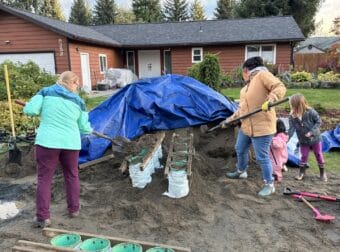
Heidi Teshner and Margaret Katzeek fill sandbags (Photo courtesy of Jennifer Katzeek)

On Thursday morning, the National Weather Service Office in Juneau detected that water levels were dropping in Suicide Basin. Sometimes, that’s the first sign that a glacial outburst flood is beginning. 

But by Thursday evening, forecasters confirmed that flooding was not in fact happening. For Mendenhall Valley residents like Renee Culp Tl’aagunk, the false alarm brought back memories of August’s flood, which swamped nearly 300 homes, including her house on Emily Way. 

“Last night, it was full-on re-experiencing the flood,” Culp said. “I stayed up late in the evening doing double checks of are the sandbags in place? Is everything off the floor?  So I was doing like the last minute prep and also freaking out, you know? Full of anxiety, and full of panic.”

More than two months after that record-breaking flood, many residents are struggling with their mental health. At the same time, they’re trying to prepare for another flood. Some have limited work on their homes, with the knowledge that they might flood again soon, while others are stocking up on sandbags or shelling out for more substantial flood barriers to protect themselves.

According to hydrologists with the weather service and the University of Alaska Southeast, the amount of water in the basin right is only enough to reach a moderate flood stage. That means water could threaten homes on View Drive and Meander Way, but most houses would be spared.

Still, there are a lot of unknowns when it comes to predicting the flood. There’s not enough information to determine how fast water would drain from the basin, or where the Mendenhall River might breach its banks and what direction the water might come from as it seeps into neighborhoods.

The basin could release at any point, though it usually doesn’t release in the wintertime — the latest it has drained in the past is late October. Right now, it’s still filling up, with the promise that it will let loose eventually. 

While Culp waits for that, plans to get her house in order have stalled. 

“We have furniture ordered, and we asked them to not deliver it. We have a refrigerator ordered, and we ask them not to have that delivered. I mean, like our artwork isn’t on the walls, our house isn’t back to normal,” Culp said. “Because if we flood again, even a couple of inches in a house is pretty devastating to the house.”

Culp and her wife Kathleen Rado have found some degree of comfort in preparing alongside their community. They’ve started a community-led flood fighting group.

Over the last few weeks, the couple and their collaborators have been coordinating evacuation plans amongst neighbors, sharing ideas for flood mitigation and having semi-regular meetings. There’s also a webpage for flood-affected residents, and a Facebook group.

Noah Teshner has been active there, advertising his sandbags. He purchased 10,000 of them after the flood, with the intention of selling them for cheap to his neighbors, and he said there’s been a lot of demand  — a couple thousand have sold so far. Teshner said he’s noticed a particular need from those who are elderly or disabled, people who worry that they’ll be left scrambling to do last minute preparations on their own when another flood comes.

Last weekend, the Juneau Douglas High School hockey team, led by head coach Matt Boline, helped fill many of the bags with sand Teshner purchased. 

“And the hockey team has been great, because not only did they fill them, but they’ve already delivered a bunch,” Teschner said. “I know there’s more people out there that need them, and I’m just hoping they’ll they’ll reach out.”

Like many of his neighbors, Teshner said he’d like to see a more substantial flood fighting solution across the Mendenhall Valley. The City and Borough of Juneau has introduced a plan to build a temporary levee along portions of the Mendenhall River. But Teshner wanted something quicker – something to comfort Juneau’s flood-affected neighborhoods as they wait in limbo. 

“That’s why the sandbags feel good, because you’re dependent on yourself, your neighbors, the people you can really trust to work together, ” he said. “And you can go, ‘I’ve done everything I can.'”

Teshner, his neighbors and some more volunteers from the hockey team will be back at it again, filling and delivering sandbags by request this weekend. 

Meanwhile, the latest updates on a potential flood can be found on the National Weather Service’s Suicide Basin monitoring page.

Site notifications
Update notification options
Subscribe to notifications