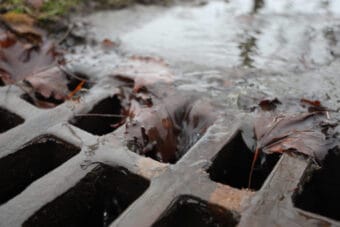
Rain runoff runs down a drain in the Mendenhall Valley in November 2022. (Clarise Larson/ for the Juneau Empire)
A strong fall storm will move across the Gulf of Alaska Friday afternoon, bringing heavy rain and strong winds to Southeast communities through Saturday.
The front originates from a low pressure system that’s currently hanging over the western gulf near Kodiak. It’s already battering the island community with gusts of up to 75 miles per hour.
National Weather Service Meteorologist Grant Smith said the storm is headed toward Southeast Alaska now. It’ll hit outer coast communities from Yakutat to Prince of Wales Island first, before spreading inland.
“It’s just a front moving essentially from west to east,” he said. “So we’ll start seeing the winds and rain along the coast, beginning this evening. And then once you get into the overnight and the weekend, that’s when the rest of the Panhandle will see the rain.”
Most places can expect rainfall totals between two and three inches at sea level, though there could be more rain on mountain slopes.
“The moisture amounts are not really all that impressive for Southeast Alaska,” he said. “The strongest winds are going to happen when the front moves through tonight into early tomorrow.”
Communities including Petersburg, Wrangell, Juneau, Hoonah, Gustavus and Yakutat could see wind speeds between 30 and 50 miles per hour as the storm passes through.
Further south, winds could be even stronger, with gusts of up to 60 miles per hour. A high wind warning is in effect from 1 a.m. to 10 a.m. Saturday for Sitka, Craig, Klawock, and Hydaburg. Ketchikan and Metlakatla are under a high wind warning effective from 4 a.m. through 1 p.m. Saturday.
Winds that strong can blow down trees and powerlines, causing property damage and the potential for widespread power outages.
People are encouraged to secure their vessels or any other loose objects that could be blown around or damaged by the winds
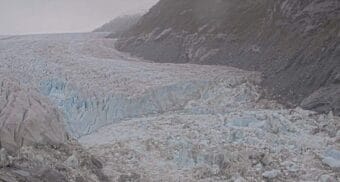
Cameras deployed above Suicide Basin captured this image of the basin filled with water and icebergs on Oct. 10, 2024. (Photo from the National Weather Service Suicide Basin monitoring page)
Update, Thursday 5 p.m.:
A Thursday evening update from the National Weather Service indicates that a glacial dam release is not happening.
Earlier in the day, laser sensors indicated that water levels in Suicide Basin were dropping, which can signal the start of a glacial outburst flood. Now, water levels are back on the rise
Over the last 24 hours, levels in the Mendenhall Lake downstream have remained stable, and no outburst flooding is expected in the immediate future.
Thursday morning’s drop was minor, with the water levels decreasing from 1,231 feet to just over 1,230 feet. Meteorologist Brian Bezenek said there are many things that could have caused that.
Icebergs calving off the face of the Mendenhall Glacier can make water levels fluctuate up or down. It’s also possible that a temporary drainage channel opened in the face of the glacial-dam.
“It could have found a crevice in the ice, that cracked, and the water rushed in and lowered the levels a little bit. It could have been a touch of a release, and then the gap closed back up,” Bezenek said. “We’re not entirely sure, but we are maintaining a close eye on that as usual.”
Original story:
The National Weather Service Office in Juneau said water levels in Suicide Basin dropped Thursday morning, indicating potential for a second glacial outburst flood this year. Based on current levels in the basin though, the flood would be far less damaging than this past summer’s flood.
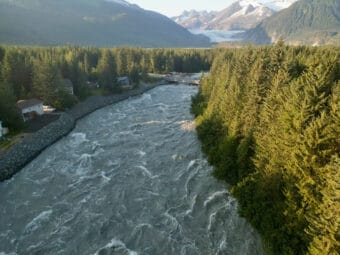
On Aug. 6, 2024, water released from the basin brought the Mendenhall Lake and River to record flood stages. The river crested at 15.99 feet, and flooding damaged 289 homes in the Mendenhall Valley.
But this time around, the basin is far less full. National Weather Service hydrologist Aaron Jacobs said that means if a release happened right now, flooding of the Mendenhall River would be much less severe.
“At this time, it would be right around an 11-foot crest from our calculations. That would be over a moderate flood stage,” Jacobs said
At a moderate flood stage, low-lying areas will flood. There could be more than a foot of water on Skater’s Cabin Road and the West Glacier trail, and up to three feet of water in parts of the Mendenhall Campground.
View Drive would be flooded and impassable at a moderate flood stage, with some homes along the river taking on water. Homeowners along Meander Way may see water seeping into their backyards, while most homes in the Mendenhall Valley would be spared from flooding.
But the volume of water in the basin is just one of the factors that shapes flooding. The other is the speed of the release, said University of Alaska Southeast hydrologist Eran Hood.
“Something that the public needs to understand is that we will put out an initial forecast based on what we know with the initial volume,” Hood said. “Then, as the event is unfolding, we can get a better idea of how that release of water is taking place, and adjust the forecast accordingly.”
Hood says a release right now could be a good thing. Water levels in the Mendenhall Lake and River are low, much lower than they typically are in the summer.
“So that also gives us more of a buffer,” he said.
The Mendenhall River would be able to absorb more water before reaching a major flood stage. And draining water from the basin now would prevent it from filling up all the way and triggering a larger flood later on.
“The sooner, the better. Get it out of there and, you know, be done with it,” Hood said. “People will get a little nervous, but I don’t think it would do any damage.”
The drop in the basin’s water levels Thursday morning was detected by laser sensors deployed at Suicide Basin. Experts from the National Weather Service, the University of Alaska Southeast and the U.S. Geological Survey are evaluating the data to see if the water levels will continue to drop, indicating the start of a release.
If that happens, the National Weather Service will put out an official flood forecast. The latest updates can be found on the Suicide Basin monitoring page.
Congresswoman Mary Peltola has launched one disparaging how challenger Nick Begich made his personal wealth.
Dr. Iki Heke, a Indigenous Maori professor from New Zealand, was in Alaska recently for a national tribal conference on climate. He spoke with KNBA’s Rhonda McBride about the growing importance of Indigenous environmental knowledge.
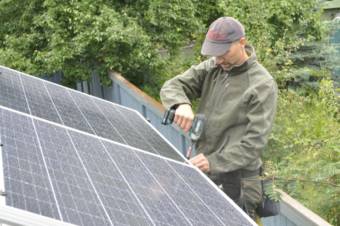
Anchorage Solar owner Ben May secures a solar panel. (Photo by Erin McKinstry/Alaska Public Media)
A Native-led economic development nonprofit based in Juneau has received $10 million toward projects that will help Southeast Alaska communities ditch fossil fuels.
The money comes to Spruce Root via the Coalition for Green Capital. They’re a national group that first partnered with Spruce Root last year to establish a “green bank” — a type of bank that supports projects to promote clean energy or otherwise reduce greenhouse gas emissions to fight human-caused climate change.
Michael Ching manages finances for Spruce Root’s Community Development initiatives. He says the money will support a wide variety of projects.
“From heat pump installers and solar equipment providers to innovative startups — perhaps renting EV scooters for tourists,” Ching said. “Green banks play a crucial role in accelerating the transition to a clean energy future.”
Investment in clean or renewable energy projects is exploding in Alaska, especially at Spruce Root. The $10 million commitment is the second major influx of money for their green bank. This summer, the U.S. Department of Energy awarded them $2.5 million to install heat pumps on Prince of Wales Island.
Just weeks later, Southeast Conference and Juneau-based nonprofit Alaska Heat Smart also received more than $38 million for heat pump promotion from the Environmental Protection Agency.
A heat pump is an efficient electric alternative to oil burning heating systems. Installing one can dramatically cut home energy costs and carbon emissions. But these funding sources don’t just pay for the heat pumps themselves. They also support renewable energy workforce development.
“Getting finance for renewable energy equipment is definitely necessary — also necessary is the manpower, the expertise, the human resource to get things installed,” Ching said. “We will develop training programs, technical assistance, including workforce development, so that people might be able to become a renewable energy installer — perhaps embark on additional income opportunity.”
That’s one of Spruce Root’s top priorities as funding for renewable energy projects grows, Ching said. And while heat pumps are getting a lot of attention in recent years, Spruce Root has already discussed other possibilities for the new funding, like beefing up charging infrastructure for electric cars and boats.
One of the strengths of green banks, Ching said, is that they’re flexible in the projects they can support. And Alaska is home to at least two other green banks. Earlier this year, lawmakers established a state-led green bank. And the Valdez Native Tribe launched their own in 2023.
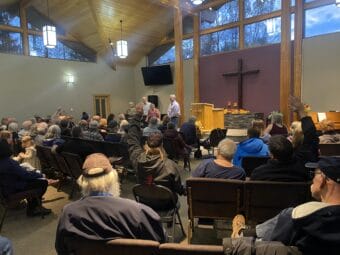
Community organizer Renee Tl’aagunk Culp and representatives from the City and Borough of Juneau addressed a crowd of residents from flooded neighborhoods on Thursday night (Photo by Anna Canny/KTOO)
A community-led flood recovery group has convened to address gaps in clean-up and emergency planning ahead of future glacial outburst floods in the Mendenhall Valley.
Organizers held the group’s second meeting on Thursday. About 60 people crowded into Riverside Baptist Church. Most of them experienced flooding firsthand during the record-breaking glacial outburst in August.
The meeting began with a mental health check-in. One of the organizers, Renee Tl’aagunk Culp, encouraged flood-affected residents to rely on each other.
“We are strong Alaskans. We are independent people, but we survive in this harsh environment with interdependence,” Culp said. “We know that that that we help each other literally survive. So just reach your hand out.”
One of the group’s priorities is finding a better system for warning and evacuation ahead of the next flood. The Mendenhall River has now seen record-breaking flooding two years in a row.
Many community members worried about the possibility of another big flood this fall, after news circulated that Suicide Basin had started filling again.
Experts say another major flood this year is unlikely, but community organizers have arranged to have Juneau Taxi provide free evacuations for those with wheelchairs or other disabilities in the event of another outburst. People can contact Juneau Taxi directly to be put on an evacuation list.
Representatives from the City and Borough of Juneau, including Deputy City Manager Robert Barr, Emergency Manager Tom Mattice and Assembly Member Michell Hale, also attended the meeting.
Mattice encouraged neighbors to make evacuation plans together before another flood comes.
“Everybody needs to have personal plans. You need to work with your family, your loved ones, your neighbors, your churches,” he said. “People need to coordinate and think about evacuation.”
Mattice also recommended purchasing a NOAA weather radio, which provides real-time updates on flooding, and the city soft-launched an opt-in emergency alert system, which they’ll be rolling out officially soon.
They also answered questions about the city’s newly introduced flood fighting plan. It will involve creating a makeshift sandbag levees along key points on the river, which could reduce flooding in some of the hardest-hit neighborhoods.
Community organizers have created a website where they plan to consolidate flood mitigation ideas from the Federal Emergency Management Agency and other sources. The website also has a place for people to volunteer to help flood-affected residents that are working to rebuild.
Water continues to rise along the Mendenhall River during Juneau’s annual glacial outburst flood on Monday, August 5, 2024. (Eric Stone/Alaska Public Media)
The Assembly approved an ordinance that will allow the city to work with the U.S. Army Corps of Engineers on the installation of flood protection barriers along the Mendenhall River.
The barriers are made by a company called HESCO. They’re Army Corps–recommended and relatively easy to install, according to City Manager Katie Koester. They’re essentially stackable heavy duty sandbags, which are about 4 feet tall and 3 feet square.
“Those HESCO barriers are what we would be lining the river with to protect life and property in the event of the next jökulhlaup,” Koester said.
The Corps will donate the barriers free-of-charge — enough to eventually line up to four miles of riverbank — along with 60,000 sandbags for individual homeowners. But the city will be responsible for distributing the sandbags and installing the HESCO barriers at key places along the river.
Phase one installation will focus on the stretch from Marion Drive to Killewich Drive to Meander Way. Those locations were selected because that’s roughly where the water first breached the bank in August. Later on, the makeshift levee might be extended along the remainder of the developed side of the river, as well as on River Road and View Drive. The city would take on responsibility for the maintenance of the flood barriers, which typically last for about five years.
It’s unclear what the total project budget will be, but the first phase may cost up to $2 million dollars. The Assembly will discuss ways to come up with that money at a regular meeting on October 21, 2024.
City leaders hope the barriers can be installed over the next few months. In previous meetings, they’ve discussed more long-term solutions to minimize or prevent flooding altogether, but those solutions will be time-consuming, costly and legally thorny. They’ll require a more in-depth study by the Corps. That study has not yet been approved, but Governor Dunleavy and the Central Council of the Tlingit and Haida Indian Tribes of Alaska have requested it and the City and Borough of Juneau have preemptively set local money aside to fund it.
The flood barriers are a more immediate solution, Koester said, though they’re not perfect.
“They’re ugly, they’re large. Again, they’re designed for a five year lifespan,” Koester said. “And while we will be expeditiously looking on long term solutions, we really don’t know what that looks like until, until that study has has been done.”
Most of the barriers will also have to be installed in people’s yards, and about 75 homes may be asked to put barriers on their private property. Koester said the city will start outreach to those homeowners this week, but members of the public who showed up to testify expressed support for the plan.
Some, like Clinton Singletary, who lives in the affected neighborhood of Center Court, also reiterated the need for long-term solutions.
“These events will continue happening as the glacier retreats, and from the research I’ve seen, they’ll likely only get worse each year until effective mitigation is in place,” Singletary said.
Suicide Basin, which is dammed by the Mendenhall Glacier, is bound to flood the valley again. And it’s already refilling, which raised concerns about the possibility of another major flood this fall.
But Aaron Jacobs, a hydrologist with the National Weather Service who attended the meeting, said the basin is only about halfway full and levels in the Mendenhall River are currently low. If Suicide Basin drained right now, it would cause a moderate flood, bringing the river to about 10.5 feet – much lower than record-breaking 15.99 feet during August’s flood.
As freezing temperatures kick in, Jacobs said the possibility of another release in 2024 will wane.
“We’ve never seen one over the wintertime — not saying that couldn’t take place — but just in the past, we have not seen one take place in November, December, January,” Jacobs said. “If it doesn’t release into the fall time, what that will tell us is that we could just see a fuller basin a lot earlier next year.”
The city also plans to welcome the Army Corps of Engineers for a public meeting this fall to provide technical advice for homeowners trying to protect their homes from flooding, but the Corps has not yet confirmed that plan and specific dates have not been announced.
Correction: A previous version of this story misspelled the word “levy.”
Close
Update notification options
Subscribe to notifications
Subscribe
Get notifications about news related to the topics you care about. You can unsubscribe anytime.