Anna Canny

Local News Reporter

Scientists, conservationists to hold forum on proposed Juneau-Douglas second crossing

A coalition of Juneau scientists, conservationists and wildlife enthusiasts will hold a forum about the proposed Juneau-Douglas second crossing on Monday at 6 p.m. in Elizabeth Peratrovich Hall.

The Alaska Department of Transportation and Public Facilities, the City and Borough of Juneau and the engineering firm DOWL have been collaborating over the past two years to identify possible routes for the transportation corridor to connect Juneau with north Douglas via their planning and environmental linkages study.

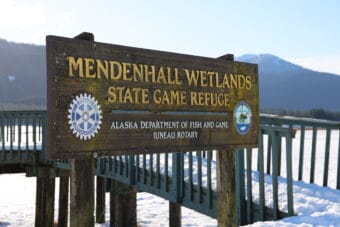
So far they’ve narrowed it down to six options. Most pass through Taashuyee-Chookan.aani, also known as the Mendenhall Wetlands. That’s a concern, said Matt Robus, a retired director of wildlife conservation for Alaska Department of Fish and Game. Robus will serve as the forum’s moderator.

“It’s a rare and very productive natural area that’s already got an airport in the middle of it, and it’s right in the middle of a city,” he said. “It was not put there just to be empty land that can be converted to a route to the other side without some very serious conditions and limitations.”

The forum will feature panelists from organizations like the National Oceanic and Atmospheric Administration, Southeast Alaska Land Trust, Southeast Alaska Conservation Council, Audubon Alaska and Territorial Sportsmen, Inc., among others. 

They’ll discuss the wetland’s role as an important habitat for fish and migratory birds. And they’ll also share concerns about the Alaska Department of Transportation and Public Facilities’ approach to the second crossing study so far.

Robus is a member of the Mendenhall Wetlands study group, a collection of nearly two dozen scientists and naturalists who serve on the technical advisory committee for the study. They’ve seen drafts of from the study’s second-stage screening which have not been publicly released.

Robus says some members of the advisory committee are concerned that the Department of Transportation’s approach thus far does not thoroughly consider the potential environmental impact of the project. 

“We’re not against a second crossing,” Robus said. “What we are for is a second crossing that is intelligently cited, and that is as much of a win-win as possible.”

Possible routes for the Juneau Douglas north crossing under consideration via the Planning and Environmental Linkages Study. The Salmon Creek route is marked in orange on the far right (Map created by DOWL)

Some organizations on the committee, including the Mendenhall Wetlands study group and the Southeast Alaska Land Trust, are especially concerned that the Salmon Creek alternative may be nixed. It’s the only proposed route that doesn’t cut through the Mendenhall Wetlands State Game Refuge. 

But Alaska DOT has expressed concern that a bridge there could be damaged by flooding in the event of a breach of the nearby Salmon Creek hydroelectric dam, which Alaska Electric Light and Power flagged as a worst-case scenario possibility.

In an email to KTOO, Department of Transportation spokesperson Sam Dapcevich said the department needs more information about the dam to proceed.

“The necessary process to acquire this data has started but does not come with a prescribed timeline,” Dapcevich wrote.

The final draft of the study was originally supposed to be publicly released this summer. Now, as the department further considers the Salmon Creek alternative, and other comments from the advisory committees, there is no precise date for the study’s completion. 

“We are committed to keeping all stakeholders informed as this evolves,” Dapcevich wrote.

The department declined an invitation to participate in next week’s forum, but Dapcevich emphasized there’s been no decision to remove any alternative.

After the study is complete, any selected routes will be subject to further review under the National Environmental Policy Act.

Climate change makes farming easier in Alaska. Indigenous growers hope to lead the way.

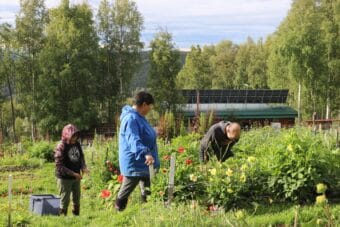
Cousins Viva Johnson (left) and Bernadette Pete harvest celery with instructor Leonardo Sugteng’aq Wassilie at Calypso Farm and Ecology Center, just outside Fairbanks, Alaska. Johnson and Pete can’t always get fresh produce in their village of Alakanuk, near the Bering Sea. In August, they participated in an Indigenous-led farmer training program at the farm. (Anna Canny/KTOO)

Editor’s note: Anna Canny reported this story for NPR’s Climate Solutions Week

Growing up in rural Alaska, Eva Dawn Burk recalls hunting, trapping and going to fish camp every summer, gathering traditional foods with her family.

Burk is Alaska Native, Dene’ and Lower Tanana Athabascan. She grew up in the small villages of Nenana and Manley Hot Springs along the Tanana River in Interior Alaska, where her family and neighbors relied on the land to fill their pantries and freezers.

But that way of life is increasingly threatened. Alaska is warming faster than any other U.S. state as a result of human-caused climate change. Heat waves and other shifting weather patterns are causing chaos in ecosystems that Indigenous hunters and fishermen have long relied on, disrupting everything from the migration of caribou and reindeer to the abundance of wild-berryharvests.

“It doesn’t matter what part of the state that we look at,” says Burk, now a community food activist and a student of sustainable agriculture at the University of Alaska Fairbanks. “Climate change is wreaking havoc on the habitat and on our fish and wildlife.”

But the warmer temperatures and changing seasons have also had another impact: Climate change is making agriculture more possible in many parts of Alaska. That’s driving a new enthusiasm for farming across the state.

Few of the state’s rural villages have farms or even community gardens. So in 2020, Burk decided to start a training program to teach aspiring Alaska Native farmers how to grow their own food.

The goal, she says, is to help Alaska communities that are being most affected by climate change — and to shore up food security as traditional foods become more unpredictable.

“An Indigenous value is to be prepared for the future,” Burk says. “What our program is doing is working to prepare some of the most vulnerable communities.”

Trainers and participants with the Indigenous farmer training program at Calypso Farm and Ecology Center spent a weekend in August camping together and harvesting food for their meals. Susan Willsrud and Tom Zimmer (back row, center) founded Calypso Farm and Ecology Center with the hope of educating more beginner farmers. (Photo by Anna Canny/KTOO)

“You can’t farm in Alaska”

Alaska isn’t usually considered farm country. Much of the state has cool summers, harsh winters and a short growing season, which can make it challenging to grow anything other than hardy crops like cabbages and potatoes.

But climate change is bringing higher temperatures during many parts of the year and longer frost-free summers.

First frosts are already arriving later in some parts of the state, allowing growers to keep their crops in the field longer. Research done at the University of Alaska Fairbanks predicts the growing season could be weeks or even months longer by 2100.

Hotter summers could support larger yields, and milder winters could shift the state’s plant hardiness zones, which describe the crops most likely to thrive in a region. By 2100, the hardiness zones in Fairbanks may resemble those in modern-day Kansas or Kentucky, the UAF study found.

Even now, Alaska farmers and gardeners are experimenting with crops that have historically been extremely difficult to cultivate.

“We’re successfully able to grow things like artichokes and field-grown tomatoes, peppers and corn here in Fairbanks,” says Glenna Gannon, a professor of sustainable food systems who runs crop trials at UAF. “I don’t think 30 or even 10 years ago that would have been successful.”

The state’s tiny agriculture industry is growing fast. The number of farms in Alaska has nearly doubled over the last two decades — from just about 600 in 2002 to almost 1,200 by 2022.

But Alaska growers like Gatgyeda Haayk still encounter a lot of skepticism.

“I hear that a lot. Like, ‘You can’t farm in Alaska,’” says Haayk, an instructor at the Indigenous-led agriculture training program at Calypso Farm and Ecology Center, just outside Fairbanks. “Even when I first came here, I didn’t think of myself as a farmer.”

Haayk runs a community garden in Metlakatla, a Tsimshian village of about 1,500 people in Southeast Alaska.

She first came to Calypso as a student, learning skills like seed starting and garden planning. Now she’s eager to pass that knowledge along.

Alaska farmers will not be exempt from the downsides of agriculture in a hotter world, like increased risk of drought or pests.

But in Haayk’s eyes, farming is still one of the best ways for Alaska Native villages to adapt to climate change. Alaska Native people make up more than 20% of the state’s population. As Alaska’s agriculture industry grows, Haayk wants to see more Indigenous-led farms and gardens.

“I feel like it’s time for the Indigenous people to be the pioneers of this change,” Haayk says. “We know this land best.”

She also thinks Alaska communities need to be less dependent on the Lower 48. Alaska currently depends almost entirely on produce grown elsewhere: Almost 95% of the state’s food is imported. Most grocery supplies arrive in Anchorage on barges. From there, everything must be transported to the state’s far-flung communities, many of which are not connected to the road system. Supplies are delivered by smaller boats or planes.

All of that means groceries are much more expensive. And shipping delays during the COVID-19 pandemic and recent natural disasters have demonstrated how fragile the system can be.

Those are all issues Eva Dawn Burk hoped to combat when she founded Calypso’s Indigenous-led farmer training program a few years ago.

Eva Dawn Burk, a community food activist, visited Calypso’s farmer training program in August. Burk founded the program to grow a network of Alaska Native farmers. (Photo by Anna Canny/KTOO)

Fresh veggies for remote villages

The Calypso Farm and Ecology Center was founded in 2000, just as the current wave of interest in Alaska agriculture was starting. It’s a small farm, nestled on 3 acres of land in the boreal forest just outside Fairbanks. But it grows hundreds of varieties of fruits and vegetables, just a few hundred miles from the Arctic Circle.

Burk first visited Calypso in 2019.

“I was really in shock and awe,” Burk says. “I was like, ‘How come we haven’t ever built something like this in one of our villages?’”

By 2020, Burk had launched the Indigenous agriculture trainings, building on Calypso’s existing suite of educational programs.

Burk views growing food as a natural complement to hunting, fishing and gathering wild foods. She hopes the training program will spur more farms in rural communities, where growers will tend to crops on the same land where they smoke salmon and tan animal hides.

Burk and her partners at Calypso have already helped develop a small statewide network of Alaska Native farmers and teachers. Late last year, the nascent program received a boost with nearly $750,000 in funding from the U.S. Department of Agriculture’s Beginning Farmer and Rancher Development Program.

On a drizzly day in August, this year’s training was well underway.

Tom Zimmer, who owns Calypso Farm, dug a hole in the deep brown soil and held out a small apple sapling to a group of trainees from across the state.

“Whoever plants this, in four years you get to come back and have some apples,” Zimmer said.

Bernadette Pete raised her hand. Pete took three flights to get to Calypso Farm, traveling for 12 hours from her hometown in Western Alaska for a weekend of lessons.

She and the other trainees were learning about transplanting and seed starting, composting and soil health, and irrigation. Between lessons, they spent the weekend camping and harvesting food for meals they cooked together.

Pete stepped up, pulled the tree roots from their plastic covering, and plopped the sapling into the ground.

“Write my name on it!” she said, laughing, as she packed the soil with her heel.

Fresh apples are one food it can be hard to get back home, Pete said, along with many of the veggies she snacked on that weekend, like sugar snap peas off the vine and celery straight from the ground.

Mikkiah Goessel and Gatgyeda Haayk (right) prepare to transplant seedlings at Calypso Farm and Ecology Center. They’re instructors for the farm’s Indigenous farmer training program. (Photo by Anna Canny/KTOO)

Like almost all the students who come to Calypso, Pete has stories about how the environment around her home is changing. Her hometown, the Yup’ik village of Alakanuk, sits at the mouth of the Yukon River, near the Bering Sea.

The community of about 700 people relies on wild foods like seabird eggs, berries, moose and especially salmon, which have been hit hard by climate change.

The decline of sea ice in Arctic and sub-Arctic communities like Alakanuk is making hunting more difficult and dangerous, and more extreme fall storms in Western Alaska have destroyed not only homes but also the gear used to get food. Salmon populations in the Yukon River have collapsed, driven at least in part, scientists say, by warmer river temperatures.

“I notice fall flooding, a lot more rain, less fish,” Pete said.

Endless rainstorms last summer drenched the salmon on Pete’s drying rack, being preserved for winter. She had to throw much of it away.

Since salmon stocks have crashed, the region’s only commercial salmon-processing plant has started pivoting to agriculture, putting up greenhouses in Alakanuk and surrounding villages.

With the knowledge she gained at Calypso, Pete is eager to get planting.

“Everyone here is so eager to teach you. It’s like they know every plant and how it grows,” Pete said. “I want to grow lettuce, potatoes, sugar snap peas.”

“I want my own little greenhouse.”

Juneau Assembly discusses funding for flood preparation, as residents ask for more guidance

Juneau Assembly chambers in City Hall during the local election on Oct. 4, 2022. (Photo by Tasha Elizarde/KTOO)

Juneau residents testified at Monday’s Assembly meeting to call for flood preparation and prevention following last month’s record-breaking glacial outburst flood, which devastated parts of the Mendenhall Valley. 

Jake Waid lives on Center Court. His neighborhood took on water for the first time this year. In his testimony, he referenced the photo of the Mendenhall Glacier that appears on the wall of the Assembly chambers. 

“The entire Valley is threatened by that glacier behind you,” Waid said. “This is our biggest test, and this will certainly be the biggest test any of you face, in your jobs.”

The City and Borough of Juneau has started to make both short and long-term plans in anticipation of another flood. 

First, they’ll create more accurate and detailed inundation maps and models of the Mendenhall River. But the Assembly will need an additional $100,000 from the general fund to cover the cost of that work. They’ll discuss it further at a special Assembly meeting next Monday.

There are also plans to bring in the U.S. Army Corps of Engineers to examine engineering solutions for long-term flood prevention. Only a state or tribal government is able to commission the Corps. Gov. Mike Dunleavy and President Richard Peterson of the Central Council of Tlingit and Haida have plans to do so. 

A study by the Corps could cost Juneau an additional $3 million in local funding. At Monday night’s meeting, the Assembly introduced an ordinance to set aside that funding, but it will be subject to a public hearing at next week’s special Assembly meeting. 

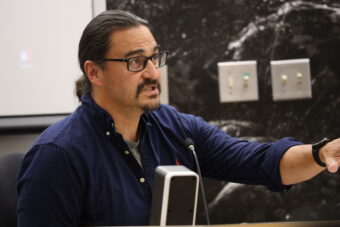
Jake Waid addressed the Assembly at their regular meeting on Sept. 17, 2024 (Photo by Clarise Larson/KTOO)

In their testimony, some residents expressed gratitude for the city’s flood clean-up and recovery efforts so far. But many, like Sandra Edwardson from Killewich Drive, also expressed uncertainty. 

“We are all feeling frustration, fear and uncertainty,” she said. “What is clear is that we need help. We are not experts in flood mitigation.”

City Manager Katie Koester and Mayor Beth Weldon are headed to Washington, D.C. this week, along with representatives from Tlingit and Haida. They’ll advocate for additional federal money to support a possible flood mitigation study by the Corps. 

But they also plan to ask for money to develop a more robust plan to ward off flood waters next year. That might include something like large-scale sandbagging. 

In the meantime, some homeowners are already moving ahead with their own flood fighting projects. And that worries Sam Hatch, who lives on Meander Way. He said there hasn’t been enough professional guidance available in the wake of the flood.

“A lot of my neighbors have been talking, and people really don’t know what to do. They don’t know whether they should repair, they don’t know if it’s worth repairing,” Hatch said. “People are talking about spending tens of thousands of dollars on their own little flood prevention projects — are they going to work?”

Hatch and some other residents asked the Assembly to bring in more experts on flood repair and mitigation, who may be able to assist homeowners through this period of flood recovery. 

The Assembly will make their final decision about flood funding during the special Assembly meeting at 12:15 p.m. next week. People are welcome to give public testimony at that meeting, which will be available over Zoom.

$15 million EPA grant for Southeast composting projects latest in local expansion efforts

Greens for compost
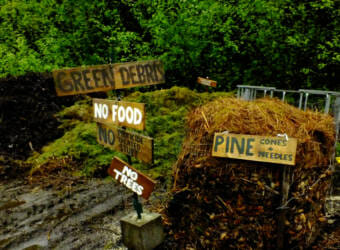
In a commercial operation like Juneau Composts in Lemon Creek, items are sorted out before they are mixed into a compost pile. (Photo by Matt Miller/KTOO)

The Central Council of the Tlingit and Haida Indian Tribes of Alaska has received $15 million in funding via the U.S. Environmental Protection Agency’s Climate Pollution Reduction grant program.

The Tribe will use the money to expand composting in Juneau and tribal communities across Southeast Alaska. It’s part of a larger trend of funding for composting in the region.
Tlingit & Haida Environmental specialist Cer Scott said the Tribe was surprised to receive the grant. They’re still developing more specific plans for how to use it, but they hope it will go towards strengthening existing composting operations in the region. 

“We’re not looking to reinvent the wheel,” Scott said. “We’re more so looking to serve as a resource to help these composters expand and reach new heights, whether that be with their local composting groups or the local municipalities, forming together partnerships across the region.”

The Tribe’s environmental department said they’re interested in working Tribal communities like Wrangell, Hoonah, Petersburg and Yakutat, which already have local composting programs. They’re in preliminary talks with leaders in those places, but the Tribe says they’re open to working with other communities too. 

Brandi Tolsma is also an environmental specialist for Tlingit and Haida. She said they’re relatively new to the world of composting, but they’re eager to invest in it. According to the U.S. Department of Agriculture, annual CO2 emissions from food waste and food loss are comparable to that of 42 coal-fired power plants.

And food waste is the single most common kind of waste in U.S. landfills. In Juneau, a recent draft waste characterization study estimated that 32% of the material in our landfill could be composted instead. 

“There’s still a lot of potential for expanding composting and really trying to divert as much as we can from these landfills,” Tolsma said. “Whether it be the Juneau landfill, to help expand that lifespan of the landfill, or also in these tribal communities, trying to divert waste. Also the other communities that are shipping their waste down south to help alleviate that economic burden.”

This is at least the third round of federal funding that Tlingit and Haida has received for composting and recycling in recent years. There was a $1.5 million earmark from the Bipartisan Infrastructure Law to develop a regional composting hub last year.

And $300,000 via the U.S. Department of Agriculture for composting at the Tribe’s Taay Hít greenhouse in Juneau. Those projects are not yet up and running. 

The City and Borough of Juneau is also looking to invest in composting, with early plans to develop a municipal facility, also supported with $2.5 million in federal funding from the Bipartisan Infrastructure Act. Tlingit and Haida said they plan to collaborate with the city, but they have yet to figure out what that partnership might look like.

Juneau already has one private composting business, run by Lisa Daugherty since 2017. Juneau Composts collects and processes food waste from 40 local businesses and at least 500 households. 

“I know that the people and the businesses of our community really support the work that we’ve done for the past seven years,” Daugherty said. “I hope that community leaders who are going to be shaping the compost future can recognize that and ensure that composting is going to be wonderful for everyone.”

In the past, Daugherty has publicly expressed concerns that the influx of federal money for composting in Juneau could put her out of business. She said she hasn’t seen any of Tlingit and Haida’s plans yet.

While she’s eager to grow composting in Juneau and the rest of Southeast Alaska, she said she hopes the process is collaborative, with room for public-private partnerships.

Juneau officials discuss short and long-term glacial flood preparation, as Suicide Basin fills again

Deputy City Manager Robert Barr, City Manager Katie Koester, City Attorney Emily Wright and City Clerk Beth McEwen at a Juneau Assembly Committee of the Whole meeting on Monday, Sept. 9, 2024.  (Photo by Anna Canny/KTOO)

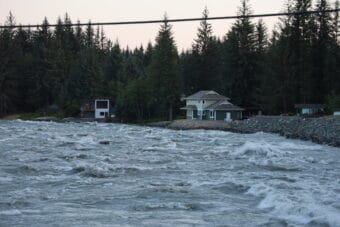
City leaders say they’re working with federal partners on strategies to endure a future of flooding in the Mendenhall Valley, following a second year of  record-breaking flooding. 
At Monday’s Juneau Assembly Committee of the Whole meeting, City Manager Katie Koester said the last two years of catastrophic glacial outbursts have changed the community’s understanding of what can flood. Two years ago, only about two dozen homes were affected. This year, nearly 300 homes were damaged. 

“Most communities that deal with flooding, they’re dealing with flooding over time, increased flooding — we have really gone from zero to 100 overnight,” Koester said. “All of those things just underscore the need for action, both in the near-term and the long-term.”

Juneau officials met with a number of state and federal agencies in Anchorage late last week to discuss ways to better understand — and possibly prevent — glacial outburst floods in the future. 

The Alaska Department of Transportation, Central Council of the Tlingit and Haida Indian Tribes of Alaska, National Weather Service, U.S. Geological Survey, U.S. Forest Service, National Resources Conservation Service, U.S. Army Corps of Engineers and representatives from the offices of Senators Lisa Murkowski and Dan Sullivan were in attendance.

On Monday, the Assembly discussed short-term plans to set aside money for updated flood maps and a new hydrologic study of the Mendenhall River, which would help homeowners better understand risks in their neighborhood. They’re also considering hiring an additional staff member for the city’s emergency management department. 

Many in the community are also hoping for a way to prevent severe flooding altogether. The Assembly discussed some possible ways to do that at a meeting last month. But Koester said the meeting in Anchorage underscored a need for more research to move forward, and she said no major flood prevention project would be feasible over the next year. 

“No one solution is going to control flooding, right? It’s going to need to be a combination of levee, a combination of some channelizing, maybe some hardening to protect the bank,” Koester said. “It became pretty obvious that there’s no short-term construction solution — you know, trenching, building — that could be done successfully before next summer.”

Meanwhile, Suicide Basin is already filling again, which means another flood might be possible even sooner than that. Koester and city officials expressed concern about that possibility, saying they’re not prepared for another flood to happen this fall. 

Researcher Eran Hood stands on the lip of an empty Suicide Basin just a few days after it drained to create a record-breaking glacial outburst flood in August 2023. (Photo by Anna Canny/KTOO)

Meteorologist Nicole Ferrin with the National Weather Service said it is not unheard of for the basin to release multiple times in one season. In fact, the basin drained last September, after August’s outburst flood. But it released relatively little water, which was largely unnoticed.

“But what is happening right now is unusual,” Ferrin said. “The basin always refills some in the fall time, but it doesn’t usually keep refilling to the level it’s at right now.”

Currently, water levels in the basin are similar to where they were in June of this year. If water were to drain right now, the Mendenhall River would only reach a minor flood stage, inundating portions of the Skater’s Cabin road. 

Typically, as the summer turns to fall, the rate of water filling the basin slows down as rain in the mountains becomes snow, and cooler temperatures slow the melting of ice. Ferrin said the likelihood of another catastrophic flood this year is low. 

“If we get multiple rain events back to back to back to back and then it releases, you know, I wouldn’t rule it out,” Ferrin said. “But I would rather alleviate people’s fears by saying it’s not imminent. Major flooding is not imminent, but we are monitoring it, and people should stay aware.”

Still, the filling of the basin is a reminder of the need for swift action. The city has already allocated $300,000 set aside from an emergency appropriation and this year’s capital improvement budget that can be put towards studying and mapping Mendenhall River flooding, which they hope to do this winter. They need a plan to allocate an additional $100,000 to cover the cost of that work, which they plan to introduce by their next regular Assembly meeting.

The city also hopes to create a plan for flood fighting and emergency response before water returns next year. Koester said Sen. Murkowski is working on a piece of national legislation on emergency response funding, which may eventually free up federal money to support that work.

And the salary of new emergency management personnel would be covered by money that was previously allocated for a city-sponsored finance position at the Juneau School District. That hiring decision does not fall to the Assembly, but member Christine Woll expressed support for the idea.

“Obviously disaster relief is front of mind given the last few years, and given the flood,” Woll said. “We also know it’s going to get worse in the future, and we need to be able to not only respond, but proactively plan — and landslides are on my mind too.”

Human-caused climate change is bringing warmer temperatures and more extreme weather events to Southeast Alaska, which could make disasters in Juneau more common. 

When it comes to glacial outburst flooding, the bigger financial lift will be the study of major flood prevention projects, which might involve construction to alter Suicide Basin, Mendenhall Lake or the greater Mendenhall River flood plain. 

Koester said the U.S. Army Corps of Engineers has a program to pursue projects like that, but it’s pricey. Koester says engaging the Corps will require the city to secure $3 million of local funding, and an additional $3 million in federal funding. 

The Assembly said they’re committed to allocating that local funding by pulling from appropriations for other planned city projects. But they’ll discuss it further at their regular Assembly meeting next Monday, Sept. 16.

Monitor the latest Suicide Basin conditions here

New research hopes to find better ways to manage interactions between Juneau’s black bears and people

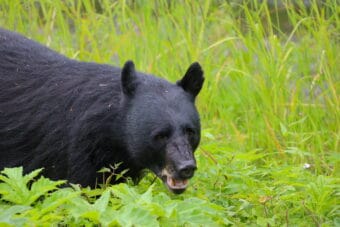
A black bear eats vegetation in the Mendenhall Valley in July 2024. (Clarise Larson/KTOO)

Juneau lies in the midst of prime black bear habitat. Bears and people have to share the city, and new research hopes to figure out how they can do that more peacefully.

The number of bears killed in Juneau has quadrupled since the 1980s. Just this summer, the Alaska Department of Fish and Game euthanized two young bears downtown after they became aggressive while eating from trash cans.

Roy Churchwell is the management coordinator for wildlife in Southeast. He says bear-human encounters have always happened in Juneau, but he suspects population growth, combined with pressures brought on by human-caused climate change, might be contributing to more problem bears. 

“There have been some upticks in some years, because it’s become a little more common for there to be fewer fish and fewer berries,” Churchwell said. “When that happens, that brings more bears into town.”

When bears have trouble finding their natural foods, he said, they might turn to “urban foraging.” That’s a fancy way of saying they eat our trash. 

That’s a problem for public safety, as bears can get overly comfortable around and aggressive towards people when they’re regularly eating trash. Often, that’s what leads the department to put a bear down. According to Churchwell, they want to avoid that outcome whenever possible.

“How, as a department, might we be able to manage the people — and manage the bears — in a way that we can both be in town but have less of an impact on each other?” he said.

To learn more about how to improve their management strategies, the department commissioned Dr. Todd Brinkman and researcher Binta Wold, experts in wildlife ecology from the University of Alaska Fairbanks. 

Brinkman and Wold have designed a survey to learn more about the way people interact with bears around town. It was sent out this spring to 5,000 randomly selected residents.

Though waste management is a known source of bear problems, the survey hopes to learn more about specific patterns in the way people interact with bears around town.

“So, how many people are getting their trash broken into every year? How many people are experiencing property damage,” Wold said. “And is there anything we can learn about that group of people?”

It might be that bear resistant trash cans are cost prohibitive, Wold said, or bear encounters are more common in neighborhoods that lack garages to store their garbage. It’s also possible that overflowing trash cans attract bears to areas that are crowded with tourists. 

The survey asks questions about those possibilities, and about how Juneau residents feel about the Department of Fish and Game’s bear management strategy over the last five years. 

Wold said nearly 1,000 people have filled out the survey so far. While there are no concrete results yet, most respondents agree that bears cause serious problems in town.

“But so far, a majority of folks responding also are saying that they enjoy living alongside bears and that the benefits of living alongside bears outweigh the costs,” she said. “It’s a complex story.”

The goal is for the survey to simplify that story, or at least help wildlife managers to make sense of it, so that they can come up with strategies to help bears and Juneauites continue living side by side with minimal conflict.

Site notifications
Update notification options
Subscribe to notifications