Anna Canny

Local News Reporter

Juneau Assembly approves emergency funds for flood recovery, lays out plans to investigate flood mitigation

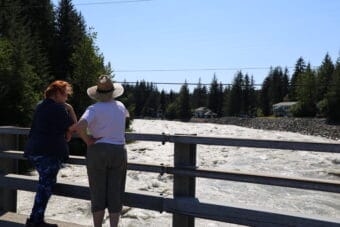
Water continues to rose along the Mendenhall River during Juneau’s annual glacial outburst flood on Monday, Aug. 5, 2024. (Clarise Larson/KTOO)

On Monday evening, Juneau Assembly unanimously passed an emergency resolution, freeing up more than a million dollars of city funding for more flood response and recovery after the record-breaking glacial outburst flood earlier this month.

Most of the money will go toward debris removal, as well as repairs to the Mendenhall Wastewater Treatment Plant and the city stormwater system, but $150,000 will go toward studying ways to prevent catastrophic flooding in the future.

Juneau resident Elizabeth Figus said her home on View Drive has flooded two years in a row. She testified at Monday’s meeting, and said she’s frustrated that the city didn’t do more after last year’s devastating flood. 

“I did witness the city and all of you on the Assembly do a lot of hand waving and make a series of statements on the record that mitigation would be too expensive or too difficult,” she said. “So I’m very heartened to hear that some real motion is hopefully taking place.”

During the meeting, deputy City Manager Robert Barr laid out some ideas for flood mitigation.

A couple suggest tackling the problem at its source. A little more than a decade ago, the rapid retreat of the Mendenhall Glacier due to human-caused climate caused one portion of the glacier break off and recede, which revealed a rocky depression known as Suicide Basin or K’óox Ḵaadí Basin. Dammed by the remaining terminus of the Mendenhall Glacier,  the basin fills with rain and meltwater each year until it drains, causing flooding downstream in the Mendenhall River.

By creating a bore hole through the mountains, it may be possible to proactively drain water into Nugget Creek. It was also suggested that the basin could be filled in with rock, so that it would not collect water in the first place.

Barr said other ideas include modifying Mendenhall Lake. Draining some of the existing lakewater could potentially make room for the basin drainage next year, or some combination of dikes, dredging and pumping could control and slow the flow of water as it moves from the lake to the river.

Another possibility is to dredge new channels for the Mendenhall River, to allow water from Suicide Basin to drain to the ocean more quickly than it does right now.

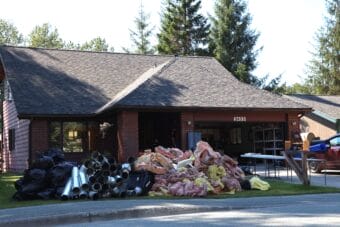
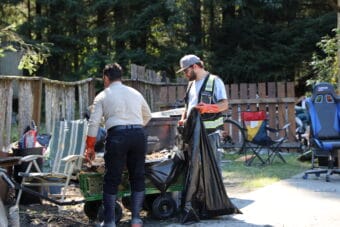
People help pick-up trash from their flood damaged homes on Emily Way on Wednesday, Aug. 7, 2024. (Clarise Larson/KTOO)

None of these options have been studied extensively, and all come with major technical, financial and legal challenges. Both the basin and the lake are on U.S. Forest Service land, so any modifications to them would be subject to federal permitting processes. And all of these options would have multi-million-dollar budgets which would likely require federal funding to cover. Barr said that federal projects like this usually take years.

“If we want to see measurable action, something that works towards the goal of prevention and mitigation by next year, that is something that can only be done via political mandate,  really at the congressional, federal level,” he said.

Though an act of Congress is possible, it is unlikely, and it would require unprecedented political pressure from the Alaska delegation. Barr said any mitigation that the City and Borough of Juneau does pursue could be a liability.

“When we change something in the natural environment, whether it has to do with flooding or landslides or other natural disasters or potential natural disasters, we have to struggle with that challenge, ” he said. “When we change something, we may be liable for the potential negative impacts of that thing that we changed and the potential unintended consequences” he said.

Assembly member Christine Woll expressed doubt that the city could pull any mitigation project before that happens, or before flooding happens again.

“I just worry that we are setting false expectations for our community members who are going to have to be making decisions soon about what to do about their properties,” she said. “I’d like to be proven wrong that there’s a solution out there, but my gut tells me there isn’t, on any timeline before the system changes completely.”

As the Mendenhall Glacier continues to recede and thin, the ice dam on Suicide Basin will eventually disappear, though it will take decades. But scientists say there is another spot, further up the Mendenhall Glacier, where a glacial lake could form in the future and create a whole new source of flooding. 

In a letter to the U.S. Army Corps of Engineers on Monday, the City and Borough of Juneau and the Central Council of the Tlingit & Haida Indian Tribes of Alaska proposed a working group made up of local experts, Federal agencies and members of the Alaska delegation, to continue investigating possible mitigation measures.

Flooding put this Juneau child care center out of commission. Community support helped it reopen.

Carolina Sekona spent the weekend scrambling to set up a new day care in the vacant Floyd Dryden Middle School. (Photo by Anna Canny/KTOO)

On Tuesday, Issac Benson crouched down to help his two-year-old son Silas take off tiny purple rain boots. Then he scooped Silas up and carried him through the doorway of a classroom at Juneau’s former Floyd Dryden Middle School.

“I’m back,” Silas Benson said, as he entered a room full of other toddlers. But he seemed shy and confused as he looked around. Silas has been coming to this day care since he was just a baby, but the room, with its soft rugs and bins of toys, was unfamiliar.

“Let’s ease our way back in, it’s okay,” Issac Benson said. “I know it’s a big transition and change, isn’t it?”

The Bensons’ regular day care, Glacier Valley Kids, flooded during last week’s record-breaking glacial outburst. Flood waters rose up to their house too.

“We stayed up all night and watched it happen, and luckily we were just high enough to not get totally inundated,” Issac Benson said. “It was still really scary.”

Their garage and crawlspace took on water. The family spent the week drying things out and helping their neighbors who were worse off, all while juggling other responsibilities. Issac Benson said it was nice to spend time with Silas at home, but seeing the Glacier Valley Kids staff on Tuesday morning was a relief.

“My wife and I were trying to still work full-time and full-time parent and I mean, those things are incongruent, right?” he said. “Without day care, without them, our lives don’t really function.”

Silas Benson eats breakfast at a plastic table, which was salavaged after last week’s record-breaking glaical outburst flood. (Photo by Anna Canny/KTOO)

The opening day of this emergency child care center marks some return to normalcy for Benson and the other parents. It’s a big day for child care provider Carolina Sekona too. She’s been running Glacier Valley Kids, a state licensed day care for children under five years old, out of her home on Emily Way for years.

Last week, more than two feet of water surged in and soaked wooden furniture, blankets, rugs, toys and stuffed animals. At least half of the stuff had to be thrown away, and it was clear that the house itself was uninhabitable. 

“I was crying, I didn’t know what was going on, I didn’t know what we were going to do,” Sekona said. “All I could see was my home destroyed, and my child care destroyed. And I knew it was going to be months before that could be built back up.”

It looked like Glacier Valley Kids was going to be out of commission. That wasn’t an option, said Blue Shibler, the executive director of The Southeast Alaska Association for the Education of Young Children, a nonprofit focused on supporting early childhood caregivers and educators. 

“In general, we can’t afford to lose any child care spaces. There aren’t any open spaces in child care programs,” she said.

Parents that rely on Sekona have nowhere else to go. Child care in Juneau is stretched thin under normal circumstances, and even before the flood Sekona was turning parents away. She cares for twelve Juneau children, and she had at least twelve more families on her waitlist. 

“If she wasn’t able to reopen, that would be 12 families that had to leave the workforce,” Shibler said. “That’s all there is to it.”

Alison Diaz plays with baby dolls and a wooden kitchen playset at the new emergency childcare center at Floyd Dryden Middle School. Many toys were thrown away after they were soaked by floodwaters. (Photo by Anna Canny/KTOO)

So Shibler’s agency pitched in some emergency money to replace the toys and other supplies. Sekona picked out a new plush campfire and a miniature wooden kitchen playset, among other things. Other day cares and schools around town donated cubbies, bookshelves, books and spare toys. 

And the City and Borough of Juneau offered up the former Floyd Dryden Middle School building, which served as an emergency shelter for people who evacuated their flooded homes just last week. Then Alaska Department of Health and Social Services issued Sekona a temporary license to set up shop there. 

Skye Taverez plays with blocks next to a plush campfire. Many of the plush items, including pillows, rugs and stuffed animals, had to be thrown away after the flood. (Photo by Anna Canny/KTOO)

She was grateful that it all came together so quickly. 

“I need to be back at work. I have a family to support,” Sekona said.

Sekona is a single mom of four. Luckily, she moved her family into a new house this summer, one that wasn’t touched by rising water. But the house that flooded supported Sekona’s livelihood, and that of the three people she employs. 

Over the weekend, they transformed two of the school’s empty classrooms. One is for mealtime and play. The other is for movies and naptime. Ever since the school building was vacated this spring, the city has been eyeing it for child care, so Glacier Valley Kids will be a trial run.

From one side of the room, Sekona watched the kids as they explored and rediscovered some of the familiar things that she was able to salvage.

A few favorite toys were spared by high shelves. The plastic tables and chairs that were designed to withstand toddlers held up pretty well against flood waters too. And on one wall, there’s a painting of a smiling lion with a rainbow mane. Sekona stopped by her gutted house on Emily Way to retrieve it.  

“The kids are so visual,” Sekona said. “They’ll see it. They’ll remember: this is us.”

Disaster assistance centers open in Juneau as flood clean-up continues

People throw trash from their flood damaged homes on Emily Way on Wednesday, Aug. 7, 2024. (Clarise Larson/KTOO)

At least 290 Juneau homes, including apartments and condos, were damaged by last week’s glacial outburst flooding.
That’s according to a preliminary damage assessment completed by the City and Borough of Juneau and the American Red Cross of Alaska this past weekend.

Many homeowners are still cleaning out their homes.

“We’re collecting all different types of garbage right now – that’s your general trash, construction and demolition debris, large appliances, hazardous waste,” said Deputy City Manager Robert Barr. “Impacted residents can place those things at the edge of their property line close to the right-of-way.”

The Alaska Department of Transportation hauled away more than 100 truckloads of trash over the weekend, and Barr said crews will continue trash pick-up through this week, and likely beyond.

The Central Council of the Tlingit & Haida Indian Tribes of Alaska is also providing free debris removal for tribal citizens. Tribal Transportation Manager RJ Hill estimates crews took 15 tons of trash to the dump in just the first day and a half of clean up last week.

The city will also set up a junk vehicle pick-up for the many cars that were totaled by flood water. It already operates a year-round junk vehicle program that takes in vehicles for free, but the sheer number of damaged cars and trucks will overwhelm that system. The city is looking for a short-term solution to store vehicles while they’re waiting to be junked.

Volunteers are helping with the clean-up too. More than 100 people showed up to help at the Melvin Park volunteer center over the weekend, but United Way volunteer coordinator Ryan O’Shaughnessy said more help is needed.

“We need folks who are willing to get into a crawl space, get dirty, and help us haul out insulation as well as sheetrock and insulation that’s behind it,” he said.

O’Shaughnessy added that people who can’t do the heavy duty work can still help out with things like cooking and delivering meals. United Way is also asking for donations or loans of dehumidifiers, respirators and elbow length gloves.

The volunteer center will be open at Melvin Park at least through Wednesday, from 10 a.m. to 6 p.m. Free hot meals will be available there each day from noon to 2 p.m. and from 5 p.m. to 7 p.m.

Information about volunteer opportunities later in the week will be posted on the city’s website.

Insulation piled outside of a home on Meander Way, which took on water during the record-breaking glacial outburst flood on Aug. 6, 2024. (Photo by Anna Canny/KTOO)

From Wednesday through Friday, the Alaska Division of Homeland Security and Emergency Management will open two disaster assistance centers to help homeowners and renters affected by flooding navigate applications for individual state disaster relief money.

People can show up to the Mendenhall Valley Library or Generations Southeast Community Learning anytime between 10 a.m. and 6 p.m. Be sure to bring documentation of damages, a valid ID, proof of occupancy and insurance information. The deadline to apply for State Individual Assistance is Oct. 9, 2024 and applications can be submitted online.

The American Red Cross of Alaska has also announced that it will be offering financial assistance for people whose primary residence was damaged in the flood. The Red Cross will be operating it’s own assistance center this week at the Open Red Cross Enrollment Center on Glacier Highway, Monday through Wednesday.

Correction: A photo previously misidentified the location of a home on Meander Way. 

More volunteers needed as Juneau flood clean-up continues

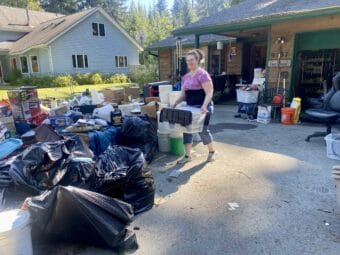
Charity Coleman hauls household goods and flood-damaged debris into the front yard of her parents home on Gee Street (Anna Canny/KTOO)

There were dozens of black garbage bags and stacks of cardboard boxes in Charity Coleman’s front yard on Gee Street on Thursday, along with a bunch of household items that she had pulled out to dry in the sun.

“My folks have been in this house for nearly 40 years, so you accumulate a lot of stuff,” she said.

She was trying to figure out what could be salvaged and what will have to hauled away to the landfill.

“We’ve already cleared the front part of the yard once,” she said. “Now all these bags again.”

Amid the debris there sodden floor boards that had been ripped out and fluffy water-logged insultation. In flood damaged neighborhoods, the line between garbage and pieces of home is blurry.

Heavy equipment provided by the Alaska Department of Transportation carries debris from a flooded house on Killewich Drive (Anna Canny/KTOO)

Around the corner on Killewich Drive, bed frames and childrens’ toys were tossed together with wet cardboard into a dumptruck owned by the Alaska Department of Transportation, which will be helping to haul trash in the coming days. Crews from Central Council of the Tlingit and Haida Indian Tribes of Alaska have been hauling debris too.

The City and Borough of Juneau is also partnering with United Way to deploy additional volunteer clean up crews. Their volunteer center at Melvin Park in the Mendenhall Valley opened up on Thursday. The volunteer center will be open Friday 10 a.m. to 8 p.m. and Saturday and Sunday 9 a.m. to 6 p.m.
Salvation Army volunteer Carol Pitts was at the volunteer center on Thursday morning. She said people who wish to help can go there to be matched with a family in need.

“We’ll meet them with a smile, a cold glass of water and maybe a sandwich,” Pitts said.

The Salvation Army is running a food truck there for both volunteers and residents in the nearby flooded neighborhoods, which they’ll operate from noon to 6 p.m. each day. They plan to keep it running at least through Saturday.

Trash bags piled in front of a house on Killewich Drive (Anna Canny/KTOO)

Volunteers can also sign up online. As of Thursday afternoon, nearly 100 volunteers have been recruited, but according to a Thursday afternoon release from the City and Borough of Juneau, more volunteers are needed.

One of the people deploying volunteers on Thursday was Brenna Heintz. She lives in the Riverside Condos, which were severely damaged by last year’s flood. This year the building made it through the flood unscathed, but Heintz and one of her neighbors  from the building wanted to help those affected by this year’s flood. She said they remember what it felt like in the early days and weeks of recovery after last year’s flood.

“Your brain is mush, and you’re really sad and you’re really scared,” she said. “It’s like, okay we know how that feels. Let’s see if we can be there to support in any way we can.”

More information about clean-up and other flood response resources can be found on the City’s flood resources page. 

Correction: A previous version of this story misidentified Carol Pitts. 

Mendenhall River neighbors recount narrow escapes after record-breaking glacial outburst flood

The flooded Mendenhall River filled Valley neighborhoods, around sunrise on on the morning of Tuesday, August 6th 2024 (Photo courtesy of Rich Ross)

Weston Holland went to bed in his apartment on Emily Way on Monday evening, but in the early morning hours on Tuesday he woke to water on the floor. So he went to investigate. 

“In the process of doing that, the front door had this look of water coming through the side — like the Titanic,” he said. “And then the bottom of the frame of the door broke in and a wall of water came.”

Water from the swollen Mendenhall River rushed into the basement apartment. The force of it pushed Holland back and floated kitchen appliances like the stove and the fridge. 

“It went from just a couple inches on the floor to about my navel in, I would say, about a minute and a half. It was just coming in quick,” he said. “And with that much time, the only thing you can think about is getting everybody out.”

Holland turned to wake up his wife and their four sons so that they could evacuate.  

“The youngest one was petrified,” Brittany Holland said. 

“He fought us,” Weston Holland said. 

Their son is just seven years old and autistic, so he didn’t understand what was happening. They didn’t either. The Hollands knew that glacial outburst flooding was underway in the Mendenhall Valley, but during last year’s catastrophic flood, their home didn’t even take on enough water to activate the sump-pumps. 

This year was different. They got their youngest out the door by floating him out on top of the refrigerator. Brittany Holland was momentarily trapped on their porch by the rushing water, but she was able to climb up on top of a wall in the front yard, where a friend was able to pull her to safety.

The Hollands left some ducks, a cat, a lizard and a beloved pet dog behind. They arrived at the city’s emergency shelter at Floyd Dryden Middle School, soaked with ice cold glacial water, around the time when flood waters were cresting just after 3 a.m. on Tuesday.

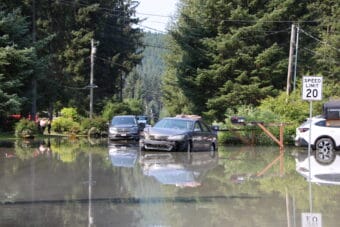
Standing water remained on Long Drive, where cars were stranded on the afternoon of Tuesday, August 6th, 2024. (Clarise Larson/KTOO)

Glacial outburst floods happen every year in Juneau. The rapid retreat of the Mendenhall Glacier due to human-caused climate change is to blame. About a decade ago, one portion of the glacier broke off and receded, which created a depression known as Suicide Basin. Each year, the basin fills with rain and meltwater before bursting downstream into the Mendenhall Lake and River. 

But the last two years of flooding have been unprecedented. Last year’s flood pushed the Mendenhall River to nearly 15 feet. This year, the river rose even higher, setting a new record of 15.99 feet. 

Deputy City Manager Robert Barr said the water pushed much further into the Mendenhall Valley this time, but the city is still trying to figure out how many houses were impacted. 

“I think many homes experience some level of flooding, some significant I think somewhere in the vicinity of a 100, maybe hundreds,” Barr said on Tuesday morning. “We just don’t really have a good handle on that yet.”

Water continues to rise along the Mendenhall River during Juneau’s annual glacial outburst flood on Monday, August 5, 2024. (Clarise Larson/KTOO)

Though he says the type of damage is different from last year’s flood. Many riverside properties were damaged by severe erosion last year, which undermined foundations and destroyed two houses entirely. 

“We saw much less erosion this year,” Barr said. “I don’t have complete reports yet, but the significance of the impact of this year is related to standing water.”

The city issued an evacuation notice on Monday evening, but not everyone left their house in time. Last year, Debbie Penrose Fischer’s house on Gee Road barely saw any flooding. 

“Last year we saw the water, but it wasn’t anywhere near,” she said. 

So she stayed put as the Mendenhall River rose on Monday, even as Alaska Electric Light and Power cut power to her neighborhood. By the time she realized that this year’s flood might be different, it was too late. 

 “We were completely surrounded,” Penrose Fischer said. “And it wasn’t just still water, it was kind of like a pretty heavy flow. And let me tell you something, that water was ice cold.”

Debbie Penrose Fischer was rescued by Capital City Fire/Rescue after flood water surrounded her home on Gee Street early Tuesday morning. (Photo courtesy of Debbie Penrose Fischer)

Bound to her wheelchair, she wasn’t sure how to escape. Penrose Fischer relies on a supply of oxygen, and she watched as the batteries on her tank started running low. Just past 7 a.m., she made a call to Capital City Fire/Rescue. 

“I was trapped. I didn’t know what to do,” she said. 

A rescue team was able to pick her up in the raft and take her to the shelter, where she joined more than 40 other evacuees. 

Juneau Mayor Beth Weldon visited the shelter just before noon. She had spent the morning patrolling flooded neighborhoods.

“Instead of a few inches in people’s houses, they had feet in people’s houses,” Weldon said. “So taking lots of pictures to hopefully help with a National declaration of disaster.” 

In a special Assembly meeting on Monday, the City and Borough of Juneau passed a resolution to declare the flood a local emergency and put in requests for state and federal aid. 

Governor Mike Dunleavy followed suit by declaring a state disaster emergency on Monday afternoon. Those declarations will free up recovery money at the state level and potentially draw attention from the Federal Emergency Management Agency.

In a statement, Sen. Dan Sullivan said he’s been in touch with FEMA’s top administrator. Weldon said she’s spoken to Sen. Lisa Murkowski too. 

“We’re already talking about what can we do to prevent this,” Weldon said. “Because it was a foot higher than last year’s, ironically on the same date.” 

But she says it will take federal help to get there.

KTOO’s Clarise Larson contributed to this report. 

Juneau residents watch Mendenhall River rise as flood level prediction increases

Water continues to rise along the Mendenhall River during Juneau’s annual glacial outburst flood on Monday, August 5, 2024. (Clarise Larson/KTOO)

Monday was a blue-bird day in Juneau, but Mendenhall Lake and River were rising quickly, on pace to break flood records.

The Mendenhall Campground took on water first. On Monday afternoon, campsite host Brendan Beard was wading through the ice cold glacial water in a pair of swim trunks.

“It’s amazing. Before it was a slow trickle and now it just seems to be flooding in real quick,” he said.

Water floods the entrance to the Mendenhall Campground on Monday, Aug. 5, 2024. (Clarise Larson/KTOO)

Up behind the Mendenhall Glacier, a glacial lake known as Suicide Basin is draining, sending billions of gallons of water downstream in what’s known as a glacial outburst flood. Last year’s outburst flooding was unprecedented, with a crest near 15 feet. Surging water tore up the banks of the Mendenhall River, which was raging on Monday.

Kim Titus was watching it from the Back Loop Road bridge. He lives on River Road, where many of his neighbors lost land due to erosion. At least one family in the neighborhood had their house swept away entirely. The whole bank is now lined with riprap, which residents installed in hopes of protecting their property.

Titus’ house is slightly further back, so it didn’t take on water last year. But he’s been keeping a close eye on the flood forecast, which predicts a flood crest of 15.7 feet — even higher than last year — sometime past midnight on Tuesday.

“It’s nerve-wracking,” he said. “I just talked to another friend of mine who lives down there and he goes, ‘Well, I won’t be sleeping tonight.'”

Water continues to rise along the Mendenhall River during Juneau’s annual glacial outburst flood on Monday, August 5, 2024. (Clarise Larson/KTOO)

Just around the corner, Bob Winter planned to stay put at his house on View Drive. It sits close to the riverbank, and it’s taken on water several times since he built it in 1981.

“I’ve been flooded more than anybody,” he said.

Sometime after the first glacial outburst floods started happening, just over a decade ago, he had the house raised three feet. It wasn’t enough. During last year’s flood, it took on more than an inch of water. So Winter raised it three more feet. The work cost him hundreds of thousands of dollars.

“This wasn’t how I planned on spending retirement money, but we didn’t want to move,” he said.

Winter hopes that the house will be high enough to avoid flooding this year, but only time will tell.

“It is what it is and if it gets to my house there’s going to be a whole lot of the Valley flooded,” he said.

The City and Borough of Juneau is advising all residents west of Riverside Drive to evacuate. Those who need a place to go can find a city shelter at Floyd Dryden Middle School starting at 8 p.m.

Site notifications
Update notification options
Subscribe to notifications