Anna Canny

Local News Reporter

As Juneau residents dry out from the flood, some wonder which repairs are worth it

Sam and Amanda Hatch circle their house on Meander Way (Photo by Anna Canny/KTOO)

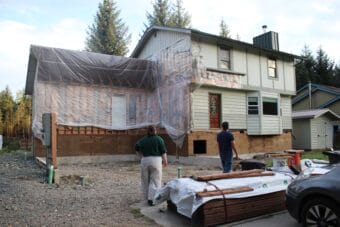
Sam and Amanda Hatch can’t reach the knob on their front door. It’s suspended in mid-air, along with the rest of their home, which towers above the others on Meander Way.

During last year’s glacial outburst flood, water filled the Hatch’s crawl space and saturated the silty land beneath their house until it was wiggly, like quick sand. The whole building sank back towards the river. The four corners drooped and the foundation folded down the middle.

“Our house is really screwed up,” Sam Hatch said. “We made this decision like ‘Okay, either we intervene now or we wait for the house to break and walk away.’”

Their frankensteined house is that intervention. The original building, with its light green siding, now sits four feet off the ground, vaulted on sheets of plywood. Beneath that, there’s a brand new foundation. The garage has not been rebuilt yet, and in the front yard, there’s some unused construction material, leftover from when they ran out of money to finish the job.

The Hatches sent their contractors away in June. Then — in August — the work they managed to finish was put to the test with the arrival of another record-breaking glacial outburst flood.

The high water threatened to breach Hatch’s house, even after it had been lifted, but they managed to stay dry while hundreds of others in the Mendenhall Valley took on water.

When flood waters surged into their neighborhood on Meander Way, the Hatches were spared because of their lift, but they watched many of their neighbors flood. (Photo courtesy of Amanda Hatch)

With the promise of more glacial outburst floods to come, Sam Hatch says he’s heard lots of people wondering about how they should fix up their homes, grappling with the same uncertainty he faced last year.

“It’s like what do I do? Do I just put it back the way that it was?” he said. “If we know the flood hazards, then people want to prepare for them. They can either harden structures, or mitigate or get away from the problem.”

It’s hard for homeowners to figure out what will make these annual floods tolerable. Staying completely dry might be difficult, if not impossible, but it’s also hard to make peace with letting the water in again and again. Both options are expensive.

“And you have to decide, is it worth selling? Is it worth walking away? Or is it worth paying to repair,” Amanda Hatch said.

The Hatches decided to lift their house, after consulting with a neighbor on View Drive who had done it after his house was damaged by a glacial outburst flood in 2015. Few contractors in the state do that kind of work. The Hatches had to fly someone in from out of town.

At first, they say, there was a small group of neighbors who were interested in lifting their houses too. That would have brought down the cost of the labor and materials, but in the end most people backed out. So the Hatches decided to go it alone.

They were able to get a small grant from state disaster assistance to fill in the land that the flood scoured from beneath their house. But they had to take out loans and open up their retirement account to scrape together the rest of the money they needed — $100,000 to fix the foundation, then another $150,000 for the lift.

Lisa Wallace and her dog Stella just returned to their gutted house on Meander Way. Wallace plans to do bare bones repairs on the first floor, in anticipation of another flood next year. (Photo by Anna Canny/KTOO)

Compromising a dream home

Lisa Wallace, who lives a few blocks over on Emily Way, said she doesn’t have that kind of money. The bottom floor of her two-story house filled with two feet of water this year, even though it had never flooded before.

“To have this place that has been my safety and my security for all these years and now be told you’re going to get a 500-year-flood every year. It sucks,” Wallace said.

She says this place was her dream home, with a freshly remodeled kitchen that’s now completely gutted and a cozy living room that’s empty now, except for the dining room table and a couple foldable camping chairs. The place is drying out with box fans, and the exposed subfloor is still dusted in glacial silt.

Wallace knows it could flood again, so she’s making plans to live with the water. She’s been researching construction materials that are used in the Southeast U.S., where things like hurricanes and sea level rise driven by human-caused climate change cause frequent floods.

She said she’ll outfit her first floor with special waterproof drywall and vinyl flooring to replace the hardwood, so it will be easier to dry out next year. A lot of the things she loved about this place will not be replaced.

“Why the heck would I buy new furniture? Why would I put beautiful flooring down? Why would I do that,” she said. “I had my perfect home, and it isn’t perfect anymore. But I’m certainly not doing any of that until we find out how the next flood goes.”

Wallace had plans to move somewhere smaller in her retirement, which is fast approaching. But she says the investment she’s making to repair this house will make affording a new place challenging.

Susan and Nico Bus dry out their belongings following Juneau’s annual glacial outburst flood on Tuesday, Aug. 6, 2024. (Clarise Larson/KTOO)

“I wouldn’t buy here again”

Most people who flooded this year, including Wallace, never paid much attention to the glacial outburst floods before. But Nico Bus did, because the Mendenhall River runs right through his backyard on Meander Way. His efforts for flood mitigation have been both a success story and a cautionary tale.

Even before the annual floods began, the river had been eroding his property — and that of his neighbors — for years. Back in 1996, Bus made an investment of $25,000 to protect his home by armoring the riverbank with rock.

When the glacial outburst floods started, they accelerated the erosion, and back in 2018 Bus even campaigned to get the entire neighborhood to split the cost of a retention wall to stop it. At the time, many of his neighbors felt the costs were too high, and the risks were too low.

That is, until last year’s catastrophic flood, which ate away at the riverbank so quickly that it undermined foundations and caused two houses to collapse into the river. Bus made it out unscathed that time.

“Clearly, it was a smart move to reinforce the bank,” Bus said. “But I don’t think the riprap, as you call it, was designed to help with this high of water.”

The nature of the flooding continues to evolve. This year, the reinforced banks held again, but it didn’t matter. The water spilled over them and surged into Bus’ home from multiple directions, as it never had before.

Bus said he and his wife love their home, but he feels it isn’t worth the money it will take to protect it.

“I wouldn’t buy here again. We have been lucky to live here for 39 years,” he said. “We’re going to give it another year, but if it floods again I’d be silly to stay here.”

The force of the water during 2024’s glacial outburst flood soured land around the Hatch’s home, but the repairs they made last year spared them from a lot of additional damage. (Photo courtesy of Sam Hatch)

As much as they’re grateful for their homes, some also feel stuck with them after the flood. In the end, the Hatches did get some financial help via a loan from the U.S. Small Business Association, which they applied for last year.  Ironically, that money finally came in on the day of this year’s flood. They say it will help them to pay back the higher interest loans they took out, but they won’t recover any of the personal savings they spent.

“That’s just gone.,” Sam Hatch said. “It’s in the house now. Yay! That’s one form of investment.”

For the Hatches, the investment to protect their house makes sense. Juneau has an enduring shortage of housing, and the homes that are available are extremely expensive. Amanda Hatch said they worried they’d have nowhere else to go, and they don’t want to leave this community.

“Is it worth it? Are we glad we did it? Absolutely, cause I think the house would have been a loss,” she said. “Juneau can’t absorb a family of five, let alone 300 houses worth of families.”

But she says there was no joy in being spared this year, while they watched their neighbors flood.

How an underwater anthropologist explores Southeast’s fluid landscape

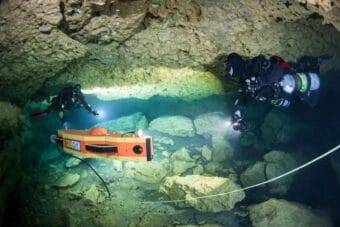
A team of scientists and Alaska Native community members use an autonomous underwater vehicle to explore the continental shelf west of Prince of Wales Island in southeast Alaska, seeking submerged caves and rock shelters that would have been accessible to early inhabitants of the region. (Photo courtesy of NOAA)

Dr. Kelly Monteleone is an underwater anthropologist at Sealaska Heritage Institute and an assistant professor at the University of Calgary.

She’s kicking off SHI’s fall lecture series Wednesday with a talk titled “Our Submerged Past: Exploring Inundated Late Pleistocene (10,500-17,000 years ago) Caves in Southeast Alaska.” She’ll be joined by Kristof Richmond, Ph.D., Chief Technology Officer at Sunfish, Inc., a robotics company specializing in undersea exploration and inspection.

Dr. Monteleone sat down with KTOO’s Anna Canny to talk about her adventures underwater.

This interview has been edited for length and clarity.

Anna Canny: So, tell me a little bit about what an underwater anthropologist is — it’s not a field I’ve heard much about before.

Kelly Monteleone: You’re not going to find another one of us around the world. I am unique, but I’m looking for the same kind of sites that archeologists are on the land, places people have lived, places people were hunting, that we can find evidence of butchering or things like that.

Anna Canny: So to find human artifacts underwater, that means, presumably, that there was a time in the past when they weren’t underwater. Could you tell me a little bit about what Southeast Alaska looked like in that  past, when sea levels were lower?

Kelly Monteleone: I really wish I could tell you more about what was happening in different areas, in areas that are now underwater or not underwater. The sea level history throughout Southeast Alaska is so complex. Most of my research has focused on the west side of Prince of Wales Island, and there we see sea level as low as 165 meters. I’m sorry, you’re gonna have to convert that yourself. But then if you just move a little bit to the east, over to Ketchikan, sea levels around the same time, we’re 200 meters above. So we’re talking about a very fluid landscape. We don’t think of the Earth’s crust as morphing and moving that much, but with the glaciers receding and the weight of the glaciers moving in different ways. You can almost think of the landscape at that time as being like the surface of a balloon, where you press in one spot and it goes up in one and depresses in another, and it causes these interesting formations. When you look at these sea level histories, the sea level was changing so freaking fast. I calculated from around that time that it’s around five centimeters a year of sea level change. Right now, globally, it’s moving at three millimeters. So that’s a magnitude difference.

Anna Canny: Wow. So I wanted to ask about one of your big discoveries, which was a fish weir that you found submerged off of Prince of Wales Island back in 2022. What does a discovery like that reveal?

Kelly Monteleone: It pushes back the knowledge in that region, and it’s about 1,000 years earlier than Shuká Káa, but it’s in the same area. I kind of wonder if, like, Shuká Káa was the human remains were found on the northwest corner of Prince of Wales Island. The other name that was known was “on your knees cave.” And so that individual would have lived in a community, and I kind of wonder, if it was in Shakan Bay, it would be a logical place that that would be within their hunting ground, and they believe Shuká Káa was just, you know, hunting for a bear and didn’t win.

Anna Canny: And you’re still exploring some of those same submerged area and looking for more things. What’s a dream artifact for you?

Kelly Moteleone: I would like to find a canoe with animal remains — because human remains trigger other things — that have evidence of butcher marks. So I can source the wood on the canoe, and I can date both the wood and the animal remains. Doesn’t that sound like the perfect find? That’s my dream find. And my goal would be that it’s actually an early enough canoe that the wood is not from Southeast Alaska. A canoe, a, you know, a vessel of some kind that was actually made further back along that kelp highway. You know? The coastal migration theory. And the kelp highway runs basically from Japan all the way down to California, where you can find these kelp forests and find similar resources to hunt, gather fish, etc.

Anna Canny: Right, so figuring when people arrived here and revealing more about just how far back time immemorial stretches. What is most exciting for you about doing that kind of work?

Kelly Monteleone: I love working with the Lingít people of Southeast Alaska and the Haida and Tsimshian too, but the Lingít are the ones we know. We’ve been here since time immemorial, and the Lingít people really are interested in learning about their ancestors. They proved that very well with Shuká Káa, and that’s what I love about doing this work here, is I actually can work with people who see an affiliation to the work I’m doing to understand their past. I always try to link what I’m doing also to climate change, because when I’m talking about five centimeters of sea level rise, we can’t comprehend that, that’s something that could happen, as we’re talking about glaciers hitting tipping points and things like that. And so understanding how people survived on that landscape as the sea level was rising, how did people adapt? That could help us moving forward as sea levels keep rising. I hope we never hit five centimeters of sea level rise a year again. But knowing that people survived that in that region, I think, is a glimmer of hope also. But part of it is that I love history and I love science, and this lets me do both.

Watch Dr. Monteleone’s lecture at noon Wednesday in-person at the Walter Soboleff Building or via livestream on SHI’s YouTube Channel.

Correction: This post has been updated to reflect that the lecture is Wednesday, not Tuesday. 

Wet Labor Day weekend kicks off Southeast rainy season

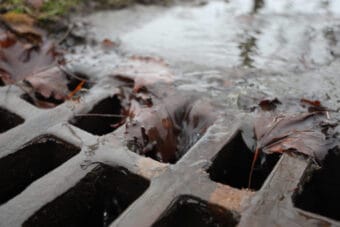
Rain runoff runs down a drain in the Mendenhall Valley in November 2022. (Clarise Larson/ for the Juneau Empire)

Heavy rainfall is coming to Southeast Alaska this weekend, beginning Friday afternoon.

This kind of precipitation can increase the risk of landslides. In a public service announcement, the City and Borough of Juneau advised residents on and around slopes to be aware of their surroundings as the wet weather moves through.

Meteorologist Pete Boyd with the National Weather Service said the storm is moving in from the Gulf of Alaska.

“It’s a long fetch of moisture coming up from the Pacific — an atmospheric river — so that’s going to be feeding in heavy precipitation to the area,” he said.

To the south, Ketchikan, Metlakatla and surrounding communities can expect between two and four inches of rain. 

The central panhandle, between Sumner Strait and Frederick Sound, is where the main swath of precipitation will be focused. Places like Kake, Petersburg, Wrangell and the northern portion of Prince of Wales Island, will be the most drenched. The forecast calls for three to five inches of rain at sea level in those communities, with the potential for up to seven inches at higher elevations.

Sitka is at the northern edge of the front, and could see that heavy rain too as the storm progresses. Further north, Juneau, Angoon, Hoonah and Gustavus can expect between two and five inches of rain, but Haines and Skagway will likely see just one to two inches. 

Boyd says people should prepare for the weekend accordingly. 

“Mariners always check your boats bilge pumps, making sure those are working, keeping an eye on it for people around their homes, check your sump pumps. Check your gutter,” he said. “And any sewer grades around the area. Those are always great to make sure that, especially in the area that they’re clear.”

Despite the rain, no flooding is expected at this time. The most intense rainfall will begin on Friday evening and continue through Saturday afternoon. Rain is expected to lighten up after that but it will remain wet through Sunday, and the forecast calls for more showers throughout next week.

“We’re now just going to see them coming more and more throughout the week,” he said. “So yep, the rainy season is going to be starting up.”

Advocates call for a ban on cruise ship scrubbers, citing pollution concerns

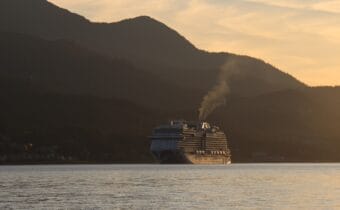
A cruise ship departs Juneau in July, 2023. (Clarise Larson/KTOO)

In June, an inspector with the Alaska Department of Environmental Conservation was on board a cruise ship at port in Ketchikan when he noticed something strange on the starboard side of the vessel — a cloudy discharge that left a shimmery film on the surface of the water. 

The inspector’s report called it an “apparent pollution incident” from the ship’s exhaust gas cleaning system, also known as the scrubber. 

“We find violations very frequently on scrubbers,” said the department’s Cruise Ship Program Manager Ben Eisenstein.

Scrubbers are technology that uses water to flush out harmful chemicals, especially sulfur, from a ship’s exhaust. Eisenstein says the use of scrubbers on cruise ships has skyrocketed in recent years, because in 2020 regulators with the International Martime Organization implemented new rules requiring ships to burn cleaner low-sulfur fuel, except for vessels with an exhaust gas cleaning technology. 

“When that came into effect, a lot of these vessels, instead of choosing to be compliant with that fuel, you know, were spending all this money on this technology to keep them to burn that dirty fuel,” Eisenstein said. “Because it’s kind of a newer technology, that’s how it’s kind of snuck through the cracks.”

Most cruise ships that visit Alaska today have scrubbers, and the majority are open-loop systems that mix seawater with exhaust gas, filter it, then dump the remaining wastewater overboard. The state’s rules for cruise ship wastewater discharge date back to a permit from 2013, and most pertain to gray and blackwater. They don’t include any rules about scrubbers. 

Now, more than three dozen entities — including Pacific Environment, the Ocean Conservancy and the nonprofit Friends of the Earth — have called on the Biden Administration and the U.S. Environmental Protection Agency to ban the use of scrubbers at the national level.

Marcie Keever is the director of Friends of the Earth’s Oceans and Vessels program. While scrubbers may prevent harmful pollutants from escaping into the air, Keever said those chemicals just end up in the ocean instead.

“That water pulls all those dirty petroleum pollutants out of the smokestack and converts it into wastewater — into water pollution,” she said.

Though the Alaska Department of Environmental Conservation still monitors cruise ships, the independent Ocean Rangers inspection program ended in 2019. And Keever said scrubber pollution today goes largely unnoticed by the public and unchecked by regulators.

“Many of the discharges happen beyond the horizon, and so I think that’s just in general a problem with enforcing against the shipping industry and the cruise industry,” Keever said. “We just have no eyes on the behavior, and the federal agency that’s tasked with enforcing it isn’t doing it.”

The state of Alaska lost much of its authority to crack down on scrubber pollution through an act of Congress known as the Vessel Incidental Discharge Act, passed in 2018. That act also requires the EPA to update national standards for scrubber discharge. Keever said the federal agency has been slow to do so. 

In an email to KTOO, an EPA spokesperson declined to comment except to say the agency is in the process of finalizing those updates. 

Eisenstein said federal authorities rarely step in, despite many state reports of scrubber pollution. When cruise ship companies are punished, he said the fines are too low.  For instance, the EPA found that ships with Carnival Corporation made hundreds of scrubber discharges in Alaska waters that violated Clean Water Act standards back in 2016. In the end, the company was fined a civil penalty of just $14,500. 

“Which is just not enough,” Eisenstein said. “It’s not enough to change that behavior. It’s not enough to balance out the gain that they’re getting by being non compliant.”

Cruise Lines International Association Alaska, a trade group representing the cruise industry, did not respond to KTOO requests for comment. 

Right now, a medium sized cruise ship can discharge between 6 and 8 million gallons of scrubber wastewater a day. 

That water is acidic, and it can contain heavy metals and other toxic chemicals from fossil fuels, including carcinogens. 

Research on the effects of these toxins are relatively limited, but one study found that scrubber wastewater negatively affects sea urchin reproduction at concentrations as low as 0.0001%.

Aaron Brakel is the Clean Water Campaigns Manager for the Southeast Alaska Conservation Council. He worries Alaska’s marine life can’t handle more pollution threats. 

“Our oceans are at so much risk already, with ocean warming, ocean acidification,” he said. “And so really the right thing to do now is stop discharging this stuff. Stop using the dirty fuel.”

Nations like Sweden and Denmark have already banned scrubbers, and California requires vessels sailing of their coast to use cleaner-burning low sulfur marine distillate fuels. Brakel says he hopes Alaska will follow suit.

Correction: A previous version of this story misspelled Aaron Brakel’s last name. 

Southeast king salmon sport fishery closed through end of September

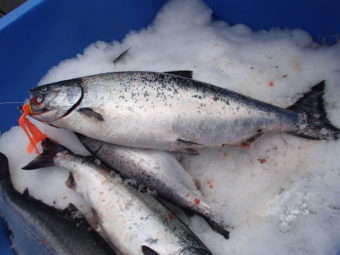
A king salmon caught in Juneau. (Photo by Lisa Phu/KTOO)

Southeast Alaska’s king salmon sport fishery is closed, effective Monday through the end of September.

King salmon caught in any Southeast salt waters may not be kept or processed. They must be returned to the water unharmed.
The Southeast sport fishery has already exceeded its 2024 allocation of king salmon, according to the Alaska Department of Fish and Game. 

In an announcement online, the agency said their management plan aims to avoid in-season changes to sport regulations. But the projected end of season harvest for king salmon would exceed the 2024 Alaska catch limit as outlined in the Pacific Salmon Treaty. 

Most of the king sport fishery in Juneau was already closed earlier this summer because of low hatchery returns. The fishery will reopen for the winter season on Oct. 1. 

Heat pump incentive program aims to lower home heating bills in Gustavus

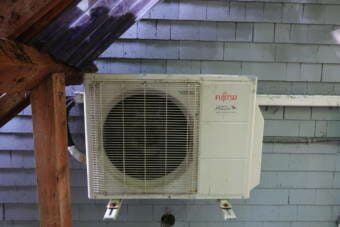
An air-to-air heat pump can provide a more efficient alternative for heating a home, particularly in regions of Alaska with less dramatic temperature swings like Southeast. Because they run off of electricity, they can also reduce greenhouse gas emissions in communities that use renewable alternatives like hydropower or solar. (Erin McKinstry/KCAW)

A new program in Gustavus will provide residents with money for heat pumps.

Incentive payments of up to $500 will be available for homeowners, businesses, agency offices and city buildings to replace their oil-based heating systems with an electric heat pump, thanks to a $20,000 grant awarded by the National League of Cities. Gustavus was one of a dozen cities nationwide selected for the organization’s Advancing Economic Mobility Rapid Grant program.

Gustavus City Councilman Mike Taylor worked on securing the grant for the community of about 600 people. He says heat pumps have been gaining popularity in town for several years. Taylor has installed a heat pump at his own home, and the city invested in one for City Hall.

“We’re a community that really cares about the environment and thinks about climate change and the role of carbon emissions,” Taylor said. “So a lot of people are looking for ways to reduce their impact, and heat pumps are a good way to do it.”

Heat pumps use electricity and refrigerants to cool air in the summertime and warm air in the winter. Because heat pumps run on electricity instead of fossil fuels, many experts consider them a key climate solution. In Gustavus, heat pumps will tap into renewable power from the Falls Creek hydroelectric project, which supplies nearly 90% of the community’s electricity needs.

Heat pumps are also generally more energy efficient than oil-burning systems, which means installing one can cut down on home energy bills. Taylor said that’s especially important in Southeast communities like Gustavus, where heating oil is barged in at costs as high as $6 a gallon.

The cost to install a heat pump typically starts at $5,000, according to the Juneau-based nonprofit Alaska Heat Smart. There are several funding sources that could help to cover those costs. Gustavus’ local utility, Alaska Power and Telephone, offers an additional $500 heat pump incentive payment, and Sealaska shareholders are eligible for another $500 on top of that, funded by the Sealaska Corporation. The federal government also offers tax credits and rebates for heat pump installation through the Inflation Reduction Act.

Taylor says he hopes that all that funding combined will be enough to motivate residents to install a heat pump.

“We’re hoping to make the most of it and maybe get as many as 40 new installations in the community by January,” he said.

Residents can apply to the incentive program now through January 20th, 2025. More information can be found on the City of Gustavus’ website.

Site notifications
Update notification options
Subscribe to notifications