Jeremy Hsieh

Local News Reporter, KTOO

I dig into questions about the forces and institutions that shape Juneau, big and small, delightful and outrageous. What stirs you up about how Juneau is built and how the city works?
Props 2 and 3 ask Juneau voters to decide how the city will pay for parks and other projects

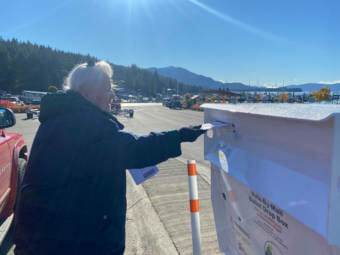
A Juneau woman drops off her ballot at the Auke Bay-Statter Harbor drop box during local election day in 2021 in Juneau, Alaska. (Photo by Claire Stremple/KTOO)

Propositions 2 and 3 ask local voters to let the City and Borough of Juneau pay for projects using two of its reliable tools for raising money: debt financing through the sale of municipal bonds, and the renewal of 1% of the local sales tax rate.

Proposition 2

Proposition 2 asks voters to authorize the city to borrow up to $6.6 million to pay for improvements to city parks and recreation facilities.

The bond financing request is a smaller ask, but for more marginal priorities of the Juneau Assembly. That’s part of why Assembly member Greg Smith supported separating them from the higher priority projects covered in the sales tax question, and the standalone question for a new city hall.

“By putting it as a bond, it does really give everyone a chance to express their opinion on the projects, and should we take out bonds, should we borrow money to develop them?” Smith said. “And then, you know, we will be paying it back with interest. So there’s a property tax impact. It’s not free. … So people have a chance to say, ‘No, we don’t want to do that.’ And that’s totally fair.”

The impact on property taxes will depend on the terms of the bonds, but city officials forecast it at about $43 a year for a $400,000 home, for 15 years.

Most of the money would go toward new turf fields and a track at Adair-Kennedy Memorial Park in the Mendenhall Valley. Some of the money is also earmarked for a new public use cabin and trail maintenance across the city.

Smith said these are good projects for improving activities for kids and the community’s overall quality of life. He said new turf fields in particular would make Juneau a more attractive host community for certain events.

“I think there’s an economic development aspect and that people will want to come and bring and play baseball and softball tournaments here now,” he said. “Whereas, they may not have wanted to as much before when we had lower quality facilities.”

The ballfields at the park right now are dirt. Smith has firsthand experience.

“I remember, you know, playing through standing water and sliding into, you know, mud puddles and stuff,” he said. “So I think it’s just going to improve the safety, improve the quality of play.”

Assembly member Alicia Hughes-Skandijs agreed they’re good projects, but has some reservations about the way the Assembly elevated these lower priority projects.

“I mean, at the end of the day, you always have limited resources,” she said. “We’re in a great position right now — our debt capacity is good. So we have things coming off the books, so it’s not that this is necessarily going to break the bank, but it all adds up.”

She said she’ll probably vote against the parks measure.

“Something like the turf field, you know that will benefit our kids, so I can’t be mad at that,” she said. “But I can still be a grump about the process.”

Proposition 3

Proposition 3 asks voters to renew 1% of the city’s sales tax rate for 5 more years to pay for about $60 million of infrastructure and special projects. It’s a temporary tax, but one that voters have renewed every time it’s come up going back to 1972.

City officials expect it to generate $60 million. The Juneau Assembly crafted the list of projects the money will go toward through a ranking process, with input from city staff and the public.

The biggest pot within that money is earmarked for extending the life of existing public infrastructure: schools, police and fire stations, harbors, parks, pools, libraries, heating and ventilation systems, and street maintenance equipment.

The rest will be set aside for a grab bag of otherwise unrelated improvements and special projects, including:

  • redevelopment of Gastineau Avenue, Telephone Hill and a combined CBJ-state of the Alaska parking garage to replace the State Office Building’s parking garage;
  • improvements at city harbors;
  • development of a multiuse path through Lemon Creek; and
  • relocating the Juneau-Douglas City Museum.

It also includes money for Assembly priorities that are not brick-and-mortar infrastructure:

  • contributions to the city’s budget reserve;
  • support for expanding childcare availability;
  • support for affordable housing and ongoing development of Pederson Hill; and
  • information technology upgrades.

Short narratives on the individual projects are available in the city’s voter information guide that was recently mailed out.

If this measure fails, the city’s overall 5% sales tax rate will fall to 4% in October 2023.

The deadline to vote is Tuesday, Oct. 4.

Proposition 1: Can the city borrow $35 million to build a new Juneau City Hall?

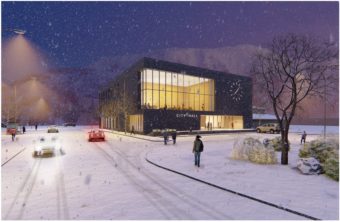
The City and Borough of Juneau’s design team shared this rendering of what a new City Hall building could look like at 450 Whittier Street during a public forum in May 2022. The design is not final.

This question asks voters to authorize the City and Borough of Juneau to borrow up to $35 million to help pay for a new City Hall.

City officials say that if this ballot measure fails, they’ll have to make a major investment to repair the existing City Hall, which dates back to the 1950s.

Public Works and Engineering Director Katie Koester has estimated the cost at about $12 million to keep it viable for another 25 years.

“Some of it is near term, like painting the facade,” she told a Juneau Assembly committee in June. “But you can’t paint the facade without repairing the plaster. You can’t repair the plaster without fixing the windows. Then you need to replace the windows – so it escalates very quickly.”

And the building only houses a fraction of the city’s workers. The city pays $820,000 a year in rent for extra office space in four other downtown buildings.

“When your business plan is to be in business forever, you should own your own building – it just makes economic sense,” City Manager Rorie Watt told the Greater Juneau Chamber of Commerce in July.

The new City Hall would let the city centralize its office workers and public-facing services, end its leases for extra office space, and free up apartments and other space downtown for the private sector.

The Juneau Assembly has already committed $6.3 million to the project, which has a total estimated cost of $41 million.

If the ballot question passes, the debt would be paid back over time using property tax revenue. City officials don’t think they will need to raise property taxes to cover those payments. That’s because a portion of current property taxes are already earmarked for other long-term debts, some of which will be paid off this fiscal year.

The City and Borough of Juneau’s design team shared this rendering of what a new City Hall building could look like on Whittier Street during a public forum in May 2022. The design is not final.

Wade Bryson is a Juneau Assembly member and unopposed candidate up for reelection. He chairs the Assembly’s Public Works and Facilities Committee, which oversaw a lot of work that led up to this bond proposition. He’s been campaigning for yes votes for this project.

Bryson said he isn’t aware of any organized opposition to the overall concept.

“Where people are disagreeing a little bit is, how do we accomplish that? And, you know, you can nitpick every idea,” Bryson said. “Unfortunately, no one is able to come up with a better idea. And as they have suggested, ‘Go look at this building or that building’ – we did. … This one always came up as a better option.”

Bryson said city staff and the Assembly evaluated and compared 52 different options for replacing city hall. They eventually chose the city’s vacant lot at 450 Whittier Street for the site. The state’s Public Safety Building used to be there. The city used that building as a cold-weather shelter for a few years before tearing it down in 2019.

Juneau's cold weather emergency shelter is in the old Alaska Department of Public Safety Building on Whittier Avenue, pictured here on Dec. 2, 2017, the day after the shelter first opened.
The City and Borough of Juneau used to run a cold weather emergency shelter out of the old Alaska Department of Public Safety Building at 450 Whittier Avenue, pictured here on Dec. 2, 2017. The city tore the building down in 2019. (Photo by David Purdy/KTOO)

Bryson said a major advantage of building new from scratch versus, say, converting the vacant Walmart, is that a new facility is expected to last 100 years.

“Repurposing, as noble as that was, renovating a building – it will cost the city just as much money if not more, and they would get less life and less use out of it,”  he said.

Juneau resident Rob Steedle argued against a new city hall during a public hearing in August. He worked out of City Hall for decades and retired as the city’s community development director in 2018.

Steedle said he understands the inefficiencies and inadequacies of the current setup but thinks telework during the pandemic showed that the city’s office space needs aren’t what they used to be.

“We haven’t seen such a profound shift in the workplace in our lifetimes and that shift isn’t over. There are still many unknowns,” Steedle said. “What we build today may not be what we wish we’d built tomorrow.”

He also said the timing is bad because of the unusually high cost of materials and rising interest rates. He thinks the city has higher priorities.

“I don’t know why we’re investing in office space when we know housing is our most central problem,” he said.

More information about the new City Hall project is available on the city’s website, juneau.org, including conceptual renderings from the design team.

For more reporting and resources on Juneau’s local election, visit KTOO’s local elections page.

Newscast – Friday, Sept. 23, 2022

In this newscast:

  • Police are investigating the killing of a 55-year-old Juneau woman found on a popular trail
  • Voters weigh competing expectations of the effects of Juneau’s mandatory real estate sales price disclosure rule
  • The Bureau of Land Management begins the scoping period for a supplemental environmental review of the proposed Ambler Road
  • A state judge says Rep. David Eastman may be ineligible to hold public office because of his association with the Oath Keepers
  • Another atmospheric river event is going to drench Southeast Alaska
Proposition 4: Juneau voters will decide whether to repeal mandatory disclosure of real estate prices

Sold sign at home along North Douglas Highway 2022 06 30
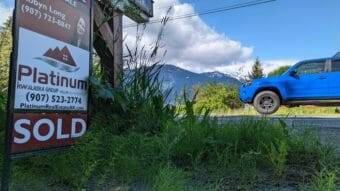
A sign marks a home that sold recently along North Douglas Highway in Juneau on June 30, 2022. City ordinances mandate the buyer disclose the sale price to city assessor’s office, though a group supported by the real estate industry wants to repeal those ordinances. (Photo by Jeremy Hsieh/KTOO)

This question asks voters to repeal measures the Juneau Assembly adopted in 2020 and this past February that mandate sharing real estate sales prices with the city assessor’s office.

The assessor’s job is to determine the fair market value of every parcel of property in Juneau, every year. These values directly affect property tax bills and the balance of who pays for city services.

Supporters of the repeal say the mandate is an invasion of privacy and expect it to lead to higher property taxes. Most Assembly members oppose the repeal. They say disclosing sales prices will lead to more fair and accurate assessments, particularly for higher-end properties, which tend to get undervalued when assessed.

Real estate professionals and developers are leading the repeal effort, which began with the citizen petition process. They often point out how common it is for jurisdictions with mandatory disclosure laws to enact real estate transfer taxes that they say add to the cost of housing.

Here’s how the group leading the repeal effort, Protect Juneau Homeowners’ Privacy, boiled it down into a 30-second Facebook video:

That’s Gary Stephens. He runs a car repair shop in Juneau.

Assembly members say the mandate is not about boosting tax revenue.

Mayor Beth Weldon voted against the original mandate, and didn’t want to share how she’ll vote on the repeal question. But she said she was disappointed with some of the messaging from repeal supporters.

“We have never said that we were going to do a transfer tax,” Weldon said. “In fact, we didn’t even know what a transfer tax was until they brought it up. Quite frankly, we’re spending millions, and I mean millions of dollars, on trying to make housing affordable in Juneau. And why would we make housing more expensive in one hand and then spend millions on the other hand to make it cheaper? … It just does not make any sense.”

No Assembly members have taken any steps or indicated that they want to create a real estate transfer tax.

Realtor Kimmi Ott hosts a podcast called “What Juneau About Real Estate?” In a May episode, she said she just doesn’t buy that.

“The city has been saying, too, ‘Oh, no, we’re never going to implement a transfer tax,’” she said. “I am calling bulls— because you guys have not kept your word. You changed the game on everyone!”

She was referring to the update the Assembly made in February to the disclosure mandate. At first, the information had to be kept confidential. But after property owners fighting their assessments demanded more transparency, the Assembly ditched confidentiality.

The February update also added the possibility of fines for failing to disclose. Juneau Assessor Mary Hammond said Wednesday that so far, no one has been fined for this.

The main argument from supporters of real estate disclosure is more nuanced. During a forum last week, Assembly member and unopposed candidate Carole Triem said she’s voting against the repeal and wants to keep the mandate in place.

“I think there’s a lot of misinformation out there,” she said. “Mandatory disclosure will help lower the property taxes of middle- and low-income homeowners, because we’ll even that out with the higher income properties that don’t come on the market quite as frequently.” 

Let’s unpack that. Why would mandatory disclosures lead to lower property tax bills for middle- and low-income property owners? And why aren’t higher income property owners already “evened out?”

Without the mandate, the assessor’s office already had a lot of publicly available market information for common types of real estate sales, like for tract homes. The more market data it has, the more confident it is about its assessments being accurate and fair.

But for extraordinary properties, say for custom homes or commercial buildings, the market is much smaller, sales are less frequent, and they tend to be more private. So the assessor’s office has to make more guesses about Juneau’s most valuable properties.

The city finance director has said in a memo that the assessor’s office tends to under value properties they have limited information about. The Alaska Legislature’s nonpartisan research service examined the issue in 2014, and its researcher came to the same conclusion on a statewide level.

Basically, Triem thinks the mandate will raise assessments of Juneau’s most expensive, but generally under-assessed properties, and have little effect on the assessments of more common properties.

“Having that information out there in the housing market, this crazy housing market that we’ve seen, will only help buyers and sellers when they have a full transparent, you know, view of the housing market,” Triem said. “They’ll be able to make the best decisions based on that and not have that kind of be secretive and kept, you know, by the experts who will dole that information out when they feel that it will benefit them. So, I would urge people to vote against that, to vote no on the mandatory disclosure.”

A property’s assessed value is only one piece of its annual tax bill. The property tax rate, also known as the mill rate, is the other main factor. And every year as part of its budget process, the Juneau Assembly revisits it.

For most property, the tax bill is calculated by simply multiplying its assessed value with the mill rate. For most of Juneau, that rate is 1.056%.

We asked several Assembly members what they would do if there were an abrupt increase in overall property assessments. Answers varied, but lowering the property tax rate was on the table.

For more reporting and resources on Juneau’s local election, visit KTOO’s local elections page.

Newscast – Thursday, Sept. 22, 2022

In this newscast:

  • The latest assessments from the aftermath of the storm that battered western Alaska
  • Congresswoman Mary Peltola picks up the her predecessor’s push to renew the nation’s primary federal fishing law
  • State health officials encourage Alaskans to get updated COVID boosters and flu shots
  • The National Weather Service forecasts another atmospheric river event coming to Southeast Alaska

Newscast – Wednesday, Sept. 21, 2022

In this newscast:

  • Alaska continues to lead the nation in its homicide rate for women killed by men
  • Former attorney general Ed Sniffen is indicted for sexual abuse of a minor
  • State forestry officials consider a new timber sale on Prince of Wales Island
  • Officials says residents of more than a dozen coastal communities recovering from the weekend’s storm should boil their drinking water
  • Residents of Shaktoolik say life is gradually returning to normal after the storm
  • The Alaska Marine Highway System ferry Columbia won’t be back in service this winter
  • Ketchikan High School gets chosen as the only high school in Alaska with rights to perform the Broadway version of the Disney musical “Frozen”
Site notifications
Update notification options
Subscribe to notifications