Jeremy Hsieh

Local News Reporter, KTOO

I dig into questions about the forces and institutions that shape Juneau, big and small, delightful and outrageous. What stirs you up about how Juneau is built and how the city works?
Newscast – Tuesday, Sept. 20, 2022

In this newscast:

  • Gov. Mike Dunleavy requests a federal disaster declaration for the storm that hit western Alaska
  • Nome works on cleaning up its infrastructure after the storm
  • The Alaska Constitutional Convention’s last living delegate explains why he opposes a new constitutional convention
  • Juneau planning officials plan to host a informational meeting about the city’s affordable housing fund
  • State health official relax expand eligibility for the monkeypox vaccine to anyone who believes they are at increased risk for infection

Feds OK concept for new ferry terminal at the end of Juneau’s road

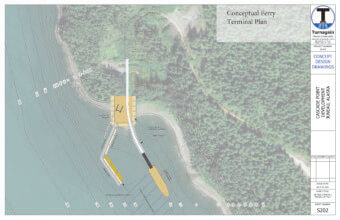
Cascade Point ferry terminal concept drawing 2022
Goldbelt Inc. commissioned this concept drawing of a ferry terminal at Cascade Point, which was included in the meeting packet for a July 2022 meeting of the Alaska Marine Highway Operations Board. (Courtesy of Turnagain Marine Construction)

State transportation officials have taken a small step toward building a new ferry terminal at the end of Juneau’s road. It’s intended to shorten travel times and improve service between Juneau, Haines, Skagway and the road system.

Federal officials approved a wide-ranging amendment earlier this month to the Statewide Transportation Infrastructure Program, or STIP. Among the dozens of new projects in the list is a call for $30 million for the new ferry terminal, but with no specific timeline.

Projects that make the STIP list aren’t guaranteed federal transportation funding, but it is one avenue that can lead to it. A Federal Highway Administration spokesperson said that the Cascade Point project is only “illustrative” at this point and is not yet eligible to be funded.

Goldbelt Inc., Juneau’s urban Native corporation, owns the undeveloped land at Cascade Point. By sea, it’s about 23 miles closer to Haines and Skagway than Juneau’s existing ferry terminal at Auke Bay. Goldbelt and the Alaska Department of Transportation and Public Facilities signed an agreement in 2021 to work together on the new ferry terminal idea.

“We’ve been working together trying to come to an agreement to develop that area. We’re still, still in a process of establishing feasibility … trying to establish that funding mechanism and who’s doing what,” said Rob Carpenter, the state’s deputy transportation commissioner. “We have a potential vision of a long-term lease with Cascade Point, where Goldbelt corporation would build it, and we would lease it (from) them in some sort of long-term period.”

The shorter ferry route is expected to reduce the system’s operating expenses, slash fares, and shorten travel time — even after factoring in the extra driving time. It also means crew could complete a full circuit between Juneau, Skagway and Haines without running afoul of a Coast Guard rule limiting work shifts to 12 hours.

The concept for the new terminal is spartan, and it would not replace the terminal at Auke Bay. It calls for an unstaffed day-use facility with off-the-grid support infrastructure: pit toilets, storage tanks for drinking water and to take sewage from ferries, and a generator for power.

Goldbelt CEO McHugh Pierre said improving this link will have wider ripple effects on the average shareholder, and on Juneau as a whole.

“Then we could have lower-cost transportation, which would provide lower cost of goods, which would lead to lower cost of services and lower cost of living in Juneau,” Pierre said. “Not to mention fresher produce, you know, better products and overall, better quality of life.”

Additional facilities at the site could also improve Goldbelt’s shuttle service for Kensington Mine workers.

The new ferry terminal concept has its skeptics and critics. Like local civil engineer Rich Moniak, who doubted many of the assumptions and expectations in a July column in The Juneau Empire. He questioned if cheaper fares and shorter rides would translate into greater demand, and he questioned Goldbelt’s assertions about lowering the costs of living in Juneau.

Aaron Brakel is with the Southeast Alaska Conservation Council, which prizes the surrounding Berners Bay for its wildlife and pristine beauty.

“Cascade Point is a terrible project for Juneau,” he said. “It’s bad for Haines, it’s bad for Skagway.”

He said it would be a logistical nightmare getting people to and from the end of the road, though Goldbelt said it will offer bus service.

Brakel said additional marine traffic in the area could also threaten herring runs in Berners Bay.

However, Brakel said he’s very supportive of the ferry system’s interest in building an electric ferry. Earlier this year, the state applied for a federal grant seeking $46 million to build one that would work for short routes — specifically, between Haines and Skagway, Homer and Seldovia, or Ketchikan and Metlakatla.

If an electric ferry regularly ran between Haines and Skagway, Brakel said a ferry from Juneau wouldn’t need to go to both communities in one day.

“It would really solve this Juneau-to-north-Lynn-Canal, day-run issue in a much better way,” Brakel said. “Auke Bay to Haines, perfect. You know, no other turnaround needed. That’s a really good solution in my view.”

Even if the ferry terminal doesn’t happen, Cascade Point and other land around Echo Cove are flagged in Juneau’s long-term land use plan for development eventually with a mix of residential, recreational and water-related uses.

Historically, Juneau’s local officials have supported development efforts there. In 1998, the Juneau Assembly supported extending the road to Cascade Point. And in 2013, the mayor attended a ribbon cutting for the new section of road.

In addition to the Cascade Point ferry terminal, the STIP list now has many more projects addressing known ferry system issues — like replacing the system’s two oldest ferries, the Matanuska and Tustumena, and improvements at ferry terminals around the state to accommodate the state’s newest ferries, the Hubbard and Tazlina.

The Tazlina is also on the list to be modified to have crew quarters. That’s already underway with the Hubbard. Without crew quarters, Coast Guard rules regarding crew rest greatly limit the routes these vessels can sail.

“We’re pursuing all kinds of different funding sources, particularly grant money that’s available through the infrastructure bill that just passed Congress,” said Carpenter, with the state Transportation Department. “In order to receive that grant money, a lot of it has to be itemized out in the STIP. So we threw things in there that we know we wanted to be done. And how we end up funding them in the end is to be determined.”

Transportation officials to share locations for a possible second Juneau-Douglas crossing

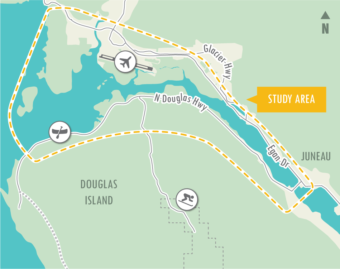
A map of the project area for a possible second crossing between Juneau and Douglas Island. (Image courtesy of Alaska Department of Transportation and DOWL)

There’s been talk of a possible second crossing between Juneau and Douglas Island for decades. Now, local and state transportation officials are ready to share early ideas for potential locations for the crossing.

“It’s not on our website yet, but we will have that at our listening sessions,” said Marie Heidemann, the project’s manager for the Alaska Department of Transportation and Public Facilities. “We’ve got a lot of locations, and we are developing screening criteria, which we will be applying.”

There are two listening sessions scheduled for Saturday. One is from 10 a.m. to 2 p.m. at Eaglecrest Ski Area during the Discover Eaglecrest event. The other is from 3 p.m. to 6 p.m. at the Safeway in the Mendenhall Valley.

These listening sessions are part of a transportation study that the City and Borough of Juneau partnered with the state to work on. The study is just one step on a long path toward securing federal funding for a potential project.

With this particular type of study, public participation is supposed to guide transportation officials’ decisions at several early stages of developing the concept. Public meetings and open houses began in April, with transportation officials sharing traffic and planning information about the area as it is now, and soliciting comments about why a second crossing may be needed.

Now they’re ready to share potential locations and get more feedback.

“We’ll take all comments,” Heidemann said. “And it’s always helpful to hear how people view impacts of a north crossing, both benefits and concerns. For the upcoming work on the study, we will be analyzing different locations. So comments related to which crossing locations would be most beneficial to support travel patterns would be useful to us.”

Comments can also be emailed to JDNorthCrossing@dowl.com.

More meetings will be scheduled over the fall and winter to refine the ideas and narrow down the options. The study, which is budgeted to cost up to $2 million, is scheduled to be complete next spring.

Newscast – Thursday, Sept. 15, 2022

In this newscast:

  • Mary Peltola finishes her first full day as a member of Congress with a seat on the House Natural Resources Committee
  • A monster storm is forecast to bring flooding and damaging winds to a huge swath of western Alaska
  • Local and state transportation officials will share potential locations for a a second crossing between Douglas and the rest of Juneau on Saturday
  • A daughter  shares memories of longtime Juneau domestic violence worker Joanne Hansen, who died earlier this month
The latest COVID-19 vaccine boosters have arrived in Juneau

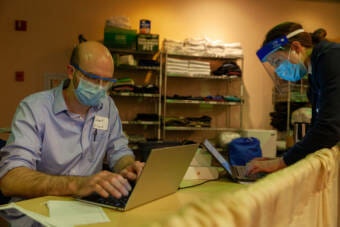
Juneau’s Emergency Operations Manager Robert Barr and Rebecca Embler, a member of Bartlett Hospital quality team during Juneau’s COVID-19 vaccine clinic at Centennial Hall on Jan. 15, 2021, in Juneau. Barr said on Wednesday that the environment and feeling around the rollout of the latest booster is completely different from the initial vaccine rollout. (Photo by Rashah McChesney/KTOO)

The latest, improved COVID-19 vaccine booster shots are now being distributed in Juneau. Most people who have had their primary series are eligible, but children under age 12 are not.

Juneau’s Deputy City Manager Robert Barr said the pharmacy at Costco had some of the first appointments this past weekend.

“Most providers in town are waiting for their first shipment,” he said during KTOO’s Juneau Afternoon on Wednesday. “Pretty much all of the same pharmacies that have been vaccinating to date will be getting this updated booster. So people can use who they’re comfortable with and used to.”

The Centers for Disease Control and Prevention recommends everyone stay up to date on these vaccinations.

These new boosters have emergency use authorization from federal authorities. They’re “bivalent,” which means they target two strains of COVID-19: the original one and omicron — specifically, the two omicron subvariants that have become the most widespread.

Barr said the planning meetings he’s been having with distributors and providers don’t have the urgency of the early days of the initial vaccine rollout.

“It’s a completely different environment, it’s a completely different feeling,” he said.

But he said it’s important to remember that protection against severe illness from COVID-19 wanes over time, and for most people, boosters restore that protection.

Barr said the city is also working on putting together a pop-up vaccine clinic in October. The specifics are not set yet.

NPR reports that White House officials are saying COVID boosters could become a regularly updated, once-a-year shot, like people get for the flu.

The CDC has a short questionnaire on its website that helps steer people to what type of vaccine or booster they should seek to stay up to date.

Newscast – Wednesday, Sept. 7, 2022

In this newscast:

  • An advisory board works on its long- and short-term plans for the Alaska Marine Highway System
  • Weekly COVID-19 case counts in Juneau dip
  • Vic Kohring, a former state lawmaker and central figure in an Alaska political corruption scandal, dies in a car crash
  • U.S. Rep.-elect Mary Peltola discusses what’s ahead for her as she assumes the seat in Congress held for decades by Don Young
Site notifications
Update notification options
Subscribe to notifications