Jeremy Hsieh

Local News Reporter, KTOO

I dig into questions about the forces and institutions that shape Juneau, big and small, delightful and outrageous. What stirs you up about how Juneau is built and how the city works?

Will a marine shipping merger pit David against Goliath?

A state antitrust lawyer says a proposed merger may pit the commercial shipping equivalents of David against Goliath in Southeast Alaska.

The plan, announced in April, involves three shipping companies: Seattle-based Alaska Marine Lines, Seattle-based Northland Services, and Sitka-based Samson Tug and Barge. AML’s parent company, Lynden Inc., wants to buy AML competitor Northland Services.

If that was the end of the plan, Lynden would have a monopoly on shipping in Southeast.

It’s Assistant Attorney General Ed Sniffen’s job to review the merger plan, negotiate fixes to the anticompetitive parts, and if necessary, fight it out in court.

Assistant Attorney General Ed Sniffen addresses the Juneau Chamber of Commerce on July 11.
(Photo by Jeremy Hsieh/ KTOO)

“Competing with someone like Lynden is a tough thing to do,” he said Thursday, speaking to the Juneau Chamber of Commerce. “I mean, they’ve been around, they’re big, they know what they’re doing. You get someone like, you know, Samson coming in, trying to swing at Goliath a little bit. And you want to make sure they’ve got a big hammer so when they hit him, he feels it.”

Though Sitka-based, Samson right now doesn’t operate elsewhere in Southeast. Samson Vice President Cory Baggen says the company only has about 10 employees in the panhandle, all of them in Sitka. However, Samson announced plans to expand its service in Southeast the same day Lynden announced its intent to buy Northland.

AML has been touting that expansion as the antidote to its Southeast monopoly.

Alaska Marine Lines President Kevin Anderson

“I think that the competition is going to be as stiff … as it is today with Northland, and normally competition tends to keep the prices down,” said AML President Kevin Anderson. “You know, we’re not going into this thinking we’re going to lose any customers. And if we have to battle for them to keep them, so be it.”

Many details of the vetting and deal making are under wraps – at least until the Department of Law files something in court – but the parties have essentially said that Northland won’t be wholly absorbed by Lynden. Instead, Northland may be carved up between Lynden and Samson in service of the smaller company’s Southeast expansion.

For example, Baggen said Samson is eyeing Northland’s current location on Channel Drive as its future port in Juneau. And if everything goes forward, she says her company will probably pick up 40 or 50 of Northland’s employees in Southeast.

That last “if” brings it back to the Department of Law. Baggen says Samson won’t start investing and expanding until the merger’s greenlit. But the merger may not be greenlit until AML actually has new competition in Southeast.

Samson Tug and Barge Vice President Cory Baggen

“I don’t want to set it up, and put a warehouse in with 25 doors and be all ready for nothing, and the consent degree doesn’t go through,” Baggen said. “So, it’s kind of a chicken-egg thing right now.”

AML’s Kevin Anderson says his company’s intent with the purchase of Northland is not to monopolize shipping in Southeast, but to expand in Seattle by acquiring Northland’s property there, and to become a full service Alaska seafood packager, carrier and marketer.

“The thing that Northland does extremely well is that they’re out in the west –Bristol Bay, Kodiak, and Dutch Harbor, I mean, some of the biggest fish runs in all of Alaska –we couldn’t play in that game,” he said.

He also says it’s been an “extremely painful” process.

“We’ve been involved in this process now for, I don’t know, close to a year. And it doesn’t seem like we’re getting any closer. It’s just one thing after another. And the amount of time and effort it takes on a lot of people’s part to put something like this together is unbelievable,” Anderson said.

Sniffen says the Department of Law hopes to have something filed in October, which would open a 60-day public comment period. Ultimately, a judge would have to sign off of on the deal. If the department can meet that timeline, Sniffen says the parties would likely know by the new year if the merger can go through.

As far as her company’s characterization as David, Baggen was lukewarm.

“I think that the history of Southeast Alaska has shown that small companies can be viable and successful and can do a really good job here, so, even though it might be a good – sort of a good analogy, I think, I think it’s OK,” she said.

That history includes echoes of another David and Goliath story. When Lynden, originally a trucking company, first got into Alaska shipping, Anderson says Lynden wasn’t taken seriously because Foss Maritime was the giant.

Juneau House districts submit 5,800+ signatures for SB21 referendum

Signature gatherers for the effort to repeal Senate Bill 21 in Juneau’s two House districts have submitted more than 5,850 signatures.

That’s almost five times the minimum threshold needed for House Districts 31 and 32 to count toward a geographic diversity requirement in the referendum process; at least 30 of the state’s 40 House districts must submit a minimum number of signatures equal to 7 percent of the voters in the last general election. For Juneau’s two House districts, that means 1,261 signatures.

State law also requires a minimum of 30,169 signatures for the repeal question to appear on statewide ballots in 2014.

Saturday is the deadline for submitting signatures. Most of Juneau’s signature booklets were mailed off earlier this week, so here, “essentially, it’s over,” says local organizer Gordon Harrison.

The state legislature passed SB21, the oil and gas tax cut bill, in April. Governor Sean Parnell signed it into law in May. It’s meant to spur new production and economic growth. But petition organizers fear the tax cut gives up too much state revenue – estimated in the billions of dollars over the next five years – and are skeptical of the touted economic benefits.

Low voter turnout renews interest in elections by mail

Chances are, if you’re registered to vote in Juneau, you didn’t the last time school board seats, candidates for the Assembly, municipal debt or sales tax extensions were on the ballot.

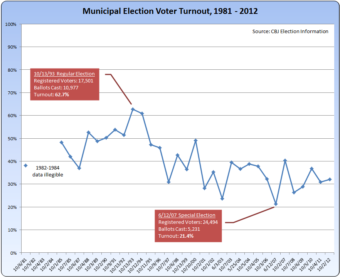
In the last municipal election in October, less than a third of the people registered to vote in Juneau actually cast a ballot, and that’s not unusual.

Voter turnout in municipal elections peaked in 1993 at nearly 63 percent, and bottomed out in 2007 at about 21 percent.
(Graphic by Jeremy Hsieh/KTOO)

“It’s election after election, and, you know, there’s definitely a way to improve it. We just have to find the right way,” said Assemblyman Randy Wanamaker.

He thinks voting by mail could improve turnout. Ballots would be mailed directly to registered voters and cast by mail, like in Oregon or with Native corporations’ shareholder elections. There wouldn’t be any polling places.

City Clerk Laurie Sica, whose duties include running municipal elections, was the impetus behind a 2007 ordinance that empowered the Assembly to hold local elections by mail. All it takes is a simple majority vote, though it’s never been done.

Sica was jazzed about the possibility of holding elections by mail in 2007, especially for special elections when there’s less notice to hire poll workers. But now, Sica says she prefers the status quo, so that Juneau stays consistent with the state’s election practices.

“In terms municipal elections, I think anything we can do to improve voter turnout — once people start voting I think they’ll continue voting, and that’s what we want to do.  And if we can make it easier for them to participate, then I think it’s worth the cost,” Wanamaker said.

Cost estimates Sica put together in 2007 suggested that increased ballot printing and mailing costs would far outweigh savings in election workers’ pay. In 2007, she estimated it cost $41,800 to hold a traditional election, but $59,800 to hold it by mail.

Today, the cost difference between holding an election by mail may be even greater because of higher postage rates, and the possible need for signature recognition software. Sica says she has more research to do.

Coincidentally, 2007 was also the three-decade low for voter turnout. In that year’s June special election, only 5,231 ballots were cast out of 24,494 registered voters, about 21 percent. Ballot propositions in that election were the last in a series of multimillion dollar decisions put to voters related to the construction of Thunder Mountain High School.

Proposition 2 passed with a 70 vote margin. In terms of turnout, that’s less than one-third of 1 percent, or about a sixth of Juneau-Douglas High School’s 2007 senior class. If Proposition 2 had gone the other way, Thunder Mountain High School might not have a track and artificial turf field today, and taxpayers would have $5 million less in debt to repay.

When Wanamaker brought up vote-by-mail at the Assembly’s last regular meeting, City Manager Kim Keifer said she would put some information together for the Assembly to review at an upcoming meeting.

Juneau’s municipal elections are held the first Tuesday in October. Three seats on the Assembly and two seats on the Juneau School Board are up. Candidates can file to run beginning Aug. 2. Information about running for local office is available at http://www.juneau.org/clerk/elections/.

Signature drive for oil tax cut repeal winding down

Volunteers also collected signatures during the Fourth of July parade.
Volunteers also collected signatures during the Fourth of July parade. (Photo by Heather Bryant/KTOO)

Signature gatherers for the effort to repeal Senate Bill 21, the oil and gas tax cut bill meant to spur new production and economic growth, are wrapping up their drive in Juneau.

Cindy Spanyers, the Juneau petition captain, says the minimum number of signatures needed from Juneau’s two House districts is about 1,900.

As of Friday afternoon, she says 65 volunteers have collected at least 4,407 signatures, with several signature books still outstanding and uncounted.

Former Attorney General and former Juneau Mayor Bruce Botelho is one of the volunteers. Botelho, who tends to be very circumspect in his political statements, says he couldn’t stay on the sidelines on this issue.

“Well, I think it is a critical issue for the state. The revenues are kind of the foundation for what government does,” Botelho said.

The petition organizers fear the tax cut gives up too much state revenue – estimated in the billions of dollars over the next five years – and are skeptical that the tax cut will generate meaningful economic growth.

“I don’t impugn the motives of those who supported SB21. I think many approach this in good faith and say, ‘This is the best outcome for the state.’ I just disagree with that,” Botelho said.

Local organizers plan to mail off the signatures on Tuesday to meet a July 13 deadline.

Statewide, the effort needs 30,169 signatures for the repeal question to appear on ballots in the August 2014 primary election.

Local opponents of the repeal could not immediately be reached for comment, though the Juneau Chamber of Commerce has joined many pro-business interests around the state in its opposition to the repeal effort. A chamber resolution cites the state’s economic dependence on the oil and gas industry, declining pipeline throughput, and the legislature’s work on SB21 as reasons to oppose the repeal.

Gordon Harrison, another local signature gatherer who was working the 4th of July crowds, notes that signing the petition merely helps get the question put on the ballot. If it gets there, he says that’s an opportunity to have a long, statewide discussion in the run up to the 2014 primaries.

Can you get Chinese food on Christmas?

(Photo by Steven Depolo/Flickr Creative Commons)

If you’re not into Christmas, what’s there do to on Christmas Day in Juneau?

A common tradition for Americans who don’t observe Christmas – Jews and secular Chinese especially — is to patronize the two businesses that are invariably open on Dec. 25: Chinese restaurants and movie theaters.

Well, almost invariably.

Twin Lakes Café and all the other Chinese, Japanese and Thai restaurants in Juneau will be closed Christmas day along with most everything else, though the Goldtown Nickelodeon and the Gross-Alaska Theatres will be open. That means musician Brandon Walker would only be able to fulfill half of the chorus of his YouTube hit, “Chinese Food on Christmas.”

Members of Congregation Sukkat Shalom, Southeast’s only synagogue, will volunteer as cooks and servers at the Glory Hole’s Christmas dinner, as they have for many years running, says organizer Bev Ingram.

“That is a tradition for our Jewish community here, yes, yes,” Ingram said.

This year, Ingram expects to serve a sit-down style dinner to about 100 people. The food is donated by local markets. And Chinese food is not on the menu.

Site notifications
Update notification options
Subscribe to notifications