
Jeremy Hsieh

Local News Reporter, KTOO

I dig into questions about the forces and institutions that shape Juneau, big and small, delightful and outrageous. What stirs you up about how Juneau is built and how the city works?

Why “Alaska” means milk and basketball to many Filipinos

When Filipinos hear “Alaska,” often the first two things that come to mind are milk and basketball.

(Composited from photos by @Doug88888 and Ion Botezatu via Flickr Creative Commons)

That’s according to the Philippines’ recently appointed honorary consul to Alaska, Jenny Gomez Strickler.

It turns out, the Philippines-based Alaska Milk Corporation sells milk in the country and sponsors the Alaska Aces — not Anchorage’s minor league hockey team, but a professional basketball team in the Philippines. Neither the milk nor the basketball team have a meaningful connection to the 49th state.

That means if Alaska wants to make inroads in trade with the Philippines, the state has a lot of work to do. In 2012, less than 1 percent of Alaska’s exports ended up in the Philippines, according to census data.

Jenny Gomez Strickler, Philippines honorary consul to Alaska

But Strickler says connections are being forged that could help build a market for Alaska seafood, and even liquefied natural gas.

The Juneau resident and retired Alaska Department of Commerce and Economic Development worker spoke to the Juneau World Affairs Council on Wednesday. In her new honorary role for the government of the Philippines, she’s part bureaucrat, and part international trade facilitator.

She’s trying to make the case that “Alaska” should mean “seafood” in the Philippines.

“The Philippines is a fish-eating country,” she said. “Yet its fish is imported from other countries. And its imported salmon is farmed salmon.”

Strickler, Juneau Rep. Cathy Munoz and the governor’s office are trying to put together a seafood festival in Manila next year to show the country what Alaska has to offer.

Strickler shared an anecdote about a missed connection that networking at the festival might fix. A former Juneau resident brought some Alaska seafood to Manila for his friends to try. One of samplers happened to be a hotel owner.

“The business owner enjoyed it so much, he said, ‘If I get this from you, can you guarantee me X amount throughout the year, or a portion of the year?’ He looked him straight in the eye and said, ‘I can’t, cause I’m not a fisherman.’”

She said they’re working on a pitch to get support from the Alaska Seafood Marketing Institute.

Strickler also said she was on a recent conference call between Philippines Ambassador Jose Cuisia Jr. and state officials. The ambassador said he’s putting together a team to visit Alaska and investigate opportunities to import liquefied natural gas.

Finally, Strickler said Aklan State University in the Philippines is interested in sending instructors to the University of Alaska Southeast through an exchange program. They want to learn about saltwater fisheries.

Strickler said she expects that arrangement to come together after the Juneau Assembly adopts a sister city proclamation linking Juneau and Kalibo, the capital city of the Philippine province Aklan.

A Juneau Assembly committee backed the proclamation on Monday.

Jenny Gomez Strickler’s talk with the Juneau World Affairs Council is tentatively scheduled to air on 360 North on October 11th.

JPD officer in training credited with saving local woman’s life

A Juneau police officer in training is being credited with saving a local woman’s life.
Police received 911 calls Monday night around 11:40 about a 50-year-old Juneau woman having difficulty breathing at the Alaskan Hotel.

Police spokesman Lt. David Campbell said officer James Dooley and his field trainer were notified within seconds.

When they arrived, the woman’s husband was attempting CPR on the bed – that’s bad for delivering compressions. Dooley put her on the floor and took over until Capital City Fire and Rescue medics arrived. They eventually got a pulse.

One medic gave Dooley credit for saving the woman’s life, Campbell said.

“One of the reasons why they were able to transport the lady, and she didn’t, you know, pass away because of her medical issues, was partially due to the quick actions of officer Dooley,” Campbell said.

She was taken to Bartlett Regional Hospital initially and flown to Harborview Medical Center in Seattle Tuesday morning.

Campbell said he cannot release additional identifying information about the woman because of health privacy laws.

A hotel clerk said the couple lives at the hotel.

Tuesday is Dooley’s last night in field training. He’ll begin working on his own next week.

Sewage sludge disposal costs on the rise

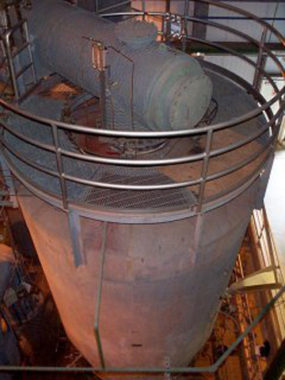
The Biosolids Incinerator (located at the Juneau-Douglas Facility) is used to burn the solid waste matter produced in the wastewater treatment processes at both the Juneau-Douglas and Mendenhall facilities.
The Biosolids Incinerator (located at the Juneau-Douglas Facility) is used to burn the solid waste matter produced in the wastewater treatment processes at both the Juneau-Douglas and Mendenhall facilities. (Photo courtesy CBJ website)

Juneau’s poop is getting expensive.

Bidding closed last week on a 5-year contract for municipal sewage sludge disposal with only one viable bid.
Bicknell Inc., a Juneau home building and paving company, has proposed a cost of about $1.6 million per year.

That’s roughly 40 percent more than the city pays for disposal between in-house costs and under the contract that expires at the end of the year with Waste Management. Homeowners and businesses bear that cost, among others, through wastewater utility fees, which have been about $64 a month for most addresses since July 2011. A city-commissioned study to inform potential rate changes is due in May.

The new contract may be the long-term solution that Juneau officials have sought for years. Or it may be the latest stopgap since the city’s sludge incinerator went offline in 2010.

The sludge is a form of treated sewage, also known as biosolids. It’s the product of Juneau’s wastewater treatment facilities.

Bicknell’s contract award will come before the Juneau Assembly on Monday. If approved, Bicknell may still have to wade through local zoning and permitting issues before the operation gets the green light.

Public Works Director Kirk Duncan declined to comment on the pending contract. And Bicknell owner and president, Spike Bicknell, declined to comment until a contract is in place.

However, his bidding documents offer clues about his plan. It is clear Bicknell plans to dispose of the sludge locally, but not specifically how or where.

Waste Management’s Lemon Creek landfill is the only site permitted for sewage sludge disposal, according to the state Department of Environmental Conservation. That suggests Bicknell plans to incinerate the sludge itself, or do additional treatment so it can be recycled as fertilizer or in other beneficial uses; those are the only alternatives to landfill disposal under the Environmental Protection Agency’s rules.

Price differences in the transport costs of moving the sludge to the undisclosed disposal site offer another clue about its location. Bicknell’s bidding documents quote the cost of one round-trip from the Mendenhall Valley treatment plant at half that of a round-trip from the Juneau-Douglas plant; suggesting the site is closer to the valley than downtown.

Waste Management also bid on the new contract, but was undercut by about $90,000. Its bid required the city treat the sludge to the EPA’s minimum standard for recycling. That caveat invalidated the bid, according to the city purchasing office.

Public Works Director Kirk Duncan says managing sewage sludge has been a longstanding local issue common in many communities.

“It’s interesting to note that back in 1985, the two priorities of the Assembly were biosolids and landfill,” Duncan said. “And we’re still sort of in that situation, so. Communities just struggle with what they do with biosolids.”

(Full disclosure: Duncan is a member of the KTOO Board of Directors.)

The contract has a 5-year renewal option.

How we got here

In late 2010, the city’s 20-year-old sewage sludge incinerator at the Juneau-Douglas Treatment Plant off Thane Road went offline. City officials initially sought repairs and a replacement, but ultimately decided replacing it was too expensive; the capital cost was estimated in the tens of millions, plus high operating and maintenance costs.

Every month, Juneau produced hundreds of tons of sludge that used to be burnt into vapors and ash.

The city bought time by signing a short-term contract with Waste Management to take the sludge. At first, Waste Management put all of the sludge in its Lemon Creek landfill. It’s got a strong odor, unlike more thoroughly treated, fertilizer-quality sludge.

Eric Vance, Waste Management’s local manager, said he curbed the odor by mixing sludge with garbage and burying it. But eventually, he ran out of places to put it.

To avoid violating nuisance laws, Waste Management began shipping some sludge in the summer of 2011 to a bigger landfill it operates in Arlington, Oregon. As odor-fighting capacity at Lemon Creek fell, the ratio shipped south rose. And so did costs. The per-ton cost of disposal in Oregon was regularly 30 percent or more than the local rate.

This year, almost all of the sludge has been shipped out of town.

Shipping had other unintended costs, too. Odor and sanitation problems with the sludge pending and during shipping led the city to spend $101,000 in 2012 on five special containers specifically for transporting biosolids.

Duncan said those containers were just an experiment. Shipping all of Juneau’s sludge requires upward of 40 containers in constant rotation.

Meanwhile, a $32,000 study released in April identified several disposal alternatives.

Oct. 22, 2013, Correction: An earlier version of this story understated current sludge disposal costs and overstated the cost increase under Bicknell’s proposal. Disposal costs would not double, but increase by about 40 percent.

Sen. Begich lays out position on Syria strike

Alaska’s junior senator says he’s likely a “no vote” on a resolution to authorize a military strike in Syria.
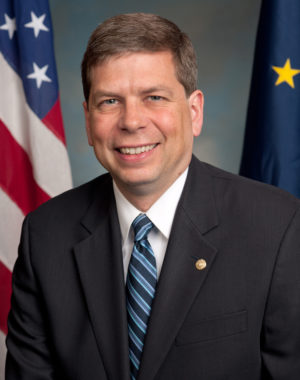
Democratic Sen. Mark Begich says he doesn’t support President Obama’s version because it was too broad, and had serious reservations about the version the Senate Foreign Relations Committee advanced to the full Senate on Wednesday.

He made the comments from Washington, D.C., during a telephone townhall meeting with constituents on Thursday evening.

Begich said he has four unsatisfied criteria. First, he said the response to the Syrian President Bashar al-Assad’s violation of an international chemical weapons ban must be an international effort that includes Russia and China.

Second, “No boots on the ground, whatsoever, of any kind.”

Third, the military strikes must be paid for without stripping down “important, needed services.”

Finally, he must have an understanding of the “real game plan” and the end game.

Begich said it was unlikely his criteria would be met.

“I know what some will say,” he said. “Well, I put too high a standard — that means I’ll probably be a ‘no.’ Well, these are the standards when you’re putting American lives on the line that we should have. So that’s where I’m at on this, they got a lot to still prove to me.”

Republican Rep. Don Young has said he’s opposed to any U.S. military intervention in Syria. And Republican Sen. Lisa Murkowski has said she is “wary” of intervention, but is soliciting constituent input on the topic.

The full Senate is expected to take up the resolution next week.

NOAA: No success yet with entangled whale

Efforts to cut a humpback whale free of gill netting it has been dragging around Southeast Alaska for the last 12 days continue to fail.
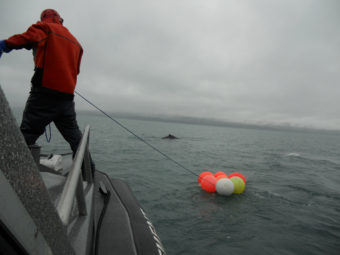
Teams from Juneau have made several unsuccessful attempts to cut the fishing gear free from the whale over the weekend. Some gear has been removed, but a “significant” amount remains, according to the National Oceanic and Atmospheric Administration.

The agency says the whale can breathe and isn’t in immediate danger.

Disentanglement teams are waiting for calmer waters before trying again later this week. A satellite tag that a team in Petersburg attached lets officials track the whale.

Team members say it’s been challenging because the weighted gear is beneath the whale, and because the whale has been evasive.

NOAA spokeswoman Julie Speegle says the whale is in Chatham Strait.

Tangled whale reaches Juneau waters

The humpback whale that was tangled up in a gill net near Petersburg earlier this week has made its way to Juneau waters.

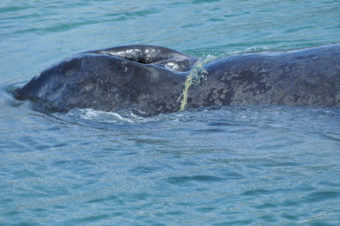
The humpback whale is tangled in a tight wrap of netting, visible behind the blowhole. This photo was taken Wednesday in Juneau waters.
(Photo courtesy John Moran/ NOAA)

National Marine Fisheries Service spokewoman Julie Speegle said a disentanglement team was out Wednesday observing the whale. Today, the three person team is out trying to cut it free.

The whale has a buoy attached to it for spotting, as well as a tracker. It was in Stephens Passage on Thursday. Speegle didn’t want to disclose its specific location, for fear of people chasing it.

But with the Labor Day weekend, sightings are especially likely. Officials are asking boaters not to intervene and to stay clear of the whale, both for its well-being and their own.

“There is also a large amount of gill net in the water that’s attached to the whale,” Speegle said. “And that could pose a hazard to vessels as well. So if you spot this whale, you’ll want to keep your distance.”

As of last report this morning, the whale had turned and was headed south.

(Check back later for updates.)

Site notifications
Update notification options
Subscribe to notifications