Filipinos in Alaska

Philippine consulate visits Kodiak for the first time since before the pandemic

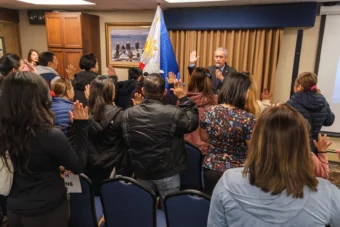
A cohort of nearly 20 people swearing in as dual citizens of the Philippines and the United States. (Brian Venua/KMXT)

The Philippine National Anthem, “Lupang Hinirang,” played for newly sworn in citizens at Kodiak’s Best Western Hotel this week. The hotel’s Harbor Room was packed with people looking to meet with the Southeast Asian country’s visiting consulate.

Daisy Briones is one of them. She lives in Kodiak and works at one of the schools and the library. She’s both a volunteer for, and a beneficiary of the consular outreach to Kodiak.

“This is much better, much faster, and more convenient – and you know everybody,” she said.

For the first time since before the pandemic, a Philippine diplomat visited Kodiak on Sept. 24. The consular team provided services that people would otherwise have to leave the island, or the state, to receive.
The Philippine consulate works as a sort of extension of the country’s embassy in Washington D.C. and serves people outside the Philippines.

Immigration can be complex, but the gist for many is that when some Philippine nationals become U.S. citizens, they end up renouncing their home country’s citizenship. But, they can regain legal ties as dual citizens later. That’s what Briones did.

If she wanted to go through the same process without the outreach to Alaska, she would have had to fly to the nearest consular office, which is in San Francisco.

The swearing in ceremony for dual citizenship lasts about 15 minutes, concluding with an oath in Filipino, the official language of the Philippines, which is largely based on Tagalog.

The Kodiak visit is important, in part because the borough has the second most people with Filipino heritage in the state, according to census data. Kodiak has about 3,253 Filipinos, while Anchorage has an estimated 18,033.

Philippine Consulate General Neil Frank Rivera Ferrer said he tries to serve Alaska at least once a year. Teams mostly have gone to cities like Anchorage and Juneau in recent years, but this is the first time anyone can remember consular outreach to Kodiak in nearly a decade.

“Since I assumed my post in 2021, I made it a priority to service our Kababayans in Alaska,” Ferrer said.

Kababayan roughly translates to countrymen in Filipino.

Ferrer is a career diplomat and works for the Government of the Philippines. (Brian Venua/KMXT)

Ferrer, his consulate staff, and volunteers helped 296 people file paperwork with the Philippine government during their day in Kodiak for a variety of administrative services. He said he’s glad to help people who might not be able to get these services otherwise. All they have to do is bring paperwork that shows previous Philippine citizenship.

While some people regained their citizenship, others registered for overseas voting and renewed their passports – or did all three – in a single day.

“It saves them a lot of money in terms of the cost for traveling, and also the time,” he said. “You’d have to take time off from work – one or two days just to travel and those things. So we try to do that as much as we can.”

A flight to San Francisco can cost over $1,000 – not including money for taxis or hotels.

Ferrer’s office is just one of eight in the U.S. including the embassy in Washington D.C. The others are in Chicago, Los Angeles, Honolulu, New York, Houston and Guam.

Ferrer serves Northern California, Northern Nevada, Colorado, Idaho, Montana, Oregon, Utah, Washington State, and Wyoming in addition to Alaska. The combined population he serves is around 1.3 million Filipino people.

Ferrer brought a team of 11 of his office staff as well as worked with several volunteers for the Kodiak outreach. (Brian Venua/KMXT)

Alaska’s honorary consul, Rebecca Carrillo, was also part of the visit. She can’t provide these services herself, but works as a sort of intermediary between Philippine nationals in Alaska and the consular offices in the Lower 48 and Hawaii. She said she loves meeting people and hearing their immigration stories.

“Their journey from the Philippines to here has transformed their lives, their families’ lives, (for) how many generations,” she said.

Carrillo said she’s heard that many Filipino people have faced discrimination, but retained their identity and love for their homeland despite that. Many of whom did so while building their lives here.

“They are thriving – they own their own homes, they’re able to send their kids to college,” Carillo said. “Those kids are doing well, and it’s the proverbial realization of the American Dream.”

And now many folks who’ve realized that dream want to go back to the Philippines. U.S. citizens can usually only stay in the Philippines for about a month depending on their visa, but dual citizenship allows them to stay longer, or even move back. With a Philippine passport, they can also have a faster process when going through customs and immigration.

Briones, the volunteer, still has siblings there. She said the consular team helped make the process to visit them easier for her.

“The consular team, they’re so accommodating,” she said. “We have plenty of senior citizens here who are applying for their dual (citizenship) or (a) passport. There’s a patience in helping out all these people and we truly appreciate all their efforts.”

The San Francisco consulate office plans to draft its schedule for the next Alaska outreach by the end of the year.

Tongass Voices: George Gress, Joseph Galgano and Bryan Bolaños on musical craftsmanship

George Gress and Joe Galgano play their handmade guitars together in Gress’s workshop on April 6, 2024. (Tasha Elizarde/KTOO).

This is Tongass Voices, a series from KTOO sharing weekly perspectives from the homelands of the Áak’w Kwáan and beyond.

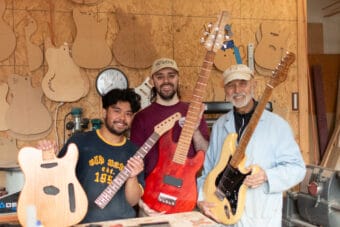
Nestled between the tall trees of the Mendenhall Valley, George Gress makes guitars in his woodshop. He’s been making them for the past decade, but in the last few years he’s brought on two ambitious students.

On Saturdays, Joseph Galgano and Bryan Bolaños bond with Gress over wood flames and handmade instruments.
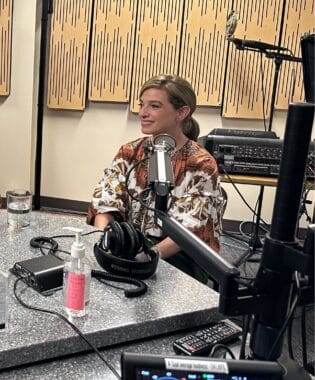
Listen: 

This transcript has been lightly edited for clarity.

George Gress: This. This is right where you want it. This is, but the profile is not yet. So you don’t, you don’t want to go any, you don’t want to grind any more of this off. So, let me make a little pencil mark…

George Gress. And I’ve been here a lifetime, about 35 years, and started making guitars 10 years ago. And have gradually been able to mentor and help some other guitar makers get started. 

Jim Weindorf and George Gress advise Bryan Bolaños after sanding his first guitar neck on May 25, 2024. (Tasha Elizarde/KTOO)

Feel right here? That’s flat. You don’t want that flat. So what you’re going to be working on is, just like this. You’re just going to go back and forth a lot.

Bryan Bolaños: I’m Bryan Bolaños. I grew up here in Juneau, originally from the Philippines. I’m a self-taught musician and artist, and I do like a million things, and this is one of them. 

This is my first guitar build. And I think about like two years into learning the guitar, I was looking at luthier colleges. Luthier is like, what this profession is, making six string instruments, or stringed instruments. And I was like, looking into it, and it was like 20 grand for tuition.

Joseph Galgano: And then you gotta stay there for like five months.

Bolaños: Yeah, but then I just messaged George, and he just got me in right away, and just like, now I’m doing it. So I didn’t need to go pay a crazy tuition, and then I just get to hang out with some cool people and make instruments.

Gress: He hasn’t seen my bill yet. 

Bryan Bolaños, Joseph Galgano, and George Gress hold guitars in various working stages at Gress’s woodshop on May 25, 2024. (Tasha Elizarde/KTOO)

Galgano: Bryan, like thought he had to earn his place here first. And he’s like, ‘I can clean up, and I can do this, and I can do that.’ And George and I were like, ‘What are you talking about? Just pick some wood and get going!’

Yeah, I’m Joseph Galgano. I moved to Juneau in 2018, and I make guitars and bass guitars under the name Intrepid Guitars. When I was in college, I always wanted, like, a custom guitar, but it just felt really unattainable. And like custom guitars are like, if you go to Fender Custom, it’s like $3,000 to $4,000. And I was just like, ‘why don’t I just try to make my own guitar?’ And then, that’s how it started. And I was, I was doing it, but being under George’s mentorship really, really expedited the process, and now I have a shop in my garage, and I’m almost, almost self-sufficient. Almost.

George Gress observes as Joe Galgano cuts a plank of bird’s eye maple into a fretboard on May 25, 2024. (Photo by Tasha Elizarde/KTOO)

Bolaños: Being a musician, you know, ourselves, like we know how we want it to sound and how it, how we want it to feel.

Galgano: That’s probably been my favorite part, seeing the guitar put together and hearing how it sounds, because each one sounds different. You know, you put the work into it, so kind of have a connection to it. 

Bryan, we cut his, it was just a block of wood, and we cut it into his guitar shape. And I saw Bryan, like, getting excited. He’s like, ‘Oh my God, it’s an actual guitar.’ And I was like, so this is how George feels. I was like, I was like, I could see why he likes it so much. 

Gress: Yeah. Yeah. 


Juneau Afternoon: National Breastfeeding Month, Harvest Fair, and Chef Pati Jinich

SEARHC, Bartlett Beginnings, and Juneau Family Birth Center hosted a Lactation Resource Fair on August 3, 2024, to connect families with resources to support their breastfeeding journeys. (photo via SEARHC)

On today’s program:

Bostin Christopher hosts the conversation. Juneau Afternoon airs at 3:00 p.m. on KTOO and KAUK with a rebroadcast at 7:00 p.m. Listen online or subscribe to the podcast at ktoo.org/juneauafternoon.

Subscribe to the podcast:

Juneau Afternoon is a production of the KTOO Arts and Culture Team.
Bostin Christopher produced today’s show with help from Erin Tripp.

Tongass Voices: Diosdado Valdez on finding family away from home

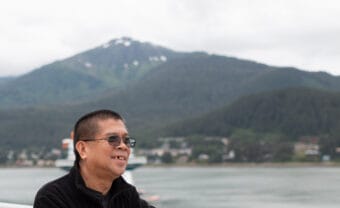
Diosdado Valdez looks out on the view of Gastineau Chanel. (Photo by Tasha Elizarde/KTOO)

This is Tongass Voices, a series from KTOO sharing weekly perspectives from the homelands of the Áak’w Kwáan and beyond.

Every summer, the docks of downtown Juneau are packed with tourists. Among the visitors are people like Diosdado Valdez, who prepares the onboard entertainment for one of the cruise ship companies. Valdez has been coming to Juneau for over 30 years, and in that time, he’s found another family off the ship.
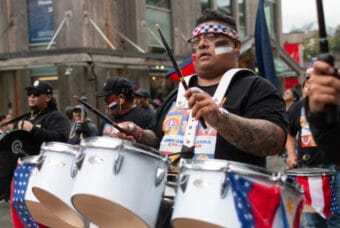
Listen: 

This transcript has been lightly edited for clarity.

Diosdado Valdez: Yeah, I am Diosdado, just Diosdado Valdez from the Philippines. Yeah, we are in a cruise ship in Juneau. And, you know, I love Juneau. I’ve been coming here since 1993. 

I have a very good friend. He was my friend at home. He asked me if I want to come to work with him, also. So I said, ‘why not?’ At first, I said, ‘only one contract.’ But then when I started, then I realized, this is the job I wanted. 

I am a production manager, and I’ve been working for this company for almost 32 years now. We are in charge of the show. If we have a comedian today, so that’s for the night. And on the daytime, there are daytime activities that we need to do. 

I go home after each contract in the Philippines. I live in Mindanao, that is in Bukidnon. I work for six months, and then get to go home for two to three months, then back to work again. 

When I started here, there is this oriental restaurant there, and the owner of that became my friend. Every time I get to Juneau, I do the dishwashing because I want, I just like to be with them. And he loves that, too. And every time I come back to the ship, I get food. He gave me food because he owns the restaurant. Play billiard, and karaoke. You know, karaoke is the most fun. That’s all I want to have when I’m in Juneau, just to see my friends.

Tasha Elizarde: Can you tell me about the first friend that you made when you started working on the cruise ships?

She is a local. We just met like, walking on the street. They kept asking me to go with them on that tram. I said, ‘Can we do it next time?’ Until this time, we haven’t been there. Yes, for years now. I admit that maybe I’m lazy. 

Since then, until this time, we are friends. Her son is my godson. And I love coming back here because of the people in Juneau. Hospitable, nice, friendly. The Juneau family is my family.

Tongass Voices: Hans Javier on celebrating the Fourth with Filipino flare

Hans Javier keeps the drummers of Juneau Ati-Atihan on tempo as they walk the streets of downtown Juneau for the annual Independence Day parade. July 4, 2024. (Tasha Elizarde/KTOO)

This is Tongass Voices, a series from KTOO sharing weekly perspectives from the homelands of the Áak’w Kwáan and beyond. 

Every year on July 4th, drums awaken the streets of downtown Juneau. This iconic sound is Juneau Ati-Atihan, a musical marching group that brings the Filipino festival of the same name from Aklan to Juneau. 

One of the lead drummers, Hans Javier, has participated in the Independence Day parade since he was a kid. Twenty years later, Juneau Ati-Atihan is his way of giving a shoutout to his culture, while spending quality time with his family. 

Listen:

This transcript has been lightly edited for clarity.

Hans Javier: First name Hans, last name, Javier. What we are doing today is, we are drumming for the parade representing specifically my Filipino culture from Aklan, Aklanon, and we are drumming for Ati-Atihan. 

Ati-Atihan is a festival, it’s generally like a week long. It honors the infant Jesus. It’s our saint, it’s Santo Niño. So primarily, the festival is celebrated for religious purposes. And you know, we do this back home in the Philippines on an annual basis. So, you know, doing it on Independence Day is a great way to represent our culture.

I watched my uncles and older cousins do this, and I always wanted to enter not knowing that, you know, they were open to me learning. And then one day, I believe it was, uncle Ed asked me if I wanted to join. And I think I was maybe 11 or 12 at the time, and ever since I’ve been doing it.

I am one of many leads. I’ve played all drums, from bass to snare. I was primarily a snare lead. We bought a new quad, so I switched over to the quad. Most importantly, my role as a quad is to make sure people stay in tempo. But my primary role overall is to make sure everything’s organized – drummers are present, organized formation, and yeah.

Hans Javier to the drummers: Ready! Start banging!

I feel like we bring flavor, and not to kind of downplay the rest of the parade, but you know, I feel like every time we pass through a certain area, you know, everybody gets up from the curb. Instead of waiting for candies, you know, they’ll get up and dance with us. We welcome people to jump in where they’re at and come dance with us. 

Funny story, last year we had, I guess my drummers were banging so hard we broke like, four drums last year. 

Yeah, when we pass a certain area, specifically like Marine Park and the Filipino Community, people tend to play louder and faster, and that’s where people generally break their drums.

I’m very close with my family, I’m very close with my cousins. And as we get older, it’s a lot harder to see them. But everybody, you know, around this time of year really makes time out to participate. And a lot of these cousins I don’t see until – and keep in mind, we live in Juneau, small town, right? – but a lot of these cousins I don’t see until, like, a month out of July 4th. 

So it’s a great time for us to kind of reconnect and, you know, be a family. I really love that part about it.

Juneau Ati-Atihan finishes their route in Juneau’s annual Independence Day parade after having won “Best in Parade” for 2024. (Tasha Elizarde/KTOO)

Visa programs draw foreign teachers to Alaska’s rural school districts

Dale Ebcas teaches Special Education at the Joseph and Olinga Gregory Elementary School in Upper Kalskag. (Emily Schwing/KYUK)

When special education teacher Dale Ebcas moved from his home in the Philippines to the tiny Alaskan village of Upper Kalskag back in the winter of 2020, the warmest layer he brought with him was a trench coat.

“I was imagining a weather like, you know, Korea,” Ebcas laughed. “Because I’m a fan of watching Korean movies and it’s like, ‘oh, they’re just wearing trench coats. It seems like it might work.’”

The average temperature in the Philippines’ coldest month is just about 78 degrees Fahrenheit. By contrast, the climate in Upper Kalskag is semi-arctic and snow can blanket the ground for more than half the year. Needless to say, the trench coat didn’t cut it. Ebcas had to borrow a down jacket from the principal of the school where he’d been hired.

His school district, the Kuspuk School District in Western Alaska, is about the same size as the state of Maryland. While the region is large, the student population is small: only 318 kids spread out across seven villages and none of those villages connected by a road system. Here, like in many other rural school districts across America, it’s a struggle to fill nearly 40 teaching positions. That’s why the Kuspuk School District is bringing in educators like Ebcas from over 5,000 miles away. So many of them, in fact, that they now make up more than half the district’s teaching staff. It’s one of many school districts around the country who are addressing a shortage of teachers by relying on special visas that allow foreign teachers to come work in the United States.

Ebcas is from Cagayan de Oro City on the Philippine island of Mindanao, an island with a population of more than 26 million people. By contrast, there are just over 200 people in Upper Kalskag. While winters are long and the community is tiny, Ebcas has seen a lot of success. Earlier this year, the Governor’s Council on Disabilities and Special Education in Alaska honored Ebcas with an Individual of the Year Award for Special Education in Inclusive Practices. Earlier this month, he was also recognized as one of among 20 teachers for Alaska’s 2024 Educators of the Year.

“I truly believe that that award only signifies that as a school district, we are doing our best to help the kids here in the village. That we are really striving hard to promote inclusion and understanding with kids, with disability and without disability,” Ebcas said.

Ebcas said that he enjoyed teaching in Alaska so much that he encouraged other teachers he knew from the Philippines to join him. His aunt, Vanissa Carbon, now teaches second grade in Upper Kalskag. Although she said that the winter in Upper Kalskag is long, she’s been pleasantly surprised by life here, where the population is predominantly Indigenous. “The people here are also like Filipinos. Their culture is somehow the same in terms of close family ties, being together on occasions and helping each other,” said Carbon.

Second grade teacher Vanissa Carbon said that the adjustment to winter in the U.S. took some patience. “Oh my God, it’s so long,” she laughed. But she appreciates the community in Upper Kalskag for its similarities to Filipino culture. (Emily Schwing/KYUK)

In the Kuspuk School district, teachers who come from the Philippines say that they can make 15 times the amount of money they could at home, in addition to benefits. And they have access to teaching tools and technologies that aren’t as readily available in the Philippines.

“I was quite fascinated with the fact that we have resources that are really readily accessible to students with special needs,” Ebcas said. He pointed to tools like a “talking pen,” which assists students in learning to read, among other technologies. “These kinds of devices, we don’t have them in the Philippines. It’s very expensive,” he said.

The teachers who come to the U.S. from the Philippines are highly qualified, said Madeline Aguillard, superintendent of the Kuspuk School District. “These were very highly educated individuals, oftentimes with multiple masters degrees or even an earned doctorate, even after we do a foreign credential evaluation,” she said.

Aguillard did her PhD research on the special education system in the Philippines. She said that the requirements for students working toward teaching degrees there aren’t so different from what’s required in the U.S. “Their studies were purely 100% based on the U.S. model of students receiving special education services,” Aguillard said. She said that her research was in the back of her mind when her school district opted to pursue hiring foreign teachers.

The Joseph and Olinga Gregory Elementary School in Upper Kalskag is one of nine schools in the Kuspuk School District, which serves 318 students spread across an area equivalent in size to the state of Maryland. (Emily Schwing/KYUK)

Both Ebcas and Carbon are here on J-1 visitor visas, which are good for three years and can be extended for two more. The J-1 is a cultural exchange visa for visitors, and J-1 visa holders often fill summer service positions related to the travel industry in Alaska. Childcare workers, including au pairs, also use J-1 visas. Nationwide, there are more than 5,700 teachers in the U.S. on J-1 visas. Ninty-one of them are in Alaska.

“They do have program requirements where they do have to share not only their culture, but also learn about the culture that they are immersed in for their job,” said Aguillard. “A big part of education in rural Alaska specifically is the emphasis on cultural heritage and keeping that culture alive, whether it be Alaska Native culture, or whatever culture an individual brings with them to the space they’re in,” she said.

Aguillard said that the teachers host Filipino-themed events in her school district. “A couple of our teachers have put on informative nights about the Philippines, so they’ll decorate the whole gym, they’ll cook food and do a lecture on Filipino cultural traditions,” she said.

Aguillard said that J-1 visas have had a dramatic positive impact in her school district. “We went from having zero applicants for positions for a year-long posting to over 100 applicants of extremely qualified people with experience, and they’re wanting to come teach our students,” she said.

Still, Aguillard said that the teacher shortage in the Kuspuk School District is so dire that 20% of teaching positions were never filled this year, even with the teachers on J-1 visas. Now the Kuspuk School District is looking at ways to keep foreign teachers on staff for more than five years. One option is the H-1B visa, a specialty occupation visa that paves the way for immigration.

Kuspuk isn’t the only remote school district in Alaska utilizing U.S. State Department visas to fill teaching positions. More than 350 miles south, the Kodiak Island School District has hired an immigration lawyer to secure H-1B visas, and they’re also recruiting teachers in the Philippines.

At an Alaska Senate Finance Committee hearing in March, Kodiak Island School District Superintendent Cyndi Mika said that the district now hosts its own job fair in the Phillipines. “This year we went to both Manila and Cebu City,” she said. “We went to Cebu [City] because it’s rural-remote, and we knew that those are the types of teachers that would be better integrated into our community.”

In Upper Kalskag, Ebcas extended his J-1 Visa for two additional years, but at the end of the next school year his time in Alaska will run out as well. He said that it’s a disappointing reality of the J-1 visa program that he can’t stay on to build on the work he’s already done.

“I could have continued the things I do with the community and the kids if only I could go beyond five years,” Ebcas said. “I consider this already as my family, the community here, the kids here.”

Site notifications
Update notification options
Subscribe to notifications