Filipinos in Alaska

Tongass Voices: Father-daughter production duo Joshua and Harmony Laboca bond through music

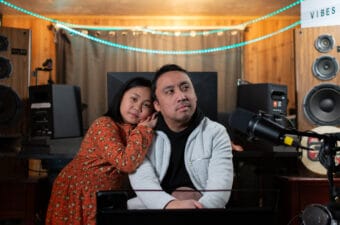
Joshua and Harmony Laboca pose in their home studio in February 2024. (Tasha Elizarde/KTOO)

This is Tongass Voices, a series from KTOO sharing weekly perspectives from the homelands of the Áak’w Kwáan and beyond. 

Joshua Laboca, known around Juneau as Jbo, is the music producer and content creator behind dozens of artists in Southeast Alaska. He and his nine-year-old daughter, Harmony, also produce music together. 

You can hear their song “Growing” and others on their YouTube page, Harmony & jboaudioe.

Listen:

This transcript has been lightly edited for clarity.

Joshua Laboca: Full name is Joshua Laboca. I go by JBo Audioe, J-B-O A-U-D-I-O-E. That’s what a lot of people know me as in town. And we are here at our home studio, where a lot of artists and bands come in to record and perform in the booth over here. So, I went to school at the Academy of Art University in San Francisco. 

So we had some family issues back here in Alaska. So I decided to continue going to school here, online. And then I ended up opening up a studio, but I never wanted to do music for artists. And then, so I had to tell myself, “I want to keep doing this. So how do I? How do I merge what I know about sound design, editing, Foley and effects? How do I apply it to music, like for artists?” So as I was mixing artists, like beats and stuff, and their vocals, I would apply it. And then I eventually grew a passion for mixing and producing for artists in town. 

My daughter and I, we do have a YouTube. It’s Harmony & jboaudioe, where we make instrumentals. I’ll have the beat down and I’ll do the mixing, and Harmony will do the guitar and pianos.

Harmony Laboca: Alright, Dad! Play my pre-roll please.

Joshua Laboca: She got inspired by the movie Sing. And there’s this character named Ash that plays the guitar voiced by Scarlett Johansson. And then the only way that I knew for us to continue to work on her playing guitar was that we had to make instrumentals. So every week she would play chords, she would lay chords down on instrumentals that I had. And every week it was just improving on that and that’s how she, she’s four years in now, she plays it pretty good now. 

Harmony Laboca: Um, usually we do a guitar first, and then if we’re making a song, we do guitar, vocals and then piano. 

Joshua Laboca: And she knows like, the basic controls of when to record, when to stop, going at certain bars and stuff, so. 

We usually film this whole process. So even during the mess-ups we still put it in the edit. So because it’s just, you’re never gonna get anything perfect.

But aside from that, once we get it mixed and edited, I’ll put some visuals to it. And then we put it on YouTube. And we just, yeah, that’s our process.

Harmony Laboca: It’s actually really fun. ‘Cuz we do it, he usually like, told me what’s wrong or like, what to improve on. And then he was like, and then sometimes we do games that we made up and like, practice together and sing stuff together, make videos together.

Joshua Laboca: We have a back and forth too, like it’s not always like Brady Bunch or anything. It’s like, ‘No, we should do this. No! No, yeah, no, I know, I know.’ You know, we have this like back-and-forth banter that we always do. But that’s kind of like the relationship that we have. And it makes it so that, you know, if I’m not doing something right, she calls me out, she’s not doing something right, you know, I call her out. 

Joshua and Harmony Laboca: The saying that we go, when right before we end our session is, “It’s never a good day without a challenge. So, fail fast. Fail forward. Fail a lot.”

Joshua Laboca: We say the word failure more than we say success. Because we’ve grown in the knowledge of music. And we’ve grown in making music from all of that.


Tongass Voices: Marilyn Lumba on making Juneau Pioneer Home residents feel at home

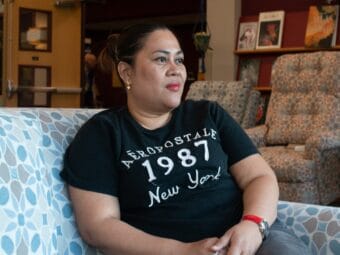
Marilyn Lumba poses for a portrait at the Pioneer’s Home in August 2023. (Photo by Tasha Elizarde/KTOO)

This is the first installment of Tongass Voices, a series from KTOO sharing weekly perspectives from the homelands of the Áak’w Kwáan and beyond. 

Marilyn Lumba is the director of nursing at the Juneau Pioneer Home and an assistant professor of nursing at the University of Alaska Southeast. She began working at the Pioneer Home in 2010, just three months after migrating to Juneau from Tagum City in the Philippines. And while she loves her career now, she didn’t think health care would become her passion.
Listen:

This transcript has been lightly edited for clarity.

Marilyn Lumba: Our facility consists of four neighborhoods. So we have Twin Lakes Lodge. We have 10 residents in here.

I always like think, “Okay, what will be the best for the resident? If this is my grandpa, what I’m going to do for them to be happy?”

If you observe, we don’t have uniform. Because this is a home. In your home, you don’t wear uniform, right? So we wanted the resident to feel that this is their home. So we have cats. We have two cats. It depends on the color. If it is Ginger, of course, it’s ginger colored. And Smokey is smoky colored. And we have birds. Before, we even have fish also.

Actually, I wanted to be an accountant — a CPA, a certified public accountant. But my best friend wanted to be a nurse. I said, “Okay, let’s just be a nurse together.” Because we wanted to go together to the same school and all that. And so, I just completed it because my mom doesn’t want me to stop.

I started working here in JPH [Juneau Pioneer Home] in 2010 as an assisted living aide, and I moved here because my husband is here. Like, he petitioned me, together with my daughter. And then I become an assistant professor, in like 2019.

I made the right choice in staying as a nurse because being a nurse is not just — you know how they always say passing meds, like in elderly people? Like here, in a long term care facility, they say, “Oh, you just pass?” No, being here and being a leader, there’s a lot. Like, you have a big impact on this resident — we call them resident, we don’t call them patient.

You become their family, and you wanted — like for me because it becomes my passion — I wanted them to be successful in what they wanted. Like, the quality of life that they deserve.

Mga Kuwento, Ep. 5: Reconnecting with culture in Juneau’s Filipino community

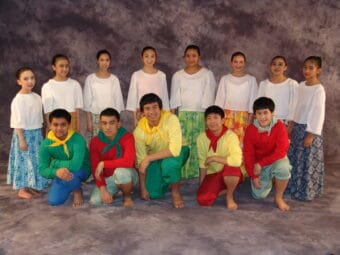
Members of Juneau’s Alitaptap Folkloric Dance group pose in traditional costumes. (Photo courtesy of Filipino Community, Inc.)

In its heyday, the Alitaptap Folkloric Dance group was a spectacle of Filipino culture both in Juneau and across Alaska.

Filipinos, from elementary schoolers to elders, learned and shared the story of Filipino history through dance. But it’s been more than a decade since those dancers took the stage.
Kaye Roldan doesn’t really recall joining the group with intention. 

“When I joined, it was like we didn’t really get the full picture of what we were actually doing,” she says. “I just did it because my mom told me to.”

Many Filipinos who grew up in Juneau had a similar experience. But years later, they can appreciate the chance they had to connect with the culture their parents and grandparents came from before arriving in Alaska.

In the fifth and final episode of Mga Kuwento, Anna Canny brings us the story of those who once danced under the careful instruction of their elders, who are now searching for spaces to reconnect and pass down Filipino culture.

Members of Juneau’s Alitaptap Folkloric Dance group pose in traditional costumes. (Photo courtesy of Filipino Community, Inc.)

‘Mana: The History We Inherit’ exhibit highlights Filipino history in Alaska

October is Filipino American History month, commemorating the arrival of the first Filipinos to modern-day California in 1587.

A new exhibit launched at the Anchorage Museum Saturday chronicles an oral history of Filipinos in the state. Mana is the Tagalog word for “inheritance” and the name of the project, founded by Shayne Nuesca, Tasha Elizarde and Joshua Albeza Branstetter.

Nuesca says the three of them had independently chronicled Filipino history, and the project took off when they came together to collaborate.

Listen:

The following interview has been edited for length and clarity.

Shayne Nuesca: We wanted to tell the stories of elders, Filipinos in Alaska, whose stories would otherwise go untold in mainstream forums. And so these are stories that were passed down orally. It’s how our stories are really told, from generation to generation, within our culture. We also had some elders who had passed away, and that motivated us to get this project going and to record the stories of the elders that we have still with us.

Wesley Early: Josh, the project covers a wide swath of the state. You’ve got Anchorage and Kodiak, and then up to Fairbanks and down to Juneau. Did you find that people were open to telling their stories? Did you find that there was maybe some hesitation?

Joshua Albeza Branstetter: There was hesitation at first. A lot of the elders hadn’t met us, they didn’t even know that I was Filipino American when we first reached out. A lot of these elders have had diverse, lengthy histories and stories that they’ve never shared with anyone. And a lot of that has to do with not feeling like they can share those stories. There’s a wonderful word that Shayne taught me just a few days ago. It’s “hiya”. So many Filipino words are entire essays, but it kind of takes this concept of this shame around like, don’t talk too much, don’t share too much. And our elders have the stories that they have felt like they couldn’t share. They didn’t have a platform to. They needed to trust us first. And once they did, we learned… I learned so much. So much about myself and our community.

WE: Tasha, all of you are Filipino. And while you all have backgrounds in various forms of media, be it filmmaking, writing, photography, journalism, I imagine there haven’t been a lot of big opportunities to do large projects about people who look like you. Did you find any additional pressure, any additional excitement about doing a project like this?

Tasha Elizarde: I was very excited, just because there’s not a lot of opportunities to be able to share the stories of our community, just in whatever spaces exists for media creation in Alaska. For example, there’s only one book on Filipinos in Alaska that’s ever been published, by Thelma Buchholdt. And that book is currently out of print. And so I think that says a lot about what kind of opportunities are available to be able to share the types of stories. She had written that book because at one point, she was just like, “Why do we have no archive?” And so we’re kind of repeating that question back and saying, “Why is there still, after so many years — that book was published, like I think 30 years ago — after so many years, we still don’t have an elaboration of that archive?” And so what we’re doing with Mana is creating a larger archive. Talking to people that exist here now, making these connections to even longer into the past. And that’s something that… it’s just not an opportunity that a lot of people go for. But we had to create that opportunity by ourselves. And that’s why I was so excited to be working with both Shayne and Josh is because we’re able to create an opportunity to share stories that are so important. You see people when we interview them, they’re just so excited to finally feel like they’re recognized and have relationships with young people that remind them we care about your stories, and other people will care about them too.

WE: Josh, you know, you got the opportunity to travel to a lot of parts of the state to meet different people and share their stories. Were there any that maybe surprised you, you learned something new or really resonated with you?

JAB: I would say one that really resonated with me was the story of Camila Cook. She is an elder here in Anchorage. And she would always call me “darling,” and I love that. But when I interviewed her she lit a cigarette and she put it in her mouth backwards, so the lit end in. And I said, “Lola, what are you doing?” And she’s like, “it’s just a thing, darling. We all did this when I was a kid, and so I still do it today.” And I think the specificity of our stories really creates a universality among our community. Because we already have the exhibit up and one of our team, she had never seen it and she went there yesterday. And she said she stopped at Camila’s, and when she saw that backwards cigarette before she’d even read the story, she said, “Josh, it sent me back 40 years, because I remember how all the kids would do that.”

WE: So Shayne, I think my last question is, what do you hope the goal of this project is? Do you see it as more of a resource for a wide audience to learn about their fellow Alaskans — their neighbors — or do you see it as a personal resource to help Filipino people learn about their own history?

SN: I definitely see it as both. So it is an avenue for the wider community to learn about our elders and the history of Filipinos, or a glimpse of the history of Filipinos in Alaska. But it’s also an opportunity now for Filipinos in Alaska to look within themselves, I hope, and to look at their families and open the door for those discussions about you know, the stories that came before them. For me, and I can’t speak for the rest of my team, this was a very healing project for me. I had immigrated here when I was six years old and had dealt with you know, the loss of my birth culture, in a sense straddling two different cultures. And so, hearing these elders speak about their experiences, and then correlating that with with mine as a child, it felt like those experiences were validated. And every emotion that I felt, all of the sort of hardships I had as a child, it felt like I was getting a hug from people that weren’t even in my family, and they were telling me they were validating my experience without even knowing.

“Mana: The History We Inherit” opened at the Anchorage Museum on Saturday, Oct. 27. The exhibit will run at the museum through January.

Editor’s note: Shayne Nuesca is a former KTOO employee and Tasha Elizarde currently works at KTOO. KTOO is not affiliated with the exhibit. 

Mga Kuwento, Ep. 4: Holding two identities in Juneau’s Filipino and Lingít community

When Filipino men migrated to Juneau in the early 20th Century, they came as bachelors to work in canneries alongside Alaska Natives. Because they were segregated together, the Filipino and Alaska Native communities intermixed. Many Alaskeros married and built families with Alaska Native women.

The word “mestizo” means “mixed” in Spanish. In Alaska, it refers to someone who has both Alaska Native and Filipino heritage, since the Philippines were colonized by Spain. Not everyone who shares these identities chooses to use this word, but many in Juneau do. 

Marcelo Quinto points to his father in an old photograph during an event at the Filipino Community Hall in October 2023. (Photo courtesy of Agnes Elizarde)

“When we were born half Filipino and half Lingít, it was difficult for us to decide — where do we belong? Because we knew we didn’t belong in a white society,” says Marcelo Quinto, who grew up in Juneau in the 40s and 50s. 

After the 1965 Immigration Act, it became possible for Filipinos to migrate with a partner, and intermarrying between the two communities slowed. Eventually, Juneau’s Filipino Community Hall became less welcoming to the Alaska Native women who had helped fundraise to purchase it, leaving their children and grandchildren to find their own place in the greater Filipino community.

“I really feel my Lingít connection to Áaní, to the land here and in our home, but I haven’t experienced that with the Filipino part of me,” says Kai Monture, an artist in Juneau. 

In the fourth episode of Mga Kuwento, Yvonne Krumrey tells the story of a community with historic roots in Juneau and how some mestizos are trying to reconnect with their Filipino side. 

Site notifications
Update notification options
Subscribe to notifications