Mga Kuwento

Mga Kuwento, Ep. 5: Reconnecting with culture in Juneau’s Filipino community

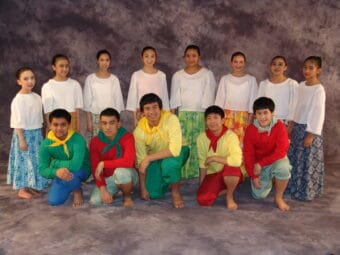
Members of Juneau’s Alitaptap Folkloric Dance group pose in traditional costumes. (Photo courtesy of Filipino Community, Inc.)

In its heyday, the Alitaptap Folkloric Dance group was a spectacle of Filipino culture both in Juneau and across Alaska.

Filipinos, from elementary schoolers to elders, learned and shared the story of Filipino history through dance. But it’s been more than a decade since those dancers took the stage.

Kaye Roldan doesn’t really recall joining the group with intention. 

“When I joined, it was like we didn’t really get the full picture of what we were actually doing,” she says. “I just did it because my mom told me to.”

Many Filipinos who grew up in Juneau had a similar experience. But years later, they can appreciate the chance they had to connect with the culture their parents and grandparents came from before arriving in Alaska.

In the fifth and final episode of Mga Kuwento, Anna Canny brings us the story of those who once danced under the careful instruction of their elders, who are now searching for spaces to reconnect and pass down Filipino culture.

Members of Juneau’s Alitaptap Folkloric Dance group pose in traditional costumes. (Photo courtesy of Filipino Community, Inc.)

Mga Kuwento, Ep. 4: Holding two identities in Juneau’s Filipino and Lingít community

When Filipino men migrated to Juneau in the early 20th Century, they came as bachelors to work in canneries alongside Alaska Natives. Because they were segregated together, the Filipino and Alaska Native communities intermixed. Many Alaskeros married and built families with Alaska Native women.

The word “mestizo” means “mixed” in Spanish. In Alaska, it refers to someone who has both Alaska Native and Filipino heritage, since the Philippines were colonized by Spain. Not everyone who shares these identities chooses to use this word, but many in Juneau do. 

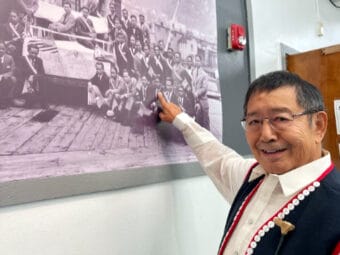
Marcelo Quinto points to his father in an old photograph during an event at the Filipino Community Hall in October 2023. (Photo courtesy of Agnes Elizarde)

“When we were born half Filipino and half Lingít, it was difficult for us to decide — where do we belong? Because we knew we didn’t belong in a white society,” says Marcelo Quinto, who grew up in Juneau in the 40s and 50s. 

After the 1965 Immigration Act, it became possible for Filipinos to migrate with a partner, and intermarrying between the two communities slowed. Eventually, Juneau’s Filipino Community Hall became less welcoming to the Alaska Native women who had helped fundraise to purchase it, leaving their children and grandchildren to find their own place in the greater Filipino community.

“I really feel my Lingít connection to Áaní, to the land here and in our home, but I haven’t experienced that with the Filipino part of me,” says Kai Monture, an artist in Juneau. 

In the fourth episode of Mga Kuwento, Yvonne Krumrey tells the story of a community with historic roots in Juneau and how some mestizos are trying to reconnect with their Filipino side. 

Mga Kuwento, Ep. 3: The story behind Juneau’s Filipino Community Hall

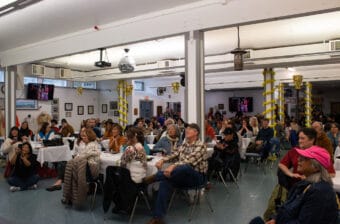
Filipino Community, Inc. members and guests gather at the Community Hall to celebrate Filipino American History Month on Oct. 7, 2023. (Photo by Tasha Elizarde/KTOO)

In the heart of downtown among the shops, you’ll find Juneau’s Filipino Community Hall.

If you’re just walking by, you could easily miss it – it’s not flashy. There aren’t many windows letting you peer inside, only a humble plaque announcing what it is. But for more than 50 years, it’s been a literal and figurative home to Juneau’s Filipino community.

A lot of Juneau’s Filipinos grew up in this building. But things have changed over the years. The building is getting older, along with many of the people who made this building their home. And now, many of their children and grandchildren have different priorities. 

Over the years, the Filipino Community Hall was a place for new arrivals from the Philippines to find a sense of community. They brought their kids there for celebrations and to connect with their heritage. 

Filipino Community, Inc. President Edric Carrillo and his father, Ed, pose inside the Community Hall. (Photo by Adelyn Baxter/KTOO)

“We all used to dress up and all were excited for our parties back then,” says Alex “Junior” Carrillo in the episode. “Now it’s hard to get kids to be involved or to want to even come and join parties anymore because it’s just a different – it’s just different. I don’t know how to explain it, but you know, they just didn’t grow up here anymore.”

The building still hosts weekly bingo nights and holiday gatherings, and lately Filipino Community, Inc. has made an effort to hold language and dance classes again. But membership is still down, and getting people to return to the hall will be critical to its survival.

Through elders who remember the hall’s beginnings as a humble pool hall to the new generation of leadership, Adelyn Baxter explores the origins of Juneau’s FilCom Hall and what it means to the community today.

Ed Carrillo holds a certificate recognizing his uncle Fred Carrillo’s assistance in buying the building that would become the Filipino Community Hall. (Photo by Adelyn Baxter/KTOO)

Mga Kuwento, Ep. 2: Filipino workers seek the American dream in Juneau

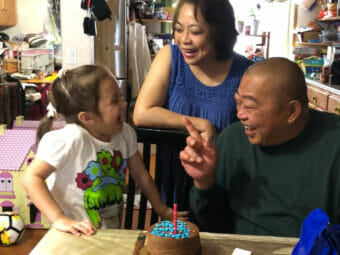
Janaea Dahl helps her lolo, or grandfather, Rodini Roldan blow out the candles on his cake while her grandmother Vicky Roldan watches on Father’s Day in 2020. (Screenshot courtesy of Kaye Roldan)

Filipinos, by nature, are very adaptable people,” Phillipine Honorary Consul for Alaska Rebecca Carrillo says in episode two of Mga Kuwento. “Our … collective goal, mostly, is to work and provide for our families. Those were the driving forces that propel us to pursue this proverbial American dream.”

That force still drives many Filipino workers in Juneau, including families like the Roldans. 

Rodini Roldan says the desire to support his family drove him to work hard. His wife worked night shifts as a nurse when their kids were little.

He worked hard, too, for 20 years in the Alaska Marine Highway system. His family motivated him as he worked his way up.

Phillipine Honorary Consul for Alaska Rebecca Carrillo in her office in Juneau. (Photo by Adelyn Baxter/KTOO)

“Started on the bottom, entry level, like cleaning the toilet, dishwashing pots and pans, and then tried to move up to the deck department,” he says.

Rodini eventually became captain of the MV Matanuska, a ferry in the Alaska Marine Highway System.

His cousin Rex Roldan had a similar progressions, retiring as a chief steward in 2014. Throughout his time in the ferry system, he was surrounded by people who also felt like family.  

But as we learn in the second episode of Mga Kuwento, that wasn’t the case when Filipino workers first came to work in canneries, mines and aboard vessels of all kinds.

As reporter Katie Anastas explains, a variety of forces have made labor one of the top reasons why Filipinos come to Alaska. And, the desire to provide for themselves and their loved ones has driven Filipino migrants to make a lasting impact on so many of Juneau’s industries today. 

Rodini Rodan before his retirement from the Alaska Marine Highway System. (Courtesy state of Alaska)

Mga Kuwento, Ep. 1: How Filipino migration shaped Juneau – and my family

Fely Elizarde (second from left), grandmother of Mga Kuwento host Tasha Elizarde, dances at a Christmas party hosted by Filipino Community, Inc. in Juneau with other elders, date unknown. (Photo courtesy of Tasha Elizarde)

Tasha Elizarde grew up listening to her mom greet friends in Tagalog, practicing Tinikling at community gatherings and walking the streets downtown, where she’d find food stands serving lumpia and adobo. 

Although it might sound like it, she didn’t grow up in the Philippines. Her hometown is almost 6,000 miles away, in a place called Juneau, Alaska.

So, how did she and so many other Filipinos end up building a home in this small corner of the U.S.?

A century before Elizarde was born, Juneau started growing into a thriving metropolis for migrants coming from all over the Philippine islands. Today, she’s just one of thousands of Filipinos living here.

On the first episode of Mga Kuwento, we explore two central questions of the series: how did Filipinos get to Juneau, and just as importantly, why do they stay?

Mga Kuwento Host and Executive Producer Tasha Elizarde guides us through the journey her family and so many other have taken to find financial security and a place to call home.

Lope Elizarde, father of Mga Kuwento host Tasha Elizarde, dances with his mother Fely Elizarde inside her home in Juneau, date unknown. Elizardes still own this house, where many of them lived when the family first migrated to Juneau, Alaska. (Photo courtesy of Tasha Elizarde)

Introducing Mga Kuwento — a podcast, museum exhibit and community celebration


For the better part of this year, our newsroom has been working on a podcast series about the Filipino experience in Juneau. We’re very excited to share it with you.

Mga Kuwento — “the stories” in Tagalog — is the brainchild of Executive Producer Tasha Elizarde. Tasha grew up in Juneau and spent a lot of time thinking about her own experience as a Filipino American in Juneau when she started working with us as a community engagement fellow. In order to tell that story and the larger story of how Filipinos came to be Juneau’s largest immigrant population, she conceived not only a podcast series, but an exhibit at the Juneau-Douglas City Museum recognizing the history and contributions of a community that is too often overlooked and a community event bringing Juneau together to celebrate.

Here is the inspiration behind Mga Kuwento in Tasha’s own words:

“I was young when my grandmother passed, but it’s through Mga Kuwento that I have learned how she scolded kids causing mischief in the Hall and helped Filipino families settle in Juneau when they first migrated. Her story, as well as the stories of the thousands who’ve shaped Juneau over the last century, are quickly being forgotten.

Mga Kuwento is an effort to dig up these stories and bring them to light again. Our podcast, exhibit and weekend celebration are a declaration of our dynamic identity, and an invitation for the greater Juneau community to celebrate our part in history.”

For the podcast, we delved into different aspects of the Filipino experience — the economic and social reasons people came to Alaska in the first place; the relationship between the Alaska Native and Filipino communities; the role of Juneau’s Filipino Community Hall as a place to celebrate and remain connected to home; efforts to maintain cultural connections to the Philippines today.

We’re extremely proud of this project, and grateful to Tasha for her leadership and vision. We’re also grateful to the many people who shared their time and experiences to help inform the project, and to the community partners who helped make it a reality.

I hope you’ll listen and join us in lifting up the stories of our neighbors and fellow Alaskans during Filipino American History Month.

Here are the dates to remember: 

NEW PODCAST LAUNCH | Oct. 6: The newest KTOO podcast, Mga Kuwento, premieres. Listen on your favorite podcast app or find it on ktoo.org.

EXHIBIT OPENING | Oct. 6 from 4 to 7 p.m.: An exhibit showcasing photos from the 1920s, parade and dance costumes, family mementos and art runs through November 22 at the Juneau-Douglas City Museum. Join us for a First Friday celebration featuring Filipino desserts by local chefs.

COMMUNITY CELEBRATION | Oct. 7 from 12 to 5 p.m.: The entire community is invited to join Filipino Community, Inc. for food incorporating Filipino flavors, cultural workshops, live music and a historical installation at the Filipino Community Hall, 251 South Franklin Street.

Site notifications
Update notification options
Subscribe to notifications