Tasha Elizarde

KTOO

Tongass Voices: Kushx̱eet.éesh/Kaasgéiy Bowers on walking the path to identity

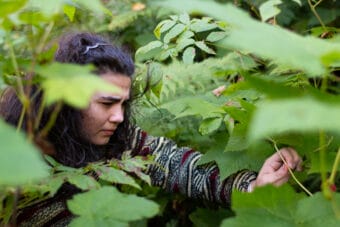
Kushx̱eet.éesh/Kaasgéiy Bowers peeks under leaves for thimbleberries near Basin Road on August 23, 2024. (Photo by Tasha Elizarde/KTOO)

This is Tongass Voices, a series from KTOO sharing weekly perspectives from the homelands of the Áak’w Kwáan and beyond.

Kushx̱eet.éesh Bowers, also known as Kaasgéiy, was 5 when he moved to Juneau to grow closer to his Native identity. He’s 18 now, and hiking along Basin Road recently, Bowers talks about harvesting and his path to identifying as a two-spirit person.

Listen: 

This transcript has been lightly edited for clarity.

Kushx̱eet.éesh/Kaasgéiy Bowers: My name is Kaasgéiy or Kushx̱eet.éesh. I’m Shangukeidí of the Eagle moiety. My people come from Klukwan and Angoon and the L‘eeneidí are my grandparents and my great grandparents people, my outer shell.

I moved to Juneau on my fifth birthday. And I lived between two homes of my mom and dad. My mom was very, she was very supportive with us being involved in our culture. And the whole reason we moved to Juneau was so we could learn our culture. So she involved us in dance groups, she tried to enroll us in TCLL (Tlingit Culture Language Literacy program), she took us fishing, berry picking. Since I was five, I’ve gone berry picking. And she always took me on her hikes before I could even walk in a small backpack, and I got to eat the tallest berries! It was the best. 

Kushx̱eet.éesh/Kaasgéiy Bowers harvests green yaana.eit, or cow’s parsnip, near Basin Road on August 23, 2024. He uses the plant to make solid perfume in a process called enfleurage. (Photo by Tasha Elizarde/KTOO)

My interest in plants peaked in high school when I learned the importance of living off the land and the full cycle of reciprocity that comes with it. I feel harvesting for me is a huge part of my cultural identity and helps me bond with other Native people. Also, when you open your freezer and it’s full, it fills your heart, just…not even eating yet! It’s my favorite.

But there’s all the brown yaana.eit that got the most sunlight. Up there is where the green yaana.eit is, and right next to it is thimbleberry. It’s a late summer berry, it has no real body of its own. It actually collapses in your hand. Mm. 

When I first discovered the term two-spirited, I think it was 2022, at Alaska Federation of Natives, AFN. There was, led by a two-spirited person. And that was the first time I’d ever encountered it. I was maybe 15, 16? And I didn’t know – I thought it was only for down south Native people, so I didn’t for a long time, I wouldn’t use the term and I wouldn’t identify under it, even though maybe it was set aside for all Native people. 

Before I graduated, I was like, well, I do feel actually very akin to having a female and male spirit within my body. I hold reverence for many of the feminine figures who played a huge role in my life, in the development of well, myself as a person. I don’t ever want to stop identifying with my female Lingít name out of respect and recognition of that. But very often, I want to be seen as male, always. And instead of Kaasgéiy, I might legally change my name to Kushx̱eet.éesh, so then again, I can step into that. 

Now, I serve male role in ceremony, but when I was younger, it was strictly female role that I served. And now I’m just learning to dance the way a guy would. And you can still see me, I look more like a dying ptarmigan, but learning is how it is. You watch, you see, and you repeat. 

I want to provide more resources for our community, especially maybe queer Native people, because it is hard. It’s huge, especially for a younger person who may not have control over every aspect of their life. Maybe, if I talk about it more often, and more people hear it, one of them could be a young, 16-year-old who only saw it once at a council meeting. And maybe they, too, will feel that they can identify with that.

Kushx̱eet.éesh/Kaasgéiy Bowers shares freshly picked thimbleberries above Basin Road on August 23, 2024. (Photo by Tasha Elizarde/KTOO)

Tongass Voices: George Gress, Joseph Galgano and Bryan Bolaños on musical craftsmanship

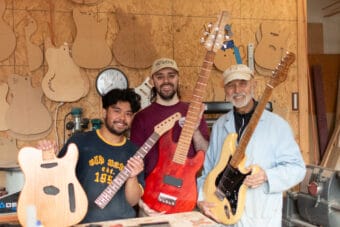
George Gress and Joe Galgano play their handmade guitars together in Gress’s workshop on April 6, 2024. (Tasha Elizarde/KTOO).

This is Tongass Voices, a series from KTOO sharing weekly perspectives from the homelands of the Áak’w Kwáan and beyond.

Nestled between the tall trees of the Mendenhall Valley, George Gress makes guitars in his woodshop. He’s been making them for the past decade, but in the last few years he’s brought on two ambitious students.

On Saturdays, Joseph Galgano and Bryan Bolaños bond with Gress over wood flames and handmade instruments.

Listen: 

This transcript has been lightly edited for clarity.

George Gress: This. This is right where you want it. This is, but the profile is not yet. So you don’t, you don’t want to go any, you don’t want to grind any more of this off. So, let me make a little pencil mark…

George Gress. And I’ve been here a lifetime, about 35 years, and started making guitars 10 years ago. And have gradually been able to mentor and help some other guitar makers get started. 

Jim Weindorf and George Gress advise Bryan Bolaños after sanding his first guitar neck on May 25, 2024. (Tasha Elizarde/KTOO)

Feel right here? That’s flat. You don’t want that flat. So what you’re going to be working on is, just like this. You’re just going to go back and forth a lot.

Bryan Bolaños: I’m Bryan Bolaños. I grew up here in Juneau, originally from the Philippines. I’m a self-taught musician and artist, and I do like a million things, and this is one of them. 

This is my first guitar build. And I think about like two years into learning the guitar, I was looking at luthier colleges. Luthier is like, what this profession is, making six string instruments, or stringed instruments. And I was like, looking into it, and it was like 20 grand for tuition.

Joseph Galgano: And then you gotta stay there for like five months.

Bolaños: Yeah, but then I just messaged George, and he just got me in right away, and just like, now I’m doing it. So I didn’t need to go pay a crazy tuition, and then I just get to hang out with some cool people and make instruments.

Gress: He hasn’t seen my bill yet. 

Bryan Bolaños, Joseph Galgano, and George Gress hold guitars in various working stages at Gress’s woodshop on May 25, 2024. (Tasha Elizarde/KTOO)

Galgano: Bryan, like thought he had to earn his place here first. And he’s like, ‘I can clean up, and I can do this, and I can do that.’ And George and I were like, ‘What are you talking about? Just pick some wood and get going!’

Yeah, I’m Joseph Galgano. I moved to Juneau in 2018, and I make guitars and bass guitars under the name Intrepid Guitars. When I was in college, I always wanted, like, a custom guitar, but it just felt really unattainable. And like custom guitars are like, if you go to Fender Custom, it’s like $3,000 to $4,000. And I was just like, ‘why don’t I just try to make my own guitar?’ And then, that’s how it started. And I was, I was doing it, but being under George’s mentorship really, really expedited the process, and now I have a shop in my garage, and I’m almost, almost self-sufficient. Almost.

George Gress observes as Joe Galgano cuts a plank of bird’s eye maple into a fretboard on May 25, 2024. (Photo by Tasha Elizarde/KTOO)

Bolaños: Being a musician, you know, ourselves, like we know how we want it to sound and how it, how we want it to feel.

Galgano: That’s probably been my favorite part, seeing the guitar put together and hearing how it sounds, because each one sounds different. You know, you put the work into it, so kind of have a connection to it. 

Bryan, we cut his, it was just a block of wood, and we cut it into his guitar shape. And I saw Bryan, like, getting excited. He’s like, ‘Oh my God, it’s an actual guitar.’ And I was like, so this is how George feels. I was like, I was like, I could see why he likes it so much. 

Gress: Yeah. Yeah. 


Tongass Voices: Diosdado Valdez on finding family away from home

Diosdado Valdez looks out on the view of Gastineau Chanel. (Photo by Tasha Elizarde/KTOO)

This is Tongass Voices, a series from KTOO sharing weekly perspectives from the homelands of the Áak’w Kwáan and beyond.

Every summer, the docks of downtown Juneau are packed with tourists. Among the visitors are people like Diosdado Valdez, who prepares the onboard entertainment for one of the cruise ship companies. Valdez has been coming to Juneau for over 30 years, and in that time, he’s found another family off the ship.

Listen: 

This transcript has been lightly edited for clarity.

Diosdado Valdez: Yeah, I am Diosdado, just Diosdado Valdez from the Philippines. Yeah, we are in a cruise ship in Juneau. And, you know, I love Juneau. I’ve been coming here since 1993. 

I have a very good friend. He was my friend at home. He asked me if I want to come to work with him, also. So I said, ‘why not?’ At first, I said, ‘only one contract.’ But then when I started, then I realized, this is the job I wanted. 

I am a production manager, and I’ve been working for this company for almost 32 years now. We are in charge of the show. If we have a comedian today, so that’s for the night. And on the daytime, there are daytime activities that we need to do. 

I go home after each contract in the Philippines. I live in Mindanao, that is in Bukidnon. I work for six months, and then get to go home for two to three months, then back to work again. 

When I started here, there is this oriental restaurant there, and the owner of that became my friend. Every time I get to Juneau, I do the dishwashing because I want, I just like to be with them. And he loves that, too. And every time I come back to the ship, I get food. He gave me food because he owns the restaurant. Play billiard, and karaoke. You know, karaoke is the most fun. That’s all I want to have when I’m in Juneau, just to see my friends.

Tasha Elizarde: Can you tell me about the first friend that you made when you started working on the cruise ships?

She is a local. We just met like, walking on the street. They kept asking me to go with them on that tram. I said, ‘Can we do it next time?’ Until this time, we haven’t been there. Yes, for years now. I admit that maybe I’m lazy. 

Since then, until this time, we are friends. Her son is my godson. And I love coming back here because of the people in Juneau. Hospitable, nice, friendly. The Juneau family is my family.

Tongass Voices: Hans Javier on celebrating the Fourth with Filipino flare

Hans Javier keeps the drummers of Juneau Ati-Atihan on tempo as they walk the streets of downtown Juneau for the annual Independence Day parade. July 4, 2024. (Tasha Elizarde/KTOO)

This is Tongass Voices, a series from KTOO sharing weekly perspectives from the homelands of the Áak’w Kwáan and beyond. 

Every year on July 4th, drums awaken the streets of downtown Juneau. This iconic sound is Juneau Ati-Atihan, a musical marching group that brings the Filipino festival of the same name from Aklan to Juneau. 

One of the lead drummers, Hans Javier, has participated in the Independence Day parade since he was a kid. Twenty years later, Juneau Ati-Atihan is his way of giving a shoutout to his culture, while spending quality time with his family. 

Listen:

This transcript has been lightly edited for clarity.

Hans Javier: First name Hans, last name, Javier. What we are doing today is, we are drumming for the parade representing specifically my Filipino culture from Aklan, Aklanon, and we are drumming for Ati-Atihan. 

Ati-Atihan is a festival, it’s generally like a week long. It honors the infant Jesus. It’s our saint, it’s Santo Niño. So primarily, the festival is celebrated for religious purposes. And you know, we do this back home in the Philippines on an annual basis. So, you know, doing it on Independence Day is a great way to represent our culture.

I watched my uncles and older cousins do this, and I always wanted to enter not knowing that, you know, they were open to me learning. And then one day, I believe it was, uncle Ed asked me if I wanted to join. And I think I was maybe 11 or 12 at the time, and ever since I’ve been doing it.

I am one of many leads. I’ve played all drums, from bass to snare. I was primarily a snare lead. We bought a new quad, so I switched over to the quad. Most importantly, my role as a quad is to make sure people stay in tempo. But my primary role overall is to make sure everything’s organized – drummers are present, organized formation, and yeah.

Hans Javier to the drummers: Ready! Start banging!

I feel like we bring flavor, and not to kind of downplay the rest of the parade, but you know, I feel like every time we pass through a certain area, you know, everybody gets up from the curb. Instead of waiting for candies, you know, they’ll get up and dance with us. We welcome people to jump in where they’re at and come dance with us. 

Funny story, last year we had, I guess my drummers were banging so hard we broke like, four drums last year. 

Yeah, when we pass a certain area, specifically like Marine Park and the Filipino Community, people tend to play louder and faster, and that’s where people generally break their drums.

I’m very close with my family, I’m very close with my cousins. And as we get older, it’s a lot harder to see them. But everybody, you know, around this time of year really makes time out to participate. And a lot of these cousins I don’t see until – and keep in mind, we live in Juneau, small town, right? – but a lot of these cousins I don’t see until, like, a month out of July 4th. 

So it’s a great time for us to kind of reconnect and, you know, be a family. I really love that part about it.

Juneau Ati-Atihan finishes their route in Juneau’s annual Independence Day parade after having won “Best in Parade” for 2024. (Tasha Elizarde/KTOO)

Tongass Voices: Sakoon Donedin Jackson on re-indigenizing her life

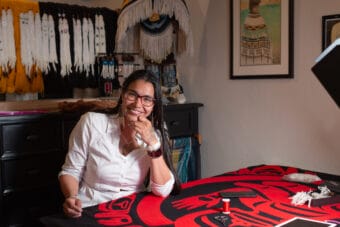
Sakoon Donedin Jackson at Wooshkindein Da.áat Lily Hope Weaver studio, where she worked on the Emergence Robe for SEARHC on June 4, 2024. (Tasha Elizarde/KTOO)

This is Tongass Voices, a series from KTOO sharing weekly perspectives from the homelands of the Áak’w Kwáan and beyond. 

Sakoon Donedin Jackson is a Chilkat weaver from Alberta, Canada who began her practice during the COVID-19 pandemic when she took classes online with Juneau’s Lily Hope. Now, Jackson is the featured resident artist at Wooshkindein Da.áat Lily Hope Weaver studio, where she has been working on a woolen button robe and teaching weaving classes for the first time. 
KTOO caught up with Jackson before she finished teaching her first weaving class the day before Celebration 2024 began.

Listen:

This transcript has been lightly edited for clarity.

My name is Sakoon. In English, I’m known as Donedin Jackson, and I am a child of the eagle moiety. And my father’s mother is Kukhittan from inland Deisleen, and my mother’s father is German. 

So, we are at Wooshkindein Da.áat Lily Hope Weaver studio, and I am currently the featured resident artist in the studio, for the time being. And I have been honored with the opportunity to work on a button robe, which is a very rare opportunity, since Lily doesn’t specialize in our woolen button robe. 

So this is the Emergence Robe, and it was commissioned first by the SEARHC medical organization 30 years ago from Lily’s mother, Clarissa Rizal. So, SEARHC organization uses this robe for patients who are transitioning from this world to the next. And so the families can request the use of this robe up to a week before they expect their family to pass, and it gets laid on their bed to aid with their transition. I am lucky enough to be here in the studio as Lily’s apprentice and working on getting that completed. 

I actually, this is my very first opportunity to work on a full size button robe for Lily, and so I get to really do some true apprentice work. But I actually came to the weaving through Lily when she went online during the pandemic. I got laid off from my government job due to said pandemic and I decided to re-indigenize my life. And I began learning Lingít, our traditional language. And the language led me to the weaving, and I have been doing nothing else ever since.

So the Goldbelt Heritage Foundation and CCHITA, Tlingit and Haida Council, has partnered together to bring me to the traditional territories to offer some weaving workshops. Because two years ago, Lily decided I was going to teach, even though I was like, “I’m not ready!” She said, “Yes, you are.” And she gave me the boot.

And so this is now, officially, I have been teaching workshops starting this last year. And so we are going to be completing my very first weaving workshop with Goldbelt. And we’re weaving the side border of a child-sized Chilkat robe to be turned into a piece of regalia for a headdress. 

Oh, it has been just absolutely delightful. And it’s been really quite a teaching experience, or a learning experience, doing the teaching, just identifying people’s understanding, who has taught them before, where they’re at and how to meet them there and bring them all together forward, collectively. And so it’s been a wonderful reconnecting opportunity to be here in Lingít Aaní and Áak’w Kwáan territory.

Tongass Voices: Nick Alan Foote on coming home for Celebration

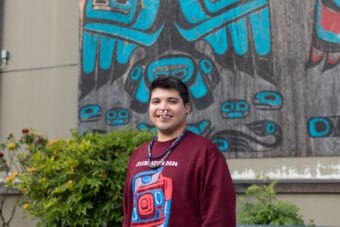
G̱at X̱wéech Nick Alan Foote, whose art was chosen to represent Sealaska Heritage Institute’s Celebration 2024, wears a sweater with his piece “Sacred Embrace” at Village Street in Juneau on June 6, 2024. (Tasha Elizarde/KTOO)

This is Tongass Voices, a series from KTOO sharing weekly perspectives from the homelands of the Áak’w Kwáan and beyond. 

Last week was Nick Alan Foote’s first time at Celebration in almost two decades. In the time he’s been away, he’s made a home in Seattle, left a job in corporate graphic design, and become a full-time Lingít artist alongside his sister, Kelsey Mata Foote. His formline piece, “Sacred Embrace,” was chosen to represent this year’s Celebration. The theme was “Together We Live in Balance.”

He performed at Celebration with the Sheet’ka Ḵwáan dancers, who honored the 50 year anniversary of the Sitka Native Education Program, during their performance at Centennial Hall.

Listen:

This transcript has been lightly edited for clarity.

My name is Nick Foote, Nick Alan Foote. My Lingít name is G̱at X̱wéech. I’m kind of from all over Southeast Alaska. I’ve lived in Juneau, Ketchikan, Sitka and Klawock in the summer. And I currently live in Seattle, but I’m up here for Celebration this year. 

My mom is in Arizona, and my sister’s in Texas, and my grandma is in Ketchikan. So everybody’s spread out, and it’s hard to get everybody together. And we are joining a dance group that we used to dance with in Sitka — the Sheet’ka Ḵwáan dancers. 

Yeah, so the piece I created for Sealaska Heritage Institute’s celebration this year is “Sacred Embrace.” On the outside, there’s a spirit embracing a human, and within that is a raven and an eagle. This represents tradition and culture and our connection to it. And then within it, in the very center, at the heart of it, is a salmon, which represents the connection that Alaska Native people have to the environment and the land. 

My parents always kept a lot of Alaska Native artwork around the house. My Aunt Kathy is an artist, and she would give us a lot of artwork. It was always on our walls. So I would just try to mimic and trace the shapes. And just, that was definitely, you know, the starter, the kicking off point into formline. 

But I also was just being exposed to it through the Johnson O’Malley program. I was also part of the Sitka Native Education Program, so I had a lot of exposure to the artwork because we would make our own regalia. So we would sew on, you know, clan crests to our robes. And by the time I got to college, I was learning Adobe Illustrator and Photoshop, and so I kind of took what I knew about formline design and started bringing it over into the digital aspect.  

I think I really started to take formline design seriously as like a career when I moved to Seattle because I kind of got homesick a little bit for, you know, Alaska. And so I started drawing a lot, creating my own designs to kind of cure my homesickness.

It’s something that I feel like I’ve always been pulled to, but it just had to slowly evolve into making that leap from graphic design corporate world to making my own art. 

I would say, just keep drawing. That’s really…if you love it, do it every day, draw what you love. There’s a place for you in the creative world, and your art.

Site notifications
Update notification options
Subscribe to notifications