Celebration

Combat veterans find solace in weeklong canoe journey to Juneau for Celebration

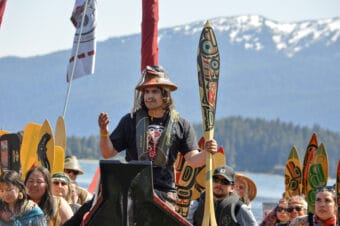
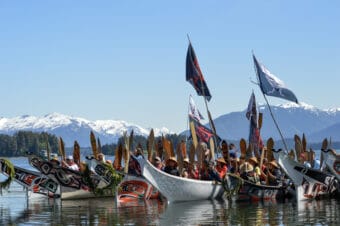
Paddlers in the veterans’ canoe (forefront) wait to land in downtown Juneau on June 4, 2024. (Colette Czarnecki/KSTK)

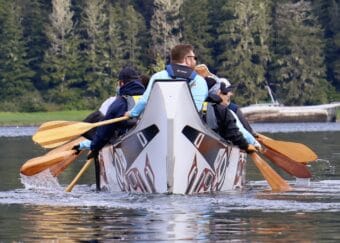
About 70 people in six canoes paddled north from Wrangell to Juneau last month for Celebration, a biennial cultural gathering that celebrates Southeast Alaska tribes.

The canoe journey to the event took a week, and veterans of war paddled one of the canoes. Many of the vets found solace during the expedition, where they were able to be together.

By Tracy Arm, a fjord about 70 miles north of Petersburg, flames crackled while a large group of paddlers sat around a campfire. People said gunalchéesh and dedicated songs  to the veterans, who introduced themselves and briefly spoke about their position in the military.

Dennis Jack, one of the founders and a previous president of Xheighaa Warrior Veteran Canoe Journey Inc., was one of the vets who spoke.He said the organization started back in 2015 when he visited his friend, Doug Chilton, who organizes canoe journeys with the One People Canoe Society.

Jack asked him if there was any representation with the veterans during the journeys, and Chilton replied no. He encouraged him to start an organization.

“It was three months later where I posted on Facebook that we have a veteran canoe journey taking place from Angoon to Juneau, and we’re looking for paddlers,” Jack said. “Maybe 20 minutes later, after it was posted, phone calls started coming in.”

Eight veterans participated during the first canoe journey in 2016. Two years later, there were 27.

“The purpose of the veteran canoe journey was so that we can help other combat veterans cope with PTSD and suicide, because we had been losing one veteran every 22 minutes to suicide,” Jack said.

He said the canoe journey is what they call a healing journey, where participants get in touch with their culture, ancestry and process personal concerns.

This year, 28 veterans paddled.

Dennis and Roberta Jack at the soft landing in Thane on June 3, 2024. (Colette Czarnecki/KSTK)

“There are others that are paddling in memory of one of their brothers or sisters or auntie or uncle who were killed in action, either in Iraq, Afghanistan, or even Vietnam,” Jack said.

Jack said that the journey has helped him deal with his own PTSD from when he was deployed to Iraq.

“I have a hard time on July 4 because of all the fireworks, and a lot of the really loud fireworks,” he said. “It sounds like a cannon or a mortar that’s going off.”

To him, it sounds like war. He said there were several times in Iraq where he’d be in the middle of a firefight, and his seven man recon unit would have to split up and meet at a rally point.

“There were times where….I’m sorry,” Jack said as he choked back tears. “There were times where our buddies wouldn’t make it and so we’d pack them out.”

“He would have loved to be on this journey”

His wife, Roberta, has witnessed his PTSD and helps him deal with it. She joined him on this year’s journey.

“He’s been asking me to come, how many years? And I kept telling him no,” she said. “I don’t know what it was about this year. I finally told him okay, I’ll go. This is all pretty amazing.”

Roberta said it won’t be her last — she has two brothers who fought in Vietnam. One lives in Angoon, and they lost the other in 2015. She said he never got the help he needed.

“He just drank and drank and drank,” she said. “His last couple of months or so, he started talking to us about what he went through.”

She said she’s thinking of him while on this journey.

“I know if he was here, he would have been on this. He would,” Roberta said. “He would have loved to be on this journey.”

Paddling with other veterans helps her feel less alone

Another veteran, Bethany Remi Onibokun served in Afghanistan and lives in Juneau. This is Onibokun’s third canoe journey to Celebration. She said paddling with other veterans lets her realize that she’s not alone, and other people are going through tough times like her.

“Things progress, and sometimes healing takes a long time,” she said. “I feel like every time I get on the water is like something gets a little bit better.”

Val Cooday (left) with her daughter, Bethany Remi Onibokun, in downtown Juneau on June 4, 2024 for the canoe landing before Celebration. (Colette Czarnecki/KSTK)

The journey helps her take focus off her troubles. She said her mom, Val Cooday, heard about the journey through Southeast Alaska Native Veterans.

“She thought it might be good for my PTSD and my other issues that I was going through, like my legal problems and my mental health issues and my help with my physical home,” Onibokun said. “They thought that it would be a good way to get me back outdoors.”

“It’s a spiritual, cultural, reawakening back to the culture”

Val Cooday served in Vietnam with the U.S. Army and also lives in Juneau. She joined her daughter on this year’s canoe journey, which is the second one she’s participated in. Her first one was in 2018.

Cooday said it’s inspirational — where the Tlingit, Haida and Tsimshian people are going back to the canoe.

“It’s the culture, the songs, the stories, the people, the humor, everything,” she said. “It’s a spiritual, cultural, reawakening back to the culture.”

As for the weather? It rained for most of the trip, with little spurts of sunshine sprinkled in. But it didn’t discouraged Cooday.

“The weather hasn’t been great, but that’s okay. It’s beautiful,” she said. “The area’s spectacular. The sights are spectacular. So it’s a beautiful journey, really. And for those of us, we grew up here in Southeast. We are used to the rain, so I’m not traumatized by rain.”

Sobriety in the canoe

The captain of the veteran’s canoe, Ketchikan resident Tim Flanery, served three years as an electrical mechanic in the military during peacetime, between 1998 and 2001.

“Gaaná aya yáada yóo duwasáakw. Yeíl naax xat sit.ee, Gaanax.adi xat sit.ee, Teikweidi yadi aya xat, L’awaa kwaani aya xat,” he said. “That means Tim Flanery in Tlingit.”

(I am of the Raven moiety, I belong to the Gaanax.adi clan, my Grandfather was Teikweidi, I am from Klawock.)

Tim Flanery on June 3, 2024 in Thane, where canoes soft landed. (Colette Czarnecki/KSTK)

This was his fourth Paddle to Celebration as a skipper — or captain. He said he didn’t have a reason — or a purpose — to paddle the first time he was invited to. He wasn’t sober before that first journey, but that changed.

“They said it’s a sobriety event, and I was looking for something different,” Flanery said. “I just really love it. How it brings all the people together — Native, non-Native, people who are interested in a different way of life.

He said his spirits are up and they’ve got a good crew this year.

“It’s an amazing event that brings us together and allows me to feel more connected to my ancestors,” Flanery said. “The way of life that they lived, you know, camping along the side of the beach.”

The group wasn’t able to paddle every day because of rough weather, but Flanery said he loves seeing all the wildlife, like killer whales, seals and eagles anyway.

“It’s a nice break away from civilization,” he said. “But I think I’m missing a shower now.”

He said no one’s complained, so he thinks he’s O.K.

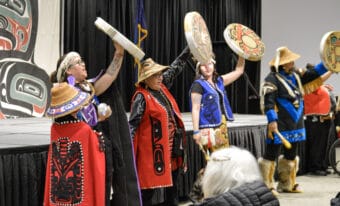
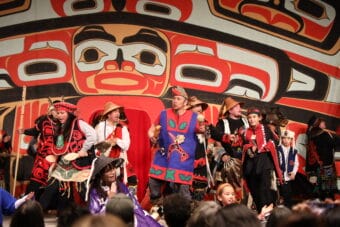
When he and the other veterans got to Celebration in Juneau, they joined each other with song and dance on stage.

New film documents local play reimagining Macbeth through Lingít lens

Jake Waid as Macbeth and Richard Atoruk as Soldier in Perseverance Theatre’s “Macbeth.” (Photo by Katherine Fogden/Smithsonian National Museum of the American Indian)

Last Thursday’s show at Juneau’s Goldtown Nickelodeon began with a blood-splattered formline title card on the screen. It read: “Macbeth through Alaskan eyes.” 

Beating drums marked the entrance of the three witches. They danced and slinked across the screen wearing masks that showed the barred teeth of a shape-shifting otter from Lingít folklore. 

As flashing stage lights evoked the stormy night that sets the play’s murderous plot in motion, actress Lily Hope delivered the familiar first line — when shall we three meet again? 

“Xeitl tóox’, séew kaa ch’u k’eeljáa gé,” Hope said — in thunder, lightning, or in rain? 

That line opens every performance of Macbeth. But the translation, and the elements of Lingít culture throughout, put a twist on Shakespeare’s tragedy. 

The production first ran at Juneau’s Perseverance Theater in the early 2000s. It even had a 2007 run at the Smithsonian Museum of the American Indian in Washington, D.C. 

“I remember going in the subways in D.C. speaking our lines together, in packed subways,” said Juneau actor Jake Waid, who played Macbeth. “And it was just like — to be in the nation’s capital, speaking our lines around the city — it was just a powerful experience to just feel like we were claiming the play.”

Recordings of the play were originally captured during those performances, but for years the footage was stored away in the Sealaska Heritage Institute archives. Now, it’s finally been adapted for the big screen as a film presented for 2024’s Celebration.

Actor Jake Waid during Macbeth’s coronation in a performance at the National Museum of the American Indian in 2007. (Photo courtesy of the Sealaska Heritage Institute archives)

Director Anita Maynard-Losh came up with the idea for the play after spending more than a decade living in Hoonah. She’s not Alaska Native herself, but the Shakespeare expert said she saw similarities between Lingít culture and the Scottish values portrayed in the play.

“The Scots and the Lingít were extremely feared for their fierceness and their warfare” Maynard-Losh said. “And they had a deep connection with the supernatural. And they had a cultural value of putting the good of the group ahead of any one individual.”

Maynard-Losh says valuing community is a virtue that prevails in Macbeth, and one that’s infused into the Lingít translation, which was originally done by the late elder Johnny Marks Kooteix’téek. While most of the characters deliver their lines in Lingít, some of the play, including most of the soliloquies and clandestine meetings between Macbeth and his sinister wife Lady Macbeth, are in English.

“We decided that we were going to lean into the metaphor by having the people who were adhering to that cultural value speak in Lingít,” she said. “And when the people were not adhering to that value, and going for personal ambition, they spoke in English.”

But delivering the rest of the lines in Lingít was a challenge. Though all of the actors are Alaska Native, and many are Lingít, none were fluent speakers. 

Waid said watching his performance brought back memories of rehearsing the difficult stanzas over and over with his castmates.

“It feels like a miracle that we got up on stage and we got the words out,” he said.

The play also incorporates cultural elements beyond language. The costumes and set feature formline designs. When Macbeth is crowned king, he dons a Ravenstail robe and a headdress adorned with ermine skins. When Banquo’s ghost haunts his killer Macbeth, he wears a raven costume. 

And when the righteous Macduff finally vanquishes Macbeth, they face off with shields that are drums and swords that are drum sticks, punctuating each blow. 

But in a lot of other ways, it’s just like any other Macbeth production, right down to superstition. Macbeth, in the world of theater, is often considered a cursed play. Hope recalls how, when they were putting the original production together, stage lights that fell from the ceiling and stage pieces that broke constantly felt like bad luck. 

“I think it was four-fold with the Lingít language being 10,000 years old, where we were like ‘Oh, let’s pull out some really dark energy in here,’” Hope said.

For Waid, all the Lingít elements enhance the play for new audiences and actors without changing Macbeth’s core meaning. 

“It’s one of the great plays in the English language. This is part of our history too, as English speakers, and also as people who want to dig deeper into our own culture and find meaning,” Waid said. “We’re not relegated to just what people might think of as Lingít things.”

Sealaska Heritage Institute staff said they’re hoping to screen the film again later this summer.

Disclaimer: KTOO 360TV was contracted to produce television and online video coverage of Celebration. 

Tongass Voices: Nick Alan Foote on coming home for Celebration

G̱at X̱wéech Nick Alan Foote, whose art was chosen to represent Sealaska Heritage Institute’s Celebration 2024, wears a sweater with his piece “Sacred Embrace” at Village Street in Juneau on June 6, 2024. (Tasha Elizarde/KTOO)

This is Tongass Voices, a series from KTOO sharing weekly perspectives from the homelands of the Áak’w Kwáan and beyond. 

Last week was Nick Alan Foote’s first time at Celebration in almost two decades. In the time he’s been away, he’s made a home in Seattle, left a job in corporate graphic design, and become a full-time Lingít artist alongside his sister, Kelsey Mata Foote. His formline piece, “Sacred Embrace,” was chosen to represent this year’s Celebration. The theme was “Together We Live in Balance.”

He performed at Celebration with the Sheet’ka Ḵwáan dancers, who honored the 50 year anniversary of the Sitka Native Education Program, during their performance at Centennial Hall.

Listen:

This transcript has been lightly edited for clarity.

My name is Nick Foote, Nick Alan Foote. My Lingít name is G̱at X̱wéech. I’m kind of from all over Southeast Alaska. I’ve lived in Juneau, Ketchikan, Sitka and Klawock in the summer. And I currently live in Seattle, but I’m up here for Celebration this year. 

My mom is in Arizona, and my sister’s in Texas, and my grandma is in Ketchikan. So everybody’s spread out, and it’s hard to get everybody together. And we are joining a dance group that we used to dance with in Sitka — the Sheet’ka Ḵwáan dancers. 

Yeah, so the piece I created for Sealaska Heritage Institute’s celebration this year is “Sacred Embrace.” On the outside, there’s a spirit embracing a human, and within that is a raven and an eagle. This represents tradition and culture and our connection to it. And then within it, in the very center, at the heart of it, is a salmon, which represents the connection that Alaska Native people have to the environment and the land. 

My parents always kept a lot of Alaska Native artwork around the house. My Aunt Kathy is an artist, and she would give us a lot of artwork. It was always on our walls. So I would just try to mimic and trace the shapes. And just, that was definitely, you know, the starter, the kicking off point into formline. 

But I also was just being exposed to it through the Johnson O’Malley program. I was also part of the Sitka Native Education Program, so I had a lot of exposure to the artwork because we would make our own regalia. So we would sew on, you know, clan crests to our robes. And by the time I got to college, I was learning Adobe Illustrator and Photoshop, and so I kind of took what I knew about formline design and started bringing it over into the digital aspect.  

I think I really started to take formline design seriously as like a career when I moved to Seattle because I kind of got homesick a little bit for, you know, Alaska. And so I started drawing a lot, creating my own designs to kind of cure my homesickness.

It’s something that I feel like I’ve always been pulled to, but it just had to slowly evolve into making that leap from graphic design corporate world to making my own art. 

I would say, just keep drawing. That’s really…if you love it, do it every day, draw what you love. There’s a place for you in the creative world, and your art.

For Celebration’s lead dance group, the gathering was a chance to reconnect with coastal relatives

The Dakhká Khwáan dance group performs at Centennial Hall. June 6, 2024. (Yvonne Krumrey/KTOO)

Every year, one dance group is chosen to lead the procession of dancers that begins and ends Celebration — the biennial gathering of Lingít, Haida and Tsimshian people in Juneau. 

About 1,600 people in regalia paraded up Willoughby Avenue to the entrance of Centennial Hall last week. Some of the 36 groups danced to the beat of a leader’s drum and calls. Babies in button blankets sat on their parents’ shoulders. The dancers came to Celebration from across Southeast Alaska and beyond.  

The Dakhká Khwáan dance group led that procession into the hall — and back out on Saturday. The group’s name means “people of the inland,” and many of them came all the way from Canada for this year’s festival.

Yadułtin Marilyn Jensen leads the group. She said Celebration was a chance for inland Alaska Native people to reconnect with their coastal relatives. 

“Another big theme for us is the unity between the coast and the interior, because there is an artificial, you know — like a boundary between us,” Jensen said. “And so, so much of our journey has been about reconnecting with our relatives here.”

The group formed in Carcross in 2007, but its roughly 40 members are from across Lingít Aaní. Jensen said she remembers how she felt at the first Celebration the group performed at, 16 years ago. 

Yadułtin Marilyn Jensen leads the Dakhká Khwáan dance group in their performance at Centennial Hall at Celebration. June 6, 2024. (Yvonne Krumrey/KTOO)

“We were just a brand new group,” she said. “And you know, we came to Celebration just so unsure of ourselves, so scared, but you know, our people just lifted us up, encouraged us, supported us, loved us, and made us feel welcome.”

Jensen said leading the procession this year was a huge honor. 

“Never in our wildest dreams, ever thought that we’d be invited to be the lead group,” she said.

On the second night of Celebration at Centennial Hall, Jensen introduced a song the group wrote. 

“I don’t know about you guys, but we like to pick berries like nobody’s business,” Jensen said on stage. “So this song is in honor of our aunties, all our aunties, that take us out picking berries. So this is our song, and it’s also in honor of our relationship with the animals. So this is a song that honors our berries and our bears and our aunties.” 

Dancers — tiny and full grown — emerged from backstage and mimed berry-picking. Others, wearing bear pelts and masks, joined them and started picking their own berries. The people and the bears startled each other on stage, and Raven took the opportunity to swoop in for his own berries.

The Dakhká Khwáan dance group performs at Elizabeth Peratrovich Hall. June 7, 2024. (Yvonne Krumrey/KTOO)

That was one of several songs the group performed over the course of the week. You can watch videos of the group’s performances — and the rest of Celebration — on the SHI youtube channel.

Disclaimer: KTOO 360TV is contracted to produce television and online video coverage of Celebration.

Toddlers strut their Southeast Alaska regalia at Celebration

Tayana Copper-Jane Cavan Adamek walks across the stage at Centennial Hall during Celebration’s Toddler Regalia Review on Thursday, June 6, 2024. (Clarise Larson/KTOO)

Southeast Alaska’s cutest models hit the stage at Centennial Hall on Thursday for Celebration’s Toddler Regalia Review. Celebration is the biennial festival of Lingít, Haida and Tsimshian culture in Juneau. 

For many, it takes a lot of courage to get in front of hundreds of people and strut your stuff. But 4-year-old Bonnie Lewis said it was fun. 

“It feeled like I was proud that there was people watching me. And I was wearing this purse, and I also was wearing my moccasins. And I was wearing my blanket that my mama made,” she said. 

Bonnie and her 2-year-old brother, Marlin, came to Celebration this week from Kake, with their parents. Her mom, Chelsea, said this Celebration is especially sweet for her. 

“It’s just super special because I’ve come as a single person, but this is the first time I got to come up with my family,” she said. “So it’s really fun.”

And it’s her kids’ first time partaking in the Toddler Regalia Review. It’s one of the most – if not the most – beloved events at Celebration. This year, nearly 30 toddlers participated, all between the ages of around two and five. Some wore Chilkat blankets, cedar hats, or moccasins. Others wore Ravenstail headbands or dance tunics. 

In front of a crowd of hundreds, each toddler walked — or was carried — to the center of the stage at Centennial Hall. There, an emcee described their toddler-sized regalia, who made it, and what it meant. 

The review is a friendly competition – technically there are no winners. But, from the cheers and smiles in the crowd to the giggles and waves on stage, it’s safe to say that everybody won.

Disclaimer: KTOO 360TV is contracted to produce television and online video coverage of Celebration.

Mother and daughter’s spruce root hat wins Celebration’s juried arts show

Goosh-shu Haa Jennie Wheeler and Káakaxaawulga Jennifer Younger at the Native artists’ market at Celebration. June 6, 2024. (Yvonne Krumrey/KTOO)

A mother-daughter duo — a weaver and an engraver — won Best of Show at this Celebration’s juried arts show. Their winning entry was a spruce root hat called Dancing in the Summer Rain. 

At her table at the Celebration Native artists’ market, Goosh-shu Haa Jennie Wheeler said she was surprised to win. 

“I was totally shocked yesterday when we got the award, because I really was not expecting it,” she said. “They asked me to say something. I just lost it. I was too emotional.”

She wove the spruce root hat. Her daughter Káakaxaawulga Jennifer Younger wove light blue trade beads into the sides and engraved formline flowers on the hat’s copper top. Red beads line the crown and drip down the hat.  

Dancing in the Summer Rain by Káakaxaawulga Jennifer Younger and Goosh-shu Haa Jennie Wheeler on display at the Walter Soboleff Building. June 6, 2024. (Yvonne Krumrey/KTOO.

It’s not the first piece they’ve made together, but the copper crown was something Younger said she hadn’t seen in spruce root weaving before. 

“I think we both just get super excited about doing something new that we hope is still honoring tradition,” Younger said. “By doing, hopefully, fine weaving, proper formline engrave design, yeah — so we just kind of just did it.”

The name of the piece — Dancing in the Summer Rain — comes from the way those new design elements come together musically. 

“When I added those strings of beads on the hat, and I put it on my head, and just the sound it made — It wasn’t like a loud rattle, but it just sounded like the rain on a roof or something,” Younger said.

The hat also won the endangered arts category. Wheeler has been bringing new spruce root weavers into the practice for more than a decade now. She said she’s especially happy to teach students who come from the place that was known for the art two hundred years ago.  

“I always wanted to bring spruce root weaving back to Yakutat, because Yakutat was known for the best spruce root weavers in the 1800s, and we lost it for many years,” Wheeler said. “And now I have five students born and raised in Yakutat, young adults, and they are doing really good.”

Dancing in the Summer Rain and the other winning pieces from the juried arts show will be on display in the Nathan Jackson Gallery at the Sealaska Heritage Institute Walter Soboleff building until December. 

Disclaimer: KTOO 360TV is contracted to produce television and online video coverage of Celebration.

Site notifications
Update notification options
Subscribe to notifications