Celebration

Celebration set to kick off in Juneau

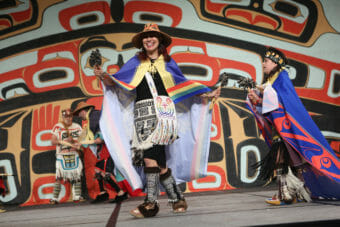
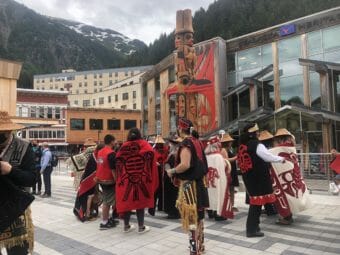
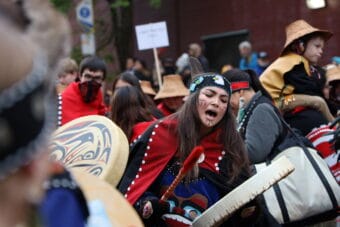
Naawéiyaa Tagaban, Lingít from Juneau, dances during a processional and grand entrance on Wednesday, June 8, 2016, near Juneau, Alaska. Celebration is a biennial festival of Lingít, Haida and Tsimshian tribal members put on by the Sealaska Heritage Institute. (Photo by Rashah McChesney/KTOO)

Celebration — the every-other-year gathering of Indigenous people in Southeast Alaska — kicks off Wednesday in Juneau.

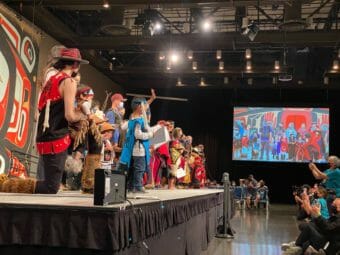
Through Saturday, Lingít, Haida and Tsimshian people will participate in dances, arts markets, cultural demonstrations and the ever-popular toddler regalia review.

This year’s theme is “Celebrating 10,000 years of cultural survival.” Sealaska Heritage Institute President Rosita Worl says the theme recognizes the many environmental, colonial, and pandemic-related challenges their people have overcome.

“We knew that we were going to survive that. I know our people suffered highly from it, but we still had the strong belief that we were going to survive and sure enough, here we are 10,001 years later and prospering,” Worl said

Indigenous people were disproportionately affected by COVID-19 in Alaska, accounting for nearly a third of the deaths from the virus. That included many elders and some of the last remaining Native speakers for several languages.

X̱’unei Lance Twitchell says more action is needed at the state level to help preserve Native languages.

“There’s probably 19 languages that are still going right now. And I think in about 10 years it will be down to maybe 10 unless we do something,” Twitchell said.

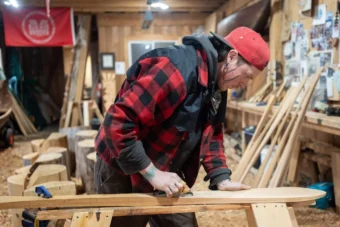
Official events begin with the dedication of SHI’s new Arts Campus. Worl says the facility will host classes aimed at preserving cultural practices and serve as the capital of Northwest Coast Arts.

“We’ve already had basket training classes there, we’ve had tin’aa training classes there, we’ve also had the box drum training,” Worl said. “So it’s not even formally open but our people are so anxious to use it that they’ve run in there, pushed things aside. And that’s just the beginning.”

A new 360-degree totem pole will also be unveiled Wednesday. Worl says it’s the first of its kind in Alaska and represents the cultural values of the three main Alaska Native groups of Southeast Alaska.

Disclosure: KTOO is under contract with Sealaska Heritage Institute to produce video coverage of Celebration.

Strict COVID protection measures planned for Celebration with Juneau cases on the rise

Celebration 2018 grand processional June 6, 2018, Juneau. (Photo by Adelyn Baxter)
Celebration 2018 grand processional June 6, 2018, Juneau. Celebration hasn’t been celebrated in person since then due to the COVID-19 pandemic. (Photo by Adelyn Baxter/KTOO)

It has been 40 years since the first Celebration, which was hosted to celebrate the survival of Lingit, Haida and Tsimshian cultures.

This year, the theme is Celebration 2022: Celebrating 10,000 Years of Cultural Survival. This will be the first time the event has been in person since 2018, and after two years in a pandemic, the term “survival” is even more meaningful. 

Sealaska Heritage Institute President Rosita Worl said that, especially before the vaccine, the organization was committed to keeping the community as safe as possible. 

“We saw how [the pandemic] was affecting our elders,” Worl said. “And so the elders became kind of a symbol, a critical symbol for us of the survival of our culture.”

Juneau’s COVID-19 case count has risen in the last two weeks, and the City and Borough of Juneau no longer manages health risks after closing down its emergency operations center last month. 

Worl said that this is something they’ve anticipated and planned for since the official decision back in January to host Celebration in person. 

“We’re monitoring those numbers very closely,” Worl said. 

The gathering has become a vital time for Southeast Alaska Native communities to connect, she said.

“Over 40 years, it is now significant for us to gather together to celebrate our culture,” Worl said. “You put that on top of all of these other events where we were not able to gather, and it becomes really important.”

Around 1,200 dancers are registered to perform, and Worl is expecting around 3,000 people to attend. This is smaller than the usual crowd of 5,000, but higher transportation costs and tight lodging options have prevented some from coming. 

To limit spread during the events, all staff will be tested daily, temperatures will be taken at the door of each event, and masks will be required. Moderators will enforce the mask requirement. 

How an art show was judged from a distance during virtual Celebration

Best of Show winner: Ch’áak’ Aanyádi (The High Caste Eagle) by Jerrod Galanin. (Photo by Caitlin Fondell courtesy of Sealaska Heritage Institute)
Best of show went to Jarrod Galanin of Sitka for a formline engraved copper vessel, traditionally used to hold seal or hooligan oil. (Photo by Caitlin Fondell)

This week marks the beginning of Celebration: An event that brings thousands of Native Alaskan people to Juneau every two years. But this year, the festivities aren’t happening in-person. They’re happening online, due to COVID-19.  That includes a Northwest Coast art show, where art pieces were judged from a distance. 

Deborah Head, or Aanutein as she’s known by her Tlingit name, is sitting in her car about a mile from her house in Craig. She drives into town to get better cell phone reception. It’s also how she got a wifi signal so she could evaluate digital pictures of artist submissions. 

“Going to a friends house and saying, ‘Can I sit in your parking lot and do some downloading?'” Head said.

Besides the technology issues, Head says it was extremely challenging judging the intricate creations, like a formline painted drum or a beaded Chilkat wall hanging, from afar. 

“We knew the biggest obstacle was going to be not being able to go to Juneau and hold the pieces,” Head said.

Sealaska Heritage Institute organizes the juried art show as a way to amplify and encourage Native Northwest Coast art. But in March, the organization had to pivot this year’s exhibit to an online format after news broke that Celebration would be held virtually. Artists were given the choice to pull out the work they submitted back in 2019. Twenty-six artists decided to still enter the competition — knowing their work would be experienced by a few online photos rather than the judges seeing it up close. 

Head says, as a judge, that was a lot of responsibility. She combed through photos saved on her laptop for hours. Then, she’d wake up around 4 a.m. and do it again.

“It was a lot of revisiting and revisiting,” Head said. “And when a piece is well done, it just jumps out at you.”

Head has had her own journey as an artist. She started out as the lone cedar bark weaver in Craig. She had to learn much of the technique herself. Eventually, she was able to take a class with famed Haida weaver, Delores Churchill. She recalls the class started early in the morning.

“By 10 o’clock, I was out behind a tree crying because it was frustrating because I can tend to be a perfectionist, and that never goes away,” she said with a laugh.

But Head mastered the Haida style of weaving. Now, she creates pieces on commission and sells items like baskets to galleries. Lately, she’s been interested in an endangered style of Tlingit root weaving. 

As for judging traditional art virtually, Head says she looked for meticulous details, creative flair and also authenticity. In the online show, there was a piece that exemplified that. You could see it was something special even through a computer screen: a spruce root basket woven by a beginner in British Columbia. 

“You could see that maybe the person was reared by an elder, an auntie, a grandma — something like that,” Head said. “I can’t wait to follow this person.”

That submission, by Marlene Liddle, was a division winner. In total, eighteen artists placed in the art competition or received honorable mentions. You can see the full list of Sealaska Heritage Institute’s Northwest Coast Juried Art Show & Competition winners here.


xx
Small Spruce Root Basket by Marlene Liddle. (Photo courtesy of Sealaska Heritage Institute)

First-ever virtual Celebration happens this week

Celebration 2018 grand processional June 6, 2018, Juneau. (Photo by Adelyn Baxter)

Without parades of dancers and a packed convention hall, this year’s Celebration will look very different.

Sealaska Heritage Institute’s board of trustees decided to postpone the four-day gathering until June 2021 due to the COVID-19 pandemic.

This year’s virtual Celebration theme is “Have Courage,” in reference to the pandemic that caused the in-person gathering to be postponed. Tlingit artists Donald Héendei Gregory designed this image with a warrior helmet and face shield to represent the strength Alaska Native peoples have always used to overcome challenges, with a devils club leaf in the background to symbolize traditional medicine and healing.(Image courtesy of Sealaska Heritage Institute)

The biennial event typically brings thousands of Alaska Natives from across Southeast and beyond to Juneau for all-day dance performances, fashion shows, arts bazaars and other events celebrating Tlingit, Haida and Tsimshian cultures.

This year, SHI put together the first-ever virtual Celebration instead. A four-day live broadcast will feature recorded dance performances from 2018 and new videos submitted by past participants.

The theme for this year’s Celebration is “Have Courage.” In addition to dance performances, the virtual events include the toddler regalia review, storytelling segments, a fashion show and a juried art show.

The show kicks off Wednesday night at 7 p.m. with a welcome and tribute to former Lt. Gov. Byron Mallott, who died last month. It concludes Saturday afternoon.

Viewers can watch the events on SHI’s Youtube channel and on 360 North. A full schedule of events can be found here.

Editor’s note: KTOO is under contract with Sealaska Heritage Institute to produce television and online video coverage of this year’s virtual Celebration.

49 Voices: Nellie Vale of Yakutat

Nellie Vale of Yakutat (Photo by Adelyn Baxter/KTOO)

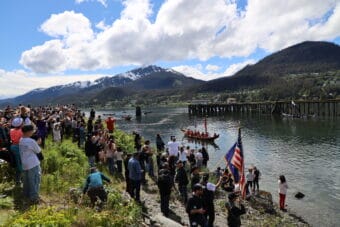
This week, Celebration 2018 kicked off. The festival is held every two years to celebrate Southeast Native culture, and it begins with canoes arriving into Juneau representing various tribes. This week we’re hearing from Nellie Vale who arrived in the Yakutat canoe. 10-year-old Vale introduced herself with her Tlingit name.

“My dad had me go on it once, and the first time I went on it was really fun. And also, I wanted to learn how our ancestors traveled and what it was like for them.”

“The first day we were on the canoe, it was super fun, and we only had to go nine miles. We practiced a bunch before we went, so we got to get there quickly because whenever we practiced, we tried going as fast as we can.”

“It was really fun. On the first night, we had to build a campfire. And there was one big campfire, and somebody’s socks got burned. It was so funny. Oh yeah, and somebody put their sweater by the fire, and it was literally steaming because it was drenched.”

“The first we camped out at my cousin Alejandre’s teacher that teaches kids how to carve. And he’s white, so that’s pretty good cause their trying to learn our culture.”

“The rest of Celebration … I’m probably just gonna be hanging out with my family when I have free time, and the rest of the time I’m going to be dancing at Centennial Hall and on the streets when we’re doing the parade. There’s a couple other places, I think. I forgot.”

“I think it’s just trying to keep our cultural spirit alive and making sure we don’t forget it. So I’m happy we get to do this every two years.”

Elders look on with pride as younger generations step up at Celebration 2018

Owen James poses with his daughter Leah Moss. James and Moss both came to Celebration 2018 from Hoonah. (Photo by Adelyn Baxter/KTOO)

Celebration 2018 came to a close on Saturday.

What began 36 years ago as an attempt to save Tlingit, Haida and Tsimshian cultures has become a vibrant reminder that Alaska Native traditions are alive and thriving.

In many ways, Celebration is a reunion. Indigenous people from all over Alaska, Canada, even Hawaii, come to Juneau every other year for the cultural festival.

Dancing along the parade route in downtown Juneau on Saturday, Owen James of Hoonah paused to hug friends in the crowd.

“Folks I haven’t seen in years. Maybe see them only once every two years,” James said.

This was James’ 17th Celebration. He only missed one.

“It feels great, because seeing all these younger generations pick up where we left off and to see and hear them singing the songs and drumming, and stepping up and taking the lead too, it’s awesome,” James said. “Makes you feel good inside.”

That’s significant, because there was a time when some feared their cultures wouldn’t survive.

Marlene Johnson, who spoke Friday on “A Juneau Afternoon,” said she was reluctant when she first heard the idea to host a cultural gathering for Southeast Alaska Natives. But she knew their cultures needed saving.

“It took a long time to get us to the point where we were able to convince the outside world that our culture is not bad, it was a thing of celebration,” Johnson said.

Johnson is the chair of Sealaska Heritage Institute’s Board of Trustees.

When Celebration first began, decades of cultural oppression and government schools had all but wiped out Native languages in the region.

Johnson said you never saw children wearing regalia or singing traditional songs in public just a few decades ago.

“When I saw those kids yesterday, the little boys from Yakutat, to see them dancing the way they did, I thought to myself, ‘Everything we’ve done the last 30 years has been worth it,’ when I see that,” she said.

Celebration brings thousands of people to Juneau every other year. It’s become one of the largest gatherings in Alaska.

Nearly every community in Southeast is represented on the main stage in Centennial Hall, where about 50 dance groups perform new and traditional songs.

Film screenings, traditional food contests, art shows, workshops and the ever-popular Toddler Regalia Review keep the crowds busy.

As efforts to revitalize Alaska Native languages continue, elders like James and Johnson can take comfort in seeing the younger generations take on a bigger role in Celebration each time.

James’ 11-year-old daughter Leah Moss has never missed one. She can’t wait for Celebration 2020.

“I just wish it would come more soon,” Moss said. “I don’t want to wait two years every time.”

Editor’s note: 360 North is under contract with Sealaska Heritage Institute to produce television and online video coverage of Celebration.

Site notifications
Update notification options
Subscribe to notifications