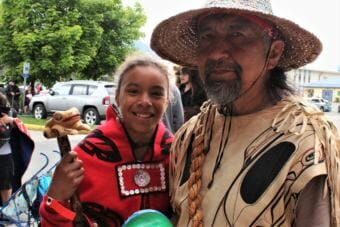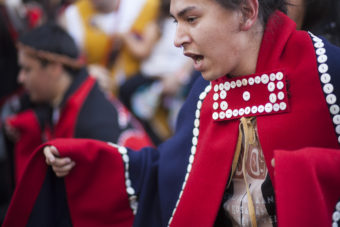
A collection of photographs from KTOO Public Media staff members during Celebration 2018.
Click on a photo to see a larger version and begin the slideshow.
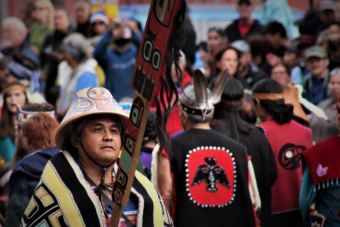
Various indigenous groups march and dance during a parade Saturday, June 9, 2018, in downtown Juneau, Alaska. (Photo by Tripp J Crouse/KTOO)
Jennifer Quinto marches with various indigenous groups during a parade at Celebration 2018 on Saturday, June 9, 2018, in downtown Juneau, Alaska. (Photo by Tripp J Crouse/KTOO)
Woodworking tools at the Yanyeidí Healing Kootéeyaa totem pole work site at Harborview Elementary School on 29, 2018. (Photo by Annie Bartholomew/KTOO)
Lead carver Yéil Ya-Tseen Nicholas Galanin of Sitka uses an adze to carve the 40 foot T’aaku Kwáan Yanyeidí Healing kootéeyaa totem pole at Harborview Elementary School on 29, 2018. (Photo by Annie Bartholomew/KTOO)
Lead carver Yéil Ya-Tseen Nicholas Galanin of Sitka selects tools to carve the 40 foot T’aaku Kwáan Yanyeidí Healing kootéeyaa totem pole at Harborview Elementary School on 29, 2018. (Photo by Annie Bartholomew/KTOO)
There were two categories for the seal oil: with and without crackling. (Photo by Elizabeth Jenkins/Alaska’s Energy Desk)
The judges get done scoring the seal oil with crackling. (Photo by Elizabeth Jenkins/Alaska’s Energy Desk)
Rosita Worl on stage at Centennial Hall during the food competition. (Photo by Elizabeth Jenkins/Alaska’s Energy Desk)
Traditional Arts Apprentice & Youth Mentor Shane Brown works on the Yanyeidí totem pole at Harborview Elementary School on May 29, 2018. (Photo by Annie Bartholomew/KTOO)
Wooden shavings cover the floor of work site at the Harborview Elementary School covered area on May 29, 2018. (Photo by Annie Bartholomew/KTOO)
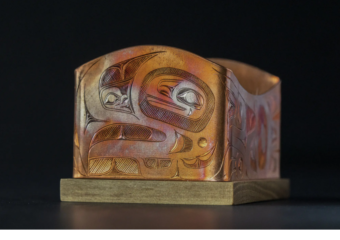
Apprentice carver Lee Burkhart cuts a two by three foot traditional copper shield or tináa to be fitted on the totem at Harborview Elementary School on May 29, 2018. (Photo by Annie Bartholomew)
Master carver Will Burkhart helps finish the totem in the final days of production at Harborview Elementary School on May 29, 2018. (Photo by Annie Bartholomew/KTOO)
Merritt Johnson paints Chilkat designs onto the 40 foot Yanyeidí totem pole at Harborview Elementary School on May 29, 2018. (Photo by Annie Bartholomew/KTOO)
Indigenous artist Merritt Johnson works alongside her partner Nicholas Galanin painting the 40 foot Yanyeidí totem pole at Harborview Elementary School on May 29, 2018. (Photo by Annie Bartholomew/KTOO)
Indigenous artist Merritt Johnson paints Yanyeidí totem pole at Harborview Elementary School on May 29, 2018. (Photo by Annie Bartholomew/KTOO)
Artist Sam Sheakley helps finish the 40 foot Yanyeidí totem pole at Harborview Elementary School on May 29, 2018. (Photo by Annie Bartholomew/KTOO)
Sam Sheakley selects his tool while carving a totem Harborview Elementary School on May 29, 2018. (Photo by Annie Bartholomew/KTOO)
Lead carver Yéil Ya-Tseen Nicholas Galanin of Sitka uses an adze to carve the 40 foot T’aaku Kwáan Yanyeidí Healing kootéeyaa totem pole at Harborview Elementary School on 29, 2018. (Photo by Annie Bartholomew/KTOO)
The Yanyeidì Gooch (wolf) totem pole is raised in Savikko Park on June 6, 2018. (Photo by Adelyn Baxter/KTOO)
Members of the Yanyeidí clan dance in celebration around the new Gooch (wolf) totem pole at Savikko Park. June 6, 2018. (Photo by Adelyn Baxter/KTOO)
A member of the Yanyeidí clan dances to celebrate the raising of the Gooch (wolf) totem pole at Savikko Park. June 6, 2018. (Photo by Adelyn Baxter/KTOO)
John Morris, a member of the Yanyeidí clan who once called the Douglas Indian Village home, raises his arm in triumph after helping to install the Gooch (wolf) totem pole at Savikko. June 6, 2018. (Photo by Adelyn Baxter/KTOO)
The Yanyeidì Gooch (wolf) totem pole is raised in Savikko Park on June 6, 2018. (Photo by Adelyn Baxter/KTOO)
Members of the Yanyeidí clan hold pictures of their mothers and grandmothers as they watch the installation of the wolf totem pole at Savikko Park. June 6, 2018. (Photo by Adelyn Baxter/KTOO)
Meghann O’Brien talks about her pieces during a break from the weavers’ presentation Wednesday, June 6, 2018, at the Walter Soboleff Building. (Photo by Tripp J Crouse/KTOO)
Nathan Jackson, left, and Della Cheney hold up a blanket made by Dorica Jackson during a weavers’ presentation at the Shuka Hit clan house at the Walter Soboleff Building in downtown Juneau on June 6, 2018. (Photo by Tripp J Crouse/KTOO)
Dorica Jackson talks about a robe she spent almost 15 years working on during a weavers’ presentation Wednesday, June 6, 2018, at the Shuka Hit clan house in the Walter Soboleff Building in downtown Juneau. (Photo by Tripp J Crouse/KTOO)
Kwakwaka’wakw and Haida weaver Meghann O’Brien listens during a break at the weavers’ presentation on Wednesday, June 6, 2018, at the Shuka Hit clan house at Walter Soboleff Building in downtown Juneau. O’Brien is of Haida, Kwakwaka’wakw and Irish descent. She was one of the presenters. (Photo by Tripp J Crouse/KTOO)
Della Cheney speaks during a weavers’ presentation Wednesday, June 6, 2018, at the Shuka Hit clan house in the Walter Soboleff Building in downtown Juneau. (Photo by Tripp J Crouse/KTOO)
Alaska Gov. Bill Walker asks Native elders for permission to land at Douglas Harbor on June 5, 2018. (Photo by Tripp J Crouse)
A woman waits in her canoe on Tuesday, June 5, 2018, in Douglas Harbor. (Photo by Tripp J Crouse/KTOO)
Doug Chilton talks with people at Douglas Harbor after the canoes landed for Celebration on June 5, 2018. (Photo by Tripp J Crouse/KTOO)
Paddlers canoe in Douglas Harbor on Tuesday, June 5, 2018. (Photo by Tripp J Crouse/KTOO)
A group of canoes wait for permission from Native elders to land in Douglas Harbor on Tuesday, June 5, 2018. (Photo by Tripp J Crouse/KTOO)
(Photo by Tripp J Crouse/KTOO)
A woman helps a child with his hat Tuesday, June 5, 2018, while waiting for the canoes at Douglas Harbor. (Photo by Tripp J Crouse/KTOO)
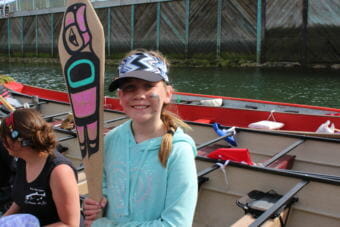
A girl waits for the canoes to land at Douglas Harbor on Tuesday, June 5, 2018. (Photo by Tripp J Crouse)
A group of people wait for the canoes to come to Douglas Harbor on Tuesday, June 5, 2018. (Photo by Tripp J Crouse/KTOO)
Paddlers aboard canoes request permission to come ashore in Douglas Harbor on June 5, 2018. (Photo by David Purdy/KTOO)
Canoes requesting permission to come ashore on June 5, 2018 (Photo by David Purdy/KTOO)
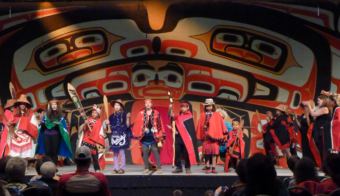
Celebration 2018 grand processional June 6, 2018, Juneau. (Photo by Adelyn Baxter)
Editor’s note: 360 North is under contract with Sealaska Heritage Institute to produce television and online video coverage of Celebration.
Traditional Arts Apprentice & Youth Mentor Shane Brown works on the Yanyeidí totem pole at Harborview Elementary School on May 29, 2018. (Photo by Annie Bartholomew/KTOO)
Beneath the covered area at Harborview Elementary School, Nicholas Galanin strikes wood with his adze.
“Definitely the tree’s been carving something in me, something that wasn’t there before the project,” Galanin said of the 40-foot log. “It will be standing when we’re not.”
The 39-year-old Sitka artist is the lead carver on a totem pole for the first time.
The monumental totem pole is the second created for Goldbelt Heritage Foundation and Douglas Indian Association, as part of a healing process for the T’aaḵú Ḵwáan Tlingit tribe.
The pole memorializes the deliberate burning of Akáx Yaa Andagán, the Douglas Indian village, in 1962 and honors the residents who lost their homes.
Lead carver Yéil Ya-Tseen Nicholas Galanin of Sitka uses an adze to carve the 40-foot T’aaku Kwáan Yanyeidí Healing kootéeyaa totem pole at Harborview Elementary School. (Photo by Annie Bartholomew/KTOO)
The construction over the last year also was an opportunity for one generation of artists to share traditional knowledge and craft with another.
“Definitely we did our own prep work before the pole, making sure that we arrive in a good mind frame to engage in the project,” Galanin said. “It shows in the work, so it will come out in the work, and it’s been embedded in the work.”
His five-person team has been working for nearly a year, through late night shifts and winter months.
Now they’re working 16-hour days with additional helpers.
Artist Sam Sheakley helps finish the 40 foot Yanyeidí totem pole at Harborview Elementary School on May 29, 2018. (Photo by Annie Bartholomew/KTOO)
Sam Sheakley selects his tool while carving a totem Harborview Elementary School on May 29, 2018. (Photo by Annie Bartholomew/KTOO)
Indigenous artist Merritt Johnson paints Yanyeidí totem pole at Harborview Elementary School on May 29, 2018. (Photo by Annie Bartholomew/KTOO)
Master carver Will Burkhart helps finish the totem in the final days of production at Harborview Elementary School on May 29, 2018. (Photo by Annie Bartholomew/KTOO)
Woodworking tools at the Yanyeidí Healing Kootéeyaa totem pole work site at Harborview Elementary School on 29, 2018. (Photo by Annie Bartholomew/KTOO)
Apprentice carver Lee Burkhart cuts a two by three foot traditional copper shield or tináa to be fitted on the totem at Harborview Elementary School on May 29, 2018. (Photo by Annie Bartholomew)
Wooden shavings cover the floor of work site at the Harborview Elementary School covered area on May 29, 2018. (Photo by Annie Bartholomew/KTOO)
Artist Sam Sheakley uses a round chisel to narrow the ear on the Wolf design. Cedar chips cover the gymnasium floor around him, as he helps finish the pole.
“Working on concrete flooring here, so we leave the wood chips down and just in case we drop some of our tools we don’t need to rebuild the shape of the edge,” Sheakley said. “We’ll sweep once we’re done.”
Galanin’s partner Meritt Johnson, a multidisciplinary indigenous artist, paints the intricate Chilkat patterns.
Merritt Johnson paints Chilkat designs onto the 40-foot Yanyeidí totem pole at Harborview Elementary School on May 29, 2018. (Photo by Annie Bartholomew/KTOO)
“We’re going about painting in a way that because they’re still carving, the pole changes so much when it gets painted,” Johnson said. “It lets Nick see the pole in a different way, and he can go back in and recarve, refine and carve in all the details.”
Sometimes painted parts get carved off, then get repainted. The pole is better because of it, she says.
The pole features a Xóots, or brown bear, holding copper tináa or shield, that apprentice carver Lee Burkhart sizes it to the totem.
He gets the copper red hot and pounds it into shape with a ball-peen hammer.
He’s been working with copper since he was 10 years old, but nothing of this scale: 3 feet by 2 feet.
“Right now I’m finalizing the copper tináa getting it cut to shape and ready to install today,” Burkhart said. “Just roughing it out right now and then coming in with files and making it perfect. I’ve seen just wooden tináa’s on totems and I think it adds a little bit of unique style to it.”
His father, master carver Will Burkhart, is helping at the bottom of the totem. The elder Burkhart also is Galanin’s uncle and mentor and one of many familial ties on the project.
Apprentice Shane Brown said they’ve discovered they share relatives.
“We’re finding out our family relations are as tight as they possibly can be, just probably like the meshing and weaving of a Chilkat or cedar had is represented as. That’s how close we are.”
The carving team finished in time for the totem raising ceremony Wednesday at Savikko Park.
This summer, the younger Burkhart and others will keep practicing their carving house post at the Mount Roberts Tramway.
Goldbelt Heritage Association and the Douglas Indian Association sponsored the project and two logs were donated by Sealaska Corporation’s subsidiary, Sealaska Timber Company.
The totem pole was funded in part by a grant from the Department of Health and Human Services.
360 North is under contract with Sealaska Heritage Institute to produce television and online video coverage of Celebration.
Behind the scenes: The judges score the seal oil with crackling. (Photo by Elizabeth Jenkins/Alaska’s Energy Desk)
There was something different about the food contest at this year’s biennial event in Juneau, Celebration. Along with the usual samples of seaweed, judges also tasted seal oil, which was rendered in communities throughout Southeast.
But the competition wasn’t just about awarding the traditional food. The event organizer says it’s also about a history of cultural resilience that still resonates today.
The judges call this tasting “the breakfast of champions,” and they aren’t kidding. They’re snacking on nutritious jars of seal oil at 10 in the morning.
Jodi Mitchell dips her spoon into a jar the color of amber.
Floating on top of the oil is crackling or crispy seal fat. She says it melts in her mouth.
“You know, my mom used to love these the best,” Mitchell said. “I remember her picking them out of the jar and eating them. She would put seal oil on everything.”
Mitchell is keeping track of the tastings with points and notes, which she’ll share with the other judges later. Some seal oil is heavy. Others are light.
It’s created by simmering the fat over a low to medium heat, a delicate process that can impact the flavor.
For Mitchell, a winning entry tastes like being transported home.
“Just taking a bite of this reminds me of my grandparents,” she said. “Sitting around the table and eating Native food with all of them. Foods is always best when you share it.”
Pictured is seal oil without crackling. It’s one of two new categories in the competition. (Photo by Elizabeth Jenkins/Alaska’s Energy Desk)
Sealaska Heritage Institute (SHI) President Rosita Worl says that’s the reason seal oil was added to the competition this year — she’d like to see more people proudly enjoying their traditional foods.
Unfortunately, she says it hasn’t always felt welcome, especially at a time when Native people were forced to assimilate.
“I will tell you, when we were growing up, people would make fun of us because of our food.”
But Worl says seal oil is something to be celebrated.
She likes to eat it with dry fish or potatoes. But as a girl, when she was just six years old, she was taken to a federal boarding school in Haines, where seal oil was nowhere to be found.
She says all the kids were homesick for the flavor. So, they gravitated towards something the boarding school had plenty of that tasted similar.
“They would serve cod liver oil. It was like a vitamin, and we would love it,” Worl said. “We would circle back in the line so we could have more of it.”
Although boarding schools are a thing of the past, Worl thinks the policies that discourage Native people from harvesting traditional foods are not.
To hunt seal, a person has to have a certain percent of Native blood, under the Marine Mammal Protection Act, and its becoming harder for the younger generations to meet that threshold.
“I went to a meeting and I heard a grandfather say, ‘I can’t even take my grandson out to go hunting seal for me,'” Worl said.
Rosita Worl on stage at Centennial Hall during the food competition. (Photo by Elizabeth Jenkins/Alaska’s Energy Desk)
Worl says that means less seal and seal oil is making it into people’s homes for elders and future generations to enjoy. She’d like to see that change.
In the meantime, she says including it in this year’s food contest, serves as a reminder — the taste for seal oil isn’t going away.
Back at the judges’ table, after discussing the nuances of all the different jars, they decide on the winner.
One judge says it’s the seal oil she’d want to crack open and share with family and friends.
Here is a list of all the winners:
Racean Fredrickson of Angoon took First Place for Best Seal Oil
Don Bolton of Metlakatla took First Place for Best Seal Oil with Crackling and First Place for Best Seaweed.
Second and Third Place awards for seal oil went to Roberta Revey of Kake and Bolton
Second and Third Place for Seal Oil with Crackling went to Fredrickson and Wanita Bunny James of Kake
Second and Third Place place for seaweed went to Linda Rae Shearer of Metlakatla and Johnny Jack, Jr., of Angoon.
Editor’s note: 360 North is under contract with Sealaska Heritage Institute to produce television and online video coverage of Celebration.