Elizabeth Jenkins, Alaska's Energy Desk - Juneau

Pandemic creates turbulent waters for Alaska’s growing oyster industry

Salty Lady Seafood Company oysters. (Photo by Elizabeth Jenkins/Alaska’s Energy Desk)

Mariculture, which includes seaweed and oyster farming, has been touted as an up-and-coming industry in Alaska. A few years ago, former Gov. Bill Walker poured resources into promoting it, but the declining price of oil and a surprise pandemic has some farmers worried about the future.

Salty Lady Seafood Company is a family operation. This becomes apparent when a small skiff picks me up beachside, just a few steps off of a hiking trail in Juneau. The captain is owner Meta Mesdag’s 13-year old son. 

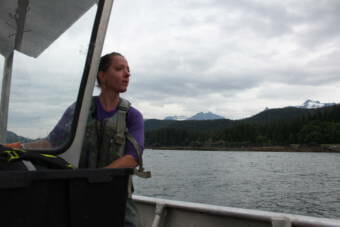
The oyster farm is located close to shore and is mostly underwater. There’s a floating dock and a large boat making up the business’s hub. When I arrive, Mesdag is just finishing up an afternoon of gathering Pacific oysters to sell in town and returning smaller ones that need more time to grow back into the water in a large square mesh container. 

Mesdag started this business two years ago as a way to get her family working outside. She wanted a new career and farming seemed like a good fit.  

“We kind of went through all our options and the cost of equipment,” Mesdag said. “And we felt like oysters were a safe thing. People generally love oysters.”

xx
Meta Mesdag is also the President of Alaska Shellfish Growers Association. (Photo by Elizabeth Jenkins/Alaska’s Energy Desk)

Other states already have a foothold on this industry. By comparison, Alaska’s mariculture startups are relatively new, and they’re being confronted by some formidable challenges. 

“I think some of the challenges that we’ve really faced that we didn’t foresee was the instability in the industry,” Mesdag said. “A lot of that is based on … state funding.”

To make sure her oysters are safe to eat, Mesdag has to get them tested by a state lab. Paralytic shellfish poisoning is a serious threat in the region. It usually takes a week or so for the bivalves to filter the toxins out, so they have to be tested weekly.

Right now, the state pays for that testing, which would cost up to $800 each week. But there are concerns the funding could go away next year. Oil prices have hit record lows in recent months and the coronavirus pandemic is compounding everything. 

Mesdag says navigating that uncertainty has made it extremely difficult to plan ahead. 

“It’s not just our farm,” Mesdag said. “I don’t think there’s any way that any farm in the state can afford up to $20 to 30 thousand dollars a year in testing fees for these small ‘ma and ‘pa farms that we have in the state.”

Before the coronavirus hit, Alaska’s Department of Environmental Conservation Commissioner proposed shifting half of the testing costs back to the mariculture industry — with the intent farmer’s would eventually pay the full price. That proposal wasn’t passed in the last legislative session. But the added strain of the pandemic on the state’s budget means that cut is likely to be taken up again in another session.

Melissa Good of Alaska Sea Grant says farmers across the state are concerned. 

“You know it could have devastating effects to the growing mariculture industry,” Good said.

Rather than pay the full testing fees, Good says there are other cost structures to be considered. She thinks it’d be beneficial to have an assessment done to see what other states are doing. 

“How do we look at these examples and help support a competitive industry?” Good said. “Because also if we nudge out our competitiveness in a broader market, that’s going to prohibit a lot of growth.”

Still, Good says the pandemic has created other issues for the mariculture industry in Alaska as a whole. A survey commissioned by Sea Grant at the beginning of the coronavirus outbreak found 43% of respondents had losses of more than half of their revenue. Good says the loss of tourism and restaurant capacity definitely affected things. 

xx
Salty Lady Seafood Company oyster farm in Juneau. (Photo by Elizabeth Jenkins/Alaska’s Energy Desk)

Mesdag says the pandemic did change some of her plans for the summer. It’s delayed her business from being able to sell oysters outside of Alaska. And she was hoping to have more wholesale buyers. For now, she’s shifting her focus to establishing winter operations. She says it’s hard to envision what next summer will look like. She’s considering opening what she calls a pop-up oyster shack. 

“It just kind of all depends on where we’re at. Everything is so unknown,” Mesdag said. “I feel like for now my main focus has to just be on my kids and getting them through school and getting the product I do have to market.”

Indigenous leaders are reimagining Vogue covers to get the word out on Tongass

xx
Marina Anderson on the Landback Issue of  Vogue Tongass. Tristan Douville helped put the covers together. (Photo by Bethany Goodrich)

The Roadless Rule debate for the Tongass National Forest has been going on since before social media websites even existed. But today, it’s not uncommon to scroll past conversations about the sweeping policy changes on Facebook or Instagram. In a push to get the word out before the Trump Administration makes a final decision, young, Indigenous leaders in Alaska and elsewhere are making that content extremely sharable.

Even if you’re not aware of the contentious, ongoing Roadless Rule debate, you’ve probably heard of Vogue, the high-end fashion magazine. Now, imagine combining the two: a Vogue cover with dense federal policy. 

Marina Anderson is the Tribal Administrator at the Organized Village of Kasaan, and she’s on that reimagined cover of Vogue, which includes headlines about real ordeals tribal governments have faced. It’s posted to her Instagram page. 

“Right Across the top in capital letters it says, ‘Vogue,’” she said. “And we have Vogue Tongass, and it’s called the Landback Issue.” 

Anderson isn’t the first person to use a mockup of a Vogue cover to make a point. A black, Oslo-based student started the #VogueChallenge over the summer to promote more diversity on the magazine’s covers, which have been photographed mostly by white males. Anderson says she’s been meaning to write a thank you note for the inspiration. 

She thought this approach could also be used to educate people about problems at home. 

“So immediately it’s able to draw somebody in because it’s something we’re familiar with, which is Vogue,” Anderson said.

Depending on how closely you keep up with the news, you might be aware of the major management changes underway in the Tongass National Forest. 

In 2018, the State of Alaska petitioned the United States Department of Agriculture for an exemption to the Roadless Rule. That would mean the rule that prohibits road building elsewhere on national forest land wouldn’t apply to the Tongass. Proponents say the exemption could open up access to logging and other activities. 

But lots of people, from commercial fishermen to tribal governments, have voiced strong opposition. There are concerns about what this could mean for deer and salmon habit and climate change mitigation. Recently, nine tribal governments requested another federal process to establish a Traditional Homelands Conservation Rule. The idea is to protect important areas for Tlingit, Haida and Tsimshian peoples. 

All of this is complicated, and that’s where the Vogue cover fits in. 

“I’ve been hearing that because it was catchy and easy to follow along with the Vogue covers on social media, they were finally ready to learn about it,” Anderson said.

Several Indigenous leaders and social media influencers have joined the cause, sharing their own Vogue Tongass covers. The posts are linked to a website that helps people generate letters to their local elected officials and the Secretary of the USDA. 
“A priority of the campaign was to be able to reach young people to keep the momentum up,” Anderson said. “A lot of us have a big large web, and we have the know-how to click fast on these little phones and make things happen.”

xx
(Photo courtesy of Richard Peterson)

Richard Peterson, the President of the Tlingit and Haida Indian Tribes of Alaska, has been following the proposed changes to the Roadless Rule closely for a long time, but he only recently learned about a Tongass edition of Vogue. 

“I had many people reach out and say, ‘hey, where’s your Vogue cover?’ And I was like what?”

Peterson now has his own Vogue Tongass cover, which he posted on Instagram. He says he was delighted to see this innovative way of getting the message across.

“I think a lot of people really don’t understand what the tribes’ concerns are right now,” Peterson said. “I think that’s how we can start the conversation.”

Marina Anderson thinks that’s a conversation young people should be prepared to have. The Roadless Rule has been an ongoing topic in Alaska for decades, and the debate doesn’t seem to be going away. 

“If we’re going to have to fight this fight in another 10 years, we’re going to need these people ready,” she said.

So far, she says 500 people have submitted letters supporting tribal governments. 

Tribal groups question state’s lawsuit over pandemic hunting requests

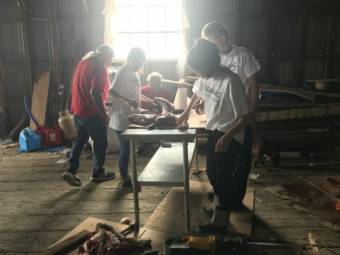
Kake Youth Conservation Corps (YCC) help butcher one of five deer obtained under the emergency season
Kake Youth Conservation Corps help butcher one of five deer obtained under the emergency season. (Photo courtesy of the Organized Village of Kake)

Alaska tribal governments and organizations are asking the State of Alaska to withdraw a lawsuit filed recently in federal court. The lawsuit alleges the federal Office of Subsistence Management overstepped its authority when it granted the Organized Village of Kake a special hunting action during the pandemic. 

Richard Peterson, the President of Central Council Tlingit and Haida Indian Tribes of Alaska, says he wasn’t surprised by the state’s lawsuit, but he was disappointed. 

“I think our state should have better things to do right now than sue its own people and communities during a time of the pandemic,” he said.

Over the summer, the federal Office of Subsistence Management granted Kake’s request. The community was able to harvest up to two moose and five male Sitka black-tailed deer. But the Alaska Department of Fish & Game Commissioner didn’t think that was warranted. A state emergency command unit deemed there wasn’t a food security issue. However, Kake’s Tribal President maintained it wasn’t just about food scarcity. It was about the health of village Elders and having access to culturally nourishing food during the pandemic. 

The joint-statement issued by President Peterson and other tribal leaders calls the state’s lawsuit “a disgraceful continuation of outdated, exclusionary, racist management practices.” 

“They should be working with us,” Peterson said. “They should’ve been applauding a community, a tribe providing for a community during this time.”

In an emailed statement, the Alaska Fish & Game Commissioner Doug Vincent-Lang said, “The State of Alaska is not opposed to the indigenous way of life of native Alaskans.” The agency will continue to pursue the lawsuit because they believe recent decisions are illegal under federal policy.

According to the federal Office of Subsistence Management, 12 special action hunting or fishing requests have been made across Alaska since the start of the pandemic. 

Southeast Alaska economy: ‘Every year from now on, we’re going to be comparing it to 2020’

The Franklin Food Court in downtown Juneau. (Photo by Elizabeth Jenkins/KTOO)

A new report captures a grim economic snapshot of how COVID-19 has affected Southeast Alaska. Not surprisingly, businesses that get a major boost from tourism have been hit the hardest. And while the findings look pretty bleak, it could serve as a roadmap for where to go next. 

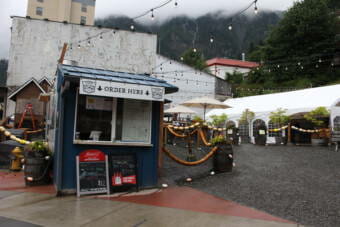
Franklin Food Court in downtown Juneau is the kind of spot that normally draws in tourists and locals. You can sit outside and look up at a view of the mountain peeking through tall buildings while ordering something distinctly from Alaska — salmon ice cream or halibut tacos. 

Today, seats in the outdoor food court are mostly empty. David McCasland is the owner of Deckhand Dave’s Fish Tacos. He says there were many unknowns leading up to the season. 

“Coming March time, I was like, well, we’re going to see how this goes,” he said.

But so far, McCasland says his business is holding up. He opened up a little later than normal, and he was able to get a loan from the federal Paycheck Protection Program, which is helping him ride out the summer. McCasland emphatically states that he’s one of the fortunate businesses. He feels empathy for his downtown neighbors who don’t have the outdoor space to spread out and make guests feel more secure.

McCasland says he’s approaching the future with a mixture of hope and caution. 

“It seems like this is going to continue on a little bit longer, and who knows what next summer will bring,” he said.

According to information collected for an economic report commissioned by Southeast Conference, 17% of Juneau businesses said they were at risk of closing over the next 12 months. That sounds bad. But across the region, that number is even higher: 23%. 

Meilani Schijvens from Rain Coast Data helped put the economic report together using surveys of 460 businesses across the region. 

“I tell people that this report is really heavy,” she said. “It’s really hard. It’s really depressing.”

Schijvens says places like Petersburg were more insulated from the economic downfall because the community isn’t as dependent on cruise ship tourism. Haines and Skagway, on the other hand, have been feeling that revenue loss the most. 

“You have COVID, and you take those cruise ships away. And the elements that the economy has been built on are destabilized,” Schijvens said.

As of June, fewer businesses in Southeast Alaska reported receiving federal COVID relief funds compared to distributions across the state. Schijvens isn’t sure why that is. But she thinks the $52 million dollars of funding businesses did receive was extremely helpful. 

Schijvens says this report didn’t show a lot of bright spots, but she thinks the region still has a lot going for it. Southeast Alaska is a place tourists will want to visit again — someday. She says this report reads as a kind of manual for how to best support businesses at this time. Most businesses named access to grants and utility assistance as the top two things that could help get them through this year.

“Every year from now on, we’re going to be comparing it to 2020,” Schijvens said. “And it’s going to be improving, so we’re going to be able to look back at 2020, and say, ‘we’re doing so much better than 2020. So this is our bottom year.'”

The Federal Subsistence Board OK’d an emergency hunt in Kake. Now it faces legal challenges.

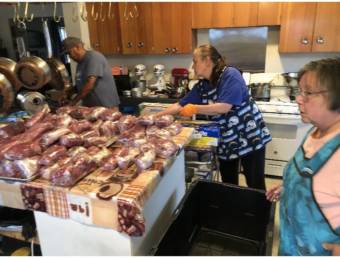
Kake residents and Elders process moose meat to be distributed to the community
Kake residents and elders process moose to be distributed among the community. (Photo courtesy of the Organized Village of Kake)

The State of Alaska is filing a lawsuit in federal court alleging the U.S. Office of Subsistence Management has overstepped its authority. 

Over the summer, the federal agency restricted one hunting area in the Interior to only local subsistence users, citing public safety concerns. It also granted permission to the Organized Village of Kake to hunt out of season during the pandemic

Alaska Department of Fish & Game Commissioner Doug Vincent-Lang says the state fundamentally supports subsistence activities, but it objects to how the subsistence board is following bedrock law — namely the Alaska National Interest Lands Conservation Act, which suggests the federal agency should cooperate with the state. 

“In the last six months, we’ve seen a rapid diversion from that, actually going well beyond what we feel are their legal authorities,” Vincent-Lang said. “So, we thought it was the proper time to challenge those.”

This isn’t the first time the state has conflicted with the federal agency over whose hunting and fishing needs should be prioritized. The state contested a decades-long case regarding subsistence fishing rights along the Copper River.

As the pandemic played out, rural residents became increasingly concerned over disruptions to the food supply chain. The federal Office of Subsistence Management received at least six requests to hunt or fish out of season. 

Vincent-Lang says the state had an agreement with the federal subsistence board. They were supposed to ask the State of Alaska if food shortages existed. A state emergency command unit determined that wasn’t an issue. However, the Office of Subsistence Management still granted Kake’s request

Vincent-Lang thinks that wasn’t justified. 

“We believe it’s time to allow the state to be the principal manager of subsistence in these areas,” he said.

Throughout the ordeal, tribal government leaders said the special action request wasn’t just about food scarcity. It was about the overall health of village elders and having access to traditional foods during a pandemic. 

Kake was able to harvest up to two moose and five male Sitka black-tailed deer, which were distributed to the community. 

The state is asking for the Office of Subsistence Management to immediately halt its first order and to no longer grant special hunting requests under these circumstances. 

Site notifications
Update notification options
Subscribe to notifications