The Kensington mine, located northwest of Juneau, recently announced the discovery of high-grade gold. It was found in a historic mining vein called Jualin near the active site.
“There’s an adage in the mining industry, you know the best place to look for a mine is near a mine,” says general manager Wayne Zigarlick.
The Kensington mine typically produces .2 ounces per ton, but Zagarlick says the Jualin material is modeled to be about .46 ounces ounces per ton.
“So considerably higher gold content per ton of material,” he says.
That means the cost to produce gold at Kensington is going to be cheaper. In 2014, it was $951 to produce an ounce of gold. Coeur Mining, the company that owns Kensington, forecasts it will be $820 per ounce in 2015. Zigarlick says it took about two years to find the high-grade gold in the historic Jualin site.
“There’s never a breakthrough moment where everyone says, ‘We had a discovery.’ It just kind of oozes out like toothpaste,” he says.
The company doesn’t plan on hiring any new employees at the location. Coeur Mining owns Kensington, along with two other mines in the U.S. and internationally in Bolivia, Mexico and Australia. Currently, the market rate price for gold is about $1,200 per ounce.
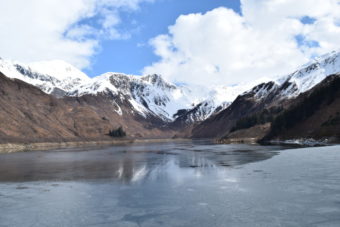
It’s been a record low year for snowpack in Southeast Alaska, but the peaks in Juneau were recently dusted with powder. Last weekend, EagleCrest Ski Area received 20 inches of precipitation at its highest elevation, and about 6 inches at the base. Senior Hydrologist Aaron Jacobs says overall, our winter has been mild and wet.
Photo by Casey Kelly/KTOO
“You put those two things together, you get a lot of liquid precipitation but not much of the frozen stuff,” he says.
Jacobs works for the Juneau office of the National Weather Service. He says it’s common to see these conditions at sea level. But this year it extended up into the higher elevations. This could mean less mountain runoff for smaller streams in Juneau, like Jordan and Montana creeks.
“If we don’t have that snowpack, those waters are going to start to get very low. When fish come into the water systems, it could really warm the water temperatures and that’s not conducive for the fish. The fish don’t like the water too warm,” says Jacobs.
The lack of moisture could also lead to forest fires as temperatures heat up this spring. Last year, Southeast saw similar weather patterns. But heavy rains in the summer months offset some of the negative impacts. Although there’s been snow recently, Jacobs says it may be too little, too late.
“Up in the higher elevation there’s been some significant snowfall, but nothing that will make up all the lost ground that we’ve had,” he says.
The climate predicted for the summer months calls for a 70 percent chance of above normal temperatures.
Easter was last weekend but some Russian Orthodox Christians will observe it this Sunday. That’s where Easter, or what they call Pascha, lands on the Julian calendar. There’s a special treat that goes along with the celebration. It’s not a chocolate bunny. It’s called kulich.
Siouxbee Lindoff has been making Easter bread for over 40 years. It’s what she’s known for.
“I’m in such high demand. I posted on Facebook, ‘I’m only making two batches of bread. I’m only making two batches and no more,'” she says.
In the kitchen of the Juneau Tlingit Haida Community Council Building, she sifts flour and sugar into a large mixing bowl. Adding a dab of salt.
After mixing in the yeast and cracking eggs, she stirs the dough with a spoon.
“My dream is to invest in a big commercial mixer but everything is still done by hand,” she says.
Lindoff measures all of the ingredients by sight. The whole process, she says, is intuitive. If you want to learn how to make kulich from her, she says it’s a hands-on process.
“People will look and say, ‘Well how can you make something and not measure?’ And I thought, ‘By the feel.’ And I don’t mind sharing, I don’t mind teaching. Cause to me, it’s like, saving our traditions,” she says.
Siouxbee Lindoff heating up yeast to make Easter bread (Photo by Elizabeth Jenkins/KTOO)
Lindoff grew up in the Russian Orthodox church. Her family split their time between Sitka and Hoonah. Her dad was the only Tlingit priest ordained from St. Herman Theological Seminary in Kodiak. She says being a pastor’s kid could sometimes be a burden.
“My mom used to say, when they look at you they say, ‘There’s that father Michael’s daughter.’ Especially when I was doing bad.”
She says her parents were strict but fair. They tried to protect her from the same discrimination they’d endured growing up. But it came at a cost. They refused to teach the Tlingit language.
“My dad said, ‘You will speak the English language. You will use the correct pronunciation. You will enunciate your words correctly. I don’t want to hear no slang.’ He was adamant about that. He didn’t want us to suffer like they had, ” she says.
Lindoff’s father paid for his high school education. Her mother went to Wrangell Institute, which was a boarding school.
“And of course Tlingit was the first language that was spoken at home and she used to have to sit at the head of the class and have a dunce hat on her head. She died never wearing a hat,” she says.
Although her mom didn’t teach her how to speak Tlingit, she did show her the traditional way to make kulich.
Siouxbee Lindoff mixes the kulich dough by hand (Photo by Elizabeth Jenkins/KTOO)
“My mom tasted my first bread dough and she said yours taste better than mine. She never baked Easter bread again,” Lindoff says.
Russian Orthodox missionaries landed in Kodiak and the Aleutian Islands around 1780. The religion spread to Southeast almost 100 years later.
Sergei Kan, a professor of anthropology and Native American Studies at Dartmouth College, says the Russian Orthodox offered Christianity that was somewhat more tolerant of Native customs and also open to the use of Native languages. He says the Russian Orthodox Church translated the gospel into Native languages, like Tlingit.
“And I think the fact that the orthodox has survived in Alaska means that it was becoming a true Native church,” Sergei says.
After Siouxbee Lindoff incorporates the ingredients for the kulich, she sets the dough aside to let it rise for the next few hours.
“You can get frozen bread dough and you can go to the store but I don’t think you’ll be able to find kulich in the store,” she says.
The finished product: a decorative loaf of kulich (Photo by Elizabeth Jenkins/KTOO)
Lindoff compares making the bread to other Native customs, like gathering herring roe. It’s a skill she’s passed down to her children.
“When I do things like this, it makes me feel like it’s part of the healing, like not being able to speak Tlingit because of that era where my mom and dad spoke it fluently and we didn’t and they didn’t want us to. But I feel like this is part of that healing now. This is part of us going forward with the traditional ways and saving what we can,” she says.
She’s excited to teach her great-granddaughter how to make kulich. She’s 5 years old and learning to speak Tlingit in an immersion class.
For the first time, a Tlingit name for a peak in Juneau will be included in the Geographic Names Information System or GNIS. This makes it possible for that name to be printed on federal maps and publications. Getting the indigenous name for a Juneau peak officially recognized actually began as an attempt to give the point a Western moniker.
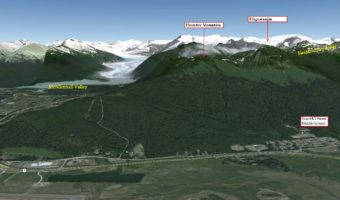
To Lance Twitchell, the point east of Thunder Mountain has always been called Tlaxsatanjín.
“From the Tlingit prospective, nothing has really changed,” he says.
He’s the assistant professor of Native languages at the University of Alaska Southeast. In Tlingit, Tlaxsatanjín means “idle hands” or “hands at rest.” If you looked at a topographic map, the peak had been nameless.
“I think you’d see Heintzleman Ridge is what would be there. And that’s it,” he says.
Twitchell wasn’t the only one who proposed a name for the peak to the Alaska Historical Commission. It almost became Mount Scribner, after the late Jon Scribner. He was a longtime Department of Transportation official in Southeast who died in 2005 in a hiking accident.
“He had sort of uncommon passion for the land here. For the people here,” says Mandy Mallott, Jon Scribner’s daughter. She’s non-Native.
“But I was adopted into the Kwaashk’i Kwaan clan out of Yakutat. And I was given a Native name, Ach Kwei,” she says.
Friends of the late Scribner submitted a proposal in 2013 to have the peak named in his honor. The commission approved it, unaware of its Tlingit name. That proposal was then sent to the U.S. Board of Geographic names, which also conducts a review.
The U.S. Board of Geographic Names added it to their list of things they would consider. But it didn’t take action. Then a proposal was submitted by Lance Twitchell. He says it wasn’t necessarily a counterproposal.
“It had nothing to do with the individual. It just has do with sort of reaching a capacity of saying, we can’t just keep naming stuff for people when these things already have names,” Twitchell says.
After Mallott found out about the peak’s indigenous name, she and her father’s colleagues withdrew their proposal.
“When we heard about the other proposal, absolutely very quickly did we decide that that was the name of that mountain,” Mallott says.
Mallott says she’s interested in seeing Native names being restored to the entire region. She believes her father would want that, too.
“His spirit would have been right there with us and that is to restore indigenous place names of this whole region. It’s not just this one peak,” she says.
Lance Twitchell says he hopes people will learn the Native names for these landmarks.
“So when they see that and they drive by that mountain, they can drive by and say ‘Tlaxsatanjín.’ And just look at it and think that’s what it’s been called for well over 500 years,” he says.
Tlaxsatanjín will be on federal maps starting next month.
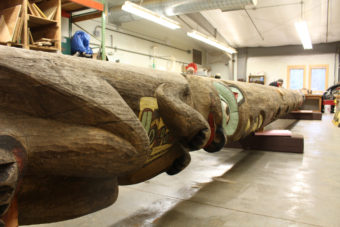
A 74-year-old totem pole that once stood at the Auke Recreation Area in Juneau is being restored for a second time. The Yax té pole had to be taken down in 2010 after it was damaged by woodpeckers and heavy rains. Now after being in storage for five years, it’s getting a new life.
In 1941, The Yax té pole was carved by Frank St. Clair, a Tlingit from Hoonah as part of the Civilian Conservation Corps. Originally, it was intended to be one of many in an Auk Village totem park. But World War II broke out and funding dried up. Fred Fulmer, Frank St. Claire’s great-grandson, is helping with the restoration.
“Whenever great-grandpa’s pole needed to be restored redone I wanted to be a part of that. My nephew told me about Wayne over here doing the totem pole so I stopped by and he said come on over,” says Fulmer.
Wayne Price is the master carver for the restoration and has been doing this kind of work for over 43 years—making dugout canoes and totems. He’s a Tlingit from Haines and says he found his calling watching his dad.
The Yax té totem is 47 feet long. (Photo by Elizabeth Jenkins/KTOO)
Wayne Price finishes painting the top of the pole. (Photo by Elizabeth Jenkins/KTOO)
(Photo by Elizabeth Jenkins/KTOO)
Yolanda Fulmer and Wayne Price finish painting the totem. (Photo by Elizabeth Jenkins/KTOO)
Yolanda Fulmer paints the wings. (Photo by Elizabeth Jenkins/KTOO)
The tools of the trade: a pair of elbow adzes used to restore the totem. (Photo by Elizabeth Jenkins/KTOO)
“I remember looking up watching him carve. That’s it. That’s what I want to do. I got the opportunity to start sweeping up the wood chips,” Price says.
He’s worked on 36 different totem poles in his career, and he says the feeling he gets is the same every time.
“You walk into the room and smell the red cedar and see the tools and create the artwork that means so much and goes so far back,” he says.
In Tlingit, Yax té means “Big Dipper.” The raven sits at the top of the 47-foot tall pole. Price says it’s one of the tallest totems he’s ever worked on.
This isn’t the only time the pole has been restored. In the 90s, the base was vandalized by arson. The carver who worked on that first restoration made a startling discovery: several bullets had been shot into it. Rosa Miller is the tribal leader for the Auk Kwaan. She remembers being heartbroken seeing it in that state before.
“I don’t understand why people shoot at things like that,” Miller says. “It’s obviously there for a reason. The reason it was put there was to honor us. We are the original settlers here. The clan of the area.”
Fred Fulmer, the original carver’s great grandson, says he has childhood memories of taking care of the totem. He’s from Hoonah but when he would come to Juneau, his mom would want visit the pole at Auk Bay Village.
“She would go around and pick up garbage and start weeding. All of us would jump in and start cleaning. She didn’t say anything. She just went to it. You know, you got the cue, get in there and do that,” Fulmer says.
He’s passed on that reverence for the Yax té pole to his daughter, Yolanda.
“The feeling I get is just one of connection with my ancestors,” she says. “You know with my great-great grandfather. I can imagine the hands that worked on this pole. So it’s a real visceral feeling. I get the tingles and I get the chills.”
The restoration will be completed in the following weeks. The wings will be put back on the totem. It’s being repainted turquoise, yellow and red. Wayne Price says story poles like this one are, essentially, a history book of Native culture.
“We didn’t have paper but we carved the whole tree. This is classical example of that. Being a part of keeping that book so people can read it is very, very rewarding,” he says.
Yolanda says it’s going to be wonderful to see the pole return to its home.
“Know that our ancestors are with us and that we can sing and celebrate and bring this pole back to life,” she says.
But it might be a while before the Yax té totem returns to the Auke Recreation Area. The Juneau Ranger District is still looking for funding to put the pole back in its place.
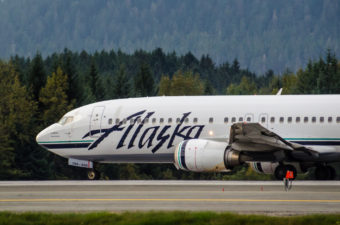
Passengers may experience a little more ground time waiting to take off from Juneau International Airport in the coming months. The main runway is about to undergo a massive construction. Airport Manager Patty deLaBruere says planes will start taking off and landing from a temporary runway.
“The aircraft will start landing on the temp runway which is the old taxiway,” she says.
It’s the second year of a multiphase project. Phase 2 is estimated to cost around $22 million and will include resurfacing the main runway.
“It will be taken down to about three inches of pavement, they’re going to be doing some work on all the light in the shoulders,” says deLaBruere.
Juneau International Airport completed a similar project 18 years ago. deLaBruere says the regular runway should be back in operation by July 1. Most of the cost for construction will come from Federal Aviation Administration grants.
Close
Update notification options
Subscribe to notifications
Subscribe
Get notifications about news related to the topics you care about. You can unsubscribe anytime.