Elizabeth Jenkins, Alaska's Energy Desk - Juneau
Governor’s revised budget restores some funding for sexual assault prevention

Bill Walker, Choose Respect
Gov. Bill Walker leads this year’s Choose Respect march through downtown Juneau. (Photo by David Purdy/KTOO)

Alaska tops a lot of lists, like best whale watching and cleanest air quality. But the state also ranks highly in something else.

“Child sexual abuse, infant rape, domestic violence, sexual assault, stalking,” says Peggy Brown, the executive director at the Alaska Network on Domestic Violence and Sexual Assault.

Earlier in the legislative session, a Senate subcommittee slashed all of the state funding for domestic violence and sexual assault prevention programs. It would have impacted projects like Girls on the Run and Choose Respect. Now, with the governor’s revised budget, some of that money has been put back.

Brown says when the network heard their 2016 state budget for prevention programs was being eliminated, it felt like being kicked in the rib.

“Not to use violent language. They got the breath knocked out of them a little bit,” she says.

In the five years the prevention programs existed in Alaska, there have already been signs of success. One program called the Fourth R was able to identify students who experienced sexual violence and role-play healthy relationships.

Choose Respect
(Photo by David Purdy/KTOO)

“And I think people really liked these programs. I think it gave people a certain amount of hope with these horrible numbers that maybe there were some normal simple things that normal simple folks could do rather than breaking up a fight or calling 911,” Brown says.

Now some of that lost funding might be reinstated. Gov. Bill Walker’s revised budget allocates $1.5 million for sexual assault prevention programs, about half of last year’s. Lauree Morton, the executive director of the Council on Domestic Violence and Sexual Assault, says she understands.

“The state’s in a difficult spot right now but that 1.5 is critical for projects moving forward,” she says.

Morton says 10 communities in Alaska currently have readiness prevention programs that help jump-start the bigger ones.

“If we have the $1.5 million restored, the number of those communities will be reduced to five,” she says.

Morton couldn’t say which locations would be cut. Projects like Green Dot, which teaches violence intervention skills, won’t be able to spread to other communities as quickly as the network hoped.

But most sexual and domestic violence prevention programs will still be able to function. Peggy Brown says for prevention work to actually be effective, it has to saturate an area for at least five years.

“And we were just at the five year mark and we were just getting data on a lot of these programs,” says Brown.

In 2011, the Alaska Victimization Survey in Juneau showed 55 out out every 100 women suffered from domestic violence or sexual assault. The network hopes that number is decreasing. A 2016 version of the survey could confirm that, but that’s contingent on the $1.5 million in the governor’s revised budget.

Juneau kids plea for full funding of schools

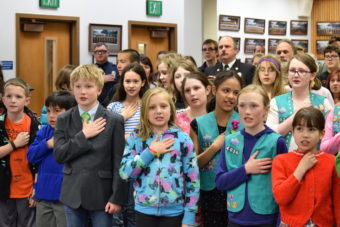
Several Juneau school kids attended Monday's Assembly meeting to show support for full funding for education. They also led the Assembly in the flag salute before the meeting. (Photo by Casey Kelly/KTOO)
Several Juneau school kids attended Monday’s Assembly meeting to show support for full funding for education. They also led the Assembly in the flag salute before the meeting. (Photo by Casey Kelly/KTOO)

More than 30 kids packed the Juneau Assembly Chambers last night to testify on behalf of full funding for the school district’s 2016 operating budget.

Annika Schwartz, who attends Gastineau Elementary School, said she experienced overcrowding in her second grade classroom and worried about the future.

“If we don’t get a good education, then who will be sitting where you are right now when you leave? And who will take care of our world?” she asked Assembly members. “I know that we are on a tight budget that we’re trying to handle. But on your list of things you could cut, education should be the very last.”

The proposed budget would appropriate more than $86 million dollars to fund the Juneau School District next year. Both general operations and student activities would receive an increase over fiscal year 2015.

Joan Pardes, a parent, said maximizing the funding could fix a blight that’s weakened the school system for years.

“I know families that are leaving Juneau because of education. I know five families in the past three years that have left because of education,” said Pardes, a former volunteer host of KTOO’s “A Juneau Afternoon.”

The Assembly voted to send the school district budget back to the Finance Committee for further consideration. Members also held onto the city and borough’s overall operating budget of more than $319 million dollars. Property taxes would remain unchanged from the current year. No one from the public testified on the proposed city budget or the property tax mill levy.

The new fiscal year starts July 1. The full Assembly has until May 31 to appropriate the school district budget and until June 15 to adopt the city’s operating budget.

Leaning into the fear: As If! The Alaska State Improv Festival is back

As If! or The Alaska State Improv Festival is back in Juneau this weekend for its third year. Some of the troops are local, from places like Sitka and Talkeetna. Other acts are from the lower 48. Mike Descoteaux and Deana Criess are here with Improv Boston.

Descoteaux is now the artistic director for the group. But earlier in his comedic career, he made a Youtube video of a mock protest, holding up the sign: God Hates Figs. It’s a satirical spoof of the Westboro Baptist Church’s anti-gay slogans.

“The idea being humor allows us to address topics we couldn’t otherwise address. So topics that are so heavily loaded that we just have trouble having a rational dialogue with. We know satire can disarm the audience,” he says.

Subversive humor is still something he uses in his act. Improv Boston’s national touring director Deana Criess says she got her start at an early age.

“At three years old I told my family I wanted to be a stand-up comedian. I thought that meant you would stand on a coffee table and tell jokes. So that’s what I would do at family parties,” she says.

Funny people: Mike Descoteaux and Deana Criess
Funny people: Mike Descoteaux and Deana Criess (Photo by Elizabeth Jenkins/KTOO)

Descoteaux and Criess are visiting with six other members of their improv troop, which relies on gusto and spontaneity for performance.

“So unlike traditional theater we are literally making up everything on the spot. We are out there doing adult make-believe,” she says.

Being script-less on stage with sweaty hands and mounting anxiety is how improv comedy gets made.

“It can be paralyzing for people so just knowing that fear is where you wanna be and leaning into that. It’s transformative for people to think about running into the fear instead of away from it,” she says.

Descoteaux says you walk on stage with an array of life experience.

“And all of this is going to lend itself to the performance,” he says.

Both comedians say they were bullied growing up. It’s part of what influences their comedy.

“I didn’t know what to do. I was the kind of kid who was too paralyzed with fear to say anything. So I turned into a very quiet kid who stopped raising their hand in the classroom, who stopped wanting to do things socially with friends. And it wasn’t until I was in high school that I realized, ‘Oh everyone’s got their own thing. We’re all weird in our own way,'” Criess says.

The experience inspired her to create an improv comedy anti-bullying initiative, where they workshop different scenarios for middle school kids.

“The first thing we tell kids to do is tell them that hurt your feelings, which is really hard when you’re a kid. Because you feel like they just hurt my feelings and I don’t want them to know that. But the reality is, if they already said that to you, they want to hurt your feelings and they’re not going to stop,” she says.

Improv Boston is working on similar programs for people suffering from PTSD and drug recovery. They say comedy is good for a laugh but it’s also good for healing.

At this weekend’s performance in Juneau, Improv Boston says there’s only one thing the audience can expect: the unexpected.

Gov. Bill Walker adopted into Tlingit Clan

Gov. Bill Walker dances during a ceremony at a Tlingit Haida Central Council function in Juneau where he was adopted into the Kaagwaantaan Clan, April 17, 2015.  (Creative Commons photo courtesy Alaska Governor's Office)
Gov. Bill Walker dances during a ceremony at a Tlingit Haida Central Council function April 17 where he was adopted into the Kaagwaantaan Clan. (Creative Commons photo courtesy Alaska Governor’s Office)

Gov. Bill Walker was recently adopted into the Tlingit Kaagwaantaan Clan. The ceremony happened during the 80th Assembly of the Central Council of Tlingit and Haida Indian Tribes of Alaska, where Lt. Gov. Byron Mallott was also given a lifetime achievement award.

In a video of Gov. Bill Walker’s adoption ceremony into the Kaagwaantaan Clan, a Tlingit tribal member places a $5 bill on the governor’s forehead to symbolize a payment for the name.

Then the crowd chants the governor’s Kaagwaantaan name four times. He’s now a member of the Eagle’s Nest House within the Kaagwaantaan Clan, which means Wolf Clan. The clan is part of the Eagle moiety. Walker said being adopted by the clan was a complete surprise.
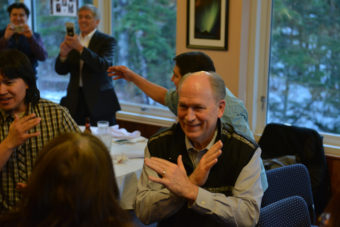
“It was exciting. Something I’d not been a part of before. It was all brand-spanking new to me and was such an honor. … My adopted name now is Gooch Waak,” Walker says.

Leona Santiago is a tribal delegate from the Kaagwaantaan Clan. She says she came up with the name in 2008 for an adopted family member. And now it’s the name given to the governor: Gooch Waak, which means “wolf eyes.”

She says tribal elders wanted to adopt Gov. Walker into the Kaagwaantaan because of the lieutenant governor’s Native roots.

“Because Byron Mallott is Raven and the Tlingit way, Eagle/Raven is a balance,” she says.

Gov. Bill Walker, Lt. Gov. Byron Mallott, and Tlngit Haida Central Council Richard Peterson at a council function, April 17, 2015. Mallott received a lifetime achievement award.   (Creative Commons photo courtesy Alaska Governor's Office)
Gov. Bill Walker, Lt. Gov. Byron Mallott, and Tlngit Haida Central Council President Richard Peterson at council assembly April 17.  Mallott received a lifetime achievement award. (Creative Commons photo courtesy Alaska Governor’s Office)

This 10,000-year-old tradition creates equal representation for Tlingit families. Few Alaskan leaders have been adopted into Native clans. Lt. Gov. Byron Mallott says it makes the relationship between him and the governor more whole.

“It was special to me. It is special for Tlingit people and I know it’s special for Alaska. The more we can bring those lives across this incredible state together, the stronger we are a state, so it was a good step,” Mallott says.

Recently, Gov. Walker introduced emergency regulations for the Indian Child Welfare Act. It would create lower barriers for extended family or tribal members to adopt Native kids. Essentially, less bureaucracy. Leona Santiago said the timing had nothing to do with adopting Gov. Walker into the Kaagwaantaan clan.

“No, that isn’t what we did. We did it to set the balance because Byron Mallott is a Raven,” Santiago says.

In the video of the ceremony, Gov. Walker dances to a traditional Kaagwaantaan song. He says being governor, you have a lot of one-and-done moments.

“And that wasn’t. That was a life changing moment for me and I knew that,” Walker says.

Gooch Waak or Gov. Bill Walker says he will continue advocating on behalf of all Alaskans.

Law and Rover: HB 147 would give pets special legal considerations

Most people don’t want to think of their pets as property. But in court, they are. A bill by Rep. Liz Vazquez likely be back in next year’s legislative session aims to give pets special considerations in the law when it comes to divorce, protective orders and animal seizures.

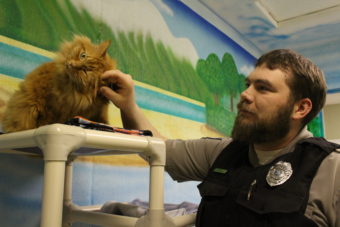
The Gastineau Humane Society in Juneau has two dogs, 17 cats and a number of smaller animals, like rabbits, guinea pigs, and a chinchilla—all up for adoption. The laminated profiles of the animals are tacked on a cork board in the lobby.

Sometimes a lot of pets come through their door, like in cases of animal hoarding. And that can cost the shelter tens of thousands of dollars while a court ruling is being decided.

“It’s frankly not fair to house animals in the shelter for the long term,” says Matt Musslewhite, the executive director of the Gastineau Humane Society.

If HB 147 passes, owners in hoarding cases can post a bond to have their pets boarded—pending the outcome of the case. Or they can relinquish them to the shelter. This simplifies the whole process so animals can be adopted faster.

“Yeah. Not only is it better for the animals. It’s fiscally better for the shelter,” Musslewhite says.

The other part of the bill would make the definition of pets, in cases of legal ownership, more clear. Right now, the courts consider pets property, and it’s ambiguous how to handle that.

Kathy Hessler, a professor of animal law at Lewis and Clark College in Oregon, says animals are clearly in the law as property.

“But people don’t treat them in their lives and in there homes as property, and so what that means is their interactions are at odds with the legal framework,” she says.

She testified at a recent hearing in support of the pet bill. She says in cases of divorce and dissolution, property with monetary value, like a house, can be divided. But your precious dog or cat can’t be cut in half.

“So courts are doing all kinds of things because they don’t have statutory guidance and sometimes courts are simply unwilling to make a ruling,” she says.

If HB 147 passes, judges will have the green light to rule in cases of pet ownership, with the understanding that the pet’s overall well-being has to be considered. The legislation doesn’t extend to dog mushing teams which, to the courts, have monetary worth. Pets could also be included as part of a domestic violence restraining order.

“A husband might say to his wife, ‘If you leave me, I’ll kill the dog,'” says Hessler.

Same principle: the judge will have the authority to protect pets as part of a restraining order. Initially, the Alaska Network on Domestic Violence and Sexual Assault opposed the bill.

“Sometimes I get a little frustrated with these big national movements. …We kind of took care of that 15 years ago,” says Peggy Brown, the network’s executive director.

She says several years ago, the advocacy group worked really hard to make sure pets were included as personal essential items on protective order forms.

“There’s a box that can be checked, it actually says ‘pets’ and then ‘names,’ in case there are more than one pet,” says Brown.

Those existing protective orders are already legally binding. The bill wouldn’t change that. Brown worried that “custody” language in HB 147 could turn pet disputes into ugly court battles, like in family law cases, increasing interactions between the victim and abuser. Brown withdrew her opposition after Rep. Vazquez changed that part of the bill. Brown says if the overall bill reinforces the victim’s ownership of the pet, it’s a good thing.

“It puts it in ink when it was kind of in pencil, I guess is one way you can look at it. Now it’s two different places. It’s in statute and on the protective order forms,” says Brown.

If the pet bill does pass, Alaska will join 28 other states with similar legislation.

Update: Northrim Bank robbery suspect arrested

Update | 5:39 p.m. April 18

A man suspected of robbing Northrim Bank on Friday with a threat of explosives has been arrested.

The Juneau Police Department says 52-year-old Larry Randolph Powell of Bay Minette, Alabama, was trying to fly out of Juneau when he was stopped. Powell fits the description of the bank robbery suspect and was found with an undisclosed amount of cash on him.

Powell was arrested for robbery, theft and terroristic threats.

Original post | 1:15 p.m. April 17

A man claiming to have an explosive device robbed the Northrim Bank near the Nugget Mall this morning, Juneau police say.

The suspect threatened employees before taking off on foot with an undisclosed amount of cash.

“He appears to be either a white or Alaska Native male, wearing blue jeans, a dark coat with a hood, and scruffy gray facial hair,” said Lt. David Campbell with the Juneau Police Department.

Northrim Bank's entrance is blocked by police tape after the robbery (photo by Elizabeth Jenkins/KTOO)
Northrim Bank’s entrance is blocked by police tape after the robbery (photo by Elizabeth Jenkins/KTOO)

Campbell says 12 to 14 officers are searching for the suspect. Call police dispatch at 907-586-0600 if you have information.

This is a developing story. Check back for updates.

Site notifications
Update notification options
Subscribe to notifications