Elizabeth Jenkins, Alaska's Energy Desk - Juneau
New Juneau business to bring salmon skin wallets, crab shell shirts to the masses

A small Juneau business launched a Kickstarter campaign this week to crowdsource funds for a unique line of apparel and accessories. Tidal Vision is hoping it’s onto the next big thing: garments sewn from discarded salmon skin and crab shells.

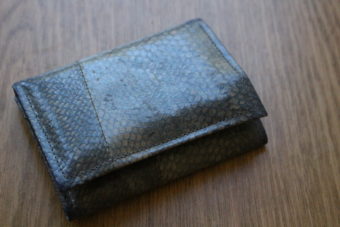
Craig Kasberg, the founder of the company, pulls out a wallet from his back pocket. It’s a muted jade color, shiny with a slightly bumpy texture.

“It’s much different than what you see when you throw a skin away in the garbage when you’re cooking up your dinner or something,” he says.

The wallet is made entirely from salmon skin sourced from a processor in Kodiak, and then sewn at a tannery in Washington State.

The odor is different than what you might think.

“I would say it smells quite similar to any vegetable tanned leather really,” he says.

Tidal Vision's salmon leather wallets will retail for about $75. (photo by Elizabeth Jenkins/KTOO)
Tidal Vision’s salmon leather wallets will retail for about $75. (Photo by Elizabeth Jenkins/KTOO)

The skin has gone through a 24-step process that dries it out until it turns into leather. The material doesn’t stink because the fish oils have all been removed.

“And then replace those with all natural based vegetable tanning oils.”

Alaska has a long history with fish leather. Historically, Alaska Natives across the state have used salmon and other fish skins to craft durable garments, bags, boots and other items necessary for village life. These days, a few Native artists continue the time-consuming tradition of processing fish skins.

The material was also marketed to tourists and fashion houses in the 1990s until those ventures fizzled. Over the last few decades numerous Alaska entrepreneurs have tried their hand at the fish leather business, prompting speculation that it could be a new cottage industry for the state.

Kasberg says the biggest hurdle is convincing consumers byproducts are cool.

“When people think of fish waste, they almost plug their nose in reaction. When people haven’t seen it, smelt it, felt it, I think there is a challenge there,” he says.

Kasberg owns a gillnetter and has fished commercially in Southeast Alaska for almost a decade. He recently sold his commercial fishing license to help fund the new business.

His partner, Zach Wilkinson, has a background in economic development in agriculture. He says the agriculture industry already uses animal byproducts to make high-end items, like shoes and handbags, so why not Alaska fisheries.

“Clearly this stuff is valuable and useful and we could be doing something with it,” he says.

Some seafood processors sell byproducts for pet food, fish meal and vitamin supplements.

“What I’m particularly excited about it is kind of moving those things up the value chain and producing higher value products,” Wilkinson says.

Another item Tidal Vision plans to roll out is clothing made from chitosan extracted from crab shells. The fabric is antimicrobial, so it’s perfect for socks, underwear or gym shirts.

“We’re still going to recommend you wash your clothes but as far as odor goes, you won’t have to,” Kasberg says.

The use of chitosan is common in many industries. It’s usually stripped away from crustacean shells with formaldehyde, but Tidal Vision has a patent pending on a greener, more environmentally friendly method. They’re hoping to eventually expand the product into bandages and other medical supplies.

“The sutures that dissolve into your bloodstream are made out of a chitosan,” he says.

If the products take off, Kasberg says the business could add an overall boost to revenue for fish processors in Alaska. He would be giving them a dollar a pound for the skins, which he says is 90 percent more than fishmeal manufacturers pay. And that money could trickle down to commercial fishermen who supply the processors, like Juneau fisherman Anthoney Sine.

“That would increase our price. That would increase the money that we would be getting on our end,” he says.

Sine owns a boat called the Fortune and is preparing for the upcoming gillnet season. He says the price of seafood can fluctuate; alternative revenue streams could provide more stability.

“It greases the wheels,” Sine says. “Our seasons are short, especially the salmon season. Being able to get a little more money for my product strengthens my business for sure.”

Kasberg’s Kickstarter campaign has already raised more than half of the money it needs to begin mass production. They’re starting with wallets and plan to roll out one item at a time.

Tidal Vision surpassed its Kickstarter goal of $17,500 in 24 hours.


Taking the heat: A graduate in lockup prepares to transition out of the kitchen

It’s graduation season for Alaska’s high school seniors. Earning a diploma marks a milestone in a teenager’s life; but for a student in a juvenile treatment center, the achievement is an opportunity for a fresh start.

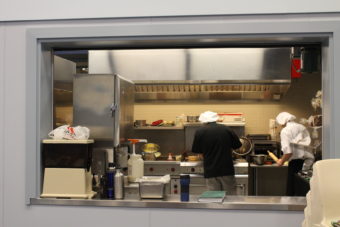
JYC students whip up brown sugar shortbread and a hollandaise sauce. (photo by Elizabeth Jenkins/KTOO)
Johnson Youth Center students whip up brown sugar shortbread and a hollandaise sauce. (Photo by Elizabeth Jenkins/KTOO)

At the Johnson Youth Center in Juneau, a handful of students are mixing, blending and whisking their way through Chef David Moorehead’s recipes. It’s not easy stuff.

For J, an 18 year-old finishing his first year here, learning how to make crème brule was a big moment.

“It tastes like heaven, but in a custard way. One time we tried to get the hard crust on the top, but we set off the fire alarm here,” he says.

We’re not releasing J’s full name because he’s a juvenile, and his criminal record is viewed as “confidential” by the courts.

In J’s culinary arts class, one of the students is using a French technique to make hollandaise sauce. Chef Moorehead says cooking teaches the kids focus and how to manage expectations. Some have felony charges and are court-ordered to spend two years locked up at JYC.

“I think this place can be really heavy on the kids,” Moorehead says. “And this kind of gives them a little outlet. So for some of them it’s the best thing since apple pie to be able to break away from the regimentation and learn something new.”

Although J’s graduating soon with his high school diploma, he still has another year left at JYC. The center houses juveniles for both the long and short-term.

“Coming here I thought my life was over. I was like, ‘Wow, what am I going to do now?’ But being here got me all these classes and activities that’s going to help me in the real world,” he says.

When he was in regular high school, J says he caved to peer pressure.

“A lot of poor decisions, I made a lot of mistakes over and over again,” he says.

A "soft" room at the Johnson Youth Center. Residents must earn points to receive amenities like a couch. (photo by Elizabeth Jenkins/KTOO)
A “soft” room at the Johnson Youth Center. Residents must earn points to receive amenities like a couch. (Photo by Elizabeth Jenkins/KTOO)

Now he lives in the treatment wing, which is separate from short-term detention. Staff don’t refer to him as an inmate: he’s a resident. And the facility isn’t called a jail. Some of kids on the treatment wing, like J, are repeat offenders who were in and out of the system until the court appointed a longer stay.

“When you go through his file and you see how many times he has come to visit us, you say, ‘Huh, at what point didn’t you get it?'” says Julia Black, a paraeducator at JYC.

She says it took some time, but eventually J came around.

“He all of a sudden woke up. Watching him buckle down and get to school, and everyday I’d go down and see him and you’d just see this kid doing everything he could to do it right,” she says.

In part, he says his wake up call came after being sentenced to two years at the center.

“Like, two years of your life taken away. After this, there’s no coming back to JYC. It’s the big boy house. There’s a lot of people counting on me. I don’t want to let them down,” he says.

A JYC resident irons their gown for graduation. (photo by Elizabeth Jenkins/KTOO)
A Johnson Youth Center resident irons his gown for graduation. Four students at the center recently earned their high school diploma. (Photo by Elizabeth Jenkins/KTOO)

One of the people counting on him is his infant son.  He missed the birth while he was serving his sentence.

“That was a really big disappointment in my life. I was like I don’t want to go through this again. I don’t want to put my son through this. I just want to be there in his life when I get out of here and stay there,” he says.

JYC offers counseling on being a good parent, dealing with stress and building healthy relationships. In a year or less, J will be back out in the world. He’s the first in his family to earn a high school diploma. He says he’s a little anxious about what the future will bring.

“I came here not having much responsibility except for going to school but now I’m out, I have to hold a job, take care of my son, and like, live on my own. And that gets me nervous, but not as nervous because I know I can do it,” he says.

With the work readiness training from JYC, J says he’s looking into careers in the culinary arts or mining.

Editor’s note: An earlier version of the story indicated J’s record will be expunged. The juvenile’s record is actually viewed as “confidential” by the courts. 

Tribes, Forest Service partner on climate change research

At the Native American Fish and Wildlife Society Conference in Juneau this week, a panel of five discussed climate change and traditional knowledge.
Jay Kazhe is a student at Eastern new Mexico. He represented the Native "youth perspective" at the panel.  (photo by Elizabeth Jenkins/KTOO)
Jay Kazhe is a student at Eastern New Mexico University. He represented the Native “youth perspective” at the panel. (photo by Elizabeth Jenkins/KTOO)

Rick Edwards is the research aquatic ecologist with the U.S. Forest Service. He likened the observations of indigenous people to scientific models.

“If we focus on that part of this integrated body of spirituality, culture and knowledge, and if we focus on observation-based natural history parts of that, then indeed, that looks a lot like science to me,” he said.

In 2010, the Forest Service partnered with tribes nationwide to study the effects of climate change. Alaska Native tribes are also participating.

Ida Hildebrand is the tribal natural resource program director for the Chugach Regional Resource Commission, a nonprofit that oversees the stewardship of natural resources in the Chugach region. Hildebrand cautioned Native people to exercise sovereignty over their traditional knowledge.

“That is your tribal choice. You have that knowledge, you don’t have to share it. Or you can share parts of it and not all of it. There’s sacred knowledge. There’s common everyday knowledge. There’s all kinds of traditional knowledge,” she said.

The research is funded with federal money which means information gathered could become public record. The goal of the project is to preserve tribal culture in the face of changing climate.

Juneau Assembly approves city, school district budgets

The Juneau Assembly approved both the city and school district’s 2016 operating budgets last night.
The City and Borough of Juneau budget totals more than $321 million next year. That includes city enterprises like Bartlett Regional Hospital, Docks and Harbors and Eaglecrest Ski Area.

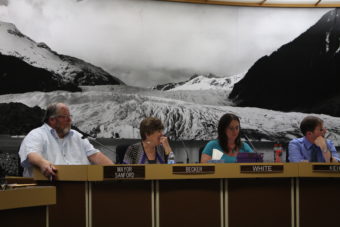
The Juneau Assembly meeting (photo by Elizabeth Jenkins/KTOO)
The Juneau Assembly approved the 2016 city and school district budgets Monday night. (Photo by Elizabeth Jenkins/KTOO)

The Juneau School District budget totals more than $85 million. Mayor Merrill Sanford was the only Assembly member to vote no on both items. He said he would have preferred CBJ have more control over how the money set aside for the school district be spent.

“In my mind that money should have went into our budget, the city and borough, and be then be doled out to whoever needs it. And it very possibly could be the school district in the next year or two. But by forwarding it to the school district, we do not have that money available to us for the next two years or the next one year,” Sanford said.

The city unexpectedly received about $600,000 from the federal Secure Rural Schools program recently. Sanford says that money could have offered some security for the the city in uncertain economic times.

“So it takes it off the table for us and gives it to only one part, one segment of our total budget,” he said.

The Secure Rural Schools funds will be counted as revenue in this year’s school district budget, which was the first in recent memory that the Assembly did not fund to the maximum allowed under state law.

No one from the public stepped forward to testify on behalf of either budget item. Both the city and school district budgets take effect July 1.

Sacred architecture: Walter Soboleff Building opens its doors

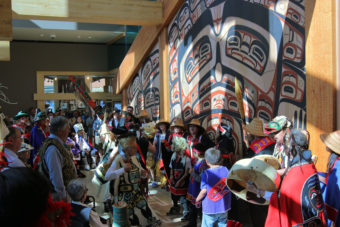
The Sealaska Heritage Institute unveiled its new structure in downtown Juneau today. It’s called the Walter Soboleff Building after the late Tlingit scholar, elder and religious leader. Inside stands a full-sized replica of a traditional red cedar clan house.

At the opening ceremony, the Aangun Yatx’i dance in their regalia in front of the Walter Soboleff building.

The Aangun Yatx’i dance in their regalia in front of the Walter Soboleff building.  (photo by Elizabeth Jenkins/KTOO)
The Aangun Yatx’i dance in front of the Walter Soboleff building. (photo by Elizabeth Jenkins/KTOO)

Davina Cole is the arts assistant here. She clutches her four-month-old baby girl tightly to her chest.

“We’re Yanyeidí from the T’aaku Kwáan area. We’re little wolves. She’s my baby pup,” she says.

Cole says she’s looking forward to what the Soboleff Building will offer her daughter. They’ve already gone to a Baby Raven Reads class before the grand opening. It teaches pre-literacy through Native stories.

“So even right now she’s benefiting from the center because it’s going to be really good for her to be surrounded by that and even have a place to go and learn that,” she says.

The building is a museum for Tlingit, Haida, and Tsimshian artifacts, a space for cultural ceremonies and it houses a gift shop. The building is part of an initiative to turn Juneau into the Northwest Native arts capital. But designing a space that could serve all those functions and reflect the past was difficult.

“When we got the responses, the designs were all very traditional,” Rosita Worl says.

Worl is the president of Sealaska Heritage Institute and a Tlingit from the Eagle moiety. She says the Native artist committee wanted a structure that was more “traditionally inspired.”

“They don’t like the word ‘contemporary,'” she says.

Yellow cedar beams in the entryway of the Walter Sobeloff Building. (photo by Elizabeth Jenkins/KTOO)

SHI sifted through submissions and picked architect Paul Voelckers’. The design was influenced by the form of ceremonial clan houses with chunky beams of yellow cedar. It has an open feel and a wall of glass at the entrance.

“I will tell you that we made the right decision in selecting Paul. It might not have even been the lowest bid. But we all said we got to go with him,” she says.

Voelckers is the president of MRV Architects. The firm’s founder Linn Forrest Sr. specialized in totem pole and clan house reconstruction.

“The firm has sort of tried to maintain that legacy of involvement in the cultural design issues from Southeast ever since,” Voelckers says.

Most recently, MRV worked on a clan house in Kasaan. For the Walter Soboleff Building, Voelckers looked at old photos of clan villages. Some were covered in moss from age.

“But it would have the angles of the house. You know, the big massive beams on the front. And sometimes the old house post inside. That became the essential element that was left in these villages. And so what we tried to do in the new design was capture some of that heavy framework,” he says.

The basement level floor houses the research lab and mechanical room. The whole building is heated using wood pellets.

“It simply flows down like grain or something,” he says.

The building was designed to meet the U.S. Green Building Council’s gold standard for energy efficiency. The wood pellets come mostly from the Sealaska Corp. land on Prince of Wales Island. Rosita Worl says that’s part of keeping the core cultural values in the design.

“Haa Aani: our relationship to the land,” she says.

On the main floor is a full-sized replica of a clan house. It can seat 300 people and fits with tradition: pitched roof, windowless and built with adzed red cedar. The floor is tiered with sunken-in seating. Worl says she knew it would a special place.

The inside of the clan house features a traditional small door to thwart invaders. (Photo by David Purdy/KTOO)

“But what we hadn’t counted on, what I hadn’t thought about was this almost sacred feeling that you get when you go into that clan house.”

Worl says she has a strong connection to her ancestors.

“And it was almost like they were saying to us, ‘Rosita, you know you’re talking about being progressive, you want to move into the 21st century.’ It almost became like their space and they said, ‘This is where we are.’”

At the the Walter Soboleff’s closing ceremony, the clan house was given the name Shuká Hít.

Deadline approaching for Juneau’s Storefront Star Awards

The application period for the Juneau Economic Development Council’s Storefront Star Awards ends soon. It’s a friendly competition among downtown businesses to beautify storefronts. Improvements can be as simple as planting flowers or as extensive as painting the exterior of a building — whatever the owner sees fit.

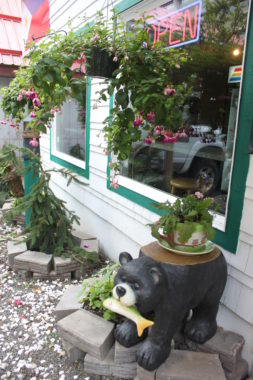
Twilight Cafe won last year after adding decorative plants. (Photo by Lisa Phu/KTOO)

“It’s a simple program but it’s a way to encourage and recognize those businesses that are making a special effort to make downtown Juneau more attractive to locals and visitors alike,” says Brian Holst, the JEDC’s executive director.

The winner will receive $400 and a Storefront Stars plaque. There will also be runners-up and people’s choice awards. Last year, Twilight Café won the competition by removing a concrete parking barrier and adding outdoor plants.

Sponsors of the competition include Princess Cruises and Tourism Best Management Practices.

The deadline to apply is Friday, May 15. Winners will be announced in June.

Site notifications
Update notification options
Subscribe to notifications