A detail of Lily Hope’s first full size Chilkat Robe. Hope is teaching an online class about career development as an artist. (Photo by Annie Bartholomew/KTOO)
This fall, students headed to the University of Alaska Southeast can enroll in a new associate degree program in art.
It’s part of a larger vision — in works for several years now — to establish a Northwest Coast arts hub.
The new degree program is a partnership between the University of Alaska Southeast, Sealaska Heritage Institute and the Institute of American Indian Arts in Santa Fe, N.M. The agreements were signed a few years ago, but it’s taken some time to line everything up.
Kari Groven, the Art Director at Sealaska Heritage Institute, says there’s a lot of room for growth.
“We’re at a really great milestone that it exists in the first place,” she said.
The program is a two-year art degree with a focus on Northwest Coast Indigenous art. As part of the new program, students are required to take an intro course in relevant Native languages. Then, there’s hands-on arts classes to choose from, such as Northwest Coast basketry and carving. The university has offered some of those courses before, but others are brand new. For instance, acclaimed weaver Lily Hope is teaching an online class about career development as an artist.
Students enrolled in the program will have the option to transfer credits to the Institute of American Indian Arts if they want to pursue a bachelor’s degree, or they can pursue a degree at UAS.
Groven thinks this kind of comprehensive academic offering is long overdue. She says many people are familiar with the region’s formline design, but the associates program is a way to gain a deeper understanding.
“In a way, the associates degree provides a starting point for that journey,” Groven said.
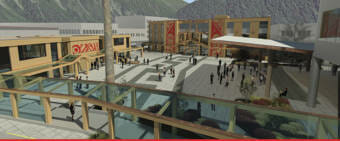
A rendering of the future Sealaska Heritage Arts Campus. (Courtesy of Sealaska Heritage Institute)
Some of this fall’s courses will be offered online, and some will happen in-person — in accordance with the university’s pandemic plan.
In the future, students will take some of these classes on a brand new campus. Sealaska Heritage has already started breaking ground on a 6,000 square foot facility in downtown Juneau. It’s designed to house big projects, like canoes and totem poles. The campus is slated for completion sometime next year.
Haida artist Robert Davidson’s metal panel “Greatest Echo” adorns the front of the Walter Soboleff Building. (Photo by Elizabeth Jenkins/KTOO)
Three young Alaska Native artists, including one from Ketchikan and one from Hydaburg, have been chosen to carve cedar house posts that will be cast in bronze and displayed in front of the Walter Soboleff Building in Juneau.
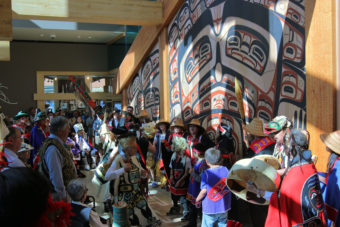
Tlingit artist Stephen Jackson, Haida artist TJ Young and Tsimshian artist Mike Dangeli submitted the winning proposals for the Sealaska Heritage Institute’s house post project.
The project will be the final installation planned for the Walter Soboleff Building, SHI Chief Operating Officer Lee Kadinger said. The house posts will go in an outdoor bench area.
“It was always our vision to have a Tlingit, Haida and Tsimshian house posts on that space,” he said. “So, Sealaska Heritage toward the end of 2016, put out a RFP seeking proposals from a Tlingit, a Haida and a Tsimshian artist to carve three cedar house posts that would then be cast into bronze and then be placed on the corner of Front and Seward streets in Juneau.”
The Walter Soboleff Building already includes work by well-known master artists, and the Institute wanted to involve younger artists, as well, Kadinger said.
“With Robert Davidson on the exterior, David (A.) Boxley on the house screen on the interior, and then Preston Singletary inside the clan house,” he said. “So, really, we had a lot of world-renowned artists working on those pieces, so it turned our attention for this project to who are some of the emerging artists that we can have working on this exterior … house post project.”
Each of the young carvers chosen for the project is an amazing artist, and the designs they submitted are exciting, Kadinger said.
He said each piece will tell a story specific to the culture. Dangeli’s piece focuses on the origin of the potlatch; “and then we have one by Stephen Jackson that’s focusing on the life of the Tlingit raven; then we have the Haida one focusing on was-go, which is a supernatural Haida figure.”
Young is from Hydaburg on Prince of Wales Island.
According to Sealaska Heritage Institute, in recent years, he and his brother, Joe Young, carved several major projects including a 40-foot totem pole for the Sitka National Historical Park, and a 32-foot crest pole for the Hydaburg Totem Park.
Jackson started carving with his father, Tlingit artist Nathan Jackson, while still in high school in Ketchikan.
Stephen Jackson has had solo exhibitions at the Alaska State Museum, the Anchorage Museum, and in Europe before pursuing his undergraduate degree.
He obtained a bachelor of arts from Columbia University in 2013, and later a master of fine arts, also from Columbia.
Dangeli recently moved to Juneau from Vancouver, British Columbia. According to the Institute, he works primarily on commission for private clients and indigenous people who use his work in ceremony and for dance groups.
Sealaska Heritage Institute officials are excited about the house post project, Kadinger said, and it will be an interesting challenge for them because they’ve previously not done bronzing.
“We also are working with consultant Preston Singletary, who has done a lot of bronze work,” he said. “He’ll be consulting with SHI as well as the artists as we move forward, and working closely with us with the foundry as well.”
The three bronze house posts are expected to be installed at the Walter Soboleff Building in 2018.
The Sealaska Heritage Institute unveiled its new structure in downtown Juneau today. It’s called the Walter Soboleff Building after the late Tlingit scholar, elder and religious leader. Inside stands a full-sized replica of a traditional red cedar clan house.
At the opening ceremony, the Aangun Yatx’i dance in their regalia in front of the Walter Soboleff building.
The Aangun Yatx’i dance in front of the Walter Soboleff building. (photo by Elizabeth Jenkins/KTOO)
Davina Cole is the arts assistant here. She clutches her four-month-old baby girl tightly to her chest.
“We’re Yanyeidí from the T’aaku Kwáan area. We’re little wolves. She’s my baby pup,” she says.
Cole says she’s looking forward to what the Soboleff Building will offer her daughter. They’ve already gone to a Baby Raven Reads class before the grand opening. It teaches pre-literacy through Native stories.
“So even right now she’s benefiting from the center because it’s going to be really good for her to be surrounded by that and even have a place to go and learn that,” she says.
The building is a museum for Tlingit, Haida, and Tsimshian artifacts, a space for cultural ceremonies and it houses a gift shop. The building is part of an initiative to turn Juneau into the Northwest Native arts capital. But designing a space that could serve all those functions and reflect the past was difficult.
“When we got the responses, the designs were all very traditional,” Rosita Worl says.
Worl is the president of Sealaska Heritage Institute and a Tlingit from the Eagle moiety. She says the Native artist committee wanted a structure that was more “traditionally inspired.”
“They don’t like the word ‘contemporary,'” she says.
Yellow cedar beams in the entryway of the Walter Sobeloff Building. (photo by Elizabeth Jenkins/KTOO)
SHI sifted through submissions and picked architect Paul Voelckers’. The design was influenced by the form of ceremonial clan houses with chunky beams of yellow cedar. It has an open feel and a wall of glass at the entrance.
“I will tell you that we made the right decision in selecting Paul. It might not have even been the lowest bid. But we all said we got to go with him,” she says.
Voelckers is the president of MRV Architects. The firm’s founder Linn Forrest Sr. specialized in totem pole and clan house reconstruction.
“The firm has sort of tried to maintain that legacy of involvement in the cultural design issues from Southeast ever since,” Voelckers says.
Most recently, MRV worked on a clan house in Kasaan. For the Walter Soboleff Building, Voelckers looked at old photos of clan villages. Some were covered in moss from age.
“But it would have the angles of the house. You know, the big massive beams on the front. And sometimes the old house post inside. That became the essential element that was left in these villages. And so what we tried to do in the new design was capture some of that heavy framework,” he says.
The basement level floor houses the research lab and mechanical room. The whole building is heated using wood pellets.
“It simply flows down like grain or something,” he says.
The building was designed to meet the U.S. Green Building Council’s gold standard for energy efficiency. The wood pellets come mostly from the Sealaska Corp. land on Prince of Wales Island. Rosita Worl says that’s part of keeping the core cultural values in the design.
“Haa Aani: our relationship to the land,” she says.
On the main floor is a full-sized replica of a clan house. It can seat 300 people and fits with tradition: pitched roof, windowless and built with adzed red cedar. The floor is tiered with sunken-in seating. Worl says she knew it would a special place.
The inside of the clan house features a traditional small door to thwart invaders. (Photo by David Purdy/KTOO)
“But what we hadn’t counted on, what I hadn’t thought about was this almost sacred feeling that you get when you go into that clan house.”
Worl says she has a strong connection to her ancestors.
“And it was almost like they were saying to us, ‘Rosita, you know you’re talking about being progressive, you want to move into the 21st century.’ It almost became like their space and they said, ‘This is where we are.’”
At the the Walter Soboleff’s closing ceremony, the clan house was given the name Shuká Hít.
Tlingit glass artist Preston Singletary was chosen as one of three people to contribute monumental art to Sealaska Heritage Institute‘s new Walter Soboleff Building. In this video he explains the inspiration for his glass screen and his take on contemporary indigenous art.
The inside of the clan house features a traditional small door to thwart invaders. (Photo by David Purdy/KTOO)
Hand prints on the wall inside the clan house (Photo by Mikko Wilson)
(Photo by David Purdy/KTOO)
Canoe coming in to dock (Photo by David Purdy/KTOO)
Canoe coming in to the dock (Photo by David Purdy/KTOO)
Lifting the canoe out of the water (Photo by David Purdy/KTOO)
The canoe is carried through the streets to the Sobolheff Building (Photo by David Purdy/KTOO)
"Today is a great day for Alaska" - Governor Bill Walker speaking at the opening ceremony (Photo by David Purdy/KTOO)
Performers during the ceremony (Photo by David Purdy/KTOO)
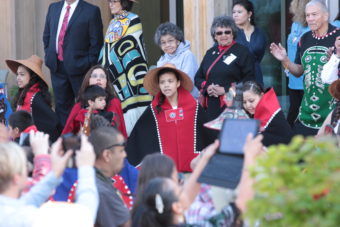
A large crowd gathered in front of the Soboleff Building listen to a series of speakers (Photo by David Purdy/KTOO)
Looking down at the crowd gathered for the opening ceremonies (Photo by Megan Ahleman)
First dancers starting off the ceremony (Photo by Mikko Wilson/KTOO)
"Dr. Soboleff was a man for the ages and this is a building for the ages" - Sen. Dan Sullivan speaking at the opening ceremonies (Photo by David Purdy/KTOO)
People from all over Southeast traveled to Juneau for the grand opening of the Walter Soboleff Building (Photo by Jennifer Canfield/KTOO)
In 2004, an awning patch-job went bad and led to a fire that razed a historic commercial building in the heart of downtown Juneau, where the grand opening of Sealaska Heritage Institute’s Walter Soboleff Building will happen Friday.
In its 108-year history, the two-story, wood-framed building at the corner of Front and Seward streets had gone by many names: The C.W. Young Building, Rusher’s Hardware, the Skinner Building, the Endicott Building and the Town Center Mall.
Oke and Robert Rodman were keeping shop at Percy’s Liquor Store across the street that Sunday afternoon in August 2004. They saw a couple of guys on top of the awning working with tar and a torch.
“I knew it’s bad idea,” Oke Rodman says.
“Well, once they started running around looking for a fire extinguisher, it seemed like a bad day,” Robert Rodman says.
Juneau fire chief Rich Etheridge was fire marshal and acting chief at the time.
Fire Chief Rich Etheridge was acting chief at the time of the Skinner building fire. He’s standing roughly where he commanded the fire department’s response from in 2004. (Photo by Jeremy Hsieh/KTOO)
When he arrived, he saw smoke rising from one corner of the building, but no open flames. The fire was burning inside the walls.
The 2004 Skinner Building fire didn’t appear serious at first. (Photo by Brian Wallace)
“We sent crews in with chainsaws and axes to cut through walls to get to the fire. But they’d cut through one wall, then they’d find another wall, then layers of plywood to another wall, and so they couldn’t get to the spots where things were burning,” Etheridge says. “Because of the old construction, and things that had been added on, what happens is the smoke travels through all those void spaces, and the smoke actually ignites.”
(Photo by Brian Wallace)
With a firefighting crew inside, the building filled with smoke floor to ceiling.
Open flames at the 2004 Skinner Building fire weren’t very apparent, but it dumped smoke everywhere. (Photo by Brian Wallace)
“And smoke explodes also. We had a smoke explosion,” he says. “It was like a low volume explosion. It was more like a big ‘woof.’”
Fortunately, he says there were no serious injuries.
“It was a big, big wave of relief after they called back in on the radio, said they were fine,” he says.
Etheridge put a crew on the roof, hoping to cut a hole in it to let the heat and smoke escape instead of spreading through the building. But that plan was foiled by multiple roofs, layered on over the years.
Meanwhile, the windless, dry weather kept much of the smoke at street level. He says downtown Juneau reminded him that day of eerie scenes in New York City on 9/11.
Smoke cuts visibility in downtown Juneau as the historic Skinner Building burns, Aug. 15, 2004. (Creative Commons photo by Gillfoto)
“With just that real thick haze in the air and nobody in the streets — that’s kind of what it looked like.”
He shut down and evacuated several downtown blocks, and the cruise ships left early.
Smoke fills the streets of downtown Juneau as the historic Skinner Building burns, Aug. 15, 2004. (Creative Commons photo by Gillfoto)
Hand tools weren’t cutting it. And it still wasn’t clear where the fire was in the building.
“There wasn’t a lot of active, open flame that you could see, it was just lots and lots of smoke, and all the flames were concealed where it was real difficult,” he says.
So Etheridge brought in an excavator to peel the walls down and keep the fire from spreading to other buildings.
The aftermath of the 2004 fire that destroyed the Skinner Building. (Creative Commons photo by Gillfoto)
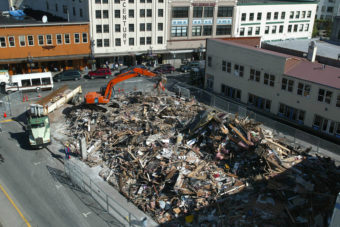
By the next morning, just about every firefighter in town had worked the blaze. When the smoke cleared, the second story was gone. Rubble from the 18 businesses that occupied the building was all over the streets.
The site was cleared by December that year; debris with asbestos in it had been scooped out to below street level, and a new eyesore was taking shape.
By the end of 2004, the debris from the Skinner Building fire had been cleared to below street level, creating “the pit.” (Photo by Brian Wallace)
The pit in March 2010. (Photo courtesy Candice Bressler)
Candice Bressler moved to Juneau in 2009.
Candice Bressler founded the Facebook page Fix the Pit in 2010. Now the Soboleff Building stands where the pit was. (Photo by Jeremy Hsieh/KTOO)
“So when I arrived, it was already ‘the pit,’” she says. “It was filled with anything from beer cans to cigarette butts to old newspapers. A lot of things.”
In early 2010, Bressler and other United Way volunteers started a public advocacy campaign for a solution. They started a Facebook page called “Fix the Pit.” Almost overnight, it drew hundreds of fans.
About that same time, city officials threatened the lot’s owners with a six-figure lawsuit, not because of the eyesore, but because the pit was literally undermining the city’s surrounding sidewalks, curbs and streets.
Before it went to court, Sealaska Corp. stepped in paid $800,000 for the 9,500 square-foot lot, which is across the street from its headquarters. Sealaska filled the pit and addressed the city’s issues. When temporary landscaping went in, Bressler declared the pit fixed.
It’s been more than 10 years since the fire, and Sealaska Heritage Institute’s new cultural center is just opening at the corner of Front and Seward streets.
“I think it’s sad that such an eyesore existed for so long. And I think it’s sad that millions of tourists got to walk past it over the years and see, basically, what people called the Ground Zero of Juneau,” Bressler says.
Standing outside the new Walter Soboleff Building, Bressler wasn’t so bleak.
“Just looking at this magnificent building. Just, it’s so spectacular to look at. And just to see that it’s filled with beauty and with development and with culture! So exciting,” she says.
Just down the street in another prime downtown spot, the husk of the Gastineau Apartments still stands after a 2012 fire. If the recovery timelines parallel, it’ll be about 2023 before something new opens its doors there.
Close
Update notification options
Subscribe to notifications
Subscribe
Get notifications about news related to the topics you care about. You can unsubscribe anytime.