University of Alaska

State education board OKs UAA program aimed at tackling school psychologist shortage

A group of students in the distance gather after exiting a yellow school bus.
Students exit a school bus outside of Juneau-Douglas High School: Yada.aat Kalé on Aug. 15, 2025 (Photo by Jamie Diep/KTOO)

The State Board of Education and Early Development unanimously approved a school psychology master’s program at the University of Alaska Anchorage aimed to address the state’s shortage of school psychologists. The approval took place during the board’s special virtual meeting on Thursday.

This comes after the board voted it down last October after some members brought up concerns about social justice mentioned in a sample syllabus.

Several people testified at the meeting in support of approving the program, including Palmer resident Rebecca Emerson. Her son Winston is a second grader with Down syndrome, and she said school psychologists are instrumental to make sure he gets the services he needs.

“I ask you to look past the ideological debate and see the faces of the students like Winston who rely on these services. Please approve this program so that more Alaskan students can have the support they need to succeed in the classroom,” Emerson said. 

Board member Kathryn McCollum originally brought up concerns about social justice in the program. After receiving clarification about how the program works, McCollum said she appreciates the efforts to create a homegrown program.

“I’m not thrilled that we have all these contractors from outside of our state. So I would much prefer to see people from Alaska serving Alaskans so I appreciate your efforts here,” McCollum said.

Board member Barbara Tyndall, who previously opposed the program, voted in favor this time around. She still had concerns about the focus on mental health.

“As I’m going through the health and safety stuff, it’s mental health, mental health, mental health,” Tyndall said. “And I don’t think we should just only be looking for mental health, because there are people out there just looking for problems.”

People have a few ways to become licensed school psychologists in Alaska. One main way is to graduate from a program accredited by the National Association of School Psychologists. Another is to go through a program approved by the state’s education board.

UAA’s program is on its way to getting NASP accreditation. The earliest it could achieve that is 2029, one year after the program’s first cohort graduates. Now, with the state board’s approval,  those students could become licensed and hired to work shortly after graduating.

University of Alaska will hold listening sessions as part of president search

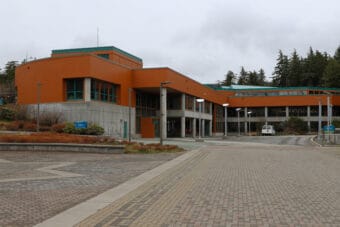
A red brick building that houses the University of Alaska Southeast Egan Library.
Egan Library at the University of Alaska Southeast in Juneau on April 16, 2025. (Photo by Jamie Diep/KTOO)

The University of Alaska will host listening sessions in Juneau, Fairbanks and Anchorage next week as it ramps up its search for a new president. 

This comes after UA President Pat Pitney announced her retirement plans last month. The university contracted with WittKieffer, a global executive search firm, to help with the search. During the session, it hopes to get input on what the university community wants to see from the next president.

In Juneau, the firm will host sessions on Dec. 8. There will be four separate sessions, one each for University of Alaska Southeast faculty, staff, students and community members. 

All Juneau sessions will be in the Glacier View Room Egan Library Classroom Wing at the University of Alaska Southeast at the following times:

  • UAS faculty — 9 to 9:50 a.m.
  • UAS staff — 10 to 10:50 a.m.
  • UAS students — 12 to 12:50 p.m.
  • Juneau community — 6 to 7 p.m.

The firm will then hold sessions at the University of Alaska Fairbanks. A community session will be held on Dec. 9 for the public. Faculty, students and staff will meet for sessions the following day.

  • Fairbanks community — Dec. 9, 5:30 to 6:30 p.m. at Schaible Auditorium
  • UAF faculty — Dec. 10, 9 to 9:50 a.m. at Schaible Auditorium
  • UAF students — Dec. 10, 10 to 10:50 a.m. at Schaible Auditorium
  • UAF and UA System Office staff — 1:30 to 3:00 p.m. in Room 106 at the Butrovich Building

Anchorage listening sessions will happen on Dec. 11 for students, faculty, staff and community members in the University of Alaska Anchorage Engineering and Industry Building Solarium at the following times:

  • UAA staff — 9 to 9:50 a.m.
  • UAA students — 10 to 10:50 a.m.
  • UAA faculty — 11 to 11:50 p.m.
  • Anchorage community — 6 to 7 p.m.

University students, faculty and staff will also be able to attend sessions over Zoom. Community members will only have an in-person option. Anyone unable to attend the meeting can also fill out an anonymous survey until Dec. 15 at 2 p.m.

According to a university press release, recruitment is expected to open in early January, with a president hired between April and May.

A 13-member search committee will review and interview candidates. Members of the community include university regents, governance representatives, as well as Alaska city and corporation leaders.

University of Alaska President Pat Pitney to retire in May

University of Alaska Regent Joey Crum and UA President Pat Pitney listen during a meeting at the University of Alaska Southeast in Juneau on Sept. 4, 2025. (Photo by Jamie Diep/KTOO)

University of Alaska President Pat Pitney will retire this spring. 

Following an Olympic gold medal in air rifle, Pitney began working for the university in 1991 and served in several positions between the system office and the University of Alaska Fairbanks. During that time, Pitney and her then-husband also coached the UAF rifle team. She was also director of the state Office of Budget and Management from 2014 to 2018.

Pitney worked as the state Legislative Finance Director before being appointed as interim president at UA in 2020, following the resignation of Jim Johnsen. She permanently took on the role in 2022, becoming the university’s first permanent female president.

Pitney said she took on the role during a difficult period, thanks to the COVID-19 pandemic and declining state funding.

“There was a lot of uncertainty and a lot of unrest at the university, and just navigating through that to bring the institution back around to enrollment, enrollment growth, and, you know, positive reputation,” she said.

During her time as president, the university increased its enrollment and expanded the UA Scholars Program and Alaska Performance Scholarship.

The university saw enrollment increase by 4% from fall 2022 to fall 2024. Enrollment is projected to keep going up by another 4% this school year.

Pitney said federal uncertainty remains a challenge. According to an update at the UA Board of Regents meeting last week, the federal government has frozen, delayed and terminated close to $25 million in federal grants. That leaves about 95% of the university’s research portfolio intact.

“We’re positioned well and doing well in this environment, and so for the most part, just keeping people focused on what it is that we can do,” she said.

University of Alaska Southeast Chancellor Aparna Palmer was hired during Pitney’s tenure. Palmer says she appreciates Pitney recognizing the importance of all campuses in the university.

“When it comes to UAS, she has been really supportive of our success as an institution, and also really, like, supportive of innovative ideas,” she said.

Palmer said those included UAS’s decision to offer in-state tuition to all undergraduate students starting next year.

The university is contracting with executive search firm WittKieffer to help with finding a new president.

Pitney plans to retire after the May Board of Regents meeting.

Correction: A previous version of this story misidentified UA Board of Regents member Karen Perdue as Pat Pitney in the photo. Regent Joey Crum’s name was also misspelled in the caption and former UA President Jim Johnsen’s name has been corrected. The story has also been updated to reflect that Pitney and her husband are now divorced. 

University of Alaska Board of Regents approves 4% tuition increase for next academic year

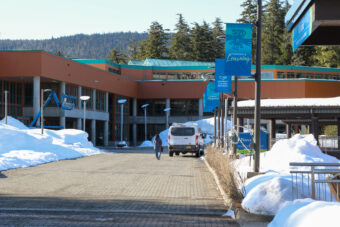
The University of Alaska Southeast campus in Juneau on Monday, March. 4, 2024. (Clarise Larson/KTOO)

Listen here:

The University of Alaska will increase tuition for the entire system for a second year in a row, and it’s higher than what its administrators recommended.

The Board of Regents approved increasing tuition across the board by 4% next year during a meeting Friday, despite an initial proposal from administrators of only 3%.

Student Regent Fernando Escobar proposed the additional increase to fund mental health initiatives. He said mental health services have not been funded for five years and suggested higher tuition as another way for the university to meet the need.

“I’m optimistic this legislative session, but I have to be realistic, and I think this may be our best approach for right now in order to support student needs in the system,” he said.

The board is requesting $965,000 in mental health services across the three campuses for the next fiscal year. State funding for the university goes through the Alaska Legislature for approval.

UA President Pat Pitney said the 4% increase is beyond what she considers to be a “modest” increase. She said they recommended the 3% increase as a way to avoid a large increase while factoring in rising costs.

“It also balances that there are anticipated fee increases in housing and dining services as we’re working on our auxiliary enterprises,” she said.

Regent Karen Purdue said she wants to see a way for progress to be made on providing mental health support to students.

“One way to think about this is it could be the students’ skin in the game to go ahead and continue to advocate at the Legislature for some, so some portion of the mental health would, there would be progress made, finally, on this issue,” she said.

Payton Callahan is the chair of the Coalition of Student Leaders, a group that represents students across the university system. She testified that many students already oppose any increase, and that the 4% figure might “blindside” students.

“I don’t know that that aligns with trying to keep retention, because I don’t know that students, frankly, can afford that increase, considering the current economic state,” Callahan said.

Union of Students University of Alaska Anchorage, the student government for the Anchorage campus, passed a resolution last month requesting the board increase the tuition by just 2% instead.

But not every incoming student will see higher tuition next year. Out-of-state undergraduate students at the University of Alaska Southeast will pay in-state tuition for the first time. That’s still a lower rate than what they currently pay.

But UAS Chancellor Aparna Palmer said the additional increase might affect the campus’ ability to recruit Alaskans.

“My sense is that we would still be a great deal in terms of out-of-state students,” she said. “But in terms of in-state students, we may not get that buy-in if we go to 4%”

Regents approved the increase unanimously, with Regent Seth Church absent. The new tuition rates will go into effect next fall.

University of Alaska unions ask Board of Regents not to sign federal higher education compact

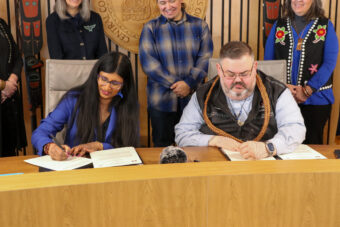
University of Alaska Regent Joey Krum and UA President Pat Pitney listen during a meeting at the University of Alaska Southeast in Juneau on Sept. 4, 2025. (Photo by Jamie Diep/KTOO)

Listen here:

A controversial higher education compact from the Trump administration has sparked a petition from several University of Alaska unions, who say they’re worried about political overreach stifling academic freedom. 

Several University of Alaska staff and community members testified against the Compact for Academic Excellence in Higher Education on Monday, ahead of the UA Board of Regents meeting later this week. A petition from unions representing faculty, graduate workers and university staff opposing the compact also received 659 signatures.

Jill Dumesnil is a mathematics professor for University of Alaska Southeast and the president of the faculty union United Academics AAUP/AFT. She said in an interview that the compact ties federal funding to a political agenda.

“It restricts the freedom to teach, research and learn,” she said. “It undermines institutional autonomy and self governance, and it ties benefits, research benefits, to factors other than scientific merit.”

The compact lays out requirements for universities to receive federal funding. Part of the compact instructs universities “to seek such a broad spectrum of viewpoints not just in the university as a whole, but within every field, department, school, and teaching unit.” It also includes a 5-year tuition freeze and limits how many international students a university can admit.

The U.S Department of Education initially sent the compact to nine universities, and most of them rejected it. In a Truth Social post last month, Trump said any higher education institution in the country could sign on to it.

Even though the UA Board of Regents has not made any move to accept the compact so far, Dumesnil said they want to make their voices heard on the issue. In February, the board suddenly approved a motion to scrub mentions of diversity, equity and inclusion in a process that didn’t give the public an opportunity to comment

“We didn’t want that to happen again. So that’s why we, we went ahead and told them what we, what we thought,” she said. “And you know, that’s all we can do.”

Kate Quick works for United Academics at the university, but testified on Monday as an individual. She says the February motion had a “chilling effect” on people in the university and community.

“When the compact came out, people started to say, ‘Oh, just wait. The board will be the first to sign,’” Quick said. “And so that’s why this petition went around, and that’s why people are calling tonight to ask you not to sign.”

But Jonathon Taylor, the director of public affairs for the university, says the motion from February is different from the compact because it was based on a direct communication from the federal Department of Education.

“If there’s a question as to whether or not the university needs to take action on particular direction or guidance changes or policy changes that have been made, we need to see those official communications to the university, because that’s what the standard practice is,” Taylor said.

Taylor said the agenda for this week’s meeting doesn’t include discussion or action items on the compact. The board is scheduled to meet on Thursday and Friday in Anchorage.

University of Alaska Southeast students gather to watch sci-fi film starring campus handyman

UAS employee Karl Sears in a scene from the 2014 film “Space Trucker Bruce.” (Screenshot)

A beloved maintenance employee at the University of Alaska Southeast starred in a low-budget sci-fi comedy a decade ago. This week, some UAS students screened “Space Trucker Bruce” to honor their friendly campus handyman, and to satisfy their own curiosity.

It’s about a space trucker hauling hog fat through the galaxy who picks up a hitchhiker whose ship has broken down. Hijinks ensue.

The low budget sci-fi comedy just so happens to star UAS handyman Karl Sears. It was made by local filmmaker Anton Doiron. He and Sears are old high school friends who reconnected in adulthood. 

Years ago, they wanted to make a short film for the JUMP Society festival in Juneau. On a drive one day, they came up with the idea of making a comedy about a space trucker. 

But the ideas kept coming, and it spiraled into something bigger, said Doiron.

“It grew from making a short to making, like, a full-length movie,” he said. 

Six years later, “Space Trucker Bruce,” starring the two of them, debuted at Juneau’s Gold Town Theater. 

Sears said it’s neat that the kids wanted to show it and invited them, but he finds their interest a bit odd. 

“It’s a little strange, and like, ‘what are you guys doing with your lives?’” he said.

The film has been out for 11 years now, and it’s available for free on YouTube, so sometimes people stumble upon it. 

“People talk about it,” Sears said. “And occasionally a student will come up to me and say, ‘I just watched it. It was so funny,’ or ‘it was good,’ you know, or, ‘I watched it,’ and they don’t elaborate.”

The 2014 film “Space Trucker Bruce” stars director Anton Doiron and Karl Sears. (Screenshot from film)

Sears said the film has been shown before, but this is the first screening he decided to come to. 

Ella Kelly is a residential advisor at UAS. She organized this screening and, like many students, she considers Sears a friend.

“He’s the only maintenance guy for housing,” she said. “So everybody’s had an encounter with Karl, and they’re all like good interactions, because he’s so nice and friendly.”

Kelly said she didn’t know about the film until she saw the poster for it outside of Sears’ office

“It’s always made me very curious,” she said. “Because I’m a big fan of a low budget film.”

About a dozen students came to the screening, and they filled the room with laughter.

Doiron said he has a new project coming soon that Kelly may like. It’s called “Girl, Yeti, and a Spaceship,” and there are some thematic similarities to his first film.

“There’s a bored state worker,” he explained. “He’s in management, and he’s bored, and he takes his dog out hiking one day, and he sees Bigfoot, and he starts following Bigfoot, and he finds this cave with a big spaceship in it, and the spaceship is broken.”

Hijinks ensue. Doiron said the new project comes out next year.

Site notifications
Update notification options
Subscribe to notifications