Elizabeth Jenkins, Alaska's Energy Desk - Juneau
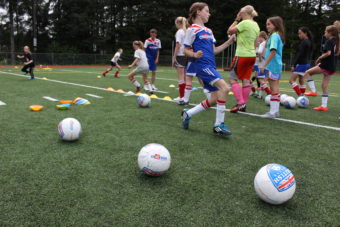
Juneau soccer camp grooms players for the international field

Juneau Soccer Club hosts the coed camp which teaches kids about the global sport. (photo by Elizabeth Jenkins/KTOO)
Juneau Soccer Club hosts the coed camp which teaches kids about the global sport. (Photo by Elizabeth Jenkins/KTOO)

As the U.S. team heads to the Women’s World Cup quarterfinals this weekend, a Juneau soccer camp is teaching kids all about the global sport.

On the turf at Adair-Kennedy Memorial Park, a group of Scots and Brits are teaching 145 kids how soccer–or what they call “football”–is played across the pond. Miley Quigley is part of the 11- to 13-year-old group. She says her favorite thing about the camp is learning new skills.

“I barely knew any tricks before and now I know a lot of tricks because Spider Man taught us,” she says.

“Spider Man” is the nickname for Stephen Paris, a sports coach major from Glasgow, Scotland. He doesn’t play competitively due to an old foot injury, but that doesn’t stop him from teaching the sport. His signature move is called a “rainbow.”

With the kick of his heel, the ball arches over the back of his body.

“Right over the head. I went right over the reporter’s head,” he says.

Coach Paris runs the girls through drills. (Photo by Elizabeth Jenkins/KTOO)

Challenger Sports sends foreign players, like Paris, to different parts of the country to teach regional techniques. Last year, a Brazilian group taught Samba dribbling.

“It’s like the fancy freestyle side of soccer. So like all these flicks you see. You run pass the player. It’s flair,” says Hamza Butt, otherwise known as “coach Hamburger.”

He can be pretty strict on the field, which he says comes from his background playing semi-professional soccer in England. Unlike Samba dribbling, the British style is more buttoned-up, strategic.

“You got to be much more technical,” he says. “Teams want an individual who has everything to his game: passing, dribbling, crossing, shooting.”

Typically, soccer teams are an international patchwork, but in the World Cup, athletes play for their home country. Coach Butt says the kids here at camp are watching.

“For example, Rapinoe, the U.S. winger. Women here in the camp, want to be like Rapinoe,” he says. “Whilst they’re dribbling the ball, they say, ‘It’s Rapinoe! Rapinoe!’  They’re are trying to imitate these players.”

But the young women say it can be tough to find equality on the field, especially when you’re teammates with pre-teen boys. They hurl what they think is the ultimate insult: “You play like a girl.”

“It’s kind of honestly really sexist when they say ‘like a girl,’ cause we’re like, ‘why?'” says camp participant Merry Neuman.

Because these soccer players know what it really means.

“Then you must be doing something really good if it’s like a girl  because we’re way better.”

The last time the U.S. men’s team reached the World Cup quarterfinals was in 2002.

Bloom boom: Juneau farmer joins Alaska peony rush

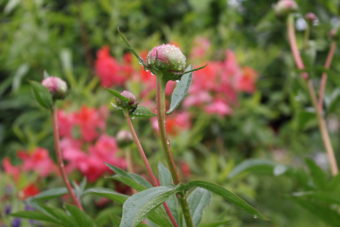
Peonies from Brad Fluetsch's home garden.  (Photo by Elizabeth Jenkins/KTOO)
Peonies from Brad Fluetsch’s home garden. The shrubs can take up to five years to mature.  (Photo by Elizabeth Jenkins/KTOO)

Interior Alaska has about 50 commercial peony farmers and now a Southeast grower is about to give the cash crop a shot. The flowers are supposed to be the next big boom in Alaska exports.

Brad Fluetsch’s home garden is pretty idyllic. Hummingbirds and bees flit around a colorful array of ornamental plants, yet the most valuable flower hasn’t even opened yet. It can take up to five years to get to this point.

“You grab it and you squeeze the bloom and if it feels like marshmallow, it’s just about ready to pick,” Fluetsch says.

Peonies are big and frilly. Picking one before it opens and refrigerating it can extend the flower’s vase life to more than 14 weeks. Its ability to withstand long travel is one of the reasons why some think peonies could be state’s next big export. Another reason is that the peony can’t be found anywhere but in Alaska in the late summer months.

“That’s why we’re doing it,” he says. “Right now, there’s such a limited a supply of stems to the market.”

Rainforest Peonies overlooks the Gastineau Channel on north Douglas Island. (Photo by Elizabeth Jenkins)
Rainforest Peonies overlooks the Gastineau Channel on north Douglas Island. (Photo by Elizabeth Jenkins/KTOO)

A short drive from Fluetsch’s house and a half-mile trek through muskeg, we arrive at 10 acres of beachfront property on north Douglas Island — the future site of Rainforest Peonies.

“This is basically a clearcut,” he says. “You have big old brush piles of stumps and logs. Some windblown trees and then some trees we haven’t cleaned up yet.”

Last year, Alaska-grown peonies were exported to 34 states. Each stem can fetch anywhere from $2-$7, and the buyer pays shipping costs.

Not too long ago the flower was considered old-fashioned, but like anything old, it can be made new again. Especially if the one selling it is America’s wedding tastemaker, Martha Stewart.

Fairbanks horticulturist Patricia Holloway says the celebrity has done a lot to promote and market peonies.

“That’s one of her favorite flowers,” she says. “And it is the number one bride’s flower in the United States.”

Holloway is a tastemaker in her own right. She’s known as the “godmother of Alaska peonies.” Several years ago, she caught wind that the flowers could grow here and fill a gap in the market.

“I was getting phone calls almost immediately from places like London wanting Alaska peonies because no one could believe that we had them in July,” she says.

Peonies in bloom. (Photo by Elizabeth Jenkins/KTOO)
The company could employee up to 15 people in Juneau once it’s fully operational. (Photo by Elizabeth Jenkins/KTOO)

Alaska Peony Growers Association already test marketed them to Taiwan. Red peonies are a favorite in parts of Asia and whites sell best in the U.S. and Canada. Alaska can’t support the international market just yet, but Holloway says that may change.

She estimates the number of commercial growers could double in the next few years.

“Just like the gold rush years and years ago. People came north trying to make some money,” she says. “There are going to be people who succeed and there are going to be people who fail.”

Brad Fluetsh and his business partner Frank Bergstrum dig waterfront beds for the peonies. (Photo by Elizabeth Jenkins/KTOO)
Brad Fluetsch and his business partner Frank Bergstrom. (Photo by Elizabeth Jenkins/KTOO)

At the farm, Brad Fluetsch plunges a shovel into coffee-colored dirt.

“We could grow just about anything in this,” he says.

About 200 peony beds will be built on the site. He says one of the challenges of growing the flower in Southeast is soil drainage. He’s barged over several tons of sand to fix that. A fungus called botrytis could be another problem.

Once the operation is in full swing, Fluetsch says he could earn up to $800,000 in a year, but there are risks involved. Peonies have to freeze in order to bloom and warm winters could be detrimental.

“If it happens in the first year, you’re out $20,000 in one year,” he says. “But if it happens to a mature crop … then you’re out a lot money for the roots plus five years.”

Rainforest Peonies first crop is expected in 2019.

40-foot cruiser towed after striking rock near Coghlan Island

A 40-foot cruiser struck a rock late Sunday morning near Coghlan Island in Auke Bay.
Petty Officer Laura Steenson said the Coast Guard station in Juneau was notified and launched a response boat to make sure there were no injuries.

“There were three good Samaritans on scene with dewatering pumps,” she said. “The vessel wound up getting towed to the beach. At this point, there are no reports of pollution or oil sheen in the water.”

The four passengers on the boat were unharmed. The Coast Guard did not name them.

The Coast Guard reminds people to be careful on the water this summer, to have emergency supplies nearby and always wear life vests.

Juneau protesters say “Shell, no!” to upcoming Arctic drilling

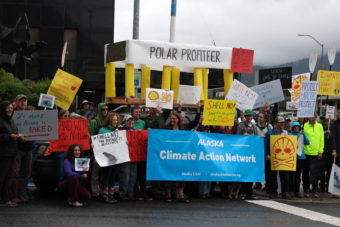
Some of the signs were taped to kayak paddles. A nod to the Kayaktavists in Seattle. (Photo by Elizabeth Jenkins/KTOO)
Some of the signs were taped to kayak paddles, a nod to the kayaktivists in Seattle. (Photo by Elizabeth Jenkins/KTOO)

A crowd of about 40 gathered in the drizzling rain outside Juneau’s federal building this afternoon to protest Royal Dutch Shell’s oil rig, the Polar Pioneer. The vessel left Seattle on Monday after weeks of public outcry.
Alaska Climate Action Network organizer Elaine Schroeder passes out a rainbow of signs, handwritten slogans in splashes of yellow and blue, to people arriving at the rally.

One reads, “Alaska moms for a renewable future: there is no creature more dangerous than a mother bear protecting her cubs.”

“So that’s one of our more adorable signs,” Schroeder says.

Shell’s massive oil rig, the Polar Pioneer, is now sailing to the Chukchi Sea. In May, the Bureau of Ocean Energy Management gave conditional approval to the company to start exploratory drilling this summer off Alaska’s Arctic coast.

“And we’re saying no to Shell. You’ve got to keep the oil in the ground. What we’re talking about here is extreme extractions,” she says.

Photo by Elizabeth Jenkins/KTOO

Concerns from environmental groups include the likelihood of a spill, the impact on coastal Native communities and climate change.

“We want renewable energy sources and that’s what our money should be going for,” Schroeder says.

In a statement, the Bureau of Ocean Energy Management said the Polar Pioneer will meet “rigorous safety standards” during its exploration.

Some of the signs at the rally are taped to kayak paddles, a nod to the kayaktivists in Seattle. Lorena Guillen and her husband are Seattleites on vacation.

“We’re trying to see the glaciers before they disappear,” Guillen says.

They were active in the protests down south but weren’t expecting to spend their trip this way. Then they saw a flyer in a Heritage Coffee shop.

“It was really nice to see the sign in the coffee shop because it was like, ‘Yes, this is exactly the fight we need to continue and not give up.'”

Mid-rally, a car swerves into a handicapped spot. The vehicle has a large wood and paper structure strapped to the top. Elaine Schroeder explains:

“Right now what just drove by was a replica of the Polar Pioneer,” she says. “Only we call it the ‘Polar Profiteer’ rather than the Polar Pioneer.”

Schroeder says the “Polar Profiteer” will make another appearance at the Fourth of July parade. But the group hopes the Polar Pioneer doesn’t arrive to its next destination.

The oil rig is expected to arrive in Unalaska later next week.

Juneau’s state employees may not suffer the full impact of cuts

Nearly 500 jobs could be cut as the dust settles on the 2016 state operating budget, but the local economy may not immediately feel the impact of those losses.
More than half of those positions will come from vacant spots.

Deputy Commissioner of the Alaska Department of Administration Leslie Ridle says that could “soften” the situation here in Juneau.

“The first round of cuts, people cut empty positions but they cut real live bodies, too,” she says. “So in the next round, because the empty positions, most of them have already been cut, it’ll be even more actual people that get cut in a second round of budget reductions.”

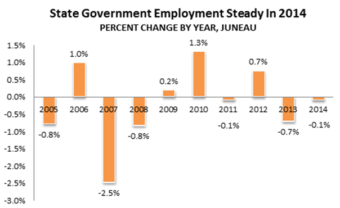
That’s expected next year. In 2014, government employment fell in Alaska by 760 jobs, but Juneau remained relatively flat.

Chart courtesy of Conor Bell, economist at the Alaska Department of Labor.

Alaska State Department of Labor Economist Conor Bell says the city’s slow population growth could be good for people looking for jobs.

“There’s more working age people leaving than moving to Juneau and so even if we’re not seeing strong employment growth. It makes it a little better than it seems for job seekers,” he says.     

Statewide, the private sector grew by about 1,200 jobs last year. Industries like hospitality, mining and construction are expected to continue to do well in the capital city.

However, new construction may cool towards the end of the year as funding for future projects dry up.

Online cemetery mapping to ensure Juneau always knows where the bodies are buried

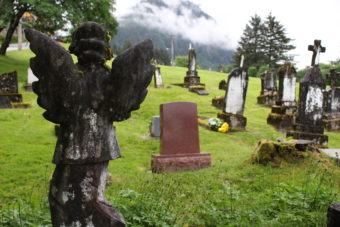
The Evergreen Cemetery is split up into different sections.  This is the "Serbian" part of the grounds. (Photo by Elizabeth Jenkins/KTOO)
The Evergreen Cemetery is split up into different groups. This is the Serbian part of the grounds. (Photo by Elizabeth Jenkins/KTOO)

A grease-smudged stack of 25 fading sheets of paper in a storage shed is one of only two copies of who’s buried where in Evergreen Cemetery. All the burials since 1986 are handwritten, but that’s about to change. The City and Borough of Juneau was recently awarded a grant to map its graves digitally.

Ben Patterson has been overseeing the grounds at Evergreen Cemetery for about 12 years. During that time, he’s been able to reflect on where he’d like to spend his final days.

“I definitely don’t want to be put into the ground, I know that,” he says. “I don’t know if that’s because I’ve spent so much time in the cemetery, but I think I’d rather be spread around a little bit.”

Inside the cemetery storage shed, along with gardening tools and a lawnmower, is an invaluable stack papers.

“Basically 25 pages of maps that show all the plots,” Patterson says.

The other known copy is kept in a separate location to avoid both being destroyed in a fire. More than 8,000 people are buried at Evergreen. The cemetery dates back to the 1880s when it was moved from its original spot on Chicken Hill.

“It was staked as a mining claim for gold. So they had to move everyone that was there,” Patterson says.

Some of the rectangular plots look like they were thrown out like dice, some are orderly. Names collected from a 1986 survey are printed inside some of those rectangles.

“All the handwritten notes are just all the burials that happened since then or were discovered since then,” he says. “And that’s basically the only record of the these locations since the 80s.”

One of only two known records of Evergreen Cemetery. (Photo by Elizabeth Jenkins/KTOO)
One of only two known paper records of Evergreen Cemetery. (Photo by Elizabeth Jenkins/KTOO)

It’s not a great system, though Patterson has almost all the grave sites memorized. He can flip through the 25 pages and find people by name, and he can find them on the ground.

“I was just mowing the other day and someone walked up and asked me where a certain person was and I just happened to have just weed whipped around his headstone and they were joking with me that I had all 8,000 graves memorized,” he says.

With the rise in genealogical databases, like Ancestry.com, Patterson says he’s noticed an increase in these requests. Last week alone, he’s located the graves of five different people. A new system will be a big help.

“It is huge. It’s going to mean that’s it’s going to be way easier for people to find everyone in Evergreen,” he says.

The City and Borough of Juneau was awarded a $17,000 grant in federal funds to put a cemetery map online.

Quinn Tracy is the lead cartographer on the project. (Photo by Elizabeth Jenkins/KTOO)

Outside, city cartographer Quinn Tracy holds a GPS device above the headstone of Joe Juneau to pinpoint the exact geographic location. The device beeps as the site is mapped.

“So when I bring these points into the information geographic names system, I’ll have a point and then name associated with that point,” he says.

Buried at Evergreen are several notable people in Alaska’s history: city co-founders Joe Juneau and Richard Harris, victims of the sinking of the Princess Sophia and civil rights activist Elizabeth Peratrovich.

Tracy only needs two coordinates per grid section to map the entire cemetery–the rest will be overlaid using a digital scan of the 1986 survey. He peels back the moss from a crumbling headstone to uncover a name.

“I don’t know, it’s just kind of sad that some of these you can’t really read,” Tracy says.

Soon family and friends will be able to search for grave sites on the city’s website with the click of a mouse.

“It’ll be similar in concept to Google Maps where you enter an address and it takes you to that location,” he says. “In that case, you’ll enter someone’s name and will take you to their location in Evergreen Cemetery.”

Most of the remaining plots were sold in the 1950s and the site is almost full. Before long, there will be no new burials. Children nearby take turns tumbling down the hill.

Groundskeeper Ben Patterson says he doesn’t mind the historic resting place being treated like a park.

“I don’t find that disrespectful. I think it’s one of the neatest things about our cemetery is that it’s just so peaceful and people like it so much,” Patterson says.

The Evergreen Cemetery map goes online in October.

Site notifications
Update notification options
Subscribe to notifications