Elizabeth Jenkins, Alaska's Energy Desk - Juneau
Forgiving without forgetting: A Tlingit village up in smoke

John Morris remembers the spot where his house once stood. (Photo by Elizabeth Jenkins/KTOO)

In 1962, the Douglas Indian Village was set ablaze to make way for a new harbor. This month marks 53 years since the city displaced households of Tlingit T’aaku Kwáan families. Little to no restitution has ever been offered.

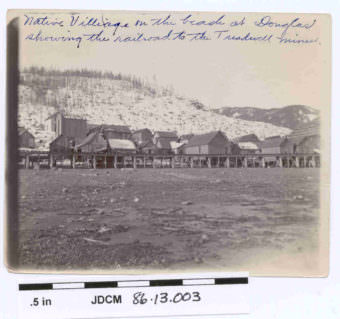
The Douglas Indian Village was a winter spot for the T’aaku Kwáan people. Water flowed underneath a row of about 20 structures on pilings. There was a saying, “this was where the sun rays touched first.”

The village had no running water or electricity. But to John Morris it was home.

“That was the trail I used to walk to go to school right here. But my house was right where that truck is right now,” he says.

Where we’re standing has been filled with gravel. The water no longer comes up to this point. It’s been turned into Savikko Park, a place where children play Little League and families grill out hamburgers.

Morris remembers seeing his childhood home here going up in smoke.

“We left everything as is in the house with the thought that if they saw that we hadn’t moved anything out that they would maybe prolong the burning. It didn’t stop them.”

Fishing nets, clothing, dishes–everything.

“There are no pictures of my childhood. It was all burned up in that house,” he says.

Morris is a carver, teacher and tribal leader. At 75 years-old, he’s also one of the last living members of the tribe to witness the burning of the village in 1962. He remembers, back then, racial tensions were high. He delivered newspapers as a kid.

“And I had a paper sack that had Juneau Empire on it. And as long as I had that paper sack I could go anywhere in Douglas. Once I took that sack off people would tell me, ‘Get down to your village.’”

This photo shows the Douglas Indian Village and railroad to the Treadwell mines in 1900.
This photo shows the Douglas Indian Village and railroad to the Treadwell mines in 1900. (Courtesy Juneau-Douglas City Museum)

In 1946, the Douglas Indian Association was looking for boat loans. At the time, boats were kept under the house. But that wasn’t deemed suitable. So the city and the Army Corps of Engineers were asked to build a harbor where the village stood–with the understanding the village would be rebuilt.

That plan didn’t go anywhere.

“But the plan for the harbor stayed on the books and in 1962, the City of Douglas destroyed the Indian village to build that,” says attorney Andy Huff. He put together a formal report in 2002 on what happened for the Montana Indian Law Resource Center.

Back in the 60s, the City of Douglas found a loophole to condemn the Native village: Most of its occupants were gone to fish camps in summer.

“Even so, the city didn’t have jurisdiction over the houses in the first place. It was a federally protected enclave.”

Huff  says when he was doing his research, two more red flags stood out. One was the Bureau of Indian Affairs, the agency that’s supposed to help, did nothing to intervene.

“They just flatly refused to get involved even though there was this plan to kind of destroy the village,” Huff says.

The other red flag was a possible conspiracy.

“I found that two members on the city of Douglas zoning commission, which was the entity in charge of destroying this village, were also members of the Bureau of Indian Affairs at the same time. ”

They were Charles Jones and A.W. Bartlett. Both men resigned from the zoning and planning committee citing conflict of interest. But the plans to burn the village were already underway. Huff says that’s an obvious breach of trust. When he put the report together 13 years ago, he thought it would affect change but no restitution has been offered. He thinks, even after all this time, there’s still a legal case.

“I don’t think the federal government can argue it doesn’t know exactly what happened and what the issues are in light of the report coming out and being released by the tribes,” he says. “Something should have happened by now.”

The Bureau of Indian Affairs could not be reached for comment.

Morris says his uncle wasn't going to leave. He had to pull him out before the fire began. (Photo by Elizabeth Jenkins/KTOO)
Morris says his uncle wasn’t going to leave. He had to pull him out before the fire began. (Photo by Elizabeth Jenkins/KTOO)

After the controlled burn in 1962, the village was never rebuilt. The Douglas Harbor and eventually the park were constructed in its place. Morris, who was on military leave at the time, says he went back to Fort Hood, Texas, changed.

“I went back with a bitterness. A bitterness that I’m not going to have anything to come back to. I don’t have a home. The people I grew up with, I got to see firsthand, how they treated us people, us Natives,” Morris says.

It took years for him to come back to the Juneau-Douglas area but he did. He says sometimes friends tell him he should file a lawsuit; he could be a millionaire.

“My response is that’s not what I’m after. I do want to see that corrected but it will never leave me. It will never leave me. It lays dormant and I don’t like to touch it unless I have to,” he says.

Morris says he forgives but he doesn’t forget. He would like to see restitution for the T’aaku Kwáan people.

Assembly addresses Juneau’s growing housing problem

(Photo by Elizabeth Jenkins/KTOO)
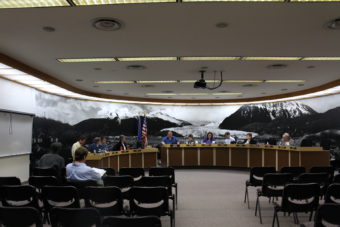
The Juneau Assembly on Monday. (Photo by Elizabeth Jenkins/KTOO)

Much of the conversation at Monday’s Juneau Assembly meeting centered on housing and how Juneau could grow as a city.
The Assembly approved $72,000 for a grant incentive program which gives homeowners cash to construct accessory apartments. Assemblyman Jesse Kiehl called the plan a “premature” use of limited funds.

“We haven’t heard from the public about what the recommendations are. We haven’t heard from the consultants about what the recommendations might even be and we’re using money quite frankly probably to incentivize things that are already, probably going to happen,” he said.

Kiehl said a housing action plan is already in process, further input is needed to make sure the funds are used wisely.

“An old saying is keep your powder dry. In this case, I think we need to keep the taxpayers’ cash dry,” he said.

In 2012, the Juneau Economic Development Council found the city needed hundreds of new units to improve the tight market for renters.

Assemblywoman Kate Troll said there is nothing in the housing action plan that suggests this is not a good move.

“The affordable housing commission is very engaged in this issue,   and they still feel very strongly in terms of trying to make a difference, a big difference on the ground for the smallest amount of money, this is a very worthwhile program,” she said.

Kiehl was the only Assembly member to vote no.

Later, zoning changes near mile 7 of Glacier Highway were discussed–a move some said could help with Juneau’s housing problem. The area is zoned for single-family homes. The ordinance would more than triple the density.

Dave Hanna testified it would “unfairly change the character of the neighborhood.”  Not fix Juneau’s housing problem.

“Now we’ve heard density is the answer to our housing problem here in Juneau but we also hear Juneau is sorely underserved in the single-family market. We really need more single-family homes here,” he said.

At an April meeting, the planning commission recommended denying the proposed rezone. The Assembly approved the ordinance with Assemblywoman Kate Troll and Assemblyman Jerry Nankervis voting no.

Editor’s Note: An earlier version of the story attributed a quote to Assemblywoman Karen Crane but it was Assemblywoman Kate Troll who said it. We regret the error. 

Bust a move: International duo brings breakdancing to Juneau

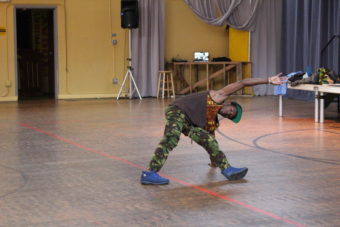
Fahad Kiryowa shows a class how to master the basic moves of breakdance. (Photo by Elizabeth Jenkins/KTOO)

A visiting breakdance duo has been teaching Juneau residents some new moves. They’re featured in a documentary that’s playing in town over the weekend about hip hop culture and social change in Uganda.
See the dancers perform tonight at 6:30 at the JACC. “Shake the Dust” premieres at the Silverbow Backroom at 8 p.m. Saturday.

About 12 people ranging from toddlers and teens to adults are learning the fundamentals of breakdance at the Juneau Arts and Culture Center.

“Breakdancing is one of the elements of hip-hop. It’s the way you use your body,” says Fahad Kiryowa, the dance teacher who lives just outside Kampala in Uganda.

Breakdancing is often characterized as being low to the ground. There’s spins and flips. It’s a full body workout.

But Kiryowa is taking it slow with his new students.

He’s here in Alaska teaching with Eric Egesa.

Juneau-born Rachelle Sloss convinced the pair to come up to her hometown. She’s lived in Kampala for several years and became fast friends with the two through Breakdance Project Uganda.

“By the end of my first week there, I was totally sold on this place with so many great dancers and this great community,” she says.

The dancers just attended a youth leadership camp in Colorado.

“And the camp funded their international flights. Then they were here and we thought, ‘Let’s go to Alaska,'” she says.

Photo by Elizabeth Jenkins/KTOO
(Photo by Elizabeth Jenkins/KTOO)

Egesa started dancing when he was a kid. He says it took some effort to convince his parents that breaking was a good thing.

“Anything football or any sports, back in Uganda when children join anything, they just go into drugs,” he says.

The director of Breakdance Project Uganda came to visit Egesa’s house to talk with his parents. It’s a nonprofit that offers free dance lessons and mentorship to at-risk youth.

Egesa’s parents said yes.

Kiryowa says breaking entered his life at the right time.

“I couldn’t listen to my parents. I was chilling with the gangs because that’s what I see people doing,” he says. “So I was just like that. Stealing, that was one of the things I always did.”

But he didn’t want to go down that path.

“When I started doing breakdance, they said if you love this you have to quit the other one.  It was at first hard for me, but when I got into dance I loved it. And I was like, ‘Oh, I’m stopping this.’”

After a while, people started to notice a change in him.

“My mom was like ‘Wow. Are you still on drugs?’ I was like, ‘No.’ I changed my life, dance changed my life,” he says.

When he’s home in Uganda, Kiryowa says people see him as a leader. The dancers are looking forward to sharing their stories of Alaska back home.

https://www.youtube.com/watch?v=NXS4RTliiO8

K-9 in training to combat Juneau’s heroin problem

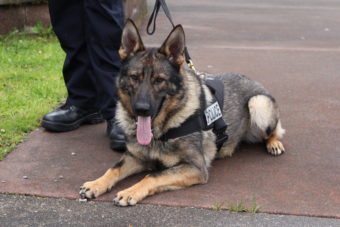
Buddy has been with the Juneau Police Department for about three weeks. (Photo by Elizabeth Jenkins/KTOO)

The Juneau Police Department’s newest recruit is a young gun, just 18 months old and 63 pounds. He’s a German shepherd named Buddy with black and sandy brown fur. It’s been about 25 years since the department had a K-9 on staff.
His partner, Officer Mike Wise, is training Buddy at Dzanktik’i Heeni Middle School to sniff out drugs on campus.

Inside a classroom, Wise snaps on blue plastic gloves while Buddy waits in the car.

“So, basically right now. I have some narcotics on me I’m going to be planting and basically getting ready to hide,” he says.

Wise unscrews the lid off a mason jar and pulls out 4 grams of black, tacky looking heroin.

“We’re going to put it in the stash box and then we’re going to put it inside the filing cabinet.”

The police department received nearly $25,000 in grant money from the feds to bring the K-9 on staff. Buddy was Russian-born and snapped up by a recruiting agency that finds dogs with a “high drive” for law enforcement.

Officer Wise had to fly down to Alabama to pick up Buddy, then named Baddie.  He remembers walking in a kennel with 30 dogs barking. The handler pointed to a German shepherd and handed him a collar.

“And I didn’t know who this dog was, I’d never met him before, and he’s never seen me,” he says. “And for a stranger just to walk into his kennel was kind of terrifying.”

But Buddy just looked at him and wagged his tail.

“There was a huge relief to know that this dog is not going to try to eat me. The first day Buddy walked off and he just wanted to pull me everywhere,” he says.

Slowly, Wise started to bond with his new partner; he brushed Buddy’s fur, played with him and did some additional training before bringing him back home to his wife and two kids.

“And from then on it’s been inseparable. We just stay together.”

Buddy is trained to smell heroin, meth and cocaine. But not marijuana since that’s legal now in Alaska. His nose is so good that he can detect each note in the narcotics. For example, you might walk into a room and smell a delicious pizza.

“He smells every little ingredient that’s involved in making that pizza. That’s how he does it with the meth, cocaine or heroin and knows that’s something,” he says.

Officer Wise says he stores the heroin used to train Buddy in his wife's old mason jars. (Photo by Elizabeth Jenkins/KTOO)
Officer Wise says he stores the heroin used to train Buddy in his wife’s old mason jars. (Photo by Elizabeth Jenkins/KTOO)

The police department is going to need the help. Last year, they confiscated over $4.6 million of heroin in Juneau. There’s a big incentive for smugglers. A dose here is worth five times more than down south.

Lt.  Kris Sell oversees investigations. She says Heroin gets to Juneau in a number of ways.

“The people who are importing heroin move regularly between the U.S. mail, other mail delivery services and bring it in on the airlines or on the ferry,” she says.

Last year’s seizures were made up of a couple of big busts and several small ones. A drug conspiracy involving stolen Costco jewelry yielded 10,000 street doses of heroin.

“In Juneau, we’ve had such a heroin problem, I think you’d be hard pressed to find an adult who doesn’t know a  family who’s been impacted in some way by the addiction.”

Sell says there hasn’t been a sudden spike in heroin, it’s more like a steady march. And finding it once it’s here can be difficult.

“People have done things like taped drugs to the underside of the baby’s dresser in the baby’s room,  Buddy will help us ferret out things like that. Things we’re worried we haven’t been finding.”

Buddy's "paycheck" is a piece of hose or PVC pipe. (Photo by Elizabeth Jenkins/KTOO)
Officer Mike Wise watches Buddy play with his “paycheck.” A piece of hose, sometimes PVC pipe. (Photo by Elizabeth Jenkins/KTOO)

Back inside the classroom, Wise holds tight to Buddy’s leash which is attached to a police harness. He walks him around but, really, Buddy is leading him to the place where we stashed the heroin.

Right when he sniffs the filing cabinet, he lays down–indicating this is the spot.

A black piece of rubber hose is discreetly thrown over Buddy’s head.

It’s his paycheck for a job well done. Wise will play tug of war with it and let Buddy win. Then he’ll hurl the toy back out of sight. Buddy is restrained from going after it.

“So, he’s always assuming his toy’s in the field out there. So when we’re working. He’s looking for this toy again. That’s why he’s doing what he’s doing for that thing right there,” he says. “So, we’re going to hide it from him. It kind of makes him mad a little bit, but we gotta keep working. ”

Wise hopes with Buddy’s help, incoming drugs can be kept off the street. They’ll start patrolling the airport, commercial barges and ferry system soon.

Man with multiple arrest warrants runs from Juneau Police

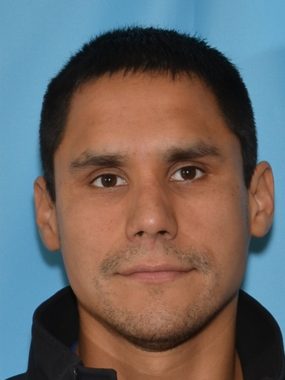
The Juneau Police Department is looking for 32-year-old Derick Nathaniel Skultka, who has three warrants out for his arrest.
On Monday, an officer spotted Skultka’s vehicle going over the speed limit in Douglas. Lt. Kris Sell says an officer attempted a traffic stop, but was unable to detain Skultka.

Derick Nathaniel Skultka has three warrants out for his arrest. (Photo c/o Juneau Police Department)

“The subject drove into a residential neighborhood, he ditched the vehicle and ran between residences in a brushy area,” Sell said.

He disappeared near Nowell Avenue. Additional officers were called to the scene; however, Skultka wasn’t found.

Six hours later, he was involved in a car accident near McDonald’s and fled immediately. His passenger, the owner of the vehicle, complained of “pains” from the crash.

JPD believes Skultka may be hanging out near Switzer Village where the woman lives.

Skultka’s arrest warrants stem back to February when he failed to appear in court for charges of burglary and fourth degree assault.

JPD is asking anyone with information on Skultka’s whereabouts to call 586-0600.

Douglas Indian Association charters cruise to the Taku Glacier

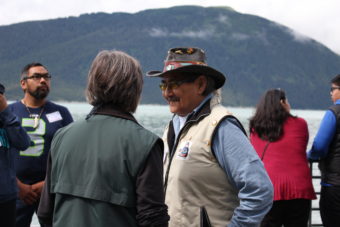
John Morris, a Douglas Indian Association Tribal Council Member, says people recognize him by his trademark hat. (Photo by Elizabeth Jenkins/KTOO)

On Sunday, the Douglas Indian Association invited tribal elders, elected officials and members of the press on a trip up to the Taku Glacier.

DIA members are Tlingit and originate from the T’aaḵu Kwáan and A’akw Kwáan clan — the original inhabitants of Douglas and Juneau.

The organization chartered an Allen Marine vessel to discuss transboundary mine issues and the culture of the T’aaku Kwáan. For some, the cruise was an opportunity to see their ancestors’ waters for the first time. Tillie Day is Tlingit of the T’aaku Kwáan

“We originate from Taku River and this is my first time seeing gillnetters and I worked in a cannery for how many years. I’ve never actually seen them do the gillnetting thing and this is pretty cool. There’s like 35 boats out here,” she said.

The cruise stopped at noon to observe the gillnet fleet put nets in the water to fish for sockeye.

Family members aboard the Douglas Indian Association chartered cruise threw flowers into the water to honor deceased relatives. (Photo by Elizabeth Jenkins/KTOO)

Later, John Morris, a Douglas Indian Association Tribal Council member, spread his brother’s ashes at Taku Inlet near Davidson Point.  His brother died in the spring.

“And since then I’ve been in possession of his ashes. I went to council a couple of months ago and told them I thought this would be a good time to lay them on the river,” he said.

Other family members threw flowers in the water to honor the deceased.

Site notifications
Update notification options
Subscribe to notifications