Elizabeth Jenkins, Alaska's Energy Desk - Juneau
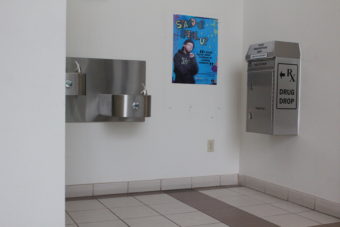
New RX Drug Drop gives community a chance to safely purge meds

The RX Drug Drop is located in the lobby of the Juneau Police Department. Prescription medication is welcome. Needles and liquids are not. (Photo by Elizabeth Jenkins/KTOO)

Starting Monday, Juneau residents will be able to walk into the police department and hand over prescription drugs without consequence. It’s been several months since the community could safely dispose of their medications.

Adam Nelson is the lead pharmacist at Juneau Drug Company. A quaint, old-fashioned pharmacy in the heart of downtown. He started working here when he was 14 and became a pharmacist about five years ago.

He says his favorite thing about the job is the people.

“Talking to them, finding out about their day and helping in any way I can,” he says.

But something that can be difficult to help customers with is what to do with leftover prescription pills. He says they inquire once or twice a week, “Can I drop this off here?”

“Because they went to the dentist, they give them 20 pain pills in case they need them, they only take three,” he says. “And they need somewhere to put them and most people in Juneau don’t want to throw them in the garbage.”

Adam Nelson says people come inquire once of twice a week what to do with prescription drugs. (Photo by Elizabeth Jenkins/KTOO)
Adam Nelson says people inquire once or twice a week what to do with leftover prescription drugs. (Photo by Elizabeth Jenkins/KTOO)

Trace amounts of medication, flushed down the toilet or thrown in a landfill, can wind up in your drinking water.

“Let’s say, you go to the dump and you throw in a handful of pills in the dump. All that rain water is going to turn it into liquid and it’s going to flow out into the streams and the creeks,” he says.

Twice a year, the DEA, along with the Juneau Police Department, would round up surplus pharmaceuticals. But that program ended last year after funding was cut.

Lt. Kris Sell from JPD says disposal options were non-existent.

“People were justifiably frustrated when they were trying to do the right thing and there wasn’t an avenue to responsibly and legally dispose of their medications,” she says.

Now with the RX Drug Drop, people can walk in and safely get rid of their meds.

The model has worked successfully in other places, such as Ketchikan. The police department there has been doing it for about 2 ½ years. Sell says people can drop off medication anonymously.

“There’s no forms to fill out it’s just like a book at the library.”

Last year, JPD confiscated 374 prescription opioid pills which can elicit the same effect on the brain as heroin. Sell says addiction can start at home and lead to harder substances.

“When we talk to addicted people, they almost always started with someone’s prescription drugs.”

With the addition of the drop box, JPD hopes it won’t come to that.

Editor’s note: The spelling of Lt. Kris Sell’s first name has been corrected. 

Adventure-bound Juneau couple moves into $8,600 tiny house on wheels

Curtiss Stedman and Kelly Tousley's new home. (Photo by Elizabeth Jenkins)
Curtiss O’Rorke Stedman and Kelly Tousley’s new tiny home. (Photo by Elizabeth Jenkins)

A 1,200-square-foot house is considered small by today’s standards. But one Juneau couple is leaving their home for something with less than 100 square feet of livable space. They’re hitting the road, but that doesn’t come without sacrifice.

On the curb in front of a brown house sits a bookshelf, a suitcase and empty picture frames. Passersby might think the tenants are moving out or spring cleaning.

“We don’t really have enough time to do a true yard sale so this is our, like, piecemeal please-everybody-come-take-our-stuff-so-we-can-move-into-98-square-feet,” Kelly Tousley says with a laugh.

There’s also a sign: “Knock on the door for more items for sale in the house.”

Kelly and her boyfriend are getting rid of nearly everything they own to fit into a tiny house on wheels parked outside their rental. From the outside, it looks like a glossy white travel trailer.

“I mean, picture opening up the back of a U-Haul and that’s what we started with,” she says.

But the inside is more like a home with vinyl hardwood floors and lime green walls. They’ll pull the trailer with a truck for a yearlong trip through the Alaska road system and down to the Lower 48.

The small bathroom is separated from the kitchen by a curtain. (Photo by Elizabeth Jenkins/KTOO)
A curtain separates the small bathroom from the kitchen. (Photo by Elizabeth Jenkins/KTOO)

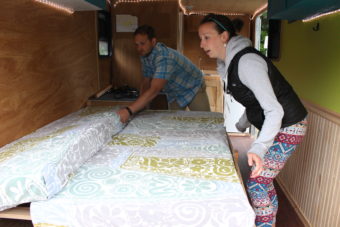
For such a small space, it’s remarkably plush. A bench folds out into a queen-sized bed.

“We had the conversation of, if we’re living in this and this is our house, we don’t want to be sitting on milk crates with cushions on top of them and feeling like we’re going to get slivers in our fingers when we touch the walls,” she says.

Electricity runs off solar panels. There’s a small bathroom separated by a curtain and a kitchenette but no running water.

It’s their version of the tiny house movement, downsizing and taking a do-it-yourself approach to home ownership. Many tiny houses are palaces compared to their trailer. But the couple needed something smaller and road worthy. It only cost $8,600.

“The coolest thing that I built to date was a birdhouse in sixth grade,” says Kelly’s boyfriend, Curtiss O’Rorke Stedman. “And to look at a box and say we can turn this into a house, that was daunting. And that fact that it actually worked so far is great.”

Curtiss is a high school English teacher and musician. Last summer, he toured the interior for his solo music project, Cousin Curtiss.

“So when I got back, I said, ‘You know, this is it. I’m hitting the road. I want to do this full time,’ and Kelly was 110 percent behind me all the way,” he says.

Kelly remembers it differently. She thought he was talking about taking a vacation.

“Whereas, I think when the conversation happened, Curtiss more so took it as I’m hitting the road with him full time,” she says. “And I think it took a couple of months of that conversation to happen. Is it realistic for both of us to hit the road, for both of us to quit our jobs?”

The bench in the "living room area" also doubles as a bed. (Photo by Elizabeth Jenknis/KTOO)
Curtiss O’Rorke Stedman and Kelly Tousley’s “living room” bench doubles as a bed. (Photo by Elizabeth Jenkins/KTOO)

Together, they decided it was. Kelly would quit her job working with autistic kids. They would sell everything and go on tour indefinitely. Traveling from Tok to Chicken, then down south through Montana and Michigan.

Friends and family had mixed reactions. But no one said it was a terrible idea, don’t do it.

“I don’t think anybody said that,” he says. “I think a few people may have said, ‘Why would you do that?’ They didn’t understand it.”

One of those people was Kelly’s grandfather, a professional builder. Kelly recounts telling him about their first big project.

“‘Grandpa, we’re going to cut in windows. We’re going to install our own windows.’ And he said, ‘You can’t do that. You can’t install windows in a trailer. That doesn’t make any sense.’ And I sent a picture of us installing the first window and he said, ‘Huh, they did it!’”

Window installation wasn't easy in the 98 square foot trailer. (Photo by Elizabeth Jenkins/KTOO)
Window installation wasn’t easy in the 98-square-foot trailer. (Photo by Elizabeth Jenkins/KTOO)

They completed the tiny house in eight months. Then came the time to purge all their stuff. For Curtiss, the most difficult thing to give away was his plants, grown from his great-great-grandmother’s clippings.

Kelly says it was her clothes.

“You know, I’ll look at a shirt and be like, ‘I love that sweatshirt! I wore that every home track meet in high school.’ But the reality is I have those memories of track and I don’t need that sweatshirt to hold onto,” she says.

Kelly is giving the tiny lifestyle a year. After that, she says she’ll reassess.

Curtiss wrote the song “Here and Now” about missing Kelly on tour. But now he won’t have to. The couple is setting off for miles of open road, pulling behind them what they’ll call home.

“I think it’s a blessing to be able to ditch everything you own and be able to take off in true nomad style like humans used to be and go hunter-gatherer across the country looking for adventure,” he says.

To see where Kelly and Curtiss are on their journey, visit paygasnotrent.com

Six-hour chum fishery to open in Amalga Harbor

(Photo courtesy of Dave Harris/ADF&G)

Thursday is the opening of the purse seine season at Amalga Harbor in Juneau. Commercial fishermen will be able to catch chum, released from the DIPAC hatchery.

The fleet is allowed to fish for profit because DIPAC has already made back the cost to hatch the salmon. Alaska Department of Fish and Game biologist Dave Harris says he’s expecting a good turnout for the opening.

“My understanding is there’s about 30 boats anchored on the set right now,” he says. “And so I assume they’ll be at least that many. We’ve had 100 boats participate in these fisheries in the past.”

The opening is only six hours and starts at 9 a.m. Typically, in fisheries like this, seiners have about 15 hours to get their catch.

But Harris says it’s a high-use area for Juneau residents; hence, the short time frame.

“This will allow the commercial fleet the opportunity to take these fish and hopefully the impacts on other people’s enjoyment and whatnot will be minimized,” he says.

Hidden Falls Hatchery on Baranof Island isn’t allowing commercial fishing because of low returns.

Captain Sig Mathisen came all the way to Juneau from Petersburg on the Marathon to fish for Icicle Seafoods.

“Well, it would be lovely to go home with a load of fish. That’s for sure,” Mathisen says. “But we’re tempering our expectations because of what we’re seeing in the waters here.”

It’s estimated that the commercial fleets could earn anywhere from 45 to 55 cents a pound for the chum.

Slideshow: July Fourth in Douglas, Alaska

East Coast theology school selling off Alaska Native art, feds to investigate

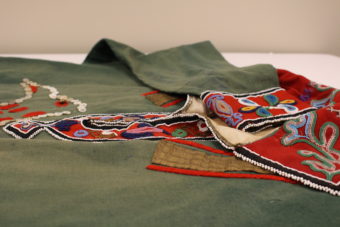
Chuck Smythe unrolls the tunic from storage. (Photo by Elizabeth Jenkins/KTOO)
Chuck Smythe unrolls the tunic from storage. It’s kept this way to avoid damage. (Photo by Elizabeth Jenkins/KTOO)

The country’s oldest theological school is selling off its Native art collection, and Sealaska Heritage Institute is asking the feds to investigate. Tlingit and Haida pieces are among the works–some of which might be sacred.

At Sealaska Heritage Institute, culture and history director Chuck Smythe walks down a flight of cedar steps to the basement, the place where Native artifacts are kept.

Behind a locked door are some of the pieces in the collection.

“We’re going into the conservation room. You hear the freezer going,” he says.

Items that arrive at the institute are cooled to 40 below to kill insects before the pieces go into long-term storage in a temperature controlled room. Smythe shows me a Southeast Native tunic, probably from the 20th century.

“It’s a green tunic with red border and it has flowers and designs.”

It has delicate beading on the sleeves and collar, a raven on the front. But that’s all we know. The tunic was repatriated from a museum in 2007. Information about which tribe and clan it belongs didn’t follow it back home.

“It’s hard. A lot of museums have very generalized identification of objects,” he says. “I used to work at the Smithsonian in the repatriation office and they have hundreds of objects that are just ‘Northwest Coast.’”

SHI is looking for the tribe the tunic belong to. (Photo by Elizabeth Jenkins/KTOO)
Sealaska Heritage Institute is looking for the tribe this tunic belongs to. (Photo by Elizabeth Jenkins/KTOO)

Even harder to track are the Native artifacts that fall into private collectors’ hands. That’s what the Peabody Essex Museum in Massachusetts says could happen to 80 pieces in its care because the owner wants to sell.

The museum has housed the collection since the 1940s; The Andover Newton Theological School is the owner.

Dan Monroe, the museum’s director, says the school informed him a few months ago.

“The 80 works are works that they’ve selected that have the greatest monetary value,” he says.

The college says it’s not an art curator; it’s an educational institution.

Sealaska Heritage Institute is questioning whether the artifacts are sacred–pieces used in ceremony.  A federally supported entity, like a school or museum, is barred from selling those and obligated to return them to the tribes.

Items in storage at Sealaska Heritage Institute. (Photo by Elizabeth Jenkins/KTOO)
Items in storage at Sealaska Heritage Institute. The Andover Newton Theological School’s collection contains works from 52 tribes. (Photo by Elizabeth Jenkins/KTOO)

Rosita Worl, the president the institute, says the spirits of her ancestors are associated with those objects.

She notified the feds that some of the Tlingit and Haida pieces in the theological school’s collection could be subject to repatriation laws–particularly a halibut hook with a wolf crest and shamanic doll.

“We believe that everything has a spirit and that includes animate and inanimate objects,” she says.

Worl is Tlingit of the Eagle moiety and Thunderbird clan. She says she’s been trying to “get over the history” of how the theological school acquired these artifacts in the 19th century.

“We know they were well meaning in terms of trying to Christianize us, but we went through a lot of difficulties with that,” she says. “And I really want to respect all different religions but having the history of that overt suppression of our beliefs was difficult to take again.

The college is estimated to turn a million dollar profit. But Martin Copenhaver, the school’s president, says the pieces for sale are not sacred items. He believes the museum is engaging in an “ugly disinformation campaign.”

“I think the status quo works for them. They have the pieces. They’re able to display them for free. They did not pay for those,” he says. “I think it doesn’t work for them now if those pieces are in other museums.”

He says the school plans to sell to other museums, not private collectors.

“Unless those are ones who intend to then in turn donate them back,” says Copenhaver.

But museum president Dan Monroe says it typically doesn’t go that way.

“I would say it’s fair to summarize the frequency of that happening as highly infrequent,” says Monroe.

Appraisers have already been sent to assess the items but there’s no date for the sale yet. Worl says the willingness to sell the artifacts contradicts the school’s mission statement: “We will strive to be good stewards of the sacred tradition we have inherited.”

“My first wish is that they would say, ‘OK we recognize that Native people have these spiritual relationships to these objects.’ That they are significant,” Worl says. “I would hope that they would recognize that.”

Federal repatriation agents have opened an investigation.

Juneau Assembly votes to raise penalty for unpermitted signs

downtown Juneau
Downtown Juneau. (Creative Commons photo by Kyle Rush)

The Juneau Assembly voted Monday night to amend the signs code, adding a penalty that’s at least five times higher for unpermitted signs outside businesses.

Violators could pay $500 a day per offense; however, they may be eligible for a “fix it” period said Assemblyman Jesse Kiehl.

“If you get a citation for one of these sign violations, within 15 days, you can fix it,” he said. “You can get a permit, you can take it down–whatever it is. And your citation gets dismissed.”

Violators can only get one “fix it” period. After that, they can incur the penalty. The ordinance is based on one used in Skagway’s historic district.

Assemblyman Jerry Nankervis disagreed with the high fine, suggesting it should be lowered to $300. But Assemblywoman Karen Crane said there’s already been an enormous amount of discussion on the topic.

“There’s been agreement by a number of people. A lot of input on the $500 fine,” she said. “It’s worked well in other communities and I say, let’s go forward.”

Previously, business owners with unpermitted signs could be fined a staggered penalty of $25 to $100. It cost $50 to apply for a signs permit, only $25 for the violation. An advisory committee said that model discouraged compliance.

The new ordinance goes into effect at the end of July.

Site notifications
Update notification options
Subscribe to notifications