A drive-by shooting occurred at a Juneau couple’s home early Thursday morning near Point Lena Loop Road. No one was hurt, but an item close to the home was struck. It has left the family shaken up, and wondering if it may be a form of intimidation.
Brian Weed received a panicked phone call from his wife while he was working at Lemon Creek Correctional Center and immediately dialed emergency dispatch.
He says his spouse, Mareta Bates Weed, was too shook up to comment, and he feels like the night shift patrol dropped the ball.
When Juneau police did arrive, they searched the area but didn’t check in on Weed’s wife or take evidence photos.
“Didn’t do what they were supposed to,” he said. “This would have been nice being a correctional officer. You know, you get death threats from inmates often. They threaten to hurt your family and stuff and as a fellow law enforcement officer and I’m stuck at work, it really would have been nice if they would have supported my family.”
Lt. David Campbell says an officer followed up Thursday afternoon after Weed complained on Facebook about the response.
“In talking to the sergeant who went out and talked to the homeowner, we did have a report of a white Jeep in the area that was driving erratically,” Campbell said. He couldn’t confirm it was related to the gunshots.
But Weed is concerned that, several hours after the crime, any evidence was washed away by the morning rain. He’s offering a cash reward to anyone who can identify the suspect.
“I’d be willing to give several hundred dollars to whoever else was in that vehicle who knows who pulled that trigger at my house.”
Weed intends to turn that information over to the cops. Juneau police are conducting their own investigation.
Editor’s Note: The Facebook complaint to police response was made in the comments section of the post.
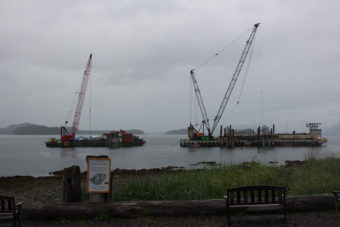
The location of the new dock at Icy Strait Point. (Photo by Elizabeth Jenkins/KTOO)
The final pilings for a new cruise ship dock are being driven at a Hoonah tourist attraction, marking an end to the nearly decade-long saga that divided the community. The publicly financed dock is being built where it serves a local Native corporation’s interests, only indirectly benefiting residents — although many are also shareholders.
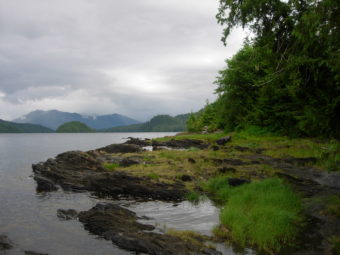
On the grounds, tourists wander in and out of a historic salmon cannery turned museum. They skim the treetops on more than a mile of zipline and bask in front of a crackling wood fire that an employee keeps going.
Tyler Hickman is the vice president of Icy Strait Point, owned by the Huna Totem Corp. He says it’s important to maintain the cannery’s off-beat charm.
“It just starts feeling fake when you overdo something,” he says. “We try to make sure that everything we do is authentic.”
Tender boats drop off passengers from the ship. (Photo by Elizabeth Jenkins/KTOO)
Part of that is making sure visitors feel comfortable when they arrive and leave. About 150,000 cruise ship passengers travel to Hoonah each year. To get to Icy Strait Point, they have to schlep over on a small tender boat. There’s no place for the big ships to dock.
Hickman points to 60 people on a cruise ship waiting for a tender to transport them to shore. In the future, he says, those passengers will be able to grab their raincoat and wander off the boat on their own.
From there, they could walk through second-growth forest. Not everyone is as enchanted with the location of what Hickman estimates is a $22 million dock, paid for primarily by a grant from the state.
Ken Skaflestad is a shareholder in the Native corporation. He says before the cruise ships started arriving back in 2004, the village felt like a different place. Its population was around 750.
“I remember a day when somebody might wear their pajamas down to pick up the newspaper or groceries on a Saturday morning. If a cruise ship’s in town, that’s changed now,” he says.
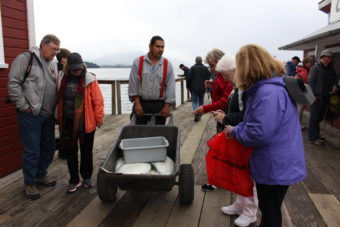
An employee in uniform answers tourists questions about a real halibut carted around the boardwalk. (Photo by Elizabeth Jenkins/KTOO)
A mile past Icy Strait Point’s traffic gate is the city of Hoonah. Tourists shuttle through for bear watching tours and to ride the zipline.
Back in the mid-2000s, the city proposed a multi-use dock located closer to the city center.
“This commercial dock that was going to help with barging, that was going to help with freighting, was going to be a place for fishing boats to tie up to,” he says.
Cruise ships weren’t the main focus, but Skaflestad says the conversation shifted after the success of Icy Strait Point as a tourist destination. A public-private partnership was created. The state put in $14 million to build the dock; the corporation put in $8 million. Although the inclusion of cruise ships was decided, the location of the dock wasn’t.
Skaflestad says the Icy Strait Point developers disagreed with where the community wanted the dock, which was about 800 feet toward town from their existing facility.
The city selected Shaman Point. He says the argument became not only about where it should be, but also what: a multipurpose dock close to downtown or a cruise ship dock on private land.
“I can say that I was one … that adamantly took opposition to that whole initiative.”
And the town, he says, was split down the middle.
“I refer to it as World War III. It was horrible,” he says.
A Royal Caribbean executive sent a letter to the city stating that if the dock was built at Shaman Point, cruise lines might not moor there. Skaflestad says the cruise ship passenger experience outweighed the community’s interests in the dock.
“The opinion of the customer’s experience was touted to far outweigh the community’s need to all of the other uses other than a cruise ship dock,” Skaflestad says.
Tourists explore the grounds of Icy Strait Point. (Photo by Elizabeth Jenkins/KTOO)
Eventually, the city council turned over. A new mayor was elected and it was decided the dock would be built at Icy Strait Point. Skaflestad says he never did agree with how everything went down. But when he became mayor in 2014, he wanted to make the best of it.
“I had to really work to be open minded about this and listen to the other points of view. The other opinions were that right now the important thing is the development of this industry and that those other uses are really relatively small uses. They’re not going to be big booms to our economy or anything,” he says. “Truthfully, this dock, it’s primarily income that’s going to come through the cruise ships.”
As the final pilings go in, Tyler Hickman says there’s no need to discuss what happened in the past.
“To me, it’s about today. When you go and walk around the corner, it’s being installed where it is and it’s in the right place,” Hickman says. “The experience the cruise ship guest is going to have is going to be the best in the world.”
The new dock could attract more cruise lines such as Disney, which would mean more visitors to Icy Strait Point and Hoonah.
Skaflestad says he’s trying to be welcoming. He leads the bear watching tours when they get overbooked. He says before, the locals just wanted the tourists to pass right through.
“This metamorphosis has happened and the town is saying ‘I can make a buck here,’ ‘Hey, I’m finding a little niche over here,’ or ‘I’m just going to sit here like I used to sit and watch the birds on the beach and now I’m going to watch tourists,'” Skaflestad says. “There’s this significant change that the presence of these visitors has brought to Hoonah.”
The dock is expected to be completed in October just as Icy Strait Point closes for the season.
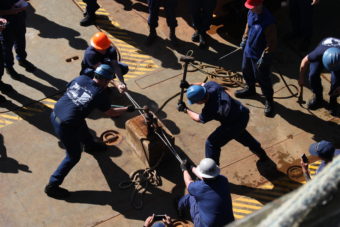
The Coast Guard’s annual Buoy Tender Roundup is in Juneau this week for the first time since 2012. Service members from Alaska, Washington, Oregon and the Canadian Coast Guard are participating. The week is filled with training and intense competition, like Tuesday’s “heat and beat” challenge.
Coast Guard members watch competitors in the heat and beat challenge. (Photo By Elizabeth Jenkins/KTOO)
On Coast Guard Cutter Maple, team members heat up a chain to make it malleable. (Photo by Elizabeth Jenkins/KTOO)
Onlookers cheer as the team beats the chain with a sledgehammer. (Photo by Elizabeth Jenkins/KTOO)
In the field, the maneuver is done to switch out the chain attached to buoy. The Coast Guard sometimes has to do this several times a day. (Photo by Elizabeth Jenkins/KTOO)
(Photo by Elizabeth Jenkins/KTOO)
The Coast Guard is offering public tours of the pier and a buoy tender from 4 to 6 p.m. Wednesday.
A neighborly dispute over property lines in the Willoughby District has escalated to chainsawing a tree, police calls and an unwelcome alteration of Twilight Cafe’s award-winning storefront.
When Catherine Cristobal and her husband Ariel bought their business in 2008, they told the previous owner they would name the cafe in his honor.
The winning storefront. (Photo by Lisa Phu/KTOO)
“I will name my cafe Sonneman’s Cafe. He said, ‘Don’t use my name. Just don’t cut my tree,'” Catherine Cristobal says.
Joe Sonneman used the small house as a business and residence. He has since passed away but the rhododendron tree outside, according to Twilight’s owners, was alive. Catherine says she had a sentimental attachment to it.
“When we were remodeling this, we’re debating to cut it down or what. I said, ‘No. I want that tree there in respect of Joe.'”
The cafe serves coffee, smoothies and adobo, a popular dish in the Philippines. As the new business grew, so did the tree, which their neighbor says was part of the problem.
The Willoughby District is a bit of a hodgepodge with zoning you wouldn’t see today. The cafe is boxed in by city-owned parking and property belonging to Bullwinkle’s Pizza.
“A warm, family place to be. People can bring their kids here and run amok and throw popcorn all over and play video games,” says Mitch Falk.
He’s owned the local chain for about seven years. The parking lot in front of Twilight Cafe is his, including a 500-gallon tank in the back.
“I poured a new concrete base for the propane tank back there. If you look back and look at it, their family handprints are in my concrete. I said go ahead and do that,” Falk says.
Mitch Falk’s office at Bullwinkle’s Pizza is decorated with pictures of goats and wildlife. (Photo by Elizabeth Jenkins/KTOO)
Both owners say the relationship was civil, but this is where their stories start to differ.
Since Twilight Cafe is pretty much boxed in, a path cuts through Bullwinkle’s property. This kind of arrangement is called an easement.
“They came to me and asked if they could move the access from this side to the other side,” Falk said.
Catherine Cristobal disagrees.
“Mitch Falk is the one who asked my husband to switch the easement. Not us. Because he wanted the tank to stay.”
A notarized document signed by both owners in 2014 shows that the easement was switched in exchange for the propane tank staying in its place. Who asked for it and why is up for debate.
Catherine Cristobal says Mitch Falk verbally assured her that the rhododendron tree wouldn’t be cut, per their agreement. Its roots are on Twilight’s property, the overhang on Bullwinkle’s. She thought the tank was a safety hazard but she was willing to let it slide.
“He drafted the agreement. We sign it and for the very first time we shake hands. We’re happy. I can’t wait to say hi to him when I come to the store,” says Cristobal.
That neighborly feeling was short-lived. About a month ago, Mitch Falk cut down Joe Sonneman’s tree.
Greg Chaney, a lands and resource center manager at the city, says with historic properties like this, issues come up.
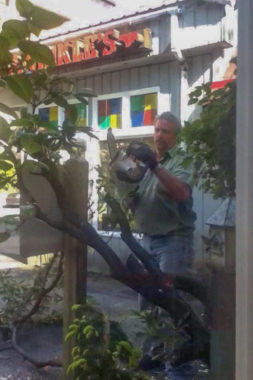
Mitch Falk chainsawing the rhododendron. (Photo courtesy Ariel Cristobal)
“I’ve seen what we call grandfathered situations or inherited situations from previous subdivisions that didn’t comply with our code and when that happens, people don’t get along,” Chaney says. “And access issues generally causes strife. It’s kind of designed to fail.”
Chaney says zoning can create harmony or discord. The subdivision ordinance now requires direct, practical access and parking.
“Specifically because these types of situations cause neighbor disputes and sometimes the neighbor disputes can be extremely acrimonious.”
When Mitch Falk cut down the tree, Ariel Cristobal watched from inside the cafe.
“I just (took) a picture … and I called the police because, you know, I’m scared. I don’t know what he (was) going to do,” he says.
There have been at least two calls to Juneau police regarding the dispute.
Falk says there was no verbal agreement and it was nothing personal. The rhododendron’s overhang was damaging his car.
“Oh, yeah. I’ve got deep scratches in my truck. You can look at it right now. It’s down there,” Falk says.
He spent $3,000 to have custom snow barricades placed between the parking lot and Twilight Cafe. They also double as flower planters.
“I feel like I’m trapped. I cannot enjoy my back(yard) because of that big ugly tank. I cannot enjoy my front because of all these things,” she says. “I don’t know what to do anymore. It’s coming from both ends.”
She says she’s thought of selling the business, but there’s too much invested. Customers have been bringing her flowers to make up for the tree’s loss.
Twilight Cafe’s attorney recently issued a letter to Mitch Falk asking him to remove the concrete snow barricades. The letter says it’s unsafe for customers and violates a previous verbal agreement.
What’s left of the tree outside Twilight Cafe. (Photo courtesy Ariel Cristobal)
The 9th Circuit Court of Appeals struck down a 2003 exemption Wednesday that would have made it possible to build roads through the Tongass National Forest.
Malena Marvin, Director of the Southeast Alaska Conservation Council, says this decision underscores management that’s already happening.
“The Forest Service is already not planning sales in roadless areas and proceeding in the same direction as the rest of the country in preserving these areas for future generations,” Marvin says. “So we’re really seeing the final legal decision just guaranteeing that direction.”
Tongass National Forest near Ketchikan, Alaska. (Creative Commons photo by Mark Brennan)
“Roadless areas” are habitat for endangered species, subsistence hunting and fishing, outdoor recreation and sacred sites.
In 2001, the Department of Agriculture created the Roadless Rule, which limits road construction and logging on nearly 50 million acres of wilderness. The Tongass National Forest was exempted two years later when George W. Bush was in office. “Economic hardship” for timber-dependent Southeast communities was given as the reason.
Earthjustice attorney Eric Jorgensen says a coalition of conservation groups and Alaska Native tribes challenged that ruling. Earthjustice provided legal representation.
“(We) argued that the agency hadn’t adequately explained its rationale for reversing course and deciding to exempt the Tongass from the protection,” Jorgensen says.
In a press release, Sen. Lisa Murkowski called the ruling a “setback for the economies of Southeast Alaska.”
Owen Graham of the Alaska Forest Association echoed that sentiment. He believes the Forest Service has a “monopoly supply” over the timber industry in the region.
“They won’t allow enough timber sales to keep our industry alive and we’re dying,” Graham says. “It’s hindering all kinds of development for no good reason other than pacifying environmental groups but we hope to get it overturned eventually.”
The state could still petition the Supreme Court to exempt the Tongass from the Roadless Rule. The Supreme Court, however, declined to hear an appeal of the rule in 2012 when the State of Wyoming and the Colorado Mining Association challenged it.
The future site of the new dock. (Photo by Elizabeth Jenkins/KTOO)
Hoonah will soon be getting more cruise ship passengers as it nears completion of a new dock at Icy Strait Point.
The town currently receives as many as 4,000 tourists a day on cruise lines like Celebrity. But arriving ships have to anchor offshore and tender passengers over with smaller boats.
Tyler Hickman, vice president of Icy Strait Point, says some vessels can’t accommodate that.
“For instance, I know that Disney doesn’t carry tenders on their ships so they don’t carry any tender ports. And so it certainly opens the door where it was completely closed to them in past. So I think it sparks interest on all the cruise lines,” he says.
For example, the Disney Wonder already has ports of call in Southeast and can carry up to 2,700 passengers.
Huna Totem Corp. owns Icy Strait Point, a historic cannery turned tourist attraction with a museum, gift shop and zip line.
Hickman says funding for the dock came from a public-private partnership.
“The city has brought $14 million that was a grant from the state and Huna Totem Corp. is putting another 8 million into it,” he says.
The dock is expected to be completed in October in time for next year’s tourist season.
Close
Update notification options
Subscribe to notifications
Subscribe
Get notifications about news related to the topics you care about. You can unsubscribe anytime.