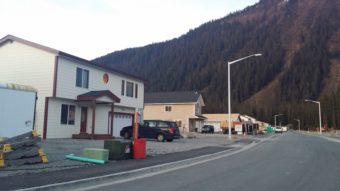
A Mendenhall Valley subdivision under construction in May. (Photo courtesy Hal Hart/CBJ Community Development Department)
The Juneau Assembly wants to draft ordinances creating new property tax breaks that incentivize denser development and redevelopment of blighted properties.
The assembly discussed it Monday in committee and also wants input from the Downtown Business Association and city staff.
Assemblymember Karen Crane asked if the redevelopment ordinance would do enough. It would allow for property tax exemptions or deferments for major building overhauls and demolition.
“When I first read this, I don’t see the incentives there for the development of housing,” she said. “I’d like to have some more discussion along that line, too. It’s one of the conclusions everyone has come to that has studied what we need downtown.”
City Finance Director Bob Bartholomew said it comes down to what level of public investment Juneau wants to make.
“It’s in addition and outside the scope of this. This could help in one little piece. But there’s a lot of other things out there,” he said.
A second ordinance would allow for property tax breaks after subdividing land for five years.
But some assembly members questioned the length of time–wondering if they could be giving tax exemptions for developers not motivated to sell. Assemblymember Debbie White said that’s often not the case.
“It’s really not as much time as you think and by the time you get the subdivision recorded and you start advertising and marketing these properties and then you design homes and then you have to take plans to permits center, five years is not that long,” she said.
White, a real estate broker, called the Montana Creek West subdivision successful and said it took about six years to develop.
An artist’s rendering of the Huna Tribal House. (Image courtesy National Park Service)
A $3 million Tlingit tribal house is being constructed on the shore of Bartlett Cove in Glacier Bay–likely the first time the National Park Service has funded a tribal house.
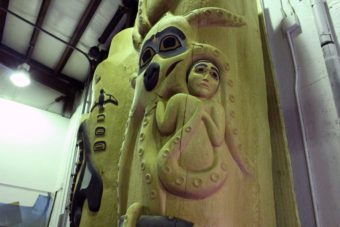
Three carvers are chipping away on an Eagle moiety pole that will go outside the red cedar tribal house with a Raven. The crest of a Wolf, Porpoise, Brown Bear and Thunderbird are starting to form, representing the clans in the area.
Gordon Greenwald, the lead carver, says it’s taken over a month to get this far on the totem and it’ll likely be six more before it’s finished.
“Now we could complete it faster than that if we used some machines. Chainsaws and so forth to do some of the major cutting but we’ve chosen not to do it that way. We’re trying to do it all by hand.”
His team has been carving the pieces to go in the 2,500-square-foot Huna Tribal House for about five years. There’s a constant flood of cruise ship tourists in and out of the shed, asking questions and marveling at the handiwork. But Greenwald says he doesn’t mind.
“For people that are new to this area, it gives them a chance to learn about our people. Going away knowing Tlingit people, knowing what our life was like. And for local people, they can stop and see something is being made in our homeland,” he says.
An interior and exterior screen is already complete. So are the house posts of the four clans that identify Glacier Bay as home: Wooshkeetaan, Chookaneidí, Kaagwaantaan and T’akdeintaan.
The house posts which will go in the Huna Tribal House. (Photo by Elizabeth Jenkins/KTOO)
Tom VandenBerg, the chief of interpretation at Glacier Bay National Park says the clans are an inextricable part of the story of Glacier Bay.
“But there’s no physical sign of their history here unfortunately,” he says.
Bartlett Cove is the site of the new tribal house. It’s where the clans originally resided until an encroaching glacier forced them to relocate hundreds of years ago to what’s now called Hoonah. In 1925, Glacier Bay became a national monument and federal laws limited what the Huna Tlingit could do in their homeland.
“It’s difficult, you know. The parks service represents the stories of our nation. And it seems like some of the Native stories have been missing from some parks.”
VandenBerg says there are places like Sitka National Historic Park with Southeast Native totems, but “there’s not much in the way of Alaska Native stories being told in parks.”
The National Park Service received a request from the Hoonah Indian Association back in 1992 to build the tribal house. VandenBerg is unaware of anything else like it: a ceremonial house paid for by concessioners fees from businesses that operate within Glacier Bay.
Tlingit elder and park management assistant Ken Grant says it’s going to be an emotional day when the tribal house is finished.
The house posts which will go in the Huna Tribal House. (Photo by Elizabeth Jenkins/KTOO)
“Our people really have a strong tie to the homeland. The feeling of being left out has been with our elders for a long time. Like they say in our language: they were buried with a sorrow in their hearts,” Grant says.
He hopes that it’ll provide a space for young Huna Tlingits to learn about their roots and enhance language and cultural preservation.
Gordon Greenwald says it’s been a long time for the project to come fruition.
“But now I’m looking back on it, I’m wondering why this hadn’t happened in all the other parks long ago,” he says.
Back at the shed, carvers Owen James and Herb Sheakley are singing a song about one of the Huna clans.
When Sheakley started this project five years ago, he says he didn’t know all of the stories and he didn’t know how to carve. He’s been practicing at home, making ceremonial hats out of spruce and working on the Eagle pole.
“It’s stuff like this that keeps me going. I can actually create this now,” he says. “Before I could look at this and say, ‘Hmm, I couldn’t do that.’ Making the knives, listening to my boss teaching me the formlines, this is the kind of thing I’m making now.”
Greenwald says he owes teaching to his mentors; passing on the knowledge so it doesn’t stop with him.
“On all of this work, none of us will sign it because none of this work is about us as individuals; it’s about our people,” Greenwald says.
The Huna Tribal House is expected to be dedicated next August.
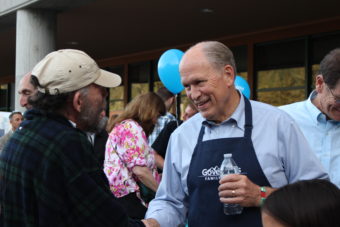
Gov. Bill Walker greets people at his the Governor's Picnic at UAS in Juneau, Aug. 14, 2015. (Photo by Elizabeth Jenkins/KTOO)
The governor and first lady Donna Walker serve the public salmon and hotdogs. (Photo by Elizabeth Jenkins/KTOO)
(Photo by Elizabeth Jenkins/KTOO)
Panning for gold at the 2015 Governor's Picnic. (Photo by Jeremy Hsieh/KTOO)
The 2015 Governor's Picnic was held at the University of Alaska Southeast. (Photo by Jeremy Hsieh/KTOO)
The grill station at the 2015 Governor's Picnic. (Photo by Jeremy Hsieh/KTOO)
(Photo by Jeremy Hsieh/KTOO)
Volunteers help someone register to vote at the Governor's Picnic at the University of Alaska Southeast, Aug. 14, 2015. (Photo by Jeremy Hsieh/KTOO)
(Photo by Elizabeth Jenkins/KTOO)
Coppa provided vanilla ice cream for the event. (Photo by Elizabeth Jenkins/KTOO)
Gov. Bill Walker hosted his first Governor’s Picnic in Juneau on Friday at the University of Alaska Southeast. While serving up hot dogs and salmon, I asked picnic-goers what they’d do as governor for the day.
The community lined up on a warm, sunny afternoon to mingle with state officials but also for the free food: hot dogs, salmon, and locally made ice cream. Gov. Walker was dressed for the occasion.
“Well, I’m wearing my cook outfit. My apron. My governor’s picnic apron and it’s the third time I’ve worn this outfit,” he says.
He says it can be tough doing double duty: serving the public fillets of fish and being a politician.
“My problem is this: I like to shake hands and say hello to people and I have to wear a plastic glove and then I have to take it back off, put it back on, take it back on,” Walker says.
Brenda Calkins and her daughter are waiting in line. They’re inching closer to the governor but not sure what they’ll say as he serves them a piece of salmon.
“Yeah, I don’t know if I have anything. … I might have to think up a question in, like two seconds,” Calkins says.
In years past, the governor’s picnic has been held at Sandy Beach. This year, it’s on the UAS campus to highlight education and kids activities.
A fire truck is parked nearby for children to hop aboard. And like the food, there’s a line for that, too. Volunteer firefighter Steven Anderson is making sure everything runs smoothly.
“I’ve been doing this about five years. As much as I can I come out to the community events,” Anderson says.
What would he do if he was governor for the day?
“I don’t know much about politics and I don’t think I could change much for a day. I’d be kickin’ back in the mansion,” he says.
After thinking a few seconds, he says he’d work on increasing the budget for firefighting.
The Thunder Mountain High School football team also helped out at the event.
“Just kind of picking up trash, handing out fliers and at one point we were helping people find a place to park,” says left tackle Josh Quinto.
He has his own ideas about what he’d do if he were governor–more community events.
“I think at most, maybe throw a big party. I’d have different music everyday. Maybe some rock, country occasionally. So random stuff like Fall Out Boy or Nickelback, I guess,” Quinto says. “Definitely not the same food. Maybe something other than salmon, I don’t know like halibut. Fish and chips, those are always good.”
Picnic-goers lounge on a half-moon concrete bench, scraping food off paper plates and watching people play corn hole.
Andualem Fanta is watching the fun. He travels for work with Delta Airlines.
“I am originally from Ethiopia so I migrated to U.S. I lived in different state. But this my first time the governor invited everybody and having a good time,” Fanta says.
What would he do as governor?
“If I’m a governor, today? Serve the people like this. It could be a great opportunity to show you care about the people,” Fanta says.
From everyone, there was a variety of responses from dog racing, building a pipeline and making it permanently sunny in Juneau.
Brenda Calkins and her daughter make it through the end of the food line. Unfortunately, Gov. Walker ducked out for a photo-op with a costumed bear but first lady Donna Walker is still there.
“I didn’t know it was the first lady,” Calkins says with a laugh.
Which is what the Governor’s Picnic is all about. Getting to know your officials.
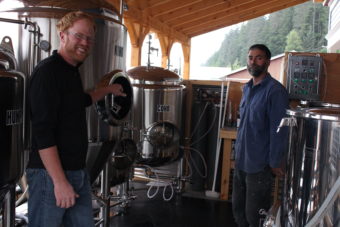
Dan Kane and his business partner Todd Thingvall. (Photo by Elizabeth Jenkins/KTOO)
On Saturday, a Hoonah microbrewery is opening its doors to serve the village a variety of craft beers. Kegs used to become scarce around the same time tourists did. Now fresh pints are guaranteed through winter.
Todd Thingvall and his business partner Dan Kane have been working hard to renovate a 100-year-old house on pilings above water, the site of the new brewery and taproom. Both left good jobs to start the business. Kane says his kids asked if he was having a midlife crisis.
“There’s been a lot of sleepless nights,” Kane says. “I’m sitting in Anchorage at my house there and I have a good life. There’s a lot mornings I would be sitting there going, ‘Have I lost my mind, is this really what I want to do?'”
He’s been homebrewing for about 20 years. They met each other through their wives.
“Dan had beer so I instantly liked him. We hit it off ever since,” says Thingvall.
He pitched Kane the idea of opening the Hoonah brewery. They invested about $400,000 and are living upstairs. The long-term plan is to move the tanks to another site but for now, they’re on a patio above the water.
Usually stainless-steel fermentation tanks are labeled one, two, three.
“We decided, eh. Let’s stay with a Southeast theme and we went with keta, humpy, king, sockeye and coho. Of course, the king is the big seven barrel,” Kane says.
(Photo by Elizabeth Jenkins/KTOO)
They’re cooled by a refrigeration unit that runs partially off solar panels. Electricity can be expensive in Hoonah and the panels could pay for themselves in a little over a year.
On the bottom of the king tank is a well kept brewer’s secret.
“You’re very lucky to see this. It’s called a sample valve. It allows you to take samples or actual drinks out of a vessel. So this is our pale which was the first beer that we made here,” Thingvall says.
He fills up a frothy golden glass of beer made with Cascade hops.
With no connecting roads, the Pacific Northwest hops and brewer’s yeast is shipped using FedEx. Thingvall and Kane say it can be nerve-wracking waiting for the delicate ingredients to arrive. Most need to remain temperature controlled. It travels from Seattle to Juneau, then over to Hoonah by small plane. A few weeks ago, their yeast was overdue.
“One great thing about a small town, even the postmaster, she knew exactly what I was looking for and it came in Saturday after their closing hours and she called us. And said, ‘Hey it’s here.’ And waiting for us to come pick it up,” Kane says.
They’ll serve pale ale, IPA and hefeweizen. A pilsner and stout are also in the works. Production will be about 500 barrels a year, and some of the kegs could be distributed to Southeast’s smallest communities like Gustavus and Elfin Cove–maybe eventually making its way to Juneau.
Overlooking the taproom of Icy Strait Brewery. (Photo by Elizabeth Jenkins/KTOO)
What Kane says they’re really looking forward to the most is experimenting with ingredients like Hudson Bay tea, a medicinal plant that grows in the muskeg.
“When it first hits your palate, it was more of light clean, crisp beer and then as it hit the back of your palate that’s when that tea just came alive,” Kane says.
It can be tricky getting FDA approval for ingredients that are locally sourced, but they say they’re up for the challenge. They want Icy Strait Brewing to reflect the community.
“Hoonah has a slogan: The little place with the big heart. And it’s true. The people here are wonderful,” Thingvall says.
The bidding process for construction of an estimated $11 million seawalk, island and park near the Douglas bridge could begin in the next few weeks–creating a home for a major Juneau landmark.
New York City has the Statue of Liberty. Seattle has the Space Needle.
“A lifesize breaching humpback whale will become iconic to Juneau,” says former mayor Bruce Botelho. He’s the vice president of The Whale Project, a nonprofit dedicated to the completion of the nearly $1.5 million bronze sculpture, designed by Skip Wallen.
Most of the money has been raised through private donors and grants, but the organization is still asking for funds. In 2012, the statue was gifted to the city of Juneau with the understanding it would find a place for it; now it seems it has.
“Oh, it’s exciting. I’ll feel a lot better once it’s actually in place but we’re moving quickly towards that,” Botelho says.
Site plans for the Bridge Park from the Juneau Planning Commission agenda.
The statue will be part of a new waterfront park and seawalk that will eventually connect all the way to the cruise ship docks about a mile away. It will cross over to an artificial island, lush with native plants.
Skye Stekoll, an engineer with the city of Juneau, says the island will mitigate some of the ecological damage done to Gold Creek and its delta. The Army Corps of Engineers has already signed off.
The bronze, life-size whale statue at a workshop. (Photo courtesy City and Borough of Juneau)
“So a habitat island is trying to replace some of the riparian habitat that may have been there in a natural state,” Stekoll says.
In June, the Assembly gave its final approval to move ahead. Cruise ship passenger fees and sales tax will fund the construction. A mixed-use plaza is in the plans and Juneau Docks and Harbors is considered opening a fish market on the other side of the bridge.
After more than a decade of discussion, disagreements about where the park should be built and concerns over funding, the only thing left to do is open the bidding process, which Stekoll says could happen in the next few weeks.
“Yeah, for the most part we are now ready to go.”
Bids then go before the assembly for final approval. Construction could start as early as October and be completed next fall.
Editor’s note: A reference to the Juneau-Douglas Bridge has been corrected. It’s the Douglas Bridge.
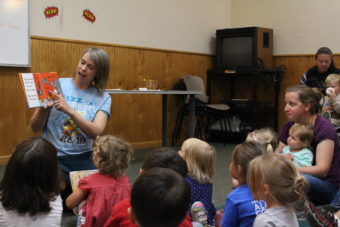
Amelia Jenkins reads a book for the last storytime at the Mendenhall Mall library location. (Photo by Elizabeth Jenkins/KTOO)
Friday was the last children’s storytime at a Juneau library branch that’s been in the Mendenhall Mall for over 30 years. The days of checking out books and grabbing a slice of pizza are over because the branch is moving to a new location at the end of the month.
About 15 kids are sitting crisscross applesauce listening to Amelia Jenkins read a picture book. She works at the Mendenhall Valley Library.
Her audience is sometimes captive, sometimes not. But she knows how to handle the crowd by breaking into song and dance.
“There’s some weeks when everybody wants to sit on a lap and listen quietly and these other weeks like today when everyone wants to do the hokey pokey straight for half an hour,” Jenkins says.
Kids can check out the books at the end of storytime, which is exactly what library staff want. Left behind materials have to be transported to the new location so patrons are encouraged to check out up to 40 books.
You can check out all the Harry Potter, Game of Thrones, Hunger Games and Fifty Shades books and you’d only be halfway.
M.J. Grande, the youth services librarian, has worked for the library for 15 years and is excited about the new 20,000-square-foot space at Dimond Park.
The advent of the mall library was in the late 70s early 80s, says M.J. Grande. (Photo by Elizabeth Jenkins)
It cost $14 million to build, paid for by a grant from the state and city sales tax. Another million was contributed by the Friends of the Juneau Public Libraries.
Of all the perks, there’s one Grande says she’s looking forward to the most.
“Space. We are almost doubling our footage here so the kids programing is a really dominant part of the library,” Grande says.”We have these wonderful reading cubicles that are extra padded and cozy.”
There’s also wheelchair accessible reading nooks and a room that has its own teen advisory committee to decide function and decor. But probably the biggest difference is it won’t be sandwiched between a restaurant and a tanning salon.
Grande says not too long ago, it wasn’t uncommon to see a library in a mall.
“You know, kind of in the 70s when malls were really getting established as a one-stop shop, you can do your shopping, you can do your library, you can do your other business. That role in the evolution of malls has changed.”
The new library at Dimond Park is expected to open in November. (Photo courtesy of Friends of the Juneau Public Libraries)
For Letha Bethel, the old location has been convenient. She’s a stay-at-home mom with two kids and another one she watches during the day.
She says the kids love dancing and singing at the reading circle, the toys in the children’s section and of course the books.
They walk to the Mendenhall Mall on sunny days and Bethel says she’s sad the library will be closed for a few months as it moves to its new location.
“It’ll be nice though that it’ll be bigger hopefully and more space to run around. They’re excited to see it and it’s right by the pool,” Bethel says.
But will she check out 40 books?
“For their sake, probably not. Because I don’t know if they’d last at our house.”
Bethel says she might consider checking out one or two before the Mendenhall Valley Library closes on Aug. 31, opening back up at Dimond Park sometime in November.
Close
Update notification options
Subscribe to notifications
Subscribe
Get notifications about news related to the topics you care about. You can unsubscribe anytime.