Elizabeth Jenkins, Alaska's Energy Desk - Juneau

Seniors pack assembly chambers to fight scale back of sales tax perk

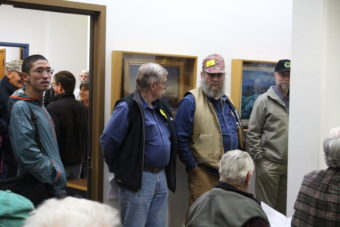
Seniors wore bright, yellow pins reminding, "We vote." (Photo by Elizabeth Jenkins/KTOO)
Seniors in assembly chambers wear bright yellow pins that say “We vote.” (Photo by Elizabeth Jenkins/KTOO)

Despite pleas from a packed house, the Juneau Assembly voted 7-2 Monday to scale back the senior sales tax exemption.

Low-income seniors will remain exempt from Juneau’s 5 percent sales tax. Other seniors will have to pay, unless they’re purchasing essential items like food, heating fuel, electricity and city water and sewer utilities. The assembly also voted to exempt garbage removal and recycling services.

More than 40 people gave passionate testimony on the issue. Nora Laughlin said when she retired, the sales tax exemption helped her stay in Juneau. She stressed seniors do a lot to give back to the community.

“The amount of hours we put in and give to this city are phenomenal. And you want to balance the budget on our backs. Come on!” she said. “I do free taxes for people: seniors and low-income during tax season. And I volunteer at nonprofits. I’m not the only one. That’s what seniors do. We are valuable assets.”

A handful of testifiers said middle-income families were suffering more. But others worried what effect the change would have on local businesses.

Melissa Highfill, the owner Seaside Yarns, said seniors with exemption cards make up 10 percent of her sales.

“I can’t afford to lose up to 10 percent of my business by people shopping online,” Highfill said. “Having things delivered for free and not paying sales taxes. I try to educate people to see it here, buy it here and keep me here. Seniors know the value of that.”

Assembly member Kate Troll  pointed out that the city’s senior population has doubled since the sales tax exemption was created and that number is projected to go up.

Troll said by making these “modest” changes now, the program could remain sustainable.

“It’s only a matter of time before the question really comes, do we do away with the exception at all?” Troll said. “As many people here have said, we know the state’s fiscal situation isn’t very rosy. And we need to make sure we keep the programs and services the seniors depend upon.”

Mayor Merrill Sanford and assembly member Mary Becker were the only no votes.

The city’s finance officials have forecast the changes will raise an extra $1 million a year from local seniors. The ordinance takes effect Jan. 1, 2016.

Suspect arrested in Switzer Village shooting

On Thursday, Juneau police detained four men, ultimately arresting one in connection with a Switzer Village shooting.

A tipster identified the man as the alleged shooter in an incident where several shots were fired. In that Sept. 13 incident, police attempted to capture the suspects but two escaped after crashing a vehicle.

“We did find a couple of guns in the area that had been ditched prior to arrival and evidence that gunshots in fact did happen,” said Juneau police Lt. David Campbell.

Campbell said the reason the gunshots were fired is still under investigation. When the men arrived at the gas pump, police conducted a “high-risk stop” to avoid another pursuit.

“A high risk stop is one where we have our weapons drawn. We don’t point it at people,” he said. “We have it as low-ready. In case something happens, we can react quicker.”

They arrested 24 year-old Erick Waters, the owner of the vehicle. Waters was arrested for a probation violation. His original charge was robbery in the second degree. He was taken to Lemon Creek Correctional Center and held without bail.

The three other men were released after police questioning.

Tlingit-Haida to open cultural immersion park at Thane Ore House site

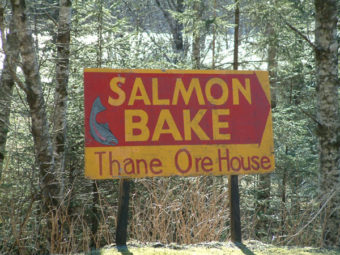
The Central Council of Tlingit and Haida Indian Tribes of Alaska announced plans on Thursday to open a cultural immersion park. Next year, the shuttered Thane Ore House is expected to be transformed into a new Juneau tourist destination.
Myrna Gardner, the council’s business and economic development manager, said the park could offer teachable experiences for Native youth and guests. They’ll see weaving and master carvers working with apprentices on totems and canoes.

Thane Ore House is located at about Mile 4 of the Thane Road just before Sheep Creek. (Photo by Matt Miller/KTOO News)
Thane Ore House is located at about mile 4 of Thane Road just before Sheep Creek. (Photo by Matt Miller/KTOO News)

“They’ll not only see a living culture, they’ll be able to talk to the artists,” Gardner said. “We’ll have cultural guides with them. Our plan is to not only strengthen our culture and the connection with our youth but also share our culture with the guests that travel into Juneau.”

Plans include a gift shop and restaurant that serves traditional foods–like blueberries, salmon and Hudson Bay tea. As many as 100 permanent jobs could be created.

President Richard Peterson said that’s part of the business model. The immersion park will draw employees from the Central Council’s existing vocational program. He hopes, eventually, it will help Central Council become more self-sufficient.

“You can’t have a program live off grants forever. Part of that sustainability is that economic development engine kicking in for tourism, kind of solves each others’ problems,” he said.

The city owns the land and solicited project proposals. Central Council beat out pitches from caterer Abby’s Kitchen and Liquid Alaska Tours.

Peterson said, as the final design plans come together, it’ll be done with careful thought and planning.

“I want to make sure that what we do is culturally sensitive and culturally appropriate,” Peterson said. “I don’t want to do something that’s a parody of our culture. This has to be something that’s done right.”

The $1.3 million Tlingit-Haida immersion park is slated to open next summer.

Juneau roller derby team starts junior league

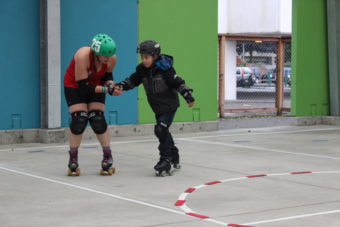
Stephanie Kruse guides a kid around the track. (Photo by Elizabeth Jenkins/KTOO)
Both girls and boys can compete on the team. (Photo by Elizabeth Jenkins/KTOO)

The Juneau RollerGirls are training a coed junior league this fall. Roller derby is characterized by fast-paced bouts, slick moves and cheeky alter egos. Helmets are essential. But the raucous sport can be adapted for kids.
At the Zach Gordon Youth Center, Kim Champney is skating backwards. She holds the hands of a young skater to help with the girl’s balance and demonstrates the utility of a wrist guard.

“I can slam my hand down and it doesn’t hurt at all,” she says.

On Juneau’s adult roller derby team, Champney is what you call a jammer.

“My derby name is Kimbustible.”

During bouts, she tries to lap the opposing team’s blockers. A blocker’s job is to stop the jammer from getting through.

“And you can do this by knocking them over, getting in front of them or physically moving people around the track,” Champney said.

The 12 to 17  year-old coed league will start out a little differently. There won’t be any physical contact to begin with. Players will have to work their way up to that. However, Champney admits roller derby may have an image to overcome.

“Back in the 70s, it was like the World Wrestling Federation or whatever. It was very staged and dramatic,” she said. “People were knocking people over. Even the movie Whip It that’s been part of the resurgence — overemphasized the violent part in it.”

Initially, she says kids will learn the basics: how to skate, how to stop and how to go backwards. By the time they’re doing more advanced moves, like blocking, they’ll have a strong foundation.

“I’ve played for five years and I’ve never had a critical injury. My daughter is going to be a part of roller derby, and I feel like there’s been a big safety aspect,” Champney said.

Just a few weeks ago, an international derby association announced it was trying to unite junior leagues. Adult teams have already cropped up in nearly every Southeast community and Champney thinks more kids’ leagues are to follow.

Taku RollerSports is loaning the gear for the junior derby league. (Photo by Elizabeth Jenkins/KTOO)

The Juneau roller girls were inspired last spring after watching kids from Seattle play. They were leaps and bounds ahead of the adults, and Champney says she’s lucky she’s playing now.

“Because when there’s established junior programs, we won’t be able to compete.”

Stephanie Kruse rolls around on skates with a toddler on her hip. Her derby name is Titan Young.

“And Luke’s roller derby name is Sling Shot. His mom is Catapult Kim. So he’s Sling Shot,” she said.

Kruse says she’s excited to teach. Derby is the first organized sport she’s played and it’s taught her a lot. One of the takeaways she thinks could be valuable for kids is body confidence.

“It doesn’t matter how tall you are, short you are, big you are. Everyone has a secret roller derby super power and figuring it out and unlocking it,” Kruse said.

As the recruiting begins, Kim Champney says the kids can put their own spin on things–coming up with derby names and a fierce team logo.

“We want to make it kid led. So any youth who’s interested in getting in on the ground floor can really help us shape that,” she said.

Petersburg’s Rok’n Blockers might have some new competition.

The Juneau Derby League recruitment meetings are Thursday, September 17 at 6 p.m. at Nugget Mall and Tuesday, September 22 at 5 p.m. at the downtown library branch.

Parts of Juneau susceptible to slides

Joel Curtis called the Sitka landslide an emotional site. (Photo by Elizabeth Jenkins/KTOO)

This past weekend, a Juneau Preparedness Expo gave the public a variety of information on how to cope in an emergency. One lecture more relevant than ever was on mudslides and landslides–just weeks after Sitka’s deadly disaster.
Joel Curtis from the National Weather Service told a small but captive audience about the mechanics of a slide.

He’s witnessed the damage firsthand. A couple of weeks ago he was on an ordinary business trip in Sitka, where he had been helping out with a diesel spill.

“And I get another message. Could you please come to the firehall immediately. One of the things we had talked about in the forecast the day before was some heavy rain combined with some wind,” he said.

Curtis rushed to the fire station and that’s when they told him.

“‘Joel, we need you to be the incident meteorologist on this. We just had a mudslide and three people are missing.’ It was terribly emotional, at least to me.”

The mudslide claimed the lives of three people. An intensive search uncovered the bodies of brothers Elmer and Ulises Diaz, who had been painting a house in the area. It took longer to find the third person: building inspector, William Stortz.

For Curtis, that really hit home.

“Knowing that this much beloved individual was missing was really, really tough,” he said. “But at the same time you just have to set that aside and go to work and do the things that you do to contribute to the recovery operation.”

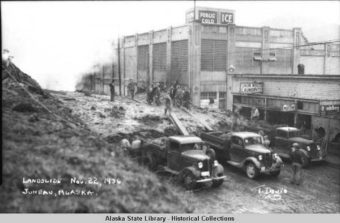
The 1936 landslide killed 15 people. (Photo courtesy of the Alaska State Library historical collection)
The 1936 Juneau landslide killed 15 people. (Photo courtesy of the Alaska State Library, Historical Collections)

Curtis helped by monitoring the weather, and Stortz’s body was located before more rain fell.

He says there are some differences between the conditions in Sitka and Juneau. For instance, Sitka gets the brunt of oceanic weather. Juneau has taller mountains to the East. But could the same thing happen here? 

Tom Mattice, the city’s emergency coordinator, said it already has. One of Juneau’s most destructive slides occurred in 1936, covering South Franklin Street and killing 15.

Although there’s little anyone can do to prevent it, Mattice said there are steps people can take to protect themselves–like have an evacuation route. Five years ago, Centennial Hall was used as a safe space when a slide hit Gastineau Avenue.

“If you live in an area that’s a mass wasting zone, an avalanche zone, a mudslide zone. On days with high wind, on days on high precip, it’s a good idea to go somewhere else,” Mattice said.

Joel Curtis agrees. He said since Southeast is a temperate rainforest, landslides are inevitable.

“They’re hazards and they’re big and they’re natural and there’s a lot of force in them. I think being prepared is the answer.”

Curtis says for him, that’s having an emergency bag packed and being able to evacuate with his dog and cat.

Update: Tugboat sinks in Gastineau Channel

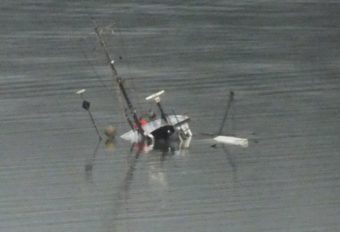
The top of the Challenger still protrudes above the water (Photo by Matt Miller/KTOO)

Update | Sept. 13, 12:09 p.m.

The Coast Guard response team is applying boom to the water Sunday morning to contain any fuel leakage from the sunken tugboat. A minimal amount of fluid was found to be on board.  The Coast Guard will be working throughout the week to coordinate a salvage operation.

The Challenger was built in 1944 for the U.S. Army and later used as a “bunk and breakfast” in Seattle. Around 2002, the tugboat made its voyage to Juneau and was eventually sold to local artist R.D. Robinson.

Original story: 

A tugboat, known as Challenger, sank near Aurora Harbor around 3 p.m. on Saturday. Coast Guard Petty Officer Geno Kludt said the 96-foot wooden vessel was engulfed by water in about fifteen minutes.

(Photo by Elizabeth Jenkins/KTOO)

No one was suspected to be on board.

“Basically, it’s one of those fixer upper type boats that’s been anchored up in Gastineau Channel. It just finally took on enough water and sank,” he said.

Kludt warned boaters to watch out for debris and the vessel’s mast sticking up. He said there are plans to assess the damage but raising it might be complicated.

“It’s ultimately the owners responsibility to coordinate the salvage efforts,” he said. “However, if he’s not able to take action on it, that’s when the Coast Guard may have to help with the salvage efforts to raise the vessel.”

There’s no word on when that might take place. For now, Kludt said boaters should proceed with caution through the site.

Editor’s Note: The story has been updated to reflect the correct size of the Challenger and to clarify that the Coast Guard used boom to contain possible fuel leaks, not a chemical solution. 

Site notifications
Update notification options
Subscribe to notifications