Aging

Ageism in health care is more common than you might think, and it can harm people

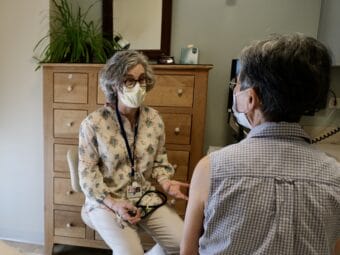
Dr. Louise Aronson, a geriatrician and author, speaks with a patient at UCSF’s Osher Center for Integrative Health in San Francisco. (Julia Burns)

A recent study found that older people spend an average of 21 days a year on medical appointments. Kathleen Hayes can believe it.

Hayes lives in Chicago and has spent a lot of time lately taking her parents, who are both in their 80s, to doctor’s appointments. Her dad has Parkinson’s, and her mom has had a difficult recovery from a bad bout of Covid-19. As she’s sat in, Hayes has noticed some health care workers talk to her parents at top volume, to the point, she says, “that my father said to one, ‘I’m not deaf, you don’t have to yell.'”

In addition, while some doctors and nurses address her parents directly, others keep looking at Hayes herself.

“Their gaze is on me so long that it starts to feel like we’re talking around my parents,” says Hayes, who lives a few hours north of her parents. “I’ve had to emphasize, ‘I don’t want to speak for my mother. Please ask my mother that question.'”

Researchers and geriatricians say that instances like these constitute ageism – discrimination based on a person’s age – and it is surprisingly common in health care settings. It can lead to both overtreatment and undertreatment of older adults, says Dr. Louise Aronson, a geriatrician and professor of geriatrics at the University of California, San Francisco.

“We all see older people differently. Ageism is a cross-cultural reality,” Aronson says.

Ageism creeps in, even when the intent is benign, says Aronson, who wrote the book, Elderhood. “We all start young, and you think of yourself as young, but older people from the very beginning are other.”

That tendency to see older adults as “other” doesn’t just result in loud greetings, or being called “honey” while having your blood pressure taken, both of which can dent a person’s morale.

Aronson says assumptions that older people are one big, frail, homogenous group can cause more serious issues. Such as when a patient doesn’t receive the care they need because the doctor is seeing a number, rather than an individual.

“You look at a person’s age and say, ‘Ah, you’re too old for this,’ instead of looking at their health, and function, and priorities, which is what a geriatrician does,” says Aronson.

She says the problem is most doctors receive little education on older bodies and minds.

“At my medical school we only get two weeks to teach about older people in a four-year curriculum,” she says.

Aronson adds that overtreatment comes in when well-meaning physicians pile on medications and procedures. Older patients can suffer unnecessarily.

“There are things…that happen again and again and again because we don’t teach [physicians] how to care about older people as fully human, and when they get old enough to appreciate it, they’re already retired,” says Aronson.

Kris Geerken is co-director of Changing the Narrative, an organization that wants to end ageism. She says research shows that negative beliefs about aging – our own or other people’s – are detrimental to our health.

“It actually can accelerate cognitive decline, increase anxiety, it increases depression. It can shorten our lifespans by up to seven-and-a-half years,” she says, adding that a 2020 study showed that discrimination against older people, negative age stereotypes, and negative perceptions around one’s own age, cost the health care system $63 billion a year.

Still, beliefs can change.

“When we have positive beliefs about age and aging, those things are all flipped,” Geerken says, and we tend to age better.

Geerken conducts anti-ageism trainings, often over Zoom, including trainings for health care workers. She also advises older adults on how to push back if they feel their medical concerns are being dismissed with comments like, “It’s to be expected at your age.”

Age-Friendly Health Systems are another initiative designed to curb ageism in the health care industry.

Leslie Pelton is vice president at the Institute for Healthcare Improvement, which launched the concept of Age-Friendly Health Systems in 2018, along with the John A. Hartford Foundation.

She describes the effort as one in which every aspect of care, including mobility, mental health and medication, is centered on the needs and desires of the older adult.

Pelton says 3,700 sites across the US – including clinics, hospitals, and nursing homes – are now designated age-friendly.

She describes the system as “a counterbalance to ageism, because it requires that a clinician begins with asking and acting on what matters to the older adult, so right away the older adult is being seen and being heard.”

That sounds great to Liz Schreier. Schreier is 87 and lives in Buffalo. She walks and does yoga regularly. She also has a heart condition and emphysema and spends plenty of time at the doctor. She lives alone and says she has to be her own advocate.

“What I find is a disinterest. I’m not very interesting to them,” she says. “And I’m one of many – you know, one of those old people again.”

She goes from specialist to specialist, hoping for help with little things that keep cropping up.

“I had a horrible experience with a gastroenterologist who said I was old, and he didn’t think he wanted to do a scope on me, which was a little insulting,” she says.

She later found one of his colleagues who would.

Schreier says navigating the health care system in your 80s is tough. What she and her peers are looking for from health care workers, she says, is kindness, and advice on how to stay active and functional no matter how old they are.

Copyright 2024 NPR. To see more, visit https://www.npr.org.

Bartlett Hospital brings home health and hospice care back to Juneau

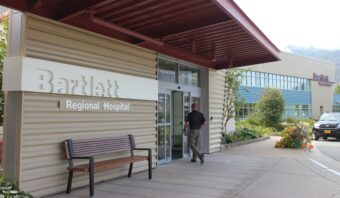
Bartlett Regional Hospital on Aug. 2, 2023. (Katie Anastas/KTOO)

When Deena McDougal’s mother was dying at a hospital, it seemed like the doctors and nurses didn’t want to talk about it.

“Being a nurse, I knew that my mom was going through the dying process,” McDougal said. “To have a whole other healthcare team not provide that information was difficult for me.”

McDougal has been a nurse in Juneau for 15 years. She’s worked in the emergency room and in surgery clinics. Now, she’s one of about 25 staff in Bartlett Regional Hospital’s new home health and hospice department.

In her new role, she talks to families candidly about what to expect when their loved one dies, and how they can best manage pain and other symptoms in the meantime.

“It’s going to happen to all of us, and it’s ok,” she said. “I really enjoy that we just talk about it — it’s real, it’s not hidden, and it’s accepted by everyone who’s involved.”

Bartlett started treating home health and hospice patients last month. It’s the first time those services have been available since Catholic Community Service stopped providing them last fall.
“It was felt in the community, it was felt in the hospital, it was felt by the clinics,” said Amanda Williams, Bartlett’s home health clinical manager. “It’s definitely a service that’s needed.”

The home health program provides intermittent in-home care for people recovering from an illness or surgery. That care can include help from nurses, physical therapists, home health aids and social workers.

Hospice is for patients with a life expectancy of six months or less. Nurses can help manage pain and other symptoms, and chaplains can provide spiritual support.

Heather Richter, the clinical manager for the hospice program, said the goal is to support both the patient and their family or other caregivers.

“As a nurse, your first instinct is to fix something that’s wrong,” Richter said. In hospice, she said, staff ask themselves, “Is the patient comfortable? Is the family comfortable with what’s happening to the patient? How can we make this the most peaceful transition?”

Staff are treating four home health patients and four hospice patients as of Friday, according to hospital spokesperson Erin Hardin. Since they started seeing patients last month, one hospice patient has passed away.

“It was a beautiful passing – what the patient wished for verbally in the beginning,” Richter said. “And the family could not have been more grateful and appreciative.”

Bartlett is hiring an occupational therapist and physical therapist for the home health program and a chaplain for the hospice program.

“Right now, we’re supported by the Bartlett therapy staff, but we can already see the big need that we’re going to have,” Williams said.

The hospital raised more than $18,000 for the new program at a fundraiser on Thursday. That money will help pay for training, equipment and other costs as the program brings on more patients.

SEARHC to close Sitka’s home health department

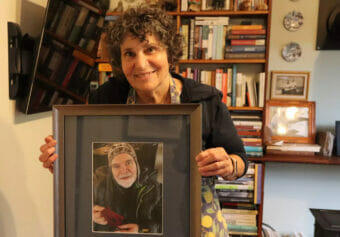
Cindy Litman holds a photo of her late husband Tony. Litman says home healthcare was incredibly important to their family as they navigated Tony’s advancing Parkinson’s Disease. (Katherine Rose/KCAW)

The Southeast Alaska Regional Health Consortium is closing its home health department in Sitka at the end of September. While the organization maintains that the closure is largely an administrative move, and that outpatient services – and in-home care – should be unaffected, some Sitkans are concerned that both the expense and quality of end-of-life care will change dramatically.

Sitkan Cindy Litman’s home smells like warm flour and butter. She’s just pulled a few trays of cookies out of the oven. Her three cats lounge in a living room filled with books and art and photographs. This is the home she and her late husband Tony shared in his final years.

Tony was diagnosed with Atypical Parkinson’s Disease in 2014. At the time, they were living in a two-story home in Sitka.

“He got to the point where he couldn’t navigate the stairs in our house, and our bedrooms and full bath were upstairs,” Litman says. “It was a pretty small lot, and we weren’t really able to make the changes we would need to make the house accessible.”

They decided to move to Olympia, Washington, to be near family and easier access to the specialized care Tony needed. And while they had better access to neurologists and cardiologists, Litman says the experience taught her how fragmented healthcare in America is.

“What was striking to me was that there was no coordination of care between those different doctors, so he would see one person and they would have no idea what the other health providers were doing,” Litman says. “And even though the health care was, I’m sure, considered good, it felt very alienating.”

And they missed Sitka, the community that had been their home for over a decadeNine months later, friends back home were selling a house that would accommodate Tony’s changing mobility. Even though they worried that there were no practitioners specializing in Parkinson’s in Sitka, they jumped on the opportunity and moved back.

That’s when they learned about what was then Sitka Community Hospital’s home health program.

“It was my first experience, really, with coordinated care. They were much more in tune to his situation than his primary care physician,” Litman says. “If it seemed like his medicine needed tweaking, or if he needed another kind of therapy or a swallowing test, they were right on top of it. These changes happened very frequently as his situation changed.”

Tony passed away on Valentine’s Day in 2019. Two months later, Sitka Community Hospital was acquired by the Southeast Alaska Regional Health Consortium, or SEARHC.

“The point of home health and post acute care, community based care, is we bring a comprehensive team to you,” says Emily Rivas. She was the first clinical manager for SEARHC’s home health department, which was created in 2018, a year before the SCH acquisition.

“From an allocation of resources standpoint, there’s not a lot of duplication, because there’s one plan of care, and everybody works together on that,” Rivas says. “The communication is pretty tight, we’re supposed to meet and discuss the patients as a whole, looking at their long term plan, chronic disease processes, build relationships, encourage better health habits.”

“We will sit down and do your medication box, but then also take a look at your medications and see, ‘Well 27 medications is just too gosh darn much. Let me call your cardiologist, diabetes doctor, and your primary and see if we can’t get rid of some of this and make it a little bit easier.’”

Like its predecessor at Sitka Community Hospital, SEARHC’s Home Health department provided everything from physical and occupational therapy to skilled nursing and end-of-life care in a home setting for anywhere from a dozen to 25 patients at a time. But this summer, SEARHC announced it would be closing the office.

“It’s an administrative structure that creates some possibilities in terms of care, but also limits some possibilities in terms of care,” says SEARHC’s Chief Medical Officer Dr. Elliot Bruh. He says it’s the home health “structure” they’re getting rid of, but not the service.

“There’s some types of care that people need in a home environment that don’t qualify under that type of program. And then there’s other kinds of care that we’ve been providing,” Bruhl says. “There’s been a lot of issues that we’ve been struggling with, and we’ve decided that we’re going to close that entity, that structure, but that doesn’t mean that we’re going to stop caring for patients, or that we somehow can’t provide care to patients.”

Bruhl says SEARHC is closing the office mainly due to federal regulations that make operating it challenging and inefficient. He says the regulations are directed at larger cities and larger hospitals with more resources that can more easily sustain full home health programs with separate medical staffs.

“I would kind of describe it like building an international airport in a location where what you really need is an airstrip,” Bruhl says.

Bruhl says SEARHC will continue to provide service referrals in the home environment through both its Mountainside Urgent Care Clinic and the hospital’s outpatient clinic. And although it’s never had a formal hospice program,the home health department has been providing some end-of-life services. Bruhl says they’ll still be able to do that. Right now they’re working through the logistics.

“We also provide really intensive types of end of life care in the hospital,” Bruhl says. “And I think we’re anticipating that we may, at times, project that care also into our long-term care facility when we need to. So our intention is not to abandon that care, abandon patients or leave patients who need that type of care without access to those services, it’s just we’re not going to provide it through this department.”

Litman says the care her husband received through home health ensured the best quality of life possible, even as his health declined.

“When I think about even the last few years, when his mobility was so restricted, he lived a rich life. We had company, we had Christmas with all the grandchildren and their children,” Litman says. “The idea that he would be in a skilled nursing home for that time, to me, just seems cruel and horrifying.”

And expensive. Litman says Tony’s home health costs were far less than had he lived in a skilled nursing facility – and Medicare covered the bills. She is skeptical that the same level of care will be provided outside of the home health umbrella, and she feels that the decision is primarily driven by finances.

“If you think about someone like Tony, if they had been in skilled nursing for two years, it would have been a million dollars. I mean, I can’t even imagine how much money that would have cost instead,” she says. “Medicare pays for home health because home health has been shown to be so effective in keeping people out of the hospital, that even part A, which is the hospitalization part of of Medicare, will pay for home health services. So it it concerns me that this is driven by by money, rather than by medical needs of people.”

Rivas, who left SEARHC in 2020 and now works as a hospice nurse in Oregon, says home health helps create better continuity of care, and doesn’t think the outcomes for patients can be replicated through outpatient services. She’s disappointed that the program she helped establish is going away.

“In a town of 9000, what we put together was much better than nothing, and it would just be really unfortunate to have that integrated,” Rivas says. “It takes time for people to build trust, especially in a community like Sitka, and to have that now, and then have it go away, it’s gonna be really hard to change yet again, in such a short period of time.”

SEARHC’S Home Health has eight staff, both medical and administrative, who were notified about the closure in July. Bruhl says all will be offered jobs in other departments beginning in October.

Pickleball could be part of Juneau’s new commitment to better serve its older population

People play pickleball at Cope Park in Juneau. (Photo courtesy of Alaska Crimson Bear Pickleball Club)

Last week, Juneau joined a program that commits to making the city more livable for seniors.

AARP’s Network of Age-Friendly States and Communities recognizes cities that commit to serving their older populations better. Juneau is the second city in Alaska to join, following Anchorage.

Emily Kane, chair of the City and Borough of Juneau’s Commission on Aging, says the designation is more of a promise than a reward. 

“We have to earn that status. Every five years, we have to make a report to AARP,” she said.

Kane is a senior herself. She said that Juneau needs to be considering its rapidly growing population of older people. 

“Alaska is one of the fastest aging states in the nation,” she said. “And Southeast Alaska is the hub of the agingness of Alaska.”

To get the designation, the Juneau Assembly and Mayor Beth Weldon had to commit to make Juneau more accessible and to invest in infrastructure for older community members. Kane said part of that commitment is identifying a project that can be done in five years.
One thing older Juneauites want that she thinks is possible in that timeframe is a senior-focused pickleball court.

“I’m like, ‘let’s put in some senior fitness equipment,’” Kane said. “But then, when I really ask seniors, they’re like, ‘No, we want a pickleball court.’”

Kane said she also hopes that a volunteer hub for the organizations that serve older Juneauites would be a feasible goal. Now, she said, programs like Meals on Wheels or the now-defunct program Friends of Seniors are hard to coordinate and streamline. 

Kane said that despite the age-friendly designation, older people in Juneau face some big barriers like access to medical care and housing. 

Juneau’s only provider of in-home and end-of-life care closed last fall, which Kane said left a major gap in the needs of older people. She also pointed to the lack of medical specialists in town.

“Our neurologist is in her 80s,” Kane said. “She’s trying to retire.”

Housing in Juneau is also a personal issue for her. 

“I want to age in place, but my house is up 66 stairs,” she said. “I’m a pretty healthy senior — knock on wood — but there’s going to come a time where I just cannot carry my flat from Costco up all my stairs. I’m going to have to find a place to stay that has fewer stairs, and is more suitable for someone who’s becoming older. And those options are limited,” she said.

Assembly member Michelle Hale said the city has been working to address lack of housing for older people through projects like the Riverview Senior Living Facility, which will open sometime this spring.

But Hale said the city still has a ways to go.

“Elder people are here, and they’re going to continue to be here,” she said. “And the better we make Juneau for older people to live, then the better they are for Juneau as well.”

On Tuesday, AARP is hosting an event at the Baranoff Ballroom from 4:30-6:30 to celebrate Juneau’s senior community and the start of the 2023 Legislative session.

Social isolation linked to an increased risk of dementia, new study finds

""
Older people who have few social connections and interactions are at a higher risk for developing dementia, a new study has found. (Charles Dharapak via AP)

Socially isolated older adults have a 27% higher chance of developing dementia than older adults who aren’t, a new study by Johns Hopkins researchers found.

“Social connections matter for our cognitive health, and it is potentially easily modifiable for older adults without the use of medication,” Dr. Thomas Cudjoe, an assistant professor of medicine at Johns Hopkins and a senior author of the study, said in a news release.

Published in the Journal of the American Geriatrics Society, the study tracked 5,022 dementia-free U.S. adults who were 65 or older – with an average age of 76 – and not living in a residential care facility. About 23% of participants were socially isolated.

Social isolation is defined as having few relationships and few people to interact with regularly. The study measured this based on whether or not participants lived alone, talked about “important matters” with two or more people in the past year, attended religious services or participated in social events. Participants were assigned one point for each item, and those who scored a zero or one were classified as socially isolated.

Over the course of nine years, researchers periodically administered cognitive tests. Overall, about 21% of the study participants developed dementia. But among those were who were socially isolated, about 26% developed dementia – compared to slightly less than 20% for those who were not socially isolated.

The study did not find significant differences by race or ethnicity. However, more than 70% of the participants in the study were white – with particularly small sample sizes of Hispanic, Asian and Native participants – and the authors call for further research on the topic.

Social isolation has previously been known as a dementia risk factor and is linked to other serious health conditions such as heart disease and depression, according to the Centers for Disease Control and Prevention.

About 5.8 million people in the U.S. have Alzheimer’s disease, which is the most common type of dementia, according to the CDC.

Social engagement can improve the quality of life for patients living with dementia and slow its progression.

A second study using related data found that access to technology such as cell phones can prevent social isolation among older adults.

“This is encouraging because it means simple interventions may be meaningful,” Mfon Umoh, a postdoctoral fellow in geriatric medicine at Johns Hopkins, said in a news release.

Copyright 2023 NPR. To see more, visit https://www.npr.org.

Nursing shortage leaves Juneau hospice patients with few options until gap is filled

Bartlett Regional Hospital pictured in Juneau on Aug. 7, 2022. (Photo By Paige Sparks/KTOO)

Juneau has been without hospice and home care since mid-September.

That’s when Catholic Community Service shut the program down because it was unable to find enough staff. Bartlett Regional Hospital plans to take over the services, eventually.

“It’s a big loss to the community because these services are so critical to people’s health and just sort of the quality of life and dignity of our last days,” said Catholic Community Service director, Erin Walker-Tolles. “It’s really tough.”

Walker-Tolles said she directed patients back to their primary care providers when she knew CCS would have to cease services.

CCS had struggled to staff the program for a while, Walker-Tolles said, but the pandemic made the market for nurses even tighter.

“There is a massive health care worker crisis happening in this country. And it’s especially challenging in Alaska. And it is affecting people’s ability to get medical care,” she said.

Walker-Tolles said hospice and home care often used traveling nurses to bolster its local staff. But as the price for nurses increased dramatically over the past few years, she says they were priced out.

“All across the country, the health care worker shortage is affecting especially nonprofit and smaller health care providers,” she said.

The hospice and home care program served about 60 residents before the pandemic, Walker-Tolles said. By the time the program shut down, there were only 17 people using the service. She said they simply didn’t have the staff to take on new patients.

Nathan Rumsey, Bartlett Regional Hospital’s business development strategist, said the hospital’s leadership decided to take over services in mid-August and applied for licenses in mid-November. He said he’s hopeful the hospital will get its licenses in the next 60 to 90 days.

“In the meantime, that obviously puts those people, especially if they can’t seek some type of service outside of this community, that puts them at a disadvantage,” he said. “That’s why we’re trying to move as quickly as we can to reestablish those services.”

Rumsey also said the lapse in service means that primary care physicians and the emergency department are now filling in.

“I am anecdotally aware that there are many patients that would otherwise be able to seek care and get care in their homes that are finding their way into the hospital for other reasons, because they can’t get that and — and that’s a frustration to everyone,” he said.

Bartlett has offered to hire staff from Catholic Community Service, but Rumsey said they will need more nurses. The hospital plans to advertise for those jobs within a few weeks.

Ultimately, he said the timeline is out of the hospital’s control until they receive licenses from the state. Once those are secured, he hopes to be up and running very quickly.

Site notifications
Update notification options
Subscribe to notifications