Aging

Haida centenarian to celebrate birthday in Craig

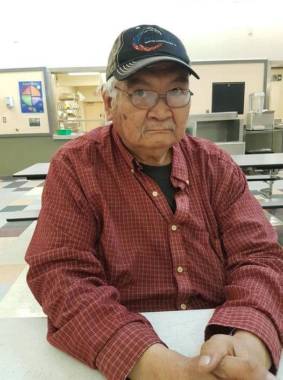
Fred Hamilton, Sr. (photo courtesy of June May).

A resident of Prince of Wales Island, who is the world’s oldest living Haida, is being honored for his longevity and community service. Fred Hamilton, Sr. will be celebrating his birthday Tuesday in Craig, where he was born.

Hamilton was born in 1921, the middle of nine children. He is of the Raven moiety and his crests are Owl, Brown Bear and Flicker.

His mother died when he was 10 years old, and he and several of his siblings were sent to the Sheldon Jackson boarding school in Sitka the following year. Hamilton said he would return to Craig each summer to commercial fish to earn money to pay the $35 annual tuition. After graduating in 1942, he and another man from Sitka joined the Navy.

“And I never did learn how to swim,” he said. “We didn’t go to boot camp because there were just two of us. So I served all my time in the Navy and I didn’t know how to swim. That should set some kind of a record.”

He was stationed in Dutch Harbor and Kodiak Island during World War II and later was sent to Seattle where he met his future wife, Beverly Jean Bailey. In 1948 the couple returned to Craig for good.

Fred Hamilton, Sr. Day proclamation (photo courtesy of the City of Craig).

His wife died in 2005. Hamilton says he’s game to remarry.

“Oh yeah,” he said. “I’m still shopping around. Do you have any suggestions?”

He’s had a varied career, working on the state ferries, for the long-defunct post-war Ellis Airlines, as a commercial fisherman and small business owner.

Hamilton lives independently in his own home with assistance from family members who prepare his meals.

He says one of the reasons for his longevity is his bright outlook on life.

“Always think positive and help people. And a happy family is very instrumental too.”

Reflecting back on changes he’s seen over his lifetime, he says because of television and smart phones and other technology, people have become disconnected from one another.

“Because for one thing, you just can’t have a good visit anymore because everybody is listening for a phone call,” he said. “You have less contact with people.”

Hamilton says family is the most important thing, and he enjoys spending time with his. Three of his five children and four of his 12 grandchildren live in Craig.

Volunteerism is also important to him. He has served as a volunteer firefighter, school board member, city council member, Boy Scout leader and timekeeper at school basketball games. His faith is important to him as well, and he is a member of the First Presbyterian Church of Craig and Klawock. Hamilton’s advice is to be friendly, help others and to not dwell on bad things that may happen in life.

His youngest daughter, June May, says he had a stroke about nine years ago but has “been a trooper” and recovered well. She says the family is very proud of him.

“We all think and know how amazing he is. He’s just been a good role model for us all our lives. And we are just doing everything we can to keep him here as long as we can and enjoy each day with him.”

Sealaska Heritage Institute is bringing attention to his upcoming birthday. It urges fellow Haidas and others to send him a birthday card or note. May says they hoped to receive 100 cards from well-wishers, and that goal has already been surpassed. The City of Craig has proclaimed February 2, 2021 as Fred Hamilton, Sr. Day.

A parade past his house was scheduled for Sunday. Organizers encouraged people to drive or walk by to wave and wish him a happy 100th birthday.

Cards and notes can be sent to Mr. Hamilton at P.O. Box 127, Craig, AK 99921.

‘It brings back memories’: Northwest Alaska health provider cleared to make seal oil and serve it to elders

A jar of seal oil processed at the Siglauq building in Kotzebue. (Photo by Wesley Early, KOTZ – Kotzebue)

In Inupiaq communities, more than any other food, seal oil is a fixture.

“I had it for lunch today,” said Cyrus Harris. “I’ll have it for supper tomorrow.”

Like many Inupiaq people in the Northwest Arctic, Harris grew up eating traditional foods like seal oil, caribou and musk ox. When his relatives moved into Maniilaq’s Utuqqanaat Inaat long term care, he found they weren’t able to eat the same food they’d lived off for years.

“They didn’t choose to be living off the Western diet that they were being served every day,” Harris said. “So I found out I could cook a meal at home and take it to my ahna and taata over at the long term care, and serve it in that manner. But where does that leave the other 18 elders there?”

Seal oil has been a diet staple for Alaska’s Inupiat people for centuries. However, because of federal and state health regulations, you can’t buy it in stores and it can’t be served in restaurants.

Cyrus Harris is in charge of Maniilaq’s hunter support program. (Photo by Wesley Early, KOTZ – Kotzebue)

In 2015, Congress passed the federal farm bill which allowed people to donate wild game that they’ve hunted to certified non-profits, like hospitals or food banks. Since then, Harris has been in charge of Maniilaq’s hunter support program, which prepares traditional foods for elders at long term care.

The food is processed at the Siglauq, a state-certified meat processing building. The name comes from the Inupiaq word for the underground ice cellars used to store meat.

“Back in the day, everybody had their own Siglauq,” Harris said. “They had their own underground cold storage.”

Cyrus Harris shows frozen musk ox meat to be served to elders at Maniilaq’s Utuqqanaat Inaat long term care. (Photo by Wesley Early, KOTZ – Kotzebue)

Walking in the Siglauq freezer, Harris described some of the donations.

“These are some products that we will most likely use for our certain potlucks,” Harris said. “This is sheefish filet. We do have moose burger. We do have some musk ox burger.”

While getting wild meat on the menu for elders has gone smoothly for about five years, Harris says seal oil remained prohibited. The only time it could be served was at a potluck, and it had to be brought in from home. It couldn’t be made and served by Maniilaq – until now.

Just before the freezer in the Siglauq is the main processing room. And sitting on a table are three large drums with blubber floating in vats of seal oil. Harris describes the process for rendering the seal oil, which starts with separating the skin and blubber from the carcass.

“Then flesh the blubber from the skin,” Harris said. “And cut into maybe one inch by three inch pieces and set into containers like this.”

Three containers of seal oil being rendered by Cyrus Harris. (Photo by Wesley Early, KOTZ – Kotzebue)

Granted, Harris says most seal oil is made out in the field, and not under the strict lab requirements of the Siglauq.

“The best seal oil I ever had was stored in seal pokes,” Harris said. “Seal pokes have a long story behind it. It’s seal hides made into a container.”

While seal oil is generally ingested without incident, a major reason it was restricted was due to its connection to a foodborne illness called botulism, which can cause nausea, blurry vision, muscle fatigue, and in some cases, death. Since the 1950s, the Maniilaq service area has seen more than 15 outbreaks of the illness tied to eating traditional Native foods.

Chris Dankmeyer is environmental health manager for Maniilaq. For the past few years, he, Harris and others have been collaborating to develop a way to safely render seal oil. Those include food safety scientists at the Kodiak Seafood and Marine Science Center as well as microbiologists at the University of Wisconsin. After several years of running lab tests, they found that heating the seal oil to 176 degrees for 10 continuous minutes made seal oil safe.

“That completely destroys the toxin that may or may not be in the oil,” Dankmeyer said.

Dankmeyer stated that this heat treatment has only proven to make pure seal oil safe and not seal oil that contains other traditional additives.

“We’re not keeping blubber in there,” Dankmeyer said. “We’re not throwing in pieces of dry meat. And that’s a traditional thing.”

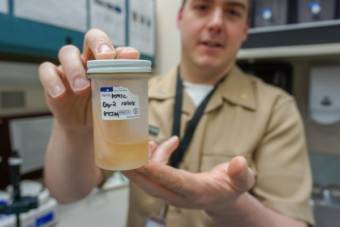
Chris Dankmeyer displays a sample of seal oil in 2018, when researchers were developing a method to heat treat the oil (Photo by Anne Hillman/Alaska Public Media)

Once the seal oil is heat treated, it’s rapidly cooled to prevent the toxin from reforming, and placed in the freezer where all the other traditional foods are.

“And we keep it frozen until it’s time to serve,” Dankmeyer said. “Basically, over there at the hospital, they’re going to dip it out frozen into a serving dish. It’s going to come up to room temp and be eaten.”

Dankmeyer says the last step is to make sure that Maniilaq’s kitchen staff are prepped on how to safely handle and serve the seal oil. For example, it can’t be left out for more than four hours, or it runs the risk of creating more toxin.

In the next few weeks elders can look forward to seeing plates filled with the traditional foods they’ve eaten their whole life.

One person excited to see the reactions from elders is Marcella Wilson, who heads Maniilaq’s long-term care facility. She says elders have been able to have seal oil during the occasional potluck, and she always sees an immediate reaction.

“It brings back memories,” Wilson explained. “Memories of when they were children and how they had the seal oil and traditional foods growing up. And that brings about storytelling. And then the storytelling starts bringing about laughter.”

Wilson says that she’s learned a lot about the Inupiaq culture from the elders, and she expects them to feel more lively as their traditional foods become more available.

“I’m not saying there’s magic in it, because there’s not,” Wilson said. “But there is such a nutritional value to it and such a cultural value to it, that the two together are just immeasurable.”

Dankmeyer says Maniilaq is the first organization in the nation approved to make and serve seal oil, and he’s excited to share their process with other organizations in the future.

For the fourth year in a row, Alaska’s population declined

Alaska flag
The Alaska flag. (File photo by Skip Gray/Gavel Alaska)

Alaska’s population dropped by nearly 4,000 people — or 0.5%– last year, according to estimates released from the state on Thursday.

It’s the fourth straight year of declines and the biggest drop since 1988. The estimate covers the period between July 2019 and July 2020.

Even though 5,000 more Alaskans were born in the state than the number of those who died, the net decline came from people moving away. Nearly 9,000 more people left the state than moved in. Also, Alaska lost roughly 46,000 jobs during this time.

Alaska’s estimated population was 728,903 in July, down from 740,637 four years earlier.

One group that saw an increase was Alaskans 65 and older. That group grew by 4%.

Of Alaska’s 30 boroughs and unorganized census areas, 23 had population declines, led by Anchorage. The Fairbanks North Star and Matanuska-Susitna boroughs had the largest increases.

Juneau’s population is 31,773 — down 286 people from the year before. There were 118 more births than deaths in the capital city, but 404 more people moved away than moved to town.

The numbers are estimates, because the numbers from the 2020 census haven’t been released yet.

Everybody liked Mike: Manokotak remembers Yup’ik Elder Mike Minista

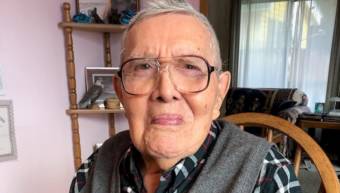
Mike Minista (Credit Melvin Andrew)

Mike Minista lived in Manokotak all his life. He was an avid hunter and fisherman who also fished commercially for decades.

One of his long-time friends, Jerry Liboff, met Minista 50 years ago at the Ekuk Cannery. Minista was commercial fishing at the time, and a storm kept him at the cannery for several days.

“I tried to stumble around with a few Yup’ik words,” Liboff said. “Once I started mis-saying Yup’ik words, that sort of broke the ice and we became actually very good friends at the beginning.”

Liboff said that during their many visits over the years, Minista would teach him Yup’ik.

“Mike would, with his patience, over and over again, ‘Say it again Jerry, say it again.’ And I would say it,” said Liboff. “He would crack up and laugh and he would do it enough times until I finally picked up and I said, ‘You should be the Yup’ik teacher for all the dumb people like me that are trying to learn it,’ and he would just laugh.”

Minista was an active member of the community, serving on the Manokotak City Council and the Village Tribal Council for several years. He volunteered for his church, and he often supported the school.
Louie Alkiak, one of Minista’s childhood friends, said that Minista stayed positive despite issues with his health.

“It didn’t affect his personality,” Alkiak said. “He was the same old guy. He was a good man, humble and jokes and would always laugh with people.”

Judy Itumulria, Minista’s sister, said that while Minista didn’t have children of his own, he loved spending time with her grandchildren.

“He was with them and he’d always give them something,” she said. “He would share with food and all that kind of stuff.”

Liboff, his friend, said Minista’s death is a loss for the community, and that his happy spirit will be missed.

“Everybody in the village of Manokotak liked Mike. He was one of those guys you couldn’t help but like – he did not have an enemy,” Liboff said. “I think everybody is going to miss him because he was always laughing and always enjoying himself so he was always a fun-loving and happy-go-lucky person.”

Minista moved to an assisted-living facility in Anchorage earlier this year due to health concerns unrelated to COVID-19. He died earlier this month. He was 66 years old. Minista is survived by his two sisters, and his nieces and nephews.

Alaska will prioritize people 65 and up for next round of COVID-19 vaccine, breaking from federal guidance

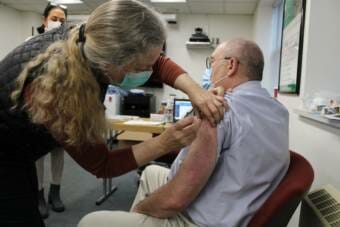
SEARHC chief medical officer Dr. Elliot Bruhl receives his first dose of the COVID-19 vaccine. (SEARHC photo)

The state of Alaska is breaking from federal guidance by focusing its next round of COVID-19 vaccine on elders age 65 and over. And it’s asking frontline essential workers, teachers, prisoners and others in high-risk settings to wait until those elderly Alaskans can be vaccinated first.
The Department of Health and Social Services released the new guidelines Thursday afternoon. They outline which groups will receive the vaccine in what’s known as Phase 1b — after the frontline health-care workers, nursing home residents and staff emergency responders in Phase 1a.

A federal vaccine committee recommended earlier this month that Phase 1b be designated for elders 75 and over, plus frontline essential workers like teachers, postal service and grocery store workers and bus drivers.

The state is including all those groups in Phase 1b. But within Phase 1b, it’s prioritizing a larger group of elders by allowing those 65 and older to be vaccinated first, instead of 75 and older.

Chief Medical Officer Doctor Anne Zink says there are a few reasons for that. First is that Alaska’s elderly population is smaller than other states’. Second, there are relatively few nursing home beds in Alaska, meaning that fewer elders were vaccinated as part of that group.

“The third reason was just a real emphasis I think culturally on elders as a priority group in the state overall,” Zink said. “We heard that loud from many different components of the state.”

The Alaska-specific recommendations were first debated by a committee of medical experts, then tweaked by Republican Governor Mike Dunleavy’s administration — a process that was not easy, Zink says.

The state took testimony from more than 380 people and groups before issuing the new guidance.

“It was really hard. It was incredibly hard. We really appreciate all the feedback, and there are really good arguments and all sorts of ways to slice this,” Zink said.

Separately, the state announced on Wednesday that it will receive another 53,000 doses of COVID-19 vaccine from the federal government in January. That’s slightly down from the 62,000 doses allocated to the state for December.

Weather permitting, Juneau’s COVID-19 vaccine will be here Tuesday

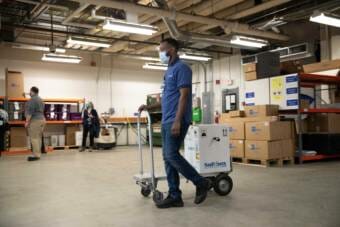
COVID-19 vaccine arrives in Alaska. (Photo from Alaska Department of Health and Social Services)

Juneau is expected to get its first shipment of the COVID-19 vaccine on Tuesday, weather permitting.

A UPS plane delivered Alaska’s first vaccine shipment Sunday in Anchorage.

Local officials say that Bartlett Regional Hospital will be the distribution hub for Juneau’s first 975 doses of Pfizer’s vaccine. Hospital staff will be among the first to receive it.

State officials decided who to prioritize as vaccines roll out, in line with guidance from the Centers for Disease Control and Prevention. The first group includes frontline health care workers, first responders and long-term care facility residents.

Ruth Johnson is the administrator for the nursing home Wildflower Court. She has about 120 employees and 55 residents who are eligible for vaccination.

“It means they’re going to be vaccinated very soon,” she said. “And there’s been a ton of logistics and works going on behind the scene.”

Logistics like where the vaccines will actually be given, and getting written permission to vaccinate. She says she’s heard some concern about the speed with which the vaccine was approved for use and some philosophical opposition. But Johnson feels confident more than 90% of her residents will get vaccinated, and thinks Wildflower Court staff may hit that benchmark, too.

A family testing out a new way to have contact at Wildflower Court. (Photo courtesy of Wildflower Court)

She says it’s not clear yet if widespread vaccination at the facility will allow her to relax rules that have largely limited residents’ interactions to virtual visits and window visits.

“I don’t know when we’ll be able to unlock the doors. And believe me, we’re all looking forward to it,” she said. “These residents have not had access to their families since March. It’s been a very long time.”

She says she’s awaiting guidance from federal regulators with the Centers for Medicare and Medicaid Services.

To be effective, a second dose of Pfizer’s vaccine is required three weeks after the first. Juneau officials expect shipments of additional doses every week or two.

The next vaccination phase covers many more people, including essential workers, workers that interact with the public a lot, people age 65 and up, and people with other health risk factors.

State officials say they are “working to ensure” the vaccines are free to individuals.

The National Weather Service’s lead meteorologist in Juneau, Wes Adkins, says Tuesday’s weather looks benign, though there may be a chance for some wind shear and fog that could affect flights.

Site notifications
Update notification options
Subscribe to notifications