Aging

Respected elder and former Alaska Territorial Guard lived life of laughter

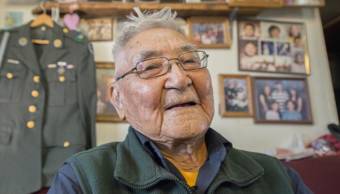
Sam Jackson, Sr. (courtesy U.S. Army)

Last month Kwethluk lost an elder — a man who had done everything from guarding his community in wartime to teaching youngsters how to fish and hunt and enjoy life.

The first thing that comes to mind when people hear Kwethluk resident Sam Jackson Sr.’s name? Infectious laughter.

“He was known as a person that always laughs,” said Alice, one of his 10 children.

Another daughter, Elizabeth, always knew when he was catching a fish.

“He would start giggling when he’s fishing, giggling away, she said. “So we would know by that that he’s going to catch a fish.”

Jokes and laughter aside, Jackson Sr. had a serious past. He joined the Alaska Territorial Guard as a teenager, defending the Yukon-Kuskokwim Delta after the Japanese invaded Alaska. The Aleutian Islands were occupied by the Japanese, so an enterprising major, nicknamed Muktuk Marston, traveled around rural western Alaska by dog sled and boat recruiting thousands of unpaid Indigenous militia men and women to defend their homeland.

As a volunteer, Jackson Sr. helped villages go dark when unknown aircraft flew by. He would help cover the windows to ensure no light could be spotted from above.

Sam Jackson, Sr. (courtesy Margie Crow)

After his army career, he worked with the Bureau of Indian Affairs School system as a janitor, and later as the head maintenance man. When the system changed hands to become the Lower Kuskokwim School District, he stayed on in his role. He also took other jobs as a carpenter. Bev Hoffman remembers him working on her family home when she was a child, telling her to not enter the construction site. When she did anyway and fell through the ceiling, the most he could do was gently chide her.

His daughter Margie agreed that he wasn’t one for scolding.

“My mom was the disciplinary parent, and my dad was the fun parent,” she said.

Jackson Sr. passed away on Nov. 10, just one month before his 97th birthday. Margie said that he was strong to the end.

“I’m proud that to his dying day he was still capable of cutting wood and packing water,” she said. “He loved to take a steam. He didn’t miss a week, even the Saturday before he died.”

His family held a socially distant funeral in Kwethluk on Nov. 13. Some of his many children, grandchildren, great-grandchildren, and even great-great grandchildren celebrated his life with singing in English and Yugtun.

How residents at this Anchorage assisted-living home are hugging their families again

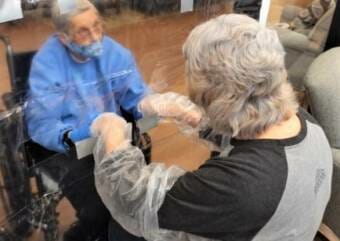
Karen Froland (right) and her mom, Alene Robinson, hold hands on Wednesday, Dec. 2, 2020, at the Aspen Creek assisted-living home in Anchorage. It’s the first time they’ve held hands since March. (Tegan Hanlon/Alaska Public Media)

First, Karen Froland put on long, plastic gloves.

Then, she sat down across from her 98-year-old mother, Alene Robinson, on Wednesday afternoon at Anchorage’s Aspen Creek assisted-living home.

A sheet of clear plastic separated them, with holes near its center. Froland put her arms through.

And, for the first time since March, the two held hands.

“You feel good. You feel so good,” Robinson cooed from behind a face mask, on the other side of the plastic. “This is marvelous.”

Aspen Creek staff call the plastic barrier the “hugging wall,” and they first adhered it to the doorway near the home’s front-entrance last month.

Executive director Anna Houser said she wanted to find a way for residents to hug and hold their families again, since they’ve been under such strict protocols for so long.

“Before the doors were never locked,” she said. “And now, they’re always locked.”

Aspen Creek Executive director Anna Houser helps to set up the hugging wall at the Anchorage assisted-living home on Wednesday. The hugging wall is a clear sheet of plastic that is adhered to a doorway with small arm holes cut near the center. (Tegan Hanlon/Alaska Public Media)

Since the pandemic began, residents can no longer come and go as they please.

In the summer, they could visit with friends and family outside, as long as they stayed at least 6 feet apart and didn’t touch.

Cold temperatures, however, brought a policy change: Families now meet one-by-one in Aspen Creek’s gym. But they have to make appointments ahead of time, and the meetings only last about 15 minutes. The time slots fill up quickly.

It’s hard on residents, Houser said.

“Which is kind of why the hugging wall happened,” she said.

Assisted-living homes across the country have set up similar plastic barriers as a way for residents to have some physical contact with loved ones.

“Their mental health is important, and it matters,” Houser said.

The hugging wall still comes with a list of protocols, Houser said. Visitors have to fill out a health questionnaire, wear a face mask and gloves and can only stay about 10 minutes. Employees sanitize the plastic barrier between visits.

“We still have our masks on,” Houser said. “And it’s really just the arms reaching through.”

No residents or staff at Aspen Creek have tested positive for the coronavirus yet, she said Wednesday, and the goal is to keep it that way.

Assisted-living homes are considered high-risk for rapid spread of the virus, and older people are more likely to get very sick if infected.

Froland, who met with her mom Wednesday, said the added precautions at the assisted-living home mean she can’t visit every day like she used to, before the pandemic.

Jackie Robinson visits with her daughter, Amanda Pagaran, and her son-in-law, Bill Pagaran. (Tegan Hanlon/Alaska Public Media)

She’s happy her mom is safe, and the protocols are in place, she said, but she knows it’s also a tough way to live.

“She’s been lonely since March,” Froland said.

So having the option to sit across from one another and hold hands means a lot.

“It’s just a great thing. And I’m just glad to be able to see her and it meant the world to her,” she said.

“If they do it again, I’ll be the first to sign up.”

Jackie Robinson, 86, also got to hug her family on Wednesday. (Though Jackie and Alene share the same last name, they’re not related.)

It was her second time at the hugging wall.

The first time, last month, her oldest daughter and great-grandchildren came.

“When we heard about it, I thought, ‘Oh, that’s silly,’” she said. “But once I did it, oh, it has a lot of meaning. My daughter, Emily, and I were in tears.”

On Wednesday, another one of Robinson’s daughters, Amanda Pagaran, and her son-in-law, Bill, came to visit. They took turns hugging Robinson, the plastic sheet wedged between their bodies.

“It just felt so good,” Pagaran said. “It’s been so long.”

Houser said Aspen Creek plans to put up the hugging wall at least once a month so residents have a chance — even if it’s brief and through plastic — to hold the people they love.

Jackie Robinson hugs her son-in-law, Bill Pagaran. (Tegan Hanlon/Alaska Public Media)

Anchorage Pioneer Home resident with COVID-19 dies

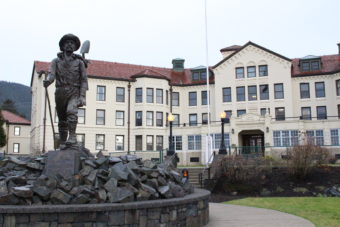
The front entrance to the Anchorage Pioneer Home with flower beds
The Anchorage Pioneer Home in July 2020 (Lex Treinen/Alaska Public Media)

A resident at the Anchorage Pioneer Home who tested positive for COVID-19 has died, the state health department said on Wednesday.

The death comes as the Pioneer Home works to contain a cluster of infections among a vulnerable population. The facility provides assisted-living care to Alaskans age 65 and older.
By Wednesday, a total of 14 residents and four staff members had tested positive for the virus, said Clinton Bennett, a spokesperson for the Alaska Department of Health and Social Services.

Two of the residents were hospitalized, including the one who died recently, Bennett said. He declined to provide additional information about the person and the death, citing federal patient privacy laws.

Bennett said eight infected residents remain isolated at the Pioneer Home and four have recovered. One staff member remains in isolation, and the other three are considered recovered, Bennett said.

In total, the health department has linked 37 Alaskans’ deaths to COVID-19 since March, including a new death reported in state data on Wednesday.

The department said a woman from Anchorage in her 40s died. It also reported four deaths the day before. It’s unclear when the Pioneer Home resident died, and Bennett declined to provide the information because of privacy laws.

The state also reported a total of 53 new COVID-19 infections on Wednesday — all but one of them in residents. About half of the resident cases are tied to Anchorage.

At the Pioneer Home in Anchorage, regular COVID-19 testing will continue for residents and staff, Bennett said.

The facility has remained closed to visitors since mid-March. It identified its first COVID-19 infection Aug. 5.

Across the country, COVID-19 has been particularly deadly in long-term care facilities for older adults. The federal Centers for Disease Control and Prevention says that older people are at a higher risk of developing serious complications from COVID-19, and the virus can spread more easily in areas where people live in a confined space.

Earlier this year, an outbreak at Providence Transitional Care Center, a long-term care facility in Anchorage, led to more than 45 infections and two deaths.

Alaska Pioneer Homes are trying out in-person visits again

The Sitka Pioneer Home was the first such facility. Five others operate in Ketchikan, Juneau, Anchorage, Wasilla and Fairbanks. (Photo by Emily Kwong/KCAW)
The Sitka Pioneer Home. (Photo by Emily Kwong/KCAW)

Assisted living facilities and nursing homes in Alaska closed to the public in March over concerns residents could easily contract and spread the coronavirus. Now, some Alaska Pioneer Homes are resuming indoor family visits. 

Gina Del Rosario, the administrator at the Pioneer Home in Juneau, says the facility started welcoming visitors inside on a limited basis three weeks ago. Socially distanced face-to-face visits are not to exceed 20 minutes. Overall, she says residents who might have felt isolated before seem happy about the change. 

“The visiting area is close to my office. I could hear part of the conversations. The majority of it is wonderful,” she said. “Air hugs, air kisses have become a normal language for them.”

In all six Pioneer Homes across the state, staff members and residents have already cleared COVID-19 tests and staff will continue to be tested every two weeks. Right now, visitors to assisted living facilities, like the Pioneer Homes, don’t have to be tested, but new state guidelines for nursing homes suggest that visitors provide a negative test within 72 hours of visiting a facility. That’s when inside visits resume. Nursing homes have not opened yet to the public.

Not all Pioneer Homes are set to reopen. There are other factors to consider, such as staffing availability and how many coronavirus cases are being reported in the community. Recently, Alaska has seen its coronavirus case numbers swell. The Pioneer Home in Anchorage isn’t reopening yet due to the high rate of infection in the city. And Fairbanks began visitations last week but stopped after infection rates jumped in the community.

Next Monday, the Pioneer Home in Juneau plans to expand its visitations from one family member to two family members per household.
U.S. Rep. Don Young downplayed COVID-19. Now he’s back to in-person campaign events.

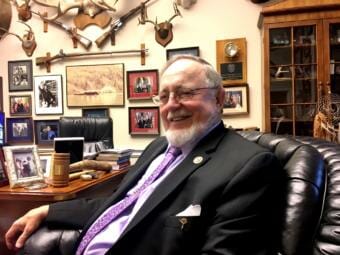
Rep. Don Young in his Washington, D.C. office in July 2019. (Liz Ruskin/Alaska Public Media)

As the Alaska economy reopens, so has U.S. Rep. Don Young’s campaign for his 25th two-year term.

At 87 years old, Young is the nation’s oldest Congressman, and he’s at increased risk of severe illness from COVID-19, according to the Centers for Disease Control and Prevention.
His campaign says it took precautions when holding a 130-person political fundraiser in mid-June, outside the downtown Anchorage home of former Alaska Lt. Gov. Mead Treadwell.

But just in case, Treadwell kept an extra layer of backup.

“If you have to do contact tracing,” Treadwell said, “there’s a pretty good list of who showed up.”

Young, a Republican, also held another outdoor event on the Kenai Peninsula earlier this month at the home of Soldotna GOP state Sen. Peter Micciche, according to an invitation. And he’s planning an in-person fundraiser to celebrate his birthday this week at a South Anchorage restaurant, Little Italy.

“This is a Covid-safe, socially distant event,” said the invitation to Young’s most recent two events. “Feel free to wear a mask.”

No one appeared to be wearing a mask, however, in a photo subsequently posted by Young’s campaign that showed dozens of people gathered outside Treadwell’s home.

The string of in-person events hosted by the Young campaign comes as Anchorage officials warn of a surge in COVID-19 cases fueled in part by people attending private gatherings. The city’s health department issued an alert Friday directing people to wear face coverings and avoid crowds and gatherings.

Young initially downplayed the coronavirus as the “beer virus” before it infected hundreds of Alaskans and killed 12. And he’s now the only major statewide candidate to resume in-person fundraising since the pandemic took hold.

At least one other GOP gathering also went forward last week, inside a busy Palmer restaurant. And on Saturday in Oklahoma, President Donald Trump held his first rally since the pandemic began, even as some health experts warned of the risk of a so-called “super-spreading” event.

Trump’s Democratic rival Joe Biden, meanwhile, held a subdued event in the Philadelphia suburbs last week, with about 20 reporters and locals each with their own socially distant chair inside a circle of tape, the New York Times reported.

The events highlight a sharp partisan split when it comes to treatment of COVID-19 at both the national and state level. In a poll of 400 Alaskans last month, 92% of Democrats said they see COVID-19 as a “real threat,” while just 1% say it’s “blown out of proportion.”

For Republicans, 42% see it as a real threat, while 53% see it as blown out of proportion, according to the poll, which was done by Dittman Research on behalf of the conservative group Alaska Policy Forum.

Nationally, twice as many Republicans as Democrats say they’re socializing in public places, according to a poll earlier this month by the data firm Morning Consult.

In Alaska, not all Republicans have resumed in-person fundraising. GOP U.S. Sen. Dan Sullivan, who’s up for re-election, has no events to announce, said campaign manager Matt Shuckerow.

But generally, left-leaning independents and Democrats have been more cautious about convening in-person gatherings. Sullivan’s best-funded challenger, independent Al Gross, has limited his fundraisers to online events, as has Young’s leading opponent, independent Alyse Galvin.

Both Galvin and Gross are seeking the nomination of the Alaska Democratic Party in the August primary election.

“COVID-19 really has no political boundaries,” Gross, an orthopedic surgeon with a master’s degree in public health, said in a phone interview. “And there’s really no reason for candidates on either side of the political spectrum to put their lives, as well as the lives of Alaskan voters, in jeopardy simply to raise money, when they can continue to raise money digitally.”

Some Alaska Democrats have gotten creative with their online fundraisers. Anchorage state House candidate Liz Snyder held a Facebook Live community event from her mostly-empty backyard last week, which had dozens of digital “co-hosts” and collected about 700 views.

“If you hear clucking, it’s cause there’s chickens,” Snyder warned viewers at the start of the event. “And if you hear kiddos, it’s because there’s kiddos.”

Gross, the independent U.S. Senate candidate, has held his own digital events, including fundraisers on the Zoom platform. Galvin, the independent challenging Young, has also shifted to virtual events, according to Malcolm Phelan, her campaign manager.

At first, Galvin’s campaign was worried about the impact of canceling in-person events, but so far, it has not seen a decline in financial support, Phelan said.

“Alyse has actually been able to reach many more voters across the state. We’ve had events in living rooms almost every night since the pandemic began. We’ve had supporters from Glennallen to Ketchikan host Alyse in their virtual living rooms,” Phelan said in a prepared statement. “We will be paying close attention to the guidance of our Alaskan public health professionals before we move back to in-person events.”

Republicans have moved more quickly to resume in-person campaigning.

After holding Zoom meetings and socially-distant gatherings in April and May, the Valley Republican Women held a forum for GOP state House hopefuls Thursday evening inside the packed Sunrise Grill in Palmer. Video footage showed candidates and viewers sitting shoulder-to-shoulder, and none appeared to be wearing masks.

As for Young, he’s only recently resumed in-person events, and other candidates are also getting out for door-knocking, parades and farmers markets, campaign manager Truman Reed said in an email. He noted that Anchorage Mayor Ethan Berkowitz, a Democrat, appeared at a Black Lives Matter rally earlier this month.

“The COVID-19 pandemic has forced all campaigns to make adjustments and we are taking all concerns very seriously,” Reed said. “Congressman Young himself is wearing masks where appropriate, and taken special precautions in regards to the distribution of food.”

Young is following the CDC’s guidelines, Reed said. But the CDC’s guidelines for “gatherings” include wearing a face covering when in close contact with other people, and avoiding handshakes — and photos from the event show an unmasked Young shaking hands with a Republican state House candidate.

Treadwell, the host, pointed out that the fundraiser was held outside, which is one of the CDC’s suggestions for gatherings. “There was hand sanitizer everywhere,” he added.

Treadwell said he’s taking the pandemic seriously, adding that the virus has killed one of his friends in Washington, D.C. But he acknowledged that not everyone at the fundraiser appeared to see things the same way, as some were giving hugs and handshakes.

“There was every opportunity for people to protect themselves,” he said. “I think most people behaved. Some didn’t. And I, as the host, could be found on the fringes of my own event — not smack in the middle.”

Alaska nursing homes are closed to the public, but joyful rituals are still happening inside.

xx
The salon at the Wildflower Court nursing home in Juneau. (Photo courtesy of Melissa Elmore)

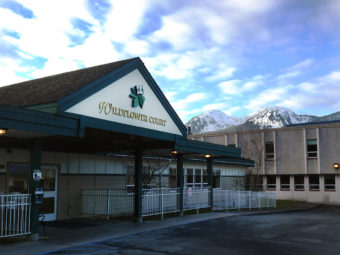
The coronavirus has wrecked many of our daily routines. And for people who live in nursing homes in Alaska, which have yet to reopen to the public, the feeling can be even more heightened. To deal with the changes, nursing home staff in Juneau are trying to create a sense of normalcy for the residents. 

When Melissa Elmore styles hair at Wildflower Court, the tunes are always playing. 

“You’re hair sure curls really nicely,” Elmore tells a resident in her 80s as she curls the woman’s blonde bob.

At times, they both sway to the song, Come and Get Your Love by Redbone. They talk about family and dancing. 

Elmore is wearing a blue face mask. But besides that, you wouldn’t know that a global pandemic is going on, or that the nursing home has been closed to the public for more than three months. 

Elmore says creating this calm environment for the residents is intentional.

“The one I just got done with, she always claps her hands and smiles real big and kicks her feet because she’s so happy,” Elmore said.

Styling hair isn’t Elmore’s normal job at Wildflower Court, where she’s worked for more than 10 years. She’s an assistant social worker. She handles things like resident admissions and Medicaid renewal. But because of the coronavirus pandemic, outside visitors — like beauticians — can’t come inside the building. So, Elmore temporarily adopted the role. 

She says, for residents, it’s about more than getting a refreshed hairdo to look good. 

“Even before this hit, it was something that was like a routine that happened every single week,” Elmore said. “I didn’t want them to have to miss that.”

Nursing home residents are missing a lot right now. They’re having to rely on video chats or window visits to stay in touch with their families. But activities that typically occupy the rest of the day have been affected as well.

Melissa’s spouse, Kirk Elmore, works at Wildflower Court, too. He organized actives around the time COVID-19 struck.

“It’s really important to have that thing that you can look forward to,” he said. 

He says the pair have taken added precautions to prevent contracting the virus and bringing it into the nursing home. Kirk Elmore hasn’t been inside a grocery since the nursing home closed its doors in March. 

And like Melissa Elmore, he’s trying to help residents fill their time with things they normally like to do. 

“We’re not doing something big and with a lot of people,” Kirk Elmore said. “But those interactions that we have, those real meaningful moments, are really nice.”

That can look like staff bringing a cup of coffee to a resident’s room and chatting for a bit, rather than a group meet-up. Singalongs have been replaced by watching Youtube videos, and religious leaders aren’t coming in to lead services: those are streamed live. 

Then, there are changes to another sacred activity. 

“Bingo is one of those things you don’t mess with because it’s typically so important to our residents,” Kirk Elmore said.

So instead of one big game, there are now two bingo games each day, which allows for smaller groups. 

Recently, dozens of people tested positive for COVID-19 at a nursing home in Anchorage. That hasn’t happened in Juneau, but Kirk Elmore said this can be a stressful time for nursing home staff, too. To cope with that added stress, Wildflower Court created a calming space for staff with essential oils and relaxing lighting. He says its a good place to pray or meditate on why the job is important.

Melissa Elmore summed it up best: 

“Not that we didn’t do it before, but we may be doing more of it,” she said. “Just to make sure that our residents are happy and safe and know that they’re loved and being taken care of.”

Site notifications
Update notification options
Subscribe to notifications