Aging

Governor signs bill lowering Pioneer Home rates following 2019 hike

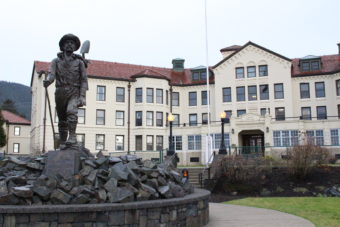
The entrance to Juneau’s Pioneer Home. (Photo by Heather Bryant/KTOO)

Legislation that dials back rate increases at Pioneer Homes has been signed by the governor. Last year’s rate hikes more than doubled rates for some residents at Alaska’s six state-run long-term care facilities.

Brad Rider spends a lot of time visiting his parents at Juneau’s Pioneer Home. Before the coronavirus led administrators to restrict visitors, he says he stopped by just about every day.

“The other residents, the people that work there, they all basically become family,” he said.

But then Gov. Mike Dunleavy announced a $12.3 million cut to the Pioneer Home system.

Clinton Lasley, then the director of the Pioneer Home system, sent a letter to residents last February saying the state’s fiscal crisis required the department to, essentially, earn what it spends.

He told a House committee last year that one way to do that was to charge more to people who could afford to pay more. The rest would be covered by payment assistance outlined in state law.

“Then it would be a truly needs-based system and we’re not subsidizing those individuals for example that may have the ability to pay for the services,” Lasley said last April.

But that meant big rate hikes for people like Brad Rider’s parents.

“My mother’s went basically overnight from just over $4,000 a month to well over $11,000 a month,” he said.

Rider says at one point, the state advised residents to look to public assistance — which he says he found insulting.

“They see that as a handout — they’ve worked their lives saving every nickel and dime they have,” he said.

And even then, qualifying for payment assistance would mean his parents had to pay full price until their savings were drained.

So Rider was among those who took the state to court. He, his parents and Ketchikan Pioneer Home resident Eileen Casey filed a class-action lawsuit to block the rate hikes.

State legislators were working on a parallel track. Anchorage Democratic Rep. Zack Fields introduced a compromise bill to slow the rate of increases for residents and their families.

“We heard heartbreaking testimony when the rates were raised that the higher rates were going to break up families and force families to send their elderly loved ones down to the Lower 48,” he said. “I mean, those are horrible decisions for anyone to have to make.”

Fields acknowledges that rates had to rise somewhat — they hadn’t kept pace with costs. But he says when rates did get raised, they often jumped by quite a bit.

“Basically, over the past decade, you’ve had somewhat volatile rates because they were adjusted irregularly through the regulatory process,” Fields said.

House Bill 96 proposed smaller increases: a $400 monthly hike for largely independent residents and a $2,500 rise in rent for residents with more complex care needs.

And the bill ties rates to Social Security benefits. Those increase every year with what’s called a “cost of living adjustment.”

“This bill establishes a much more predictable process where the rates are going to maintain the same real value by being linked to inflation,” Fields said.

He says he hopes that’ll offer residents some stability. He says Ketchikan independent Rep. Dan Ortiz and Republican Senate President Cathy Giessel were instrumental in shepherding the bill through the legislature amid the COVID-19 pandemic.

Though the bill was initially opposed by four lawmakers in the House, final passage was without opposition in both chambers. Dunleavy signed the bill on April 29. A spokesman for the governor didn’t offer any further comment.

Juneau’s Brad Rider says that even though his parents’ rates will still be higher than they were before last year’s hike, he says he’s satisfied.

“I think the outcome was absolutely wonderful. I don’t think we could have done any better,” he said. “Our seniors definitely deserve this, and this is a wonderful end.”

Vance Sanders, Rider’s attorney, says he’s planning to file paperwork to get the residents’ lawsuit dismissed.

State restricts visitors to Alaska nursing homes

The sign outside the Alaska Pioneer Home in Juneau. (Photo by Heather Bryant/KTOO)

The Alaska Department of Health and Social Services is placing new restrictions on visitors to long-term care facilities and nursing homes to shield residents from exposure to the coronavirus.

“Our elders in nursing homes are particularly vulnerable to this disease, and our actions are intended to protect vulnerable adults,”said Dr. Anne Zink, Alaska’s chief medical officer, in a statement Friday.

Only family members and medical providers will be allowed to visit. All visitors will be screened for illness, and their movement within the facility restricted.

The policy also says facilities should establish a process to evaluate large numbers of patients and workers with respiratory symptoms. And it advises homes they should figure out how they will operate if many of their regular employees are absent.

The Alaska State Hospital and Nursing Home Association has endorsed the new policy.

The Alaska Pioneer Homes also announced policy changes Friday. They will have limited visiting hours and conduct health screenings on all visitors. The Pioneer Homes provide assisted living, a level less intensive than most nursing homes.

Medical experts say people over 60 are more likely to get severe symptoms of a COVID-19 infection, and that risk increases with age.


Tribal health programs throughout Alaska take precautions against coronavirus

(Poster by Ḵaaḵal.aat Florence Sheakley, Ḵaanáḵ Ruth Demmert, and X̱ʼunei Lance Twitchell)

Alaska Native and tribal health organizations take the wellness of their communities pretty seriously. Many of them are taking a precautionary approach to coronavirus — but their biggest piece of advice is this: Don’t panic.

About 130 miles northeast of Fairbanks, in the city of Fort Yukon, health providers at the Yukon Flats Health Center diligently wash their hands, use hand sanitizer — and continue to pass along healthy hygiene recommendations to patients.

Debra McCarty has been the clinic director at the health center for about 10 years.

“We’re pretty much up to this point business as usual,” McCarty said by phone. “We’re ordering enough supplies so the staff can have handy wipes and gloves at their workstations and wipe them down themselves every day, in addition to … the regular infection control that our janitorial staff are doing.”

The health center is a part of the Council of Athabascan Tribal Governments — a consortium of 10 villages. Five of those villages fall under the health program, which McCarty said serves about 1,200 people in the region.

The biggest hurdle the health center faces, she said, is combatting misinformation.

“Our main goal is just to kind of educate everybody, let them know what we’re doing and that we’re prepared,” McCarty said. “We’re really trying to make sure that our community members, our patients and our chief and counsels are not getting overly paranoid and just kind of really listening to the facts and then getting their information from the CDC through us.”

McCarty said the health center has about two teleconferences daily, either from the Tanana Chiefs Conference, Indian Health Services or Alaska Native Tribal Health Consortium.

Currently, the health center can test for COVID-19, but they have to send it to the state to determine whether further testing is necessary.

“If there’s a chance that somebody has COVID-19, they’re going to self-quarantine at home and we’re just going to treat everybody that way,” McCarty said. “And anybody who has any increased respiratory issues that need admission, well, obviously, medevac will be called and they’ll be sent in.”

McCarty said no programs or services have been suspended because of the potential for coronavirus.

In Southeast Alaska though, some Elder programs are being temporarily suspended as a precaution.

The Central Council of Tlingit and Haida Indian Tribes of Alaska made the decision to suspend several social events for seniors through March. Tlingit and Haida wellness coordinator Justin Jones said the move was a proactive one to protect Elders from potential risk of illness.

“It’s very much at the forefront of everyone’s minds and the concerns,” Jones said. ” So it just came down to making sure that they feel safe, and we don’t want to put them in a situation where they’re concerned, where our staff would be concerned.”

https://www.facebook.com/ccthita/posts/1291131791081153

In lieu of the regularly scheduled gatherings, Jones said Tlingit and Haida will deliver lunches to Elders, as well as care packages of thermometers, soap and hand sanitizer.

“It’s just really making sure that the Elders understand that we care for them and that they are valued,” Jones said. “We’re looking to have that from a health perspective. …  And just keeping our personal health a top priority.”

Francine Eddy Jones is the director of Tlingit and Haida’s Tribal Family Services. She said there are other groups and gatherings for families that some Elders will participate in. But Tlingit and Haida plans to continue to assess the risk of illness and take as much precaution as possible.

“I think as a Native community, being proactive and taking precautions is definitely the message we’d like to give,” she said. “And I think how can we collectively do that across our Native communities is important.”

Jones said once the tribe has more information, it will reassess whether — and how —  future programs will be affected.

In Hoonah, Tlingit language teacher Lgéikʼi Heather Powell made signs instructing Hoonah City Schools students and staff in Lingít to wash their hands: i jín na.óos’.

“My students will be posting them throughout the school today in an effort to be informed and proactive,” said Powell, who is also director of the Alaska Native education program Haa Kusteeyi Áyá, or This is Who We Are, for Hoonah City Schools.

Ḵaaḵal.aat Florence Sheakley, Ḵaanáḵ Ruth Demmert and X̱ʼunei Lance Twitchell also created a poster detailing the steps of proper hand washing.

Calls requesting comment from the Alaska Native Health Board and the Alaska Native Tribal Health Consortium were not returned in time for this story.


On high alert for coronavirus, services to Anchorage elders roll on

Hand sanitizer is prominent for an art reception at the Anchorage Senior Activities Center. (Photo by Liz Ruskin/Alaska Public Media)

One subset of Alaskans is particularly at risk from the coronavirus – the elderly – and that has Anchorage facilities that serve senior citizens on high alert.

Still, the Anchorage Senior Activity Center was busy with the usual traffic last week: People coming in and out for lunch at the restaurant, to take art classes and to use the gym.

Fitness Manager Brittney Mitchell says she hasn’t noticed any decline in participation.

“Our members in the fitness department are very inclined to continue to come in,” she said. “We’re just making sure that everyone’s washing their hands before and after classes, wiping down equipment … . We’ve had these rules implemented for quite some time but we’re being extra careful.”

That, more or less, was also the response from the state Pioneer Homes and Providence, which operates several residential facilities that serve seniors. They say they have protocols to prevent infection, and they’re making sure everyone follows them.

The Anchorage Senior Center is a community hub, with all sorts of classes and social events. It’s a meeting place for several clubs, formal and not. It’s open to the public.

The center’s director, Rebecca Parker, said about 200 people visit daily. Every year they take measures to protect their clientele the flu, she said. The center is relying on those practices now, with some extra emphasis.

“We already had signs in the restrooms, but now they’re bigger and laminated. So we’re trying to get people to really pay attention,” Parker said. “And you can see we’ve got (more hand) sanitizers.”

They’ve decided to use disposable dishes and cutlery in the restaurant, for now. Parker hasn’t ruled out wearing a mask at work. But, she said, some habits die hard.

“I notice still there are lots of seniors who come here and they just want to be hugged. And they will open their arms,” she said. “I haven’t declined a hug yet, and I hope I don’t have to.”

A few dozen people gathered at the senior center Friday for the judging of an art show. Sandwiches and cookies were served.

“Just to remind everybody: Before you have something to eat, please wash your hands for 20 seconds,” announced Gordon Glaser, president of the senior center’s board. He pointed out where the bathrooms are, and noted the bottles of hand sanitizing gel on the food table.

Glaser said the day is coming when they may have to do more than focus on hand-washing.

“We also have to make some hard decisions. Like this is a crowd,” he said, looking around the art show in the center’s lobby. “Do we have these type of activities? And what kind of activities do we do and don’t do?”

But Glaser said there is a cost to being overly cautious.

“A lot of people depend on programs like this,” he said. ” Some people – this is where they get their main meal. Or this is where they meet their friends.”

Mary Belton is a participant at the senior center. She thinks all the attention on the coronavirus might be a bit overhyped.

“Well, I think it’s a political thing,” she said. “They’re trying to get rid of Trump. And whatever bad thing comes down the road, ‘It’s Trump’s fault.’ You know.”

Belton said she’s washing her hands more, and she’s concerned about a woman she knows in Washington state who is in her 90s. Belton said other parts of Anchorage might be more risky, but she feels safe at the senior center.

“I’m going to keep coming,” she said.

Leaders of the senior center, like those of the Pioneer Homes and Providence, say they’re following the recommendations of the Centers for Disease Control and other government authorities, and they are ready to adapt if the advice changes with the spread of the coronavirus.

The Pioneer Homes sent a letter to elders and families last week saying it’s likely they will begin asking all visitors to sign in, and answer a few questions before they enter.


Alaska’s ferry shutdown adds steep costs for medical travel

A passenger on the deck of the Alaska Marine Highway System ferry Taku, Aug. 3, 2009. The Taku is no longer in service. (Creative Commons photo by supafly)

A shutdown of most of the Alaska Marine Highway System has created numerous challenges for residents in coastal communities.

Gaps in ferry service have stranded travelers and disrupted the movement of freight. A lack of accessible transportation has also jeopardized medical care for seniors and people with mobility issues.

Haines has the oldest population of any borough in Alaska. The median age is just over 48 years old. There’s a thriving retirement community and many local services for seniors.

James Studley is the executive director of Haines Assisted Living. He said the facility offers an option for seniors to receive care in their hometown, rather than moving to a larger city.

“When people leave their hometown, and they get away from their friends and that contact of family that they might have, their health degenerates rather quickly,” Studley said.

Most of the time, seniors in Haines can take care of their medical needs at the local clinic operated by Southeast Alaska Regional Health Consortium, or SEARHC. Studley said sometimes they may need to go to a larger hospital with more resources.

“There’s a couple of instances where they have specialized doctors in a particular field that SEARHC wouldn’t have, and there’s also certain tests that can be done in Juneau but not in Haines,” he said.

When seniors need to get to Juneau for those specialized appointments, they have to travel by boat or plane. If they have mobility issues, that limits their transportation options.

“A lot of the elders have walkers, and they’re in wheelchairs, and they don’t have the ability to just get around on an airplane, even our small puddle jumpers that we have here,” Studley said. “The only option they have is a ferry.”

The Alaska Marine Highway System has not provided service to Haines for the past month. This has made it extremely difficult for people with mobility issues to travel from Haines for medical care.

Studley said the lack of reliable transportation affected him personally.

Recently, his daughter Nicole broke her leg and had to get flown to Anchorage for treatment. She left the hospital in a wheelchair. Studley said the two of them got stuck in Juneau for 10 days last month while trying to return to Haines.

His daughter couldn’t fly on a regular passenger plane, he said, so they had to charter a private flight with a local pilot to get home.

“That’s a pretty expensive flight, and what other option would you have? That’s something that comes out of pocket. There’s no insurance for that,” he said.

Waiting in Juneau until marine transportation becomes available isn’t any cheaper.

Studley said getting stuck there can be particularly risky for people who rely on local services in Haines for their care.

“Staying in Juneau at a motel where there is no help, or maybe at a friend’s house where they have difficult living conditions but they don’t have any other option, it can be a life-threatening situation,” he said.

Margaret Sebens works for Southeast Alaska Independent Living in Haines. The organization assists and advocates for seniors and people with disabilities.

At a recent rally for ferry service, she shared anecdotes about Haines residents with mobility issues missing appointments and struggling to cover the cost of staying in Juneau when transportation is not available.

“This is severely impacting people with disabilities and senior citizens, and we need to make change happen,” Sebens said.

The Alaska Marine Highway System already has canceled ferry service in most of Southeast Alaska until March.

But at a legislative committee meeting earlier this month, Alaska Department of Transportation and Public Facilities Commissioner John MacKinnon said it is possible the wait may be even longer: He told state lawmakers there’s a “good likelihood” that Southeast Alaska will have no ferry service in March.

In the meantime, DOT has been exploring options for chartering private marine transportation services such as Allen Marine Tours.


Alaska Senate considers bill to dial back Pioneer Home rate hikes

The Sitka Pioneer Home was the first such facility. Five others operate in Ketchikan, Juneau, Anchorage, Wasilla and Fairbanks. (Photo by Emily Kwong/KCAW)

Last September, residents at the six Pioneer Homes across Alaska saw their rates jump between 40 and 140 percent. That left some seniors in dire financial straits.

Juneau resident Brad Rider says his mother’s rate more than doubled.

“Directly after it went into effect, my mother’s rate went from just over $4,000, it went to over $11,000 — almost overnight,” he said.

Rider, his parents and a resident of Ketchikan’s Pioneer Home, Eileen Casey, are plaintiffs in a lawsuit that seeks to reverse the rate increases.

The state has justified the new rates by arguing they are bringing fees in line with the cost of caring for Alaska’s elders.

Pioneer Homes charge residents based on the level of care they need. In September, the lowest-paying residents saw their rates jump by about $1,000. But rates for some residents requiring more intense care jumped by more than $6,000.

Legislators have been weighing in. At a recent Senate hearing, Anchorage Democratic Representative Zack Fields pushed a bill that would dial back the rate increases. He presented the bill to the state Senate Health and Social Services Committee Monday, Jan. 27.

“There are three goals of House Bill 96,” he said. “Maintain the Pioneer Homes and Alaska’s historic commitment to our elders, provide revenue and financial stability for the homes and provide some certainty and predictability to both residents and the department about the trajectory of rates in the future.”

Fields acknowledges that rates have to rise to ensure that the Pioneer Home system remains viable. But he proposes tying rates to inflation to ensure that seniors aren’t caught off-guard by dramatic rate hikes.

“The real value of rates had not kept pace with inflation over several years,” he said. “Our bill looks back and says, ‘If we were going to take into account inflation going back to 2004, what would that look like?’ And that establishes a new baseline for rates recognizing that costs do increase over time.”

Rates under Fields’ bill would still be higher than they were before last year’s hike, but the increases would be less dramatic. Residents requiring the most intense care would see increases of less than $2,000. Lower-level residents’ rates would only rise by a little more than $400.

Rider pushed the committee to advance the bill. He asked the Legislature to support both the homes and the elders that live there.

“We should be holding it up for the rest of the country to look at,” he said. “Those guys are great. And the people in there are great.”

The bill passed the Alaska House 35-4 during the last legislative session. Senate president Cathy Giessel and Senate minority leader Tom Begich have signed on as sponsors in the Senate. But even if passed by lawmakers, it could face the governor’s veto.

In the meantime, there is financial assistance for those who can’t afford the higher rates. But in many cases, residents are forced to sell most of their properties and belongings. Or even get a divorce to untangle their assets.

Site notifications
Update notification options
Subscribe to notifications