Nat Herz, Alaska Public Media

A new $350 million Bering Sea fish fight could hinge on a miniature Canadian railroad

Crew members shovel pollock on the deck of the Commodore after a harvest on the Bering Sea in 2019. (Photo by Nat Herz / Alaska Public Media)
Crew members shovel pollock on the deck of the Commodore after a harvest on the Bering Sea in 2019. (Photo by Nat Herz / Alaska’s Energy Desk)

A high-seas legal fight is causing havoc for one of Alaska’s biggest commercial fisheries, the Bering Sea pollock harvest out of Dutch Harbor.

The quickly escalating saga involves hundreds of millions of dollars in fines, a miniature Canadian railway and Donald Trump’s personal lawyer and it stems from the way that one of Alaska’s biggest fishing companies, American Seafoods, is using an exemption in the federal law that typically allows only U.S. ships to move cargo between U.S. ports.

American Seafoods’ shipping subsidiary and an affiliate company, Kloosterboer International Forwarding, sued U.S. Customs and Border Protection in federal court Thursday.

They’re challenging $46 million in fines issued directly to American Seafoods, plus more than $300 million levied against industry partners over the past month — some of which are holding American Seafoods’ subsidiary liable.

In legal filings, the companies say the threatened penalties are paralyzing the Alaska seafood industry’s supply chain to a port called Bayside, on the East Coast, and have stranded millions of pounds of frozen fish destined for American customers.

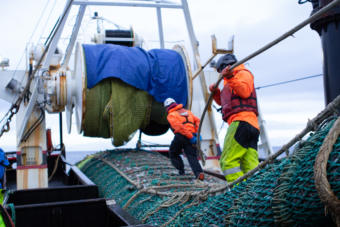
Crew members on the fishing vessel Commodore empty a trawl net of pollock on the Bering Sea. (Photo by Nathaniel Herz / Alaska's Energy Desk)
Crew members on the fishing vessel Commodore empty a trawl net of pollock on the Bering Sea. (Photo by Nat Herz / Alaska’s Energy Desk)

“Cargo vessels are no longer being sent to Bayside with seafood for the eastern United States. Fishing vessels returning from the Bering Sea to Dutch Harbor are facing dangerously tight conditions as the limited cold storage capacity fills up with cargo that was destined to the United States,” an Anchorage-based lawyer for the companies, David Gross, said in a court filing Tuesday. “The entire transportation route used by plaintiffs has been paralyzed and will be irreparably damaged, absent court intervention.”

Officials at the American subsidiary that filed the lawsuit, Alaska Reefer Management, declined to comment beyond a prepared statement. A Customs and Border Protection spokesman also declined to comment.

American Seafoods says it has the world’s largest operation processing $400 million worth of pollock each year, on its huge ships with onboard factories.

The company, like other major Alaska seafood players, sells much of its harvest to Asian and European markets.

But it is also a major supplier of pollock to U.S. customers, with products like fish sticks that end up at food banks and in school lunches. A little less than 15% of the company’s catch is shipped to the eastern U.S. on ships coordinated by Kloosterboer and American Seafoods’ shipping subsidiary, Alaska Reefer Management, according to court documents.

The Jones Act, a century-old federal law, typically requires American-flagged ships to move cargo between American ports. But the legislation contains an exception known as the “Third Proviso,” which allows companies to use foreign-flagged ships between U.S. ports if the routes include “Canadian rail lines” — and if they’re certified by an obscure federal agency called the Surface Transportation Board.

Alaska seafood companies have been using that exception since 2000, according to court documents.

Vessels flagged in countries like Singapore and the Bahamas first pick up frozen seafood products in Dutch Harbor, then travel to the Canadian port of Bayside, New Brunswick, just across the border from Maine.

From Bayside, the seafood would be trucked to a Canadian train, loaded and moved 20 miles between two stations — sometimes in the opposite direction of the U.S. border. Then the cargo would be loaded back onto the trucks to drive into the U.S.

In their court filings, the shippers say that both Customs and Border Protection and the Surface Transportation Board signed off on that practice, even though it was clear that the only purpose of the brief rail movement was to satisfy the requirements of the Jones Act. They also argue that they made customs officials aware of a new, even shorter rail line that they switched to using in 2012 to satisfy the Jones Act: a 100-foot stretch of track that’s entirely within the Bayside port.

“The trucks travel the length of the Canadian rail trackage and back,” Gross said.

The seafood products’ 200-foot train ride now appears likely to be at the core of the companies’ legal dispute with Customs BP.

Other companies with Bering Sea fishing vessels, including O’Hara Corp., Glacier Fish Co. and Arctic Storm Inc., also ship their seafood with Kloosteboer and the American Seafoods subsidiary. And in court documents, they say they face their own threatened fines from Customs and Border Protection.

In addition to Gross, Kloosterboer and the American Seafoods subsidiary have hired a high-profile New York-based law firm, Kasowitz Benson Torres, which has experience on Jones Act cases.

One of the firm’s partners working on the lawsuit, Marc Kasowitz, represented former President Donald Trump in the investigation into Russian interference in the 2016 election.

In their court filings, the companies say they were “completely blindsided” by what they call the “draconian penalties” proposed by Customs and Border Protection.

U.S. District Court Judge Sharon Gleason, in an order late Friday, granted the companies expedited consideration of their request for a temporary restraining order and preliminary injunction against the agency. If Gleason ultimately grants that request, Customs and Border Protection would be barred from penalizing the companies under the Jones Act for shipping more seafood while the lawsuit plays out.

Custom and Border Protection’s response is due next week.

Alaska agency moves to spend $1.5 million on Arctic Refuge development, setting up clash with Biden administration

Congress opened the Arctic National Wildlife Refuge’s coastal plain to oil and gas leasing in 2017, but the fate of the area is uncertain as the Biden administration has announced a new legal analysis of the Trump administration’s environmental reviews. (Nat Herz/Alaska’s Energy Desk)

The Biden administration has suspended oil leases in the Arctic National Wildlife Refuge and aims to thwart drilling there, but an Alaska agency is still pushing ahead with its plans for development.

The state-owned Alaska Industrial Development and Export Authority, which won seven leases at a sale in the final days of the Trump administration, is proposing to spend $1.5 million on its development efforts.

The money would go toward studies, data collection and permitting needed in advance of what’s known as seismic exploration: using heavy equipment to map areas under the earth’s surface to see how much oil could be there.

AIDEA’s board will consider the staff proposal at its meeting next week.

If it’s approved, the agency aims to begin its seismic work in the refuge next year.

But the Biden administration opposes drilling in the refuge and has moved to block development there — and AIDEA’s move could put the two sides on track for a battle in court.

Earlier this month, the Interior Department suspended the oil and gas leases issued for the refuge by the Trump administration, and it placed a temporary ban on all federal activity related to a Trump-era development program. That includes acting on applications for activity like the seismic work that AIDEA wants to carry out.

The Biden administration says it’s now studying what it describes as legal errors in the Trump administration’s environmental reviews used to pave the way for leasing — and it says the leases could be reaffirmed, voided or subject to tighter environmental controls.

In a memo to board members, AIDEA’s executive director, Alan Weitzner, argued that the suspensions lacks a legal basis, adding that his agency still holds “valid and enforceable leases.”

He said AIDEA has already informed the Biden administration that it “will continue to assert our legal rights as authorized for the responsible development of the leases.”

Leaseholders generally enjoy stronger legal rights to conduct seismic work in the area under their control — so if the Biden administration were to reject an AIDEA application for such work based on the lease suspension, it could strengthen AIDEA’s case if it decides to sue the federal government.

Officials at both AIDEA and the Interior Department, which oversees the management of the refuge and the leasing program there, declined to comment.

One of the groups opposed to drilling in the refuge, the Northern Alaska Environmental Center, criticized AIDEA’s proposal to advance towards development.

“This resolution is a continuation of AIDEA’s commitment to throwing the state’s money at bad ideas — projects that will cause harm to people, our climate, and our state’s economy,” Emily Sullivan, the group’s Arctic program manager, said in a prepared statement. “By asking for approval, from themselves, to spend more money on work that is not permitted and is unlikely to ever occur is just another round of political posturing to prove an increasingly irrelevant point.”

Alaska joins states seeking to block youth climate activists’ lawsuit

Tristan Glowa addresses the crowd at an October 2018 rally held to support Juliana vs. United States in Fairbanks. (Ravenna Koenig/ Alaska’s Energy Desk).

Alaska Republican Gov. Mike Dunleavy’s administration has joined a group of 17 states that’s trying to defeat a lawsuit by youth climate activists.

The motion to intervene, by Attorney General Treg Taylor, comes in a case called Juliana vs. United States.

The 21 plaintiffs in the case, who filed their lawsuit in Oregon, allege that federal government promotion of fossil fuels and the lack of policies to reduce them violates their constitutional rights. And they’ve asked the courts to require the federal government to draft plans to phase out carbon emissions.
Alaska Gov. Mike Dunleavy follows Deputy Attorney General Treg Taylor into a news conference at the governor's Anchorage office on Friday, Sept. 27, 2019.
Alaska Gov. Mike Dunleavy follows Deputy Attorney General Treg Taylor into a news conference at the governor’s Anchorage office on Friday, Sept. 27, 2019. (Photo by Nat Herz/Alaska Public Media)

A divided federal appeals panel ruled last year that the activists made a compelling case, but that it had to be made to elected officials rather than to the courts.

The plaintiffs and the federal government are now fighting over whether the case should be dismissed, or allowed to continue on a narrower basis. Instead of asking the courts to force the federal government to draft an emissions reduction plan, the activists are now asking for a simple declaration of their constitutional rights, said Andrew Welle, one of their attorneys.

A spokeswoman for Taylor, Grace Lee, wouldn’t directly describe the attorney general’s position on carbon emissions. But she said in an email that Alaska’s involvement in the case is about how Congress and state Legislatures are the right avenue for addressing that policy question — not the courts.

“That is why we have a democracy where we elect our representatives, who then struggle with these difficult questions where you have to balance economic prosperity, responsible resource development and impacts from a changing climate,” Lee said.

Welle was skeptical of Alaska’s separation of powers argument, noting that the states, in their filing, made multiple references to the likelihood that the litigation could change the federal government’s energy policy.

“It’s pretty clear from the state’s papers that this is not about saying, ‘Let the states handle this,’” Welle said in a phone interview Thursday. “It’s about them protecting their continuing promotion of fossil fuels and opposing any movement on those issues.”

Of the 16 states joining Alaska in the filing, all but one are led by Republican governors, and many — like North Dakota, Texas and Louisiana — depend on the oil and gas industry. They contend that upcoming, court-ordered negotiations between the activists and the Biden administration could lead to a settlement that transforms the country’s energy system and violates principles like the separation of powers.

Dunleavy, the attorney general’s boss, has promoted Alaska’s oil industry and also disbanded a state panel charged with setting the state’s climate policy not long after he took office.

Welle said the states’ participation in the lawsuit is aimed at protecting their interests in fossil fuels and blocking movement on greenhouse gas regulation.

“If you look at the states that are involved in this litigation, none of them are making progress on climate,” he said. “They’re moving in the opposite direction, and continuing to throw fuel on the fire.”

Welle is also involved in a similar case that’s quietly been playing out in Alaska over the past few years.

In 2017, a group of young Alaskans sued the state and asked the courts to order the government to draft a plan to reduce Alaska’s emissions. A lower court judge dismissed the case a year later, but it was appealed to the Alaska Supreme Court.

Welle says his side has been waiting for more than a year and a half for a decision from the Alaska Supreme Court about whether the case can continue in the lower court — an amount of time he described as “extremely frustrating” given the plaintiffs’ argument that “we’re in a climate emergency now.”

A spokeswoman for the state court system, Mara Rabinowitz, noted that the Alaska Supreme Court justices asked for extra written filings after the oral arguments, which took an extra six months to complete.

“The court is carefully considering the important issues raised in the appeal,” she said.

Alaska Gov. Dunleavy debuts new tourism ads, with old vaccine data

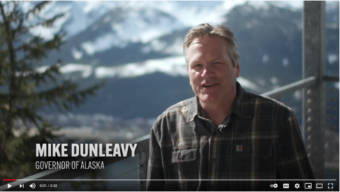
Screenshot from Gov. Mike Dunleavy’s 2021 Alaska tourism ad.

Governor Mike Dunleavy has launched a national ad campaign promoting a post-pandemic revival of Alaska’s tourism industry. But the campaign uses outdated data that claims the state’s COVID-19 vaccination rate is higher than it really is.

The $5 million campaign, funded with federal COVID-19 relief money, debuted Monday. It features Dunleavy, a Republican, atop a prominent tourist attraction: the mountainside tramway in Juneau operated by Goldbelt, the local Native corporation.

“Do you want to see glaciers? Bears? Pan for gold? You name it,” he says in a voiceover. “Alaska is the place, having one of the highest vaccination rates in the country, our people are safe, and you will be too.”


Alaska once had one of the highest vaccination rates in the country, but other states have since overtaken it when it comes to giving out the shots.

Alaska is now the 28th-ranked state when it comes to the rate of people who have had at least one dose, and 25th in the rate of full vaccinations.

Dunleavy spokesman Corey Allen Young said in an email that the ad was filmed April 20. That was when Alaska had the 5th highest rate of fully-vaccinated people.

In his email, Young pointed to the numerous regions of Alaska with high vaccination rates, like Juneau, Skagway, Bristol Bay, Petersburg, Nome and Sitka, where more than 70% of people ages 16 and up have gotten the shots.

“Because of the awesome work of Alaskans statewide that includes vaccinations, Gov. Dunleavy shot the Alaska tourism video weeks ago, to advocate that Alaska and Alaskan businesses are open,” Young said. “More Alaskans are getting vaccinated, case counts are going down, the state is promoting the Sleeves Up for Summer Campaign — all of which is resulting in communities opening up for business, which includes tourism.”

The main channels running the ads are Fox, History, Travel and National Geographic, Young said. They’ll continue over six and a half weeks.

This story has been updated to include comment from Dunleavy’s spokesperson and to add that the campaign was funded with federal COVID-19 relief money. The headline has also been updated. 

New proposal from Gov. Dunleavy would put PFD in Constitution, along with rural electricity fund

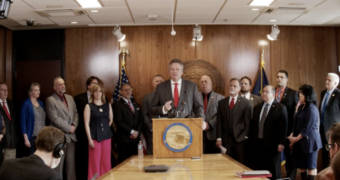
Alaska Republican Gov. Mike Dunleavy, speaking at a Capitol news conference on May 12, 2021, introduces a new proposed constitutional amendment to restructuring the Permanent Fund. (Screenshot)

Alaska GOP Gov. Mike Dunleavy and a bipartisan group of legislators have unveiled a new plan for the state budget that would put the Permanent Fund dividend in the state Constitution, alongside a fund that helps lower electricity prices in rural areas.

Dunleavy, flanked by legislators Wednesday at a news conference at the Capitol, said he’s supporting a draft constitutional amendment that would restructure the way the Permanent Fund is managed — a goal that lawmakers have tried and failed to achieve for the last several years.
“We always say there’s tomorrow,” Dunleavy said. “But tomorrow keeps eluding us.”

“We need to solve this now,” he added.

The proposal would end a long-running fight that’s consumed weeks of legislative time in recent years, while giving lawmakers and Alaskans more certainty about the amount of revenue available for government services and the size of the dividend — an estimated $2,350 this year and $2,500 next year.

But it will also take a two-thirds vote by both the state House and Senate before the proposed constitutional amendment could go before voters — a level of support that’s far from assured.

Both top lawmakers from the House and Senate appeared at Dunleavy’s news conference. House Speaker Louise Stutes, the Kodiak Republican who leads the largely-Democratic majority in her chamber, said her caucus is “excited to be part of the solution.”

“The PFD has been the elephant in the room since I’ve been in the Legislature, and I’m in my seventh year,” she said.

Senate President Peter Micciche, R-Soldotna, was slightly more reserved, calling Dunleavy’s proposal a “good start” and a “pretty important step.”

The Permanent Fund is currently split into two accounts: $59 billion in principal, which is off-limits to lawmakers, and $17 billion in earnings, which lawmakers can spend with a simple majority vote.

Dunleavy’s new proposal would combine the two accounts into one and manage the fund like an endowment, where lawmakers could only spend 5% of its overall value each year. Half the money would go toward spending on government services, and the other half would go toward dividend payments.

The proposal would leave lawmakers with a substantial budget deficit that the governor proposes to temporarily fill with a one-time, $3 billion withdrawal from the Permanent Fund.

Lawmakers have managed the fund in a similar way in recent years to the one Dunleavy’s proposing.

But they’ve also been repeatedly derailed by debates between legislators and the governor over exactly how much of the Permanent Fund’s earnings should go toward government services, and how much should go toward the dividend.

And as Alaska’s structural budget deficit has persisted, and the state’s other savings accounts have dwindled, there’s also been growing discussion about spending more than the 5% annual withdrawals from the Permanent Fund that legislators have agreed is the maximum sustainable amount.

Withdrawing a larger share of the fund would reduce its spending power for future generations. But there are currently no legal safeguards that would stop the Legislature from using up to the full value of the earnings reserve account — so long as a majority of lawmakers support the idea.

Dunleavy’s proposal would solve those two problems by keeping the fund off-limits to lawmakers beyond the 5% annual withdrawal, and by defusing legislators’ arguments over the split between dividends and government services by requiring the money to be divided 50-50.

“Imagine a world where we’re not wrestling over the Permanent Fund again,” Dunleavy said at the news conference. “It’s unlimited what we can do, once we get these heavy lifts out of the way.”

The proposal would leave a substantial deficit, which would ultimately need to be filled by either taxes or spending cuts. Rather than proposing those alongside the constitutional amendment, Dunleavy wants to use the $3 billion, one-time withdrawal from the Permanent Fund to fill the deficit until lawmakers can agree on those taxes or spending cuts.

The proposal would also move the $1 billion Power Cost Equalization Fund into the Permanent Fund, shielding it from lawmakers who have considered using it to fill budget deficits in recent years. The state uses the PCEF’s earnings to help offset high electricity costs in rural Alaska.

15 years after VECO scandal, Stevens’ new oil job renews old ethics questions

Department of Transportation and Public Facilities Commissioner John MacKinnon, Gov. Mike Dunleavy's Chief of Staff Ben Stevens, and Senior Policy Advisor Brett Huber watch a press conference unveiling Dunleavy's budget proposal on Wednesday, December 11, 2019, at the Capitol in Juneau, Alaska. (Photo by Rashah McChesney/KTOO)
Department of Transportation and Public Facilities Commissioner John MacKinnon, Gov. Mike Dunleavy’s Chief of Staff Ben Stevens, and Senior Policy Advisor Brett Huber watch a press conference unveiling Dunleavy’s budget proposal on Dec. 11, 2019, at the Capitol in Juneau. (Rashah McChesney/KTOO)

In 2007, Alaska Republican Gov. Sarah Palin signed sweeping ethics reforms into law, in what she touted as a necessary response to the VECO corruption scandal that ensnared several state lawmakers.

Among the lawmakers investigated in that scandal was then-Senate president Ben Stevens, son of the late U.S. Sen. Ted Stevens. Ben Stevens’ Senate office was twice searched by the FBI, and two oil industry executives said they had paid him bribes. Stevens always denied wrongdoing and was never charged with a crime.

More than a decade later, Stevens is now renewing questions about those very same ethics laws in his new job as an executive at oil company ConocoPhillips — a position he started March 1, just three days after leaving one of the most powerful jobs in state government: Chief of staff to Gov. Mike Dunleavy.

Stevens, in a phone interview Monday, said he’s carefully followed state ethics laws in his job transition. And last month, Dunleavy quietly signed an ethics waiver allowing Stevens to work on a Conoco project that was the subject of discussions in the governor’s administration while Stevens was still chief of staff.

Senate District Q candidate Jesse Kiehl, a Democrat, talks to a supporter on Election Day, Tuesday, November 6, 2018, in Juneau, Alaska. (Photo by Rashah McChesney/Alaska’s Energy Desk)
Senate District Q candidate Jesse Kiehl, a Democrat, talks to a supporter on Election Day, Nov. 6, 2018, in Juneau. ( Rashah McChesney/Alaska’s Energy Desk)

But Stevens also acknowledged the Dunleavy administration has opened an ethics investigation into his job change in response to a formal request by an advocacy group. Some lawmakers are now asking whether the 2007 ethics reforms need to be updated again to more effectively guard against conflicts of interest.

“Despite whatever technical detail you could read if you squint your eyes and hold your head sideways, I don’t think anyone should be allowed to go from one of the three most powerful jobs in the state of Alaska, where inevitably oil tax policy comes through, to go be an oil lobbyist without so much as two weeks in between — let alone the two years that the law calls for,” said Juneau Democratic Sen. Jesse Kiehl.

“Not the decision maker”

Alaska’s ethics laws bar public officials from working for private companies on matters that were under consideration by their agency for two years after leaving their state job, if the official participated “personally and substantially through the exercise of official action.” Those matters could include cases, contracts, regulations or legislative bills, the law says.

But the ethics laws also allow top executive branch officials to waive those requirements if they find it’s not “adverse to the public interest.”

Conoco had previously said that Stevens would not seek an ethics waiver in his new job because, as the company’s vice president for external affairs and transportation, he would not work on any issues that might present a conflict.

But less than two weeks later, Stevens sent Dunleavy’s administration a waiver request.

In a letter to Attorney General Treg Taylor dated March 12, Stevens asked that Dunleavy’s administration waive the requirements of the ethics law for his advocacy on Conoco’s behalf for its multi-billion-dollar Willow project, which is planned on federal land on Alaska’s North Slope.

Environmental groups have filed lawsuits challenging federal authorizations for the Willow development. On April 15, Dunleavy’s administration filed a motion to intervene in the litigation in the project’s defense.

Stevens, in his chief of staff job, was “aware of discussions” about the state’s possible intervention in the case, Dunleavy and Taylor wrote in the waiver they ultimately granted. But, the waiver argues, the actual decision to join the litigation was only under consideration by the Department of Law, the attorney general and the governor — not by Stevens.

In an interview, Stevens argued that as chief of staff he did not “personally or substantially” participate in any decisions at all, let alone any specific to Conoco, saying he served instead as a “conduit of information” to Dunleavy.

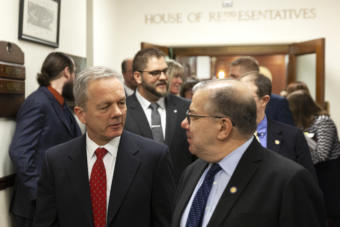
Gov. Mike Dunleavy’s Chief of Staff Ben Stevens talks to Senate Majority Leader Lyman Hoffman, D-Bethel, after Dunleavy's State of the State address on Monday, January 27, 2020 in Juneau, Alaska. (Photo by Rashah McChesney/KTOO)
Gov. Mike Dunleavy’s Chief of Staff Ben Stevens talks to Senate Majority Leader Lyman Hoffman, D-Bethel, after Dunleavy’s State of the State address on Jan. 27, 2020 in Juneau. (Rashah McChesney/KTOO)

“A chief of staff is a facilitator of a decision,” Stevens said. “Not the decision maker.”

In his request, Stevens wrote that he viewed a waiver as unnecessary but was asking for one “out of an abundance of caution, and given the degree of public misunderstanding” of state ethics law.

Dunleavy and Attorney General Treg Taylor both signed off on the waiver a few weeks later, in early April. They wrote that Stevens did not need the approval but granted it nonetheless, justifying it by writing that his work for Conoco — recruiting local boroughs’ legal and political support for the project — is in the public interest.

Public outreach and education about the benefits of resource development, mitigation of environmental impacts and local tax revenue is “aligned and consistent with the public interest of the state of Alaska,” they wrote.

“The state of Alaska also benefits from the development of the Willow project,” they added.

Ethics laws “you could drive an oil tanker through”

Both Stevens’ request and the waiver itself were only recently released in response to a public records request by the Alaska Public Interest Research Group, the advocacy organization which asked Dunleavy’s administration to conduct a formal investigation into the legality of Stevens’ new job.

Stevens said he’s aware that the state is investigating the group’s allegations. But he referenced his previous experiences, arguing that he’s well-aware of his legal and ethical obligations and is upholding them.

“Nobody in this state alive has been investigated for alleged wrongdoing more than me,” Stevens said. “The allegations against me (are) by political opposition — it’s been that way forever. It’s not going to change. I’m not going to change. I’m not going to violate the law — I follow the rules. I know what the rules are.”

He added that he has not spoken to Dunleavy since leaving the chief of staff job in February.

In interviews Monday, Kiehl and another Democratic senator both questioned the legal argument that Stevens did not need a waiver.

“My immediate reaction when I heard he was going to take that job was, ‘He can’t do that,’” said Anchorage Sen. Bill Wielechowski. “I would find it hard to believe that the chief of staff did not participate, personally and substantially, in the exercise of trying to have Willow approved for federal permits, or to have local support.”

Sen. Bill Wielechowski speaks on the floor of the Alaska Senate, Feb. 10, 2014. (Skip Gray/Gavel Alaska)

Other observers were similarly skeptical the law allowed Stevens’ move, though they also argued the law should be tightened.

“We have ethics statutes in the state that you could drive an oil tanker through, and we’ve been driving them through for years,” said Ray Metcalfe, a former state legislator and longtime Stevens critic. “The laws leave a lot to be desired, and the Legislature doesn’t want to fix it.”

Kiehl, the Juneau Democratic senator, said the waiver’s approval has also called into question his support for Taylor, the attorney general, whose confirmation vote is scheduled for Tuesday.

At one of his confirmation hearings, in early April, Kiehl asked Taylor whether he or the Department of Law had counseled Stevens on his legal obligations in his new post at Conoco, and on when he would need a waiver.

At that point, Dunleavy had already signed Stevens’ waiver two days earlier, and Taylor would sign it a day later, according to the dates on their signatures on the document.

Alaska Gov. Mike Dunleavy follows Deputy Attorney General Treg Taylor into a news conference at the governor's Anchorage office on Friday, Sept. 27, 2019.
Treg Taylor, then the deputy attorney general, walks into a news conference trailed by Gov. Mike Dunleavy in 2019. (Nat Herz/Alaska Public Media)

But Taylor, in his response to Kiehl, made no reference to Stevens’ waiver request, nor the pending waiver itself, saying instead that “as issues arise in Mr. Stevens’ work, he will approach the Department of Law and ask for advice.”

Kiehl, in a phone interview Monday, said that Taylor’s response indicated “that this was still a hypothetical thing, off in the future.”

“He didn’t make any false statements in his testimony,” Kiehl said. “But he definitely left that impression.”

A spokeswoman for the Department of Law, Charlotte Rand, said state law barred Taylor from publicly discussing Stevens’ request for the waiver until after it was issued. She cited a section of the statute that makes requests for ethics advice confidential.

“This also serves the public policy behind this portion of the Ethics Act, by allowing current and former employees to make candid requests to avoid violating the law in the first place, instead of having to address or remedy issues after the fact,” Rand said.

Site notifications
Update notification options
Subscribe to notifications