Nat Herz, Alaska Public Media

Here’s how a planeload of salmon gets from Cook Inlet to customers in Anchorage

Handlers at Spernak Airways unload a planeful of salmon Friday at Merrill Field in downtown Anchorage. (Photo by Nathaniel Herz / Alaska’s Energy Desk)

It was a tough start to Alaska’s fishing season this year. The famed Copper River red run was a bust, and the state harshly restricted king salmon fishing in the Mat-Su and in Southeast Alaska.

But now the sockeye runs in Bristol Bay and Cook Inlet have heated up, which makes for an action-packed month for fishermen across the state.

Alex Pfoff is among them. He works 50 miles southwest of Anchorage, across the waters of Cook Inlet and off the road system, running a family business called the Salmon Hookup.

Further southwest, in the salmon hub of Bristol Bay, much of the fish gets delivered to processing plants. But Pfoff’s business is different: He sells straight to customers and restaurants in Anchorage.

“We have no problem doing the smallest of orders,” he said in a phone interview from the beach at his fishing site. “Our smallest unit of sale is a fish.”

Like many others’, Pfoff’s season started late, thanks to state-ordered closures to preserve king salmon stocks. The sockeye began arriving in force earlier this month.

Pfoff’s fish fly by bush plane to Merrill Field, the airport smack-dab in the middle of Anchorage. Pfoff’s mom, Kathy, was there Friday to meet one load of sockeye and silvers. (She also sends goods back out to her son’s remote site, which last week included a connector cable for a Nintendo Wii.)

When the plane landed, two handlers pulled out more than a dozen boxes, then carted them to a scale: 745 pounds.

Most of the fish was destined for individual customers, who arrived with coolers in the back of their trucks and SUVs.

One woman decided to buy her two silvers 12 hours earlier. Kathleen Katkus said she found the Salmon Hookup’s ad on Craigslist.

“It was really late, actually, and I had really bad pregnancy cravings,” she said. “I think it was like one in the morning?”

A pair of salmon sit on ice after being shipped to Merrill Field on Friday. (Photo by Nathaniel Herz/ Alaska’s Energy Desk)

Others said they use Pfoff’s business to fill their freezers, as a way of escaping the hordes of dipnetters on the Kenai Peninsula.

Paul Bauman bought 15 fish, arriving with a check for $510. He’s a general contractor, and he said he carves out a full afternoon for salmon processing.

“It’s not like other states where you can go out fishing in a reservoir or lake and get a fish or two, or three or four,” he said. “Here, when the salmon are in, you’ve got to deal with the salmon. Just like when the caribou are here, you’ve got to deal with the caribou.”

The rest of the fish went to restaurants. From the airport, Kathy drove downtown in her Ford Explorer, then along a dingy back alley.

Jose Martignon, one of the owners of Pangea restaurant, came out to meet her.

“Look at the fat content in these pieces, right here,” he said, pointing to a salmon belly. “That’s all your flavor, right there.”

Spernak Airways flew salmon for Pfoff’s business, and it works with others, too. The flight service can carry 5,000 pounds to Anchorage in a single summer day, said owner Mike Spernak.

But that’s a tiny fraction of Alaska’s overall catch: On Sunday, Bristol Bay fishermen brought in 1.3 million salmon, according to figures collected by the Alaska Department of Fish and Game.

With groceries dwindling on a remote Alaska island, the government opened a seal harvest early

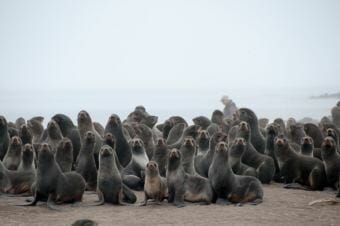
Northern fur seals gather at a resting area in the Pribilof Islands, where non-breeding seals congregate while they’re not out at sea feeding. (Dave Withrow/NOAA)

Dwindling supplies of groceries on a remote Bering Sea island prompted the federal government last month to approve an unusual, early opening of an annual subsistence seal harvest.

Federal managers in June agreed to the early harvest on St. George, which is more than 200 miles from the mainland.

The decision came after a request by the tribal government, which said members needed the meat because the island’s store was running out of food, according to the National Marine Fisheries Service. Flights to the island are often canceled amid bad weather and because of what airlines say is a poorly-positioned runway.

“I don’t know how many times I’ve called ACE to say, ‘Hey, where are our groceries? Why can’t we get them?'” said Mayor Pat Pletnikoff, referring to the cargo airline that serves the island. “It happens on a regular basis.”

About 60 people live on St. George, Pletnikoff said. Passenger planes only come twice a week, and frequent flight cancellations can make it hard for residents to keep fresh food around.

One thing that’s not in short supply on the island? Meat.

St. George and nearby St. Paul both host massive populations of northern fur seals in summer and fall — about 500,000 between the two. It’s about half the world’s population, said Mike Williams, who works with the fisheries service.

But the seals’ harvest is strictly regulated by the federal Fur Seal Act.

While the St. George store was starting to run short on food last month, the harvest season wasn’t scheduled to open until June 23. So the tribal government asked the fisheries service to allow it to start earlier. (Tribal leaders did not respond to requests for comment.)

The fisheries service, which co-manages the harvest with the tribe, responded by issuing a special, temporary rule allowing the harvest to start three days early.

“The community needed food. And this was the way that the government could help with that,” Williams said in a phone interview from a federal bunkhouse on St. George.

Typically no more than 150 seals are taken in a year, and each one has about 30 pounds of edible meat, Williams said.

Those harvest numbers are down substantially from when the seals were hunted commercially for their fur. That’s how St. George and St. Paul were originally settled two centuries ago, when Russians forcibly moved Alaska Natives from the Aleutian Islands to help with the harvest.

Even after the U.S. bought Alaska from Russia, the government continued relying on the Pribilofs’ residents to hunt and process fur seals. But since the hunt ended in the 1980s, Pletnikoff, St. George’s mayor, said his island hasn’t received enough government support to transition to a more diverse economy.

St. George faces continuing uncertainty about its flight schedule amid the bankruptcy of PenAir, the passenger airline that serves the island. And without better, federally subsidized air service, Pletnikoff said St. George will continue to face problems like the food shortage that led to the early seal harvest.

Residents are also pushing Congress and federal agencies for improvements to their boat harbor to allow better access for barges.

“This early start on fur sealing — while a good gesture on the part of the United States government and the tribe — doesn’t begin to address the serious issues that we need to deal with and we need to get a handle on,” he said.

Site notifications
Update notification options
Subscribe to notifications