Nat Herz, Alaska Public Media

Here’s how a rag-tag group of scientists produced a paper on a 300-foot Alaska tsunami

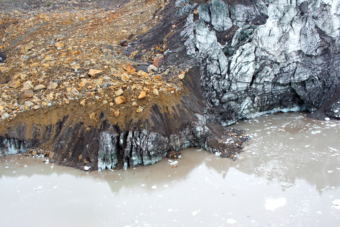
Debris sits on the Tyndall Glacier in 2016 after a massive landslide caused a huge tsunami. Photo by Ground Truth Trekking.

Imagine a wave as tall as the ConocoPhillips building in downtown Anchorage. It happened just three years ago in Southeast Alaska.

A new scientific paper makes the case that climate change could increase the likelihood of these events. It synthesized the findings of a rag-tag crew of scientists who descended on the remote fjord where the tsunami happened.

Three years ago, Bretwood Higman heard about a tsunami set off by a landslide. It was so far away from civilization that it was only detected by two Columbia University scientists using earthquake monitors. 

Higman lives with his family in a yurt in Seldovia, off the road system near Homer. He has a PhD in geology, and he’s fascinated by tsunamis and the landscape of Southeast Alaska. So he started scheming about how he could go take a look.

“Sort of dirtbag style, like, find, you know, $3,000, $4,000. Logistics are expensive out there, but that would be enough to get a plane out there, drop me off with my packraft,” he said. “Go paddle around, dig holes, collect some sand and gravel, and I’d figure out what to do next.”

The tsunami happened in a place called Taan Fiord. The nearest town is Yakutat, population 600, about 60 miles away. And Yakutat itself is way out there: Juneau is another 200 miles to the southeast.

Higman figured he should call the two Columbia scientists who first noticed the tsunami. It turned out they were organizing their own expedition and wanted help with logistics from Higman, who’s adventured all over Alaska with his wife, author Erin McKittrick.

With money from the National Science Foundation, a team of scientists converged on the fjord two summers ago. One of them was Peter Haeussler, an Anchorage geologist who motored across the Gulf of Alaska on the Alaskan Gyre – a salmon fishing boat turned research vessel.

“We’d trade off cooking meals,” said Haeussler, who works with the U.S. Geological Survey.

The view from the Alaska Gyre, a research vessel, in Taan Fiord in 2016. Photo by Peter Haeussler.

When Haeussler got to the fjord, he could see the aftermath of the tsunami. It happened after a gigantic landslide crashed into the water at the toe of the Tyndall Glacier. It sloshed as high as 600 feet above sea level.

Haeussler said the first thing he noticed is what’s called a “trimline.”

“All of the forest that you would normally expect to find up on the mountainside is gone. It’s just wiped clean. You’re coming in and it’s like, it’s just clear there were giant waves on each side of the bay,” he said. “You definitely think, ‘Boy, I’m glad I wasn’t here when this was happening.’”

Some of the scientists looked at the landslide deposits left on land. One chunk was so big they named it: Edgar.

Others looked at the path of the tsunami. Haeussler’s research focused on the landslide remnants that ended up underwater, determining their size and characteristics. From the boat, he mapped the ocean floor, using technology called “multi-beam bathymetry.”

“It’s really neat because the topography on the ocean bottom just reveals itself as you go along so clearly,” he said. “You can see, ‘Oh, here you’re in flat fjord bottom. Here’s this blocky stuff that clearly looks like landslide debris.’”

The goal was to understand the specifics of the landslide and wave to give scientists a better sense of how this kind of event happens. One of the paper’s take-home messages is that global warming will make them more likely, since retreating glaciers can leave behind unstable slopes.

In Alaska, scientists are now thinking about how they should apply the paper’s findings to management of public land and water.

For Mike Loso, a geologist with Wrangell-St. Elias National Park who worked on the study, the issue is personal. He explained how by talking about Hoof Hill, the spot in the fjord where the water reached its highest point.

“I spent my honeymoon with my wife on Hoof Hill, based out of sea kayaks,” he said.

Loso said he doesn’t think it’s appropriate to close places like the fjord where the tsunami happened, or other areas where scientists think there could be risks of similar events, like in Glacier Bay National Park, which is popular with cruise ships.

Scientists might not ever understand this type of tsunami well enough to issue warnings, or to predict them, according to Haeussler.

And they’re not very likely to occur in places where there are people, Loso said.

But Loso does think managers could give out more information about the risks of landslides and tsunamis, even if they’re small.

“An important role of the Park Service is to allow people to take those risks if they choose to. But we want to make sure they’re well-informed,” Loso said. “So, the better we understand these things, the better we can convey those hazards to the public and let them make decisions, whatever a good decision is for them.”

A political consultant’s work was scrutinized amid allegations of voter fraud in Anchorage. Now he’s dead.

A political consultant has died while his work was being scrutinized amid allegations of voter fraud in a close Anchorage state House race, according to the state representative who hired him.

Charlie Chang worked with Anchorage Republican Rep. Gabrielle LeDoux, whose district includes parts of the Muldoon neighborhood and Joint Base Elmendorf-Richardson.

Chang, who lives in California, helped LeDoux recruit Hmong voters, and LeDoux’s opponents tied him to what they described as irregular absentee voting patterns.

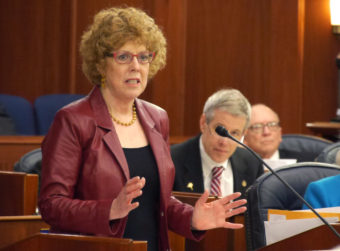
Rep. Gabrielle LeDoux, R-Anchorage, wraps up debate on House Bil
Rep. Gabrielle LeDoux, R-Anchorage, speaks on the floor of the Alaska House in 2016. (Photo by Skip Gray/360 North)

LeDoux, in a brief phone interview Wednesday, said Chang died Tuesday from a “major stroke.”

“He was on life support for a couple of days and then he passed away,” she said. “That’s all I know and it’s sad, and I feel pretty devastated by it.”

Chang had worked with LeDoux periodically for a decade, and she said they’d become friends. His death was first reported by Anchorage TV station KTUU.

LeDoux caucuses with Democrats in the House’s majority coalition, and the Alaska Republican Party has been trying to unseat her. She trailed her GOP primary opponent, Aaron Weaver, by three votes after the first round of counting election night, last month.

A subsequent count of absentee ballots gave LeDoux a 117-vote win. But state elections officials also said they found evidence of voter fraud among the absentee ballots, and they sent their findings to prosecutors for review.

Elections officials said they received absentee applications in the names of seven dead people. Those ballots were not mailed out, but officials also identified 26 suspicious ballots that were returned.

All 26 of those votes went to LeDoux.

The state hasn’t released details about the voters who sent in those suspicious ballots.

But LeDoux’s Republican opponents point to more than two dozen people with Hmong last names who registered to vote from two different Muldoon mobile homes. And they note that LeDoux paid Chang more than $10,000 to recruit Hmong voters.

LeDoux said she told Chang to be careful, and added that she has no reason to believe he broke any laws.

State prosecutors have declined to comment about a possible voter fraud investigation. They did not immediately respond to questions Wednesday about how their work could be affected by Chang’s death.

The company that runs the trans-Alaska pipeline is cutting its workforce by 10 percent

The Trans-Alaska Pipeline runs alongside the Dalton Highway near the Toolik Field Station on June 9, 2017, in the North Slope Borough. (Photo by Rashah McChesney/Alaska's Energy Desk)
The Trans-Alaska Pipeline runs alongside the Dalton Highway near the Toolik Field Station on June 9, 2017, in the North Slope Borough. (Photo by Rashah McChesney/Alaska’s Energy Desk)

The operator of the trans-Alaska pipeline is cutting its staff by about 10 percent, or roughly 130 jobs.

That’s according to a letter Alyeska Pipeline Service Company president Tom Barrett sent to state leaders Tuesday.

The pipeline system moves almost $40 million of oil every day.

Alyeska spokeswoman Michelle Egan says the company faces twin pressures. On one hand, it’s the only way to ship oil off the North Slope. That means Alyeska can’t cut corners and risk a spill or a shutdown of the pipeline, she said. (The company calls it TAPS, for “Trans-Alaska Pipeline System.”)

“Everyone who works here understands that Alaska, its economy, its oil industry is dependent upon TAPS operating. And that operation depends on us being safe and environmentally responsible,” Egan said.

At the same time, she added, the pipeline has to be financially sustainable.

“And so we’re looking at ways to modernize the way we do things and find efficiencies,” she said.

In his letter to state leaders, Barrett said Alyeska is reorganizing to streamline its maintenance work, centralize its emergency response, and add new technology.

Barrett said employees at all levels of the organization will be affected. That includes people in Anchorage, Fairbanks, Valdez and field sites.

Alyeska’s 1,300 workers include about 750 employees and 550 contractors, according to Egan.

It’s owned by four different oil companies, including three of Alaska’s biggest: BP, ExxonMobil and ConocoPhillips. Unocal Pipeline Co. owns slightly less than 1.5 percent.

Alyeska is responsible for moving oil to Valdez, then helping to make sure tankers safely carry it from there out of Prince William Sound, according to Egan.

The Prince William Sound Regional Citizens’ Advisory Council was created after the Exxon Valdez oil spill. It helps monitor Alyeska’s operations in Valdez and Prince William Sound. Spokeswoman Brooke Taylor said the council learned about the reorganization Wednesday, and wants to know more.

“The council was put in place to ensure complacency did not creep into the system, because it was complacency that led to the Valdez oil spill,” she said. “So any time you see a restructuring and reductions in workforce, it could be fine. But it’s something the council takes very seriously and will want to get a lot more information on.”

Barrett said employees and contractors affected by the cuts will be notified by early November.

Rep. LeDoux, Alaska GOP try to fill in blanks in disputed state House race

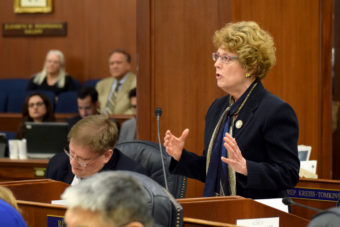
Rep. Gabrielle LeDoux addresses the Alaska House of Representative on April 10, 2014, during debate on Senate Bill 49. The bill aims to limit Medicaid coverage of abortions to only "medically necessary" ones. (Photo by Skip Gray/Gavel Alaska)
Anchorage Republican Rep. Gabrielle LeDoux speaks on the Alaska House floor. (Photo by Skip Gray/Gavel Alaska)

State election officials have wrapped up their vote-counting from last month’s primary. Now, they’re preparing to move on to the general election.

But Alaska’s political world can’t stop talking about the results in one particular state House district, in East Anchorage. Questions are swirling about one of the candidates, Republican Rep. Gabrielle LeDoux, and a political consultant she hired to help her get-out-the-vote in the district’s Hmong community.

Elections officials say they’ve asked prosecutors to investigate evidence of voter fraud, including seven absentee ballots requested in the names of dead people. The state also says it has suspicions about 26 more absentee ballots — all 26 of which were votes for LeDoux.

But they’ve released few other details, like the names of those voters, which makes it difficult to determine who could be responsible.

To Republicans, who are trying to get rid of LeDoux because she caucuses with Democrats, it’s still an easy game of connect-the-dots.

Tuckerman Babcock was elected chairman of the Alaska Republican Party (Photo by Josh Walton)
Tuckerman Babcock chairs the Alaska GOP. (Photo courtesy Josh Walton)

“All signs point to the one person who benefits from the fraud, which is Gabrielle LeDoux,” said Tuckerman Babcock, the Alaska GOP chairman.

But LeDoux said it’s too early to draw conclusions.

“I do not understand what’s happening at this point,” she said. She added that she’s looking forward to state prosecutors finishing an investigation of the “irregularities” identified by elections officials.

Beyond the numbers themselves, Republicans are also posing quesitons about LeDoux’s political consultant from California, Charlie Chang.

Chang didn’t respond to requests for comment. But LeDoux agreed to talk about him.

She said a friend put her in touch with Chang nearly a decade ago. That was when she was first running for office in Anchorage and wanted help getting out the Hmong vote in her district.

“I talked to him on the phone and he knew all sorts of things. You can tell when somebody’s asking you: ‘Do they have absentees? Early voting in Alaska?’” LeDoux said. “Seemed like he really knew what he was doing, and he had relatives here so I thought, ‘Okay, let’s bring him up.’”

Since then, LeDoux said she’s become friends with Chang and visits him and his wife annually for a Hmong New Year’s festival.

This year, LeDoux flew Chang up to Alaska twice, once with his wife, and paid him more than $10,000. She said she told Chang to cross his T’s and dot his I’s, because the election was going to be closely watched. But she also said it wasn’t her responsibility to keep track of Chang’s every move.

“I can’t be doing day-to-day monitoring,” she said. “All I can say is, I had no reason to believe that there was anything illegal or improper going on.”

LeDoux said Chang was responsible for helping her turn out Hmong votes both in-person on Election Day, and by absentee ballot.

A quick refresher: The Hmong are an ethnic group from Asia, some of whom fled to the U.S. during the Vietnam War era. LeDoux has a whole section of her re-election page devoted to Hmong issues.

The Republicans targeting LeDoux say they’re skeptical about more than 30 absentee ballots issued to people with Hmong names in two different mobile homes off Muldoon Road. A man named Charlie Chang mailed in an absentee ballot from one of them, as did eleven other Changs registered at the same place.

“The number of people who applied to vote from different trailers is preposterous on its face,” Babcock said.

Sen. Bill Wielechowski fields a question from a reporter during a Senate Minority press availability, Jan. 28, 2015. (Photo by Skip Gray/360 North)
Anchorage Democratic Sen. Bill Wielechowski talks at a news conference at the Alaska Capitol. (Photo by Skip Gray/360 North)

But Anchorage Democratic Sen. Bill Wielechowski, who represents the same area, said people should be cautious about drawing conclusions based on the numbers alone. Two or three generations of the same Hmong family can sometimes live in the same household.

“One of the first meetings I had with members of the Hmong community was when I went to someone’s trailer and there were literally, probably, 40 or 50 people at this meeting in a little trailer,” Wielechowski said. “They have trailers where they have a lot of people living in them. That is not uncommon.”

Then there are Alaska’s voting laws, which Wielechowski described as relatively permissive. In Alaska, the law allows people to vote absentee even after they move out-of-state, as long as they intend to come back at some point.

That’s how Dan Sullivan, who’s now a U.S. senator, voted in the Alaska election in 2008, when was working as a top State Department official. Sullivan lived in Maryland and declared his home there as his principal residence for tax purposes. But he still voted absentee in Alaska.

“There are many people that move out of state to go to college. There are many people that move out of state to take care of sick parents. And they still maintain their addresses here and they still vote in the state of Alaska,” said Wielechowski. “If we’re going to have this conversation, let’s not just limit it to the Hmong.”

The elections division has referred its suspicions about “irregularities” with the House race to state prosecutors for investigation — a process that could take months. Meanwhile, a Republican write-in candidate, Jake Sloan, announced Tuesday that he’s challenging LeDoux in the general election.

Explainer: What’s going on with the District 15 House race in Anchorage?

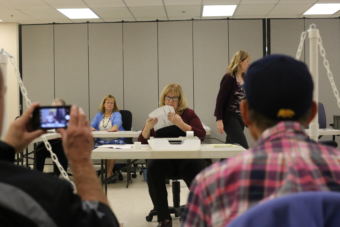
Julie Husmann, a supervisor at the Alaska Division of Elections, counts absentee ballots in the closely-watched House District 15 primary election Tuesday. (Photo by Nathaniel Herz / Alaska’s Energy Desk)

A new count of absentee ballots Tuesday appeared to give Anchorage Republican Rep. Gabrielle LeDoux an insurmountable lead in her GOP primary, but questions are still swirling about evidence of voter fraud that’s been turned over to state prosecutors.

State elections officials counted more than 200 absentee ballots Tuesday, with the vast majority going to LeDoux. She now has 113 more votes than Aaron Weaver, her GOP primary challenger, which appears to be an insurmountable lead.

But LeDoux is now parrying attacks from the Alaska Republican Party, and questions from reporters, about the “irregularities” that state elections officials publicly disclosed Monday. They include absentee ballots requested in the names of seven dead people, and two more ballots returned from people who later told the state they hadn’t voted.

Elections officials haven’t pinned responsibility for the irregularities on any campaign or candidate. But they did separate out a batch of 26 absentee ballots Tuesday that had questions about their authenticity. And all 26 of those votes went for LeDoux.

Confused about why this race is important, and how it’s all playing out? Let’s explain:

Q: Why should we care about this race at all?

A: LeDoux, the incumbent, is a really polarizing figure. She represents Joint Base Elmendorf-Richardson, an Anchorage military base, as well as part of the Muldoon neighborhood in the eastern part of the city.

Two years ago, LeDoux made Republican Party leaders really angry. Typically in the state House, Republicans stick together in their own caucus. But LeDoux flipped and took a leadership spot in a mostly-Democratic majority, along with a couple of her Republican friends, Paul Seaton of Homer and Louise Stutes of Kodiak.

Since then, the Alaska GOP has been campaigning to defeat all three. But LeDoux’s opponent, former television cameraman Aaron Weaver, barely campaigned and didn’t raise much money, so everyone in the political world was shocked when the two candidates were separated by just three votes on Election Day.

Then, the state announced Monday that it had discovered evidence of the “irregularities” in the district’s absentee votes, which they’d noticed even before the primary election took place last week.

A state attorney, Margaret Paton-Walsh, said Monday that the irregularities are palpable evidence of voter fraud.

Q: What happened Tuesday?

A: The state elections division counted about 200 absentee ballots in LeDoux’s district. Because of these irregularities and the intense focus on the race, they had a special process.

https://www.instagram.com/p/BnCISVGlcdn/

Typically, election workers open all the absentee ballots, mix them together and count them all at once. But Tuesday they wanted to keep each absentee ballot associated with the person who sent it, to ensure there’s a paper trail in case someone decides to challenge the results. One election worker would open the absentee envelope and remove the ballot, which remains in a “secrecy sleeve” that hides the markings inside. Then the election worker would hand the ballot, inside the sleeve, to another worker, who would feed the ballot through a counting machine without seeing any of the voter information on the envelope. That allowed the state to maintain the secrecy of people’s votes. It also was a little more strenuous for the election workers — one joked about how many steps her Fitbit had recorded by midday: 5,814.

Q: What do we know about the “irregularities,” and who could be responsible for them?

A: Not much, aside from the details that the state has already released. But there’s a lot of speculation swirling around LeDoux, in part because the 26 absentee ballots that the state described as suspicious all were votes for her.

Election materials sit at the Anchorage offices of the Alaska Division of Elections on Tuesday, August 28, 2018. (Photo by Nathaniel Herz / Alaska’s Energy Desk)

Right now, the state is not talking about where it thinks the irregularities came from. The elections division said it referred its concerns to state prosecutors, and those prosecutors declined to comment Tuesday. Meanwhile, the Alaska Republican Party alleges that the irregularities trace back to LeDoux – specifically, to a consultant that she hired to do outreach with the Hmong community in East Anchorage. But they haven’t shown any evidence that directly links LeDoux or the consultant to the irregularities. Still, GOP leaders now say they’re going to try to find someone to mount a write-in campaign against LeDoux in the general election.

Q: What’s LeDoux saying?

A: She denies that she’s done anything wrong. After two days where she didn’t answer reporters’ questions, she released a prepared statement Tuesday afternoon calling the GOP’s accusations “absurd.” She acknowledges that she hired the consultant to do outreach and get-out-the-vote work among her Hmong constituents. But she said she’s “never looked for ways to manufacture votes,” and said such an effort would be absurd “in this day and age of voter verification.”

Q: What else happened with elections results Tuesday?

A: The elections division, at a separate office in Juneau, counted absentee ballots in two other really close races on the Kenai Peninsula. One will decide who replaces Mike Chenault, the Republican representative from Nikiski who used to be House speaker. The other will determine if Senate Majority Leader Peter Micciche, a Republican from Soldotna, keeps his seat in a tight race against challenger Ron Gillham.

The elections division hadn’t released official updates by late Tuesday afternoon. But the Juneau Empire reported that Micciche had taken a substantial lead in his race. It also reported that Ben Carpenter, a peony farmer and longtime member of the Alaska Army National Guard, was narrowly leading Wayne Ogle, the president of the Kenai Peninsula Borough Assembly.

State attorney says there’s evidence of voter fraud in hotly contested Alaska House district

Voters cast ballots in the Aug. 21, 2018, primary election at Glacier Valley Baptist Church in Juneau.
Voters cast ballots in Alaska’s primary election last week. (Photo by Andrew Kitchenman/KTOO)

Alaska elections officials said Monday that they’ve asked criminal investigators to examine “irregularities” with absentee ballots in a hotly contested Anchorage House district — including seven absentees requested in the names of dead people.

The irregularities are evidence of voter fraud, according to one state attorney, Margaret Paton-Walsh. But officials said they haven’t identified a particular campaign or candidate that’s responsible for them.

Elections workers first noticed the irregularities before last week’s primary, which left the two Republican candidates in District 15, in East Anchorage — incumbent Gabrielle LeDoux and challenger Aaron Weaver — separated by three votes.

There are 40 House districts in Alaska, but of all 70 absentee ballots that were returned as undeliverable, more than half came from District 15, the Division of Elections said in a statement Monday.

The state’s review continued after the election. Elections workers ultimately found two people who said they hadn’t voted in spite of the fact that absentee ballots had been submitted in their names, the division said.

Those votes won’t be counted. And when the state does count the absentee votes from District 15, starting Tuesday, it will take the unusual step of ensuring each ballot remains linked to the envelope it arrived in. That way, any votes subsequently found to be invalid can be subtracted, the division said.

“The integrity of our elections is vital to our democracy,” Josie Bahnke, the state elections director, said in the statement. “The division will continue to look into this matter throughout the week and remove any ballots that we determine should not be counted.”

The number of ballots that raise authenticity concerns are a small fraction of the 300 that haven’t been counted — an estimated 10 to 20 ballots, according to Paton-Walsh.

Anchorage Republican Rep. Gabrielle LeDoux sits at Election Central at the Dena’ina Center downtown Tuesday, August 21, 2018, while she waits for results in her closely-fought GOP primary with Aaron Weaver, a former cameraman at KTUU. (Photo by Nathaniel Herz/Alaska’s Energy Desk)
Anchorage Republican Rep. Gabrielle LeDoux sits at a party on Election Nigh last week as she awaits for results in her closely-fought primary. (Photo by Nathaniel Herz/Alaska’s Energy Desk)

The House race has been closely watched because of LeDoux’s position in the state House majority: She and two other Republicans infuriated GOP leaders in 2016 by joining 17 Democrats and two independents to form the chamber’s ruling coalition. LeDoux was awarded a spot in leadership and chairmanship of the House Rules Committee, which gives her control over which bills move to the floor for a vote.

The Alaska Republican Party backed Weaver, LeDoux’s primary challenger. But Weaver, a former television cameraman, raised little money and said he barely campaigned. LeDoux is known as an energetic campaigner, and political observers — including state GOP leaders — said they were shocked that the primary results were so close.

Each side will likely be carefully scrutinizing absentee ballots when the count starts Tuesday. Elections officials briefed LeDoux and Republican Party officials Monday afternoon.

LeDoux, accompanied by attorney Tom Amodio, wouldn’t answer questions on her way out of the election division’s Anchorage office Monday, saying, “No comment.”

An attorney representing the Alaska Republican Party, Stacey Stone, said she’s been satisfied with the state’s review of the absentee ballots.

“There are questions and they’re being resolved and the division seems to be taking the appropriate scrutiny to make sure those questions are answered,” Stone said.

Listen to Alaska Public Media’s Casey Grove discuss this news with Alaska’s Energy Desk’s Nat Herz on Monday:

Site notifications
Update notification options
Subscribe to notifications