Nat Herz, Alaska Public Media

This woman came all the way to Alaska from the Pacific Islands to talk climate change

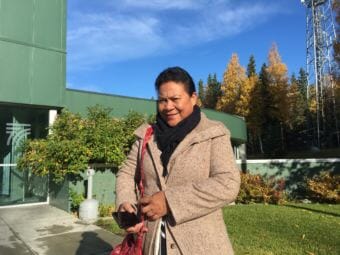
Pelenise Alofa, from the Pacific island of Kiribati, poses for a photo outside Alaska Public Media on Monday, October 1, 2018. She’s in Alaska this week for a climate change conference of indigenous people in Girdwood. (Photo by Nathaniel Herz / Alaska’s Energy Desk)

Climate change and rising sea levels are threatening remote Alaska villages. They’re also hitting other low-lying places around the world, from Bangladesh to the Pacific Islands.

Local leaders from all these places have gathered at an indigenous peoples conference in Girdwood this week. They’re going to tell stories, network and agree on shared principles to guide their advocacy work.

Pelenise Alofa is one of the participants. She’s from Kiribati in the Pacific Islands. Nat Herz with Alaska’s Energy Desk interviewed her and started by asking how she got to Alaska.

Red Dog Mine, in hunt for more ore, proposes new road

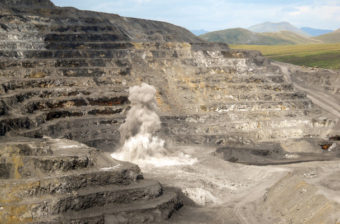
The Red Dog Mine in 2010. (Photo by Alaska Public Media)

One of Alaska’s largest mines is moving toward a significant expansion, applying for state and federal permits to build a 10-mile road to a pair of new prospects in a remote part of Northwest Alaska.
The 30-year-old Red Dog Mine has generated profits for its operator, Canadian mining company Teck. Teck, in turn, pays hundreds of millions of dollars in yearly royalties to the Alaska Native regional corporation, NANA, that owns the land where the mine sits. It also hires hundreds of NANA shareholders.

But without a new source of zinc and lead, the money and jobs could disappear in less than 15 years, when Red Dog is expected to run out of ore. Teck’s planned road leads to a pair of new prospects, Anarraaq and Aktigiruq, that could extend the mine’s lifespan.

Teck has been drilling into the prospects from the surface, moving equipment by helicopter. Now, the company wants to do more intensive drilling from underground, and it wants to build the road to bring in heavy equipment, according to permitting documents that the company filed with the U.S. Army Corps of Engineers.

Teck, in a prepared statement from spokesman Chris Stannell, said it chose the route for the road in consultation with local elders and subsistence hunters. And it’s given helicopter tours to local leaders in nearby Kivalina, who get drinking water and fish from the Wulik River, in the same watershed as the mine.

Teck’s plans for a road from the Red Dog Mine to a pair of new prospects, included in documents submitted to the U.S. Army Corps of Engineers.

A group of Kivalina residents sued the mine’s operators over wastewater discharge in 2004, in a case that was later settled. One said this week that she’ll be closely watching Teck’s expansion plans.

“We are not trying to close the mine down — we know that’s not going to happen. We just want them to be careful as much as they can,” said Janet Mitchell, a former village administrator. “We just want as little spills as possible and as little dust flying out in the air as possible. And they’ve been pretty good about that.”

The mine has been operating since 1989 and last year produced more than 500,000 tons of zinc. Its gross profit in 2017 was $971 million, according to Teck’s annual report, and the company paid $325 million in royalties to NANA, which distributes about two-thirds of the money to other Alaska Native corporations under federal law.

The mine also employs hundreds of Northwest Alaska residents and NANA shareholders.

Teck, in its annual report, said it expects Red Dog to run through 2031. It’s assessing the new deposits to see if it’s “economically and environmentally viable” to extend the mine’s operations past that date, Stannell said.

One key fact is that the new prospects are on state land, so NANA wouldn’t collect royalties like it does now — though the road to access the prospects does have to cross NANA land.

Teck applied with the Alaska Department of Natural Resources in June for permission to build the road, as well as pads for things like a camp and waste rock storage. The state published the plans Wednesday and said it would accept comments on them for two weeks.

Stannell said road construction is expected to start in mid-January, and the project will include a half-dozen steel bridges over creeks, according to Teck’s application with the state. Teck, Stannell added, is working with residents, elders and NANA “to ensure we conduct this work in a way that is protective of the environment, such as ensuring that water sources are protected and preventing any potential impacts to subsistence resources such as caribou.”

Some Kivalina residents have “grave concerns” about possible contamination to the Wulik River, said Millie Hawley, former president of Kivalina’s tribal council.
Teck’s new prospects are closer to the river than the mine’s current operations.

“But it doesn’t look like it’s going to get too close,” Hawley said. “We’ll just have to wait and see.”

The man who translates climate change data for Alaskans is retiring. Here’s a Q+A.

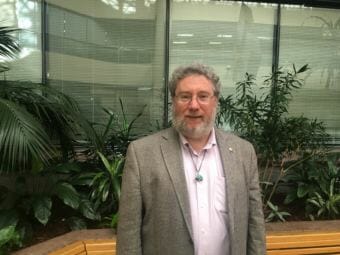
Climatologist Rick Thoman is retiring this week after more than three decades working at the National Weather Service. (Photo by Nathaniel Herz / Alaska’s Energy Desk)

If you’re looking for concrete evidence of climate change in Alaska, here’s some: Fairbanks’ typical time between the last spring freeze and the first autumn one has increased by a full month in the past century.

That fact is courtesy of Rick Thoman, a federal climatologist based in Fairbanks. For the past five years, Thoman has been something like the voice of climate change in Alaska, measuring new trends against old baselines.

He retires this week after spending more than three decades with the National Weather Service, and next week he starts a new job with the Alaska Center for Climate Assessment and Policy, based at the University of Alaska Fairbanks. Some of his work will be similar to his old job, and he said he plans to keep his Twitter account as active as ever.

Thoman sat down Monday for an interview with Alaska’s Energy Desk. He started by talking about how personal memories of climate and weather don’t always align with the data, making it important to keep broader context in mind.

The interview has been edited and condensed.

Rick Thoman: We are seeing changes in parts of Alaska and in some seasons that are beyond anything that’s occurred not just in living memory, but now we can push that past living memory. And I think going forward, as Alaskans make decisions about our future, that context is very important. It’s more than just, ‘What I happened to remember except for those two years when I was gone to Hawaii.’

Nat Herz: Can you talk to me a little bit more about people’s memories aligning with what the data tells us happened? Is there anything specific you can point to that helps illustrate that?

RT: People base their expectations on a relatively short time frame. The classic example is this summer in Anchorage. Many people thought it was unusually cool and rainy, and in fact it was significantly warmer than the multi-decade average. But it was cooler than some of our recent summers. So it’s pretty clear that people aren’t judging what’s happened this summer from the World Meteorological Organization’s 1981 to 2010 normals, which is the standard. They’re basing it on the last few years. That’s perfectly valid. The problem becomes when the last few years get projected back into, ‘Oh, that’s the way it was so this year was, in fact, cool.’ Well, in fact, in the longer term we can see that this was actually quite a mild summer, but not as mild as some of the recent years.

NH: Are there any other interesting things you take away about how Alaskans are seeing and experiencing climate change?

RT: I think it would be fair to generalize and say that there are quite different perceptions of what’s happening with Alaska’s environment and climate between rural Alaska and urban Alaska.

NH: Talk to me more about that.

RT: So, I think that in rural Alaska, where most of the communities are fairly strongly subsistence dependent and people are out on the land, there’s a general recognition that things are changing. And of course, when you’re doing subsistence hunting or gathering, weather and climate is just one part of the equation. How are the times that animals are available? How’s that changed? When are plants, if you’re berry picking, when are they coming ripe? Those are all part of the equation. When is the snow melting? When are rivers and lakes freezing, so you can get out in the winter time? That’s a very different experience than if you’re living in urban Anchorage or Fairbanks and your experience of the changes is driving to work.

NH: Or skiing at Alyeska?

RT: Or skiing at Alyeska. Those are very different experiences. They’re equally valid but they’re quite different perceptions, potentially, than a rural subsistence-based community.

NH: What are the things you’re most curious about, as far as trends that might continue or things that might develop in the next five, 10, 15 years?

RT: Particularly, changes in the seasonality of things: When does snow cover come? When does it melt off? Potentially, precipitation trends. I think those are going to become more clear over the next decade or so. Things like seasonality have big impacts beyond just mere dates. For instance, the Alaska Fire Service is spinning up operations weeks earlier now than they used to, because of a run of early snow melt. Before greenup. So, very flammable fuels. It’s already starting and will likely accelerate.

Two men charged as feds crack case of missing Anchorage mammoth tusk

A wooly mammoth on display in the Royal BC Museum. (Photo by FunkMonk/Wikimedia commons)

Prosecutors are charging two men with stealing a 10,000-year-old mammoth tusk from the federal Bureau of Land Management in Anchorage.

Federal prosecutors Friday unveiled theft and conspiracy charges against Gary Boyd and Martin Elze. The two were also charged with breaking a federal fossil theft law, and Elze faces a fourth charge of witness tampering.

Federal prosecutors didn’t immediately respond to a request for comment. But the indictment against Boyd and Elze appears to be a break in a case that had gone unsolved since the tusk went missing six months ago.
The Bureau of Land Management distributed this flyer of the stolen tusk. (Photo courtesy Bureau of Land Management)

Charging documents allege that in March, Boyd, Elze and an unidentified accomplice visited the BLM-run Campbell Creek Science Center in East Anchorage. The accomplice asked questions about the tusk’s type and weight, the documents charge.

The documents allege that the next day, Boyd and Elze went back to the center, where Boyd used a rock to break into a window and door. Boyd is charged with taking the 100-pound tusk, and prosecutors assert that Elze waited outside.

They also allege that Elze later defaced the tusk by cutting it.

Elze is already being held in the Anchorage jail on another charge. A spokeswoman for federal prosecutors in Anchorage didn’t immediately respond to a question about Boyd’s whereabouts.

The BLM had offered a $500 reward for information leading to the tusk’s recovery.

This solar farm is built on oil industry money, know-how and even some recycled drilling pipe

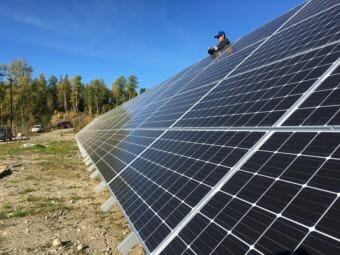
Chris Colbert stands atop a ladder while installing parts at Alaska’s first commercial-scale solar projects in Willow, just north of Anchorage, on Friday, Sept. 14, 2018. (Photo by Nathaniel Herz / Alaska’s Energy Desk)

Alaska’s first commercial-scale solar farm is about to come online. Its builders say they want to move the world toward cleaner energy sources. But they’re not ready to renounce oil and gas just yet.

Jenn Miller is the project’s chief executive. She was working on her 400-panel commercial solar project north of Anchorage last week, with black flies buzzing and her dog, Ralfie, wandering around with a chunk of moose bone.

Miller was there with her husband, Chris Colbert. They both had drills and leather tool belts and were moving a ladder around, putting in some of the last few pieces before they can flip the switch. Miller said she’s excited about the outlook for solar power and its potential to slow global warming.

“The cool thing is, I don’t think renewables have to be a charity case. I think they can be a business case,” she said. “And the more you get to that point, I think the faster we are able to address the climate issue.”

The solar farm could power about 30 homes. The local electric utility, Matanuska Electric Association, will buy the power at wholesale rates. That could slightly reduce the use of natural gas in its existing power plant and reduce greenhouse gas emissions.

In a lot of ways, Miller fits the stereotype of someone trying to fight global warming. She has solar panels on her house in Anchorage. She bikes to work. She’s been on a river-rafting trip in the Arctic National Wildlife Refuge.

But here’s something you might not expect: Miller works at BP, the oil company.

“When I went to go work for an oil company out of college, the way you hear about oil companies is like, everyone who works there is evil,” she said. But, she added: “They’re actually nice people and they’re pretty smart.”

The solar project is personal — it’s not endorsed or paid for by BP. But Miller is a project manager at the company, and her three partners are all current or former BP employees.

One is Sam Dennis. Dennis drives a Tesla, a pricey electric car. He thinks the future is in electricity. But he also has a pickup truck, and he thinks the future will be built on a foundation that the oil industry helped create.

In an interview at the site, Dennis pointed out that the solar panels at the site stand on a foundation of recycled oil drilling pipe. And that’s not all.

“The money came from our work with the oil industry. And our expertise in running projects came from our work with the industry,” he said. “And I was thinking back, and I was like, how much of the development of oil 100 years ago was based on knowledge from coal?”

Dennis said he thinks oil companies and their workers can help with the transition toward renewables. Just like the partners in this solar project, big oil companies have expertise building things. And they have a lot of money.

It turns out that Dennis’ views aren’t that far off from the company he once worked for. Janet Weiss, BP’s top executive in Alaska, said her company has been boosting its renewable energy holdings after scaling them back following the Deepwater Horizon explosion in 2010.

“What our company is doing is certainly taking some of the cash flow that’s been earned through the oil and gas and investing it into our renewables business,” she said in an interview. “It’s a natural evolution of what we need to do here on the planet.”

To be sure, BP still produces a ton of oil — about 4 percent of global production. Its renewable investments are also small in relation to the company’s overall portfolio.

But BP last year announced it was investing $200 million in a British solar company. It also has a wind branch, and Weiss said a company wind executive, Laura Folse, is interested in a trip to Alaska to see if the state has potential for power generation.

Lt. Gov. Byron Mallott,talks salmon politics on March 21, 2018.
Lt. Gov. Byron Mallott talks in Sitka earlier this year. (Photo by Katherine Rose/KCAW)

Officials drafting Alaska’s new climate policy have also enlisted the oil industry in tackling global warming. Weiss last year was named to the state’s climate leadership team, which is chaired by a Democrat, Lt. Gov. Byron Mallott.

“If the energy industry, as it exists now, is an opponent of dealing with climate change, we have a steep hill to climb,” Mallott said in an interview. “My belief is that they are a partner. They will continue to be a partner. But they must be held to account, as all of us must be.”

Back at the solar farm, Miller was still drilling in parts, while Dennis fired up an excavator to fill in a trench. Miller said she wants people to understand that these climate change and energy discussions aren’t black and white.

“I think a lot of times there’s an image that people who work for the oil industry are of certain political views or putting a box over their heads about climate change and don’t think it’s happening,” she said. “But I think humans are much more sophisticated than that. I think humans can hold a much bigger picture in their head.”

The partners expect to get a 3 to 5 percent return on their investment, or roughly equivalent to bonds. Miller wouldn’t specify the exact cost of the project, but she said it’s in the hundreds of thousands of dollars.

The project won’t generate much revenue in the winter — maybe $500 in the whole month of December. But some of the Alaska-specific challenges are offset by the high price that the project will get for its electricity, and the fact that solar panels actually operate more efficiently in cold weather.

“We started looking at the numbers and started researching what you get for revenue for wholesale power, and then we started looking at what an installation would actually cost,” Dennis said. “And it was like, ‘Wow. Looks like it pencils out.'”

Miller and her partners are already thinking about a second project. One option is to expand their existing site; another is to build a new one in a place with higher power costs than the Anchorage area, like Fairbanks.

A federal plan to save Alaska’s belugas starts with recruiting an army to count them

The population of beluga whales that live in the Cook Inlet has been steadily declining in recent years. (Photo courtesy Marine Mammal Commission)

Federal wildlife managers organized an event over the weekend based on a really basic principle: You’re more likely to care about something if you can see it. That’s why they recruited an army of citizen scientists Saturday to count endangered beluga whales near Anchorage.

There were 18 viewing stations scattered across Cook Inlet. At one of them just off the Seward Highway south of town, Brooke Faulkner, a college student, spotted a whale and a calf.

“I was just talking and then all of a sudden I was like, ‘It’s right there!'” said Faulkner, who’s studying biology at a Homer-based semester program. “It was within like 50 feet of us.”

Scientists estimate that there are about 330 belugas in the inlet, down from more than 1,000 in the 1970s. The federal government named Cook Inlet beluga whales as an endangered species in 2008.

Biologists think hunting originally caused the decline. But even though hunting has stopped, the population hasn’t recovered, and scientists aren’t exactly sure why.

“They just didn’t bounce back the way we expected they would. So the question is, once you remove that immediate source of mortality, if they’re not bouncing back from that, what else might be hindering them?” said Jon Kurland, a Juneau-based official with NOAA Fisheries, the agency charged with protecting belugas. “Is it food? Is it noise? Is it contaminants? Is it just something else that we haven’t thought of yet?”

The process to list Cook Inlet belugas as endangered was contentious, in part because of fears that beluga protections could interfere with commerce in Cook Inlet.

The inlet has offshore platforms producing oil and gas. There’s also a commercial fishing industry. And Anchorage’s port is a hub for food, cars and fuel shipped into the state. The state of Alaska and an oil company actually sued to block the beluga listing, though they lost.

Now things are a little more cooperative. The state chairs a beluga recovery team alongside the federal government, and oil company workers looked for whales from their platforms in Cook Inlet on Saturday.

Federal managers said they think events like the count can help build public support for belugas.

“We all tend to care about things that are in our backyard, right? And things we can see,” said Donna Wieting, a NOAA Fisheries official who traveled to Anchorage from the Washington, D.C. area for Saturday’s count.

Wieting said her agency tries to get people spotting other species, too. All along the West Coast, there are “Whale Trail” stations where people can look for orcas.

Julia Grindstaff said that idea makes sense to her. She was also at Point Woronzof on Saturday — she moved to Anchorage a few years ago and said she got way more excited about belugas after she saw them in Cook Inlet.

“I’d been landlocked in Illinois and Colorado, so when I came here and actually saw the belugas — oh my gosh, it was pretty amazing,” Grindstaff said. “It does make it more real to you than just seeing it on television or hearing about it.”

Grindstaff said she calls the belugas the “ghosts of the Inlet,” because of how quickly and smoothly they rise out of the water.

Organizers said just under 2,000 people showed up to count them Saturday, and spotted an estimated 100 whales.

Site notifications
Update notification options
Subscribe to notifications